Amazon Ads in 2026: What Changed for Established Brands
Read more
.png)
Plan Amazon PPC for pet brands by spend tier: launch buys rank at a looser ACoS, then growth to enterprise tighten TACoS, bid on lifetime value, and add DSP.
Pet is a large, loyal, repeat-purchase category, and that changes the math of paid advertising in ways generic advice misses. Most guidance hands a founder spending $3,000 a month the same tips it hands a brand spending $80,000.
Those two brands should be doing almost opposite things: one is buying its first rankings and cannot chase efficiency yet, while the other is defending shelf space, running Amazon Demand-Side Platform (DSP) campaigns, and reading Amazon Marketing Cloud (AMC) reports.
A single Advertising Cost of Sale (ACoS) target for both is close to useless, and in pet it is doubly so, because the value of a customer stretches far past the first order.
This guide plans Amazon pay-per-click (PPC) advertising for pet brands by spend tier, so the moves match the money. You get benchmark ranges, budget splits, and a launch-to-scale sequence you can act on today. If your goal is specifically crossing six figures a month, pair it with our guide on how pet brands scale past $100K a month.
Budget advice only means something once you know your own math. Three numbers frame every tier below: what you can afford to pay for a sale, how much of your revenue should go to ads at your stage, and what a customer is worth over time.
ACoS is ad spend divided by ad sales. Your break-even ACoS is your profit margin before advertising, and in pet it varies sharply by product, because heavy food and litter carry oversize Fulfillment by Amazon fees that a light supplement never sees.
If a bag of food sells for $45 and you keep $9 after cost, fees, and freight, your break-even on that single sale is 20 percent. But the pet twist is lifetime value: if that buyer reorders four times a year, the true worth of acquiring them is far more than one sale, so a first order that looks like a loss on ACoS can be a strong decision.
Calculate break-even per product, then decide how far past it your customer value lets you bid.
This is why a single ACoS number handed to a pet brand is close to meaningless. The healthy target for a heavy bag of food with thin margins and high repeat is nothing like the target for a one-time bed purchase with no reorder behind it, even at the same price.
The discipline is to hold two numbers for every product: the break-even that says what the first sale can bear, and the lifetime value that says how far past break-even you can push because the customer will come back.
Brands that skip the second number leave growth on the table by bidding too cautiously on their most repeatable products, while brands that ignore the first overspend on hard goods that never reorder. Both mistakes come from using one target where pet demands two.
New pet brands often spend 20 to 40 percent of revenue on ads while they buy traction. Scaling brands settle into 15 to 25 percent.
Mature brands with strong organic rank and a base of Subscribe & Save buyers run leaner, often 8 to 15 percent, because rank and repeat orders carry sales that no longer need paid support. TACoS, Total Advertising Cost of Sale, measures ad spend against total revenue, so it exposes whether paid growth is pulling organic up with it.
When TACoS holds steady while total sales climb, your ads are building rank; the mechanism behind that lift is covered in our guide on how pet brands combine PPC and organic to win search rank.
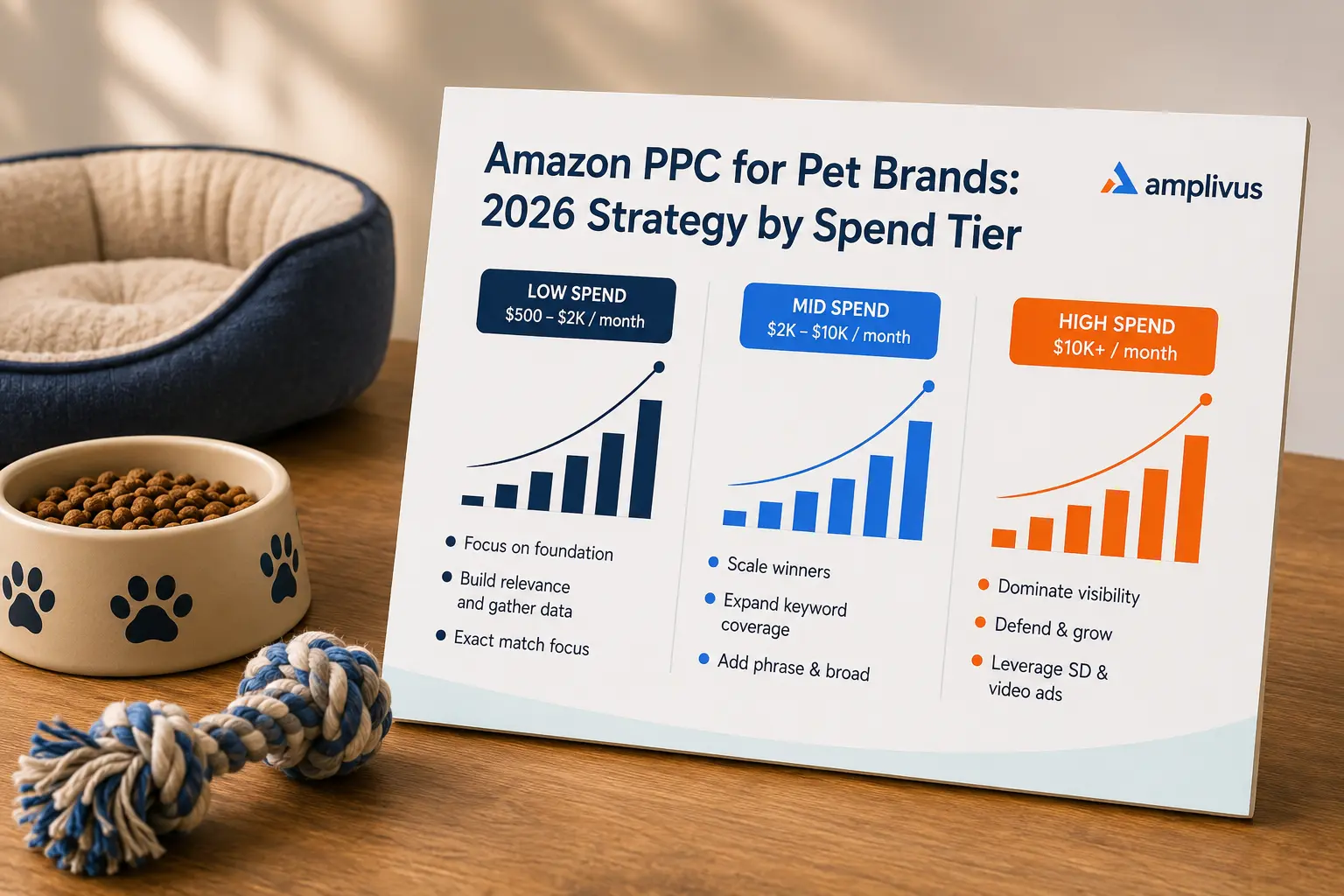
The right move at $3,000 a month is often the wrong move at $80,000. So instead of one plan, here are four, sorted by monthly Amazon Ads spend. Find your tier, read it closely, then skim the one above to see what comes next.
At this stage you have one or two hero products and no room for waste, so resist running every ad type. The temptation at launch is to spread a small budget across Sponsored Products, Brands, Display, and video to feel like you are covering everything, but a thin budget split four ways teaches you nothing on any of them.
Concentrate instead. Put the majority of your budget into Sponsored Products, because pet is still search-driven at the point of purchase. Run one Auto campaign to surface converting search terms and one manual Exact campaign to control the terms you already know matter. Mine the Auto campaign's search-term report every week, move winners into Exact, and add the junk as negatives.
Expect a higher ACoS here, running 45 to 60 percent for the first two to three months while you buy rank and reviews on a new listing. Seed early reviews through Amazon Vine, because a trust-heavy category punishes an unproven listing, and enroll in Brand Registry so you can run video and A+ Content later.
You have proof now: certain keywords convert, a few products carry the account, and you can afford to widen the funnel. Sponsored Brands and Sponsored Brands Video start to matter, because pet products sell on trust and demonstration, and video of a dog eating eagerly or a calm, settled pet answers the buyer's doubt before the click, as our guide on Sponsored Brands Video for dog brands lays out.
A disciplined Sponsored Brands management approach keeps that video budget productive. Start defending your brand name here too, since a competitor may bid on it. Your ACoS target tightens to roughly 30 to 40 percent as ranking work pays off, and this is where Subscribe & Save attach starts to matter: fund the products that convert to subscriptions harder, because their lifetime value repays a looser target.
Now you are a category contender, and the job shifts from capturing demand to owning share of voice. Sponsored Display grows from a test into a real line item, retargeting the shoppers who viewed a product and left to compare, and cross-selling the supplement to the food buyer.
You start adjusting bids by placement, paying up for top-of-search where conversion is strongest, and dayparting enters the plan, which matters in seasonal corners like the anxiety category covered in our guide on capturing Q4 pet anxiety demand without an ACoS spike. AMC becomes useful here, letting you see how your ad types work together across a shopper's path.
Blended ACoS at this tier usually lands around 25 to 35 percent, read alongside lifetime value rather than on its own.
Market leaders stop asking only how to capture searches and start asking how to create demand. Amazon DSP is the tool for that, running programmatic display and video on and off Amazon, retargeting shoppers who left and reaching look-alike audiences that match your best repeat customers. Self-serve Sponsored TV extends that reach into streaming.
AMC Audiences turn your own purchase data into targetable segments, so you can reach a food buyer before their bag runs out or exclude recent purchasers from acquisition campaigns.
At this tier the metric that matters most is new-to-brand sales, because growth comes from new households, and blended ACoS often runs 20 to 30 percent read alongside customer lifetime value.
The mindset shift is real: a launch brand counts every sale, while a market leader counts new customers and the value they will bring over years, and judges spend against that longer horizon rather than the efficiency of a single order.
Numbers give you something to aim at. Treat both tables as starting points you adjust against your own margin, fee tier, and repeat rate, not fixed rules.
There is no single public benchmark for every pet subcategory, so treat these as directional and pull each target toward your own break-even.
A heavy bag of food and a light supplement at the same price will not share the same healthy ACoS, because their fees and margins are different, and a product with high Subscribe & Save attach can run looser than one bought once.
The tiers set your budget and targets. What separates a strong pet account from an average one is the detail: which segment you sell, the value of a repeat buyer, and the mistakes you sidestep.
Amazon treats pet as one department, but the segments do not behave alike. Food and litter carry the highest repeat rates and the worst per-unit economics, heavy and often oversize, so bid them to the subscriber and respect the fee floor.
Treats and chews sit in the middle with better margins, lighter weight, and high impulse and repeat, so this is where much of your scaling budget belongs. Supplements carry the best margins and the most rules, since the FDA's animal food labeling and pet food claims guidance permits structure-function but not disease claims.
Hard goods like beds and crates are higher-ticket, lower-repeat, and often oversize, so treat them as considered purchases. Fund each group to its own ceiling rather than at one target.
The US pet industry reached about $158 billion in 2025 and is projected near $165 billion in 2026, and much of that runs on repeat purchase. That is the pet advantage: a first sale of food or a supplement is often the start of a subscription, so acquisition spend that looks expensive on first-order ACoS pays back over the relationship.
Pet demand is also steadier than gift-driven categories, with sharper spikes in specific corners, gifting in Q4 and anxiety demand around travel and fireworks. Build reviews and rank in the quiet stretches, then raise budgets and loosen targets ahead of the peaks and tighten on the way down, and sync ad budgets to restock cycles so you never outrun inventory and lose rank you paid to build.
Running out of stock at the top of a peak is one of the most expensive mistakes in the category, because it hands your hard-won rank to a competitor at the exact moment demand is highest and recovery is slowest.
A guide like this gets you a sound plan. What it cannot do is look inside your account and tell you which campaign is leaking or which heavy SKU is being scaled past its margin. If your ACoS has crept up, your sales have flattened, or you are about to scale spend, a structured review of your search-term reports, campaign structure, and placement data usually finds money faster than another round of guesswork.
The common pattern is a brand convinced the problem is bid strategy when the real leak is a blended target flattening the difference between a low-margin bag of food and a high-margin supplement.
That kind of structural gap is cheap to find and expensive to leave running, and it rarely shows up until someone looks at your products separately instead of at one account-wide average.
As a specialist Amazon PPC agency, Amplivus reviews pet accounts at every tier described here.
A free Amazon PPC audit reviews your account before you scale, and a short Amazon strategy session maps the move to your next tier.

Talk with an Amazon PPC expert to match budgets, bids, and ad formats to your spend tier, margins, and customer lifetime value profitably.
Get a free Amazon PPC audit to uncover wasted spend, align bids with lifetime value, and scale each pet product at the right tier.