
How Amazon Brands Scale Past $100K/mo With PPC
Read more
.png)
Pet brands scale past $100K a month by bidding on lifetime value, not first-sale ACoS, protecting Subscribe & Save, and adding DSP and AMC.
Crossing $100,000 a month in pet is a different problem from getting there. Below six figures the job is finding keywords that convert and buying first rankings.
Above it, the account is already working, and the growth question changes: how do you spend more without the returns falling apart, and how do you turn one-time buyers into subscribers who come back on their own?
Pet rewards brands that answer the second question well, because so much of the category runs on repeat purchase, and a strategy built only around the first sale leaves most of the value on the table.
This guide is about that shift. It covers the metric that should drive your bids at scale, why Subscribe & Save changes the math, how to fund each pet segment to its own ceiling, and when Amazon Demand-Side Platform (DSP) and Amazon Marketing Cloud (AMC) start to earn their keep.
If you want the general framework that applies across categories first, our guide on how to scale Amazon PPC past $100K a month sets the foundation, and this one adapts it to pet economics.
Most sellers scale on Advertising Cost of Sale (ACoS), the ratio of ad spend to ad-driven sales, and below six figures that is fine. In pet, past six figures, it quietly becomes the wrong lens, because it only counts the first sale.
A pet owner who buys your dog food, your supplement, or your cat litter rarely buys once. If the product works, they reorder for years. That means the true return on an acquisition is not one sale, it is a stream of them.
A first order that breaks even on ACoS can be an excellent decision when the customer goes on to buy six more times, and judging that campaign on first-order efficiency alone would have you switch off the very spend that is building your most valuable asset.
The brands that scale past $100,000 make this shift in thinking first: they calculate what an average customer is worth over a year, then decide how much they can pay to acquire one.
That number is almost always higher than a single-sale ACoS target would allow, which is exactly why lifetime-value bidders can outbid single-sale bidders for the same click and still come out ahead.
A quick worked example makes it concrete. Say a bag of dog food sells for $45 and leaves you $9 in margin after cost, fees, and freight, so your break-even ACoS on that single sale is 20 percent.
Judged on the first order, a 30 percent ACoS looks like a loss. But if the average buyer reorders four times over the next year, that one acquisition is really worth $45 in margin, not $9, and the same 30 percent first-order ACoS is comfortably profitable across the relationship.
The mistake is not spending too much to acquire the customer; it is measuring the spend against the wrong number. Once you set the target against the relationship rather than the transaction, the ceiling on what you can afford to bid rises, and so does how fast you can grow.
That is the same repeat-purchase logic behind our guide on scaling wellness and consumable brands on Amazon PPC, where subscription and reorder behavior drive the same decisions.

Total Advertising Cost of Sale (TACoS), ad spend against total revenue including organic and repeat, is the metric that shows whether that engine is working.
When TACoS falls or holds flat while total sales climb, your ads are buying new customers who then reorder organically, and paid spend is pulling the whole business up with it. When TACoS climbs while sales stall, new spend is not converting into repeat buyers, and the fix is upstream in the listing or the targeting, not in the bid.
The same paid-to-organic flywheel that lifts rank is explained in our guide on how PPC powers organic rank without cannibalizing spend, and it applies directly to a repeat-purchase category like pet.
If lifetime value is the metric, Subscribe & Save is the mechanism that delivers it. It is the single biggest reason pet economics differ from a one-off product category, and it changes how you should think about every acquisition dollar.
When a shopper subscribes to your food, treats, or supplement, they buy again on a schedule without clicking another ad. You paid once to acquire them, and every reorder after that arrives at effectively zero ad cost.
That is why a pet brand can afford a looser acquisition ACoS than a light-goods seller: the first sale is a down payment on a subscription, not the whole return.
So the goal of your paid program is not just a sale, it is a subscriber, and campaigns that drive products with strong subscription attach rates deserve more budget than their first-order ACoS alone would justify.
This also reframes how you read a campaign that looks inefficient. A campaign selling a first-time trial size at a high ACoS is not necessarily failing; if a large share of those buyers convert to a subscription on the full-size product, the trial is doing exactly its job.
The number worth watching at scale is not just ACoS by campaign but subscription attach rate by product, because that is what tells you which acquisition spend compounds and which simply buys a one-time sale.
Two products can post the same ACoS while one quietly builds an annuity and the other does not, and only the attach rate shows you the difference.
At scale, defending your existing subscribers is as important as winning new ones. Keep a low-cost branded campaign live so that when a loyal owner searches your name to reorder or buy an adjacent product, a competitor bidding on your brand does not intercept them.
Use Sponsored Display and DSP to reach lapsed subscribers and to cross-sell the next logical product, the supplement to the food buyer, the larger bag to the trial-size buyer.
A steady Amazon PPC management cadence keeps these retention and cross-sell campaigns from being neglected in favor of chasing new acquisition, which is the more common and more expensive mistake.
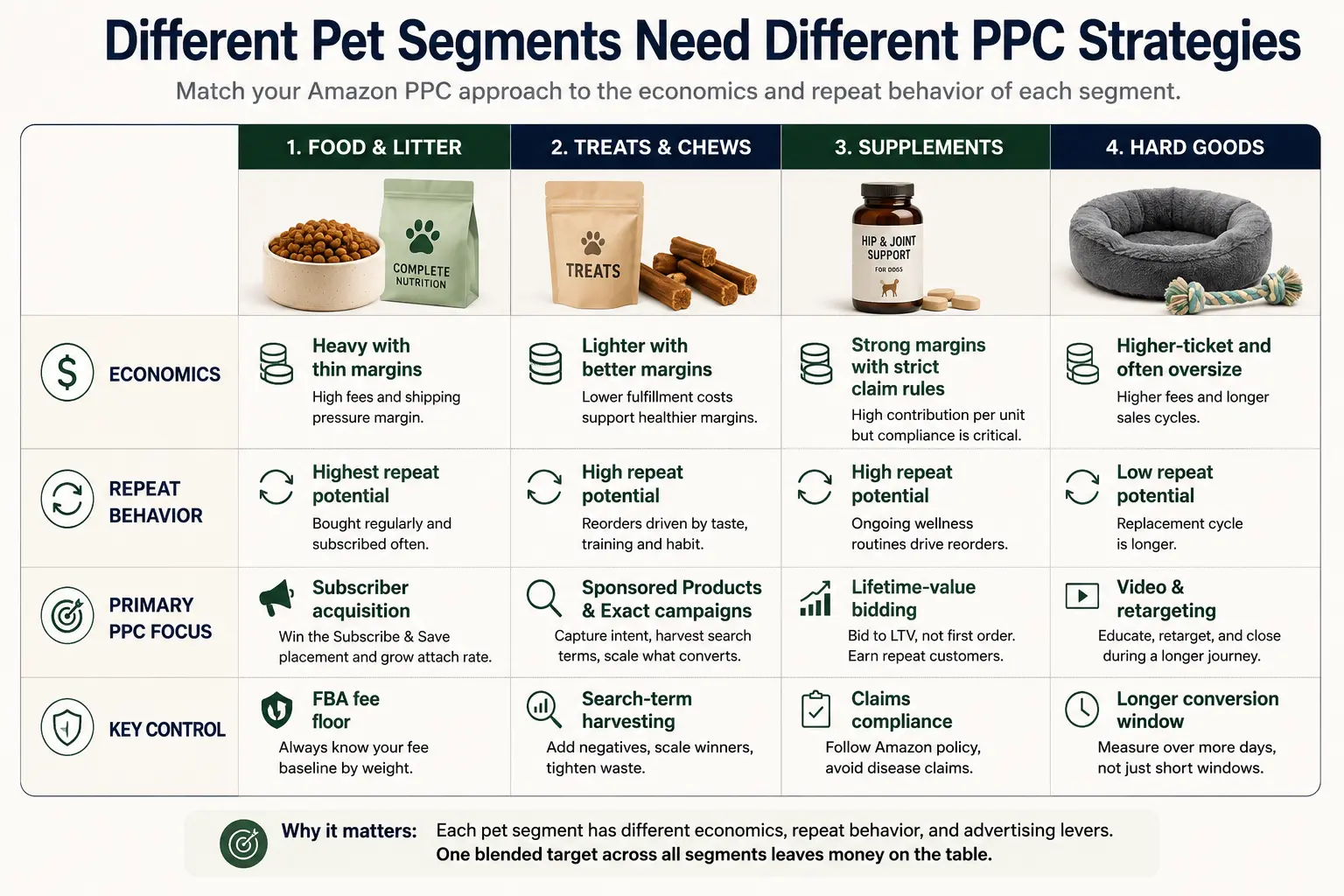
Amazon treats pet as one department, but the segments inside it behave nothing alike. A single blended target across all of them wastes money on some and starves others. Set a strategy per segment based on its margin, its weight, and its repeat rate.
Food and litter carry the category's highest repeat rates and its worst per-unit economics. They are heavy and often oversize, so Fulfillment by Amazon fees eat a large share of a thin margin, and a click that looks affordable can be underwater on the first sale.
The saving grace is stickiness: these are the products most likely to convert to Subscribe & Save, so lifetime value justifies an acquisition target that would look reckless in isolation.
Bid these to the subscriber, not the sale, but respect the fee floor and never let a first order lose more than your customer value can realistically repay over the expected life of the subscription.
Treats, chews, and dental products sit in the middle: better margins than food, lighter weight, high impulse and repeat purchase, and enough search volume to build rank quickly.
This is where a large share of your scaling budget belongs, because it converts efficiently and feeds the organic flywheel.
Push Sponsored Products hard here, harvest winning search terms from Auto campaigns into Exact, and use the volume to lift your whole account's rank profile.
Supplements carry the best margins in pet and the most rules.
The FDA's animal food labeling and pet food claims guidance draws a firm line between permitted nutrition or structure-function language and prohibited disease claims, so your ad copy and listings must sell benefit without promising to cure, treat, or prevent anything.
Stay on the right side of that line and the margin funds aggressive acquisition; cross it and you risk suppression. Because supplements repeat like food but earn more per order, they often deserve the highest lifetime-value bids in the account, and the same discipline that governs human supplement advertising applies here, as our guide on Amazon PPC for supplement brands lays out in detail.
Hard goods like beds, crates, and fountains are higher-ticket, lower-repeat, and often oversize, so treat them like considered purchases: video, retargeting, and a longer view of conversion rather than a fast-repeat model.
Do not force a bed, which a household buys once every few years, into the same reorder-driven target as a monthly supplement.
Below six figures, Sponsored Products and Sponsored Brands do almost all the work, and reaching for programmatic tools early just spends faster. Past $100,000 a month, with a real base of customers and subscribers, the picture changes.
Amazon DSP runs programmatic display and video on and off Amazon, and in pet its best use is timing.
AMC Audiences let you build segments from your own purchase data, so you can reach a food buyer just before their bag runs out, exclude recent purchasers from acquisition campaigns to stop paying for sales you would have won anyway, and find look-alikes of your best repeat customers.
That timing and exclusion work is where the next efficient dollar lives once search is saturated, and it depends on the customer base you have already built. Enrolling in Brand Registry opens up the Sponsored Brands and Sponsored Display formats that feed these audiences.
AMC stitches together how Sponsored Products, Sponsored Brands, Sponsored Display, and DSP work across a shopper's path instead of crediting each in its own silo.
In a repeat-purchase category, that cross-channel view matters more than in most, because the sale that a search campaign appears to lose is often the subscription that display recaptured.
Reading the path as a whole is what keeps you from cutting a channel that is quietly doing the assist work. Getting the structure right underneath all of this is what a Sponsored Brands management approach is built to protect as spend grows.
A guide gives you the framework. What it cannot do is look inside your account and tell you which segment is being scaled past its margin or which campaign is leaking spend on searches that never convert.
At six figures those leaks are expensive, and pouring a bigger budget on top of a structure that is already misfiring only makes them cost more.
The pattern is common: a brand is sure the problem is bidding when the real issue is a blended target flattening the difference between a low-margin food SKU and a high-margin supplement.
That kind of structural leak is cheap to find and expensive to ignore, and a fresh review usually surfaces it faster than another round of bid tinkering.
As a specialist Amazon PPC agency, Amplivus works with pet and consumable brands across every stage described here, from a founder buying first rankings to a market leader running DSP against its own purchase data.
A free Amazon PPC audit reviews your account before you scale and flags what to fix first, and a short Amazon strategy session maps the move to your next tier.

Talk with an Amazon PPC expert to improve lifetime value, protect Subscribe & Save, and scale your pet brand profitably.
Get a free Amazon PPC audit to uncover wasted spend, protect subscriber growth, and scale your pet brand with confidence.