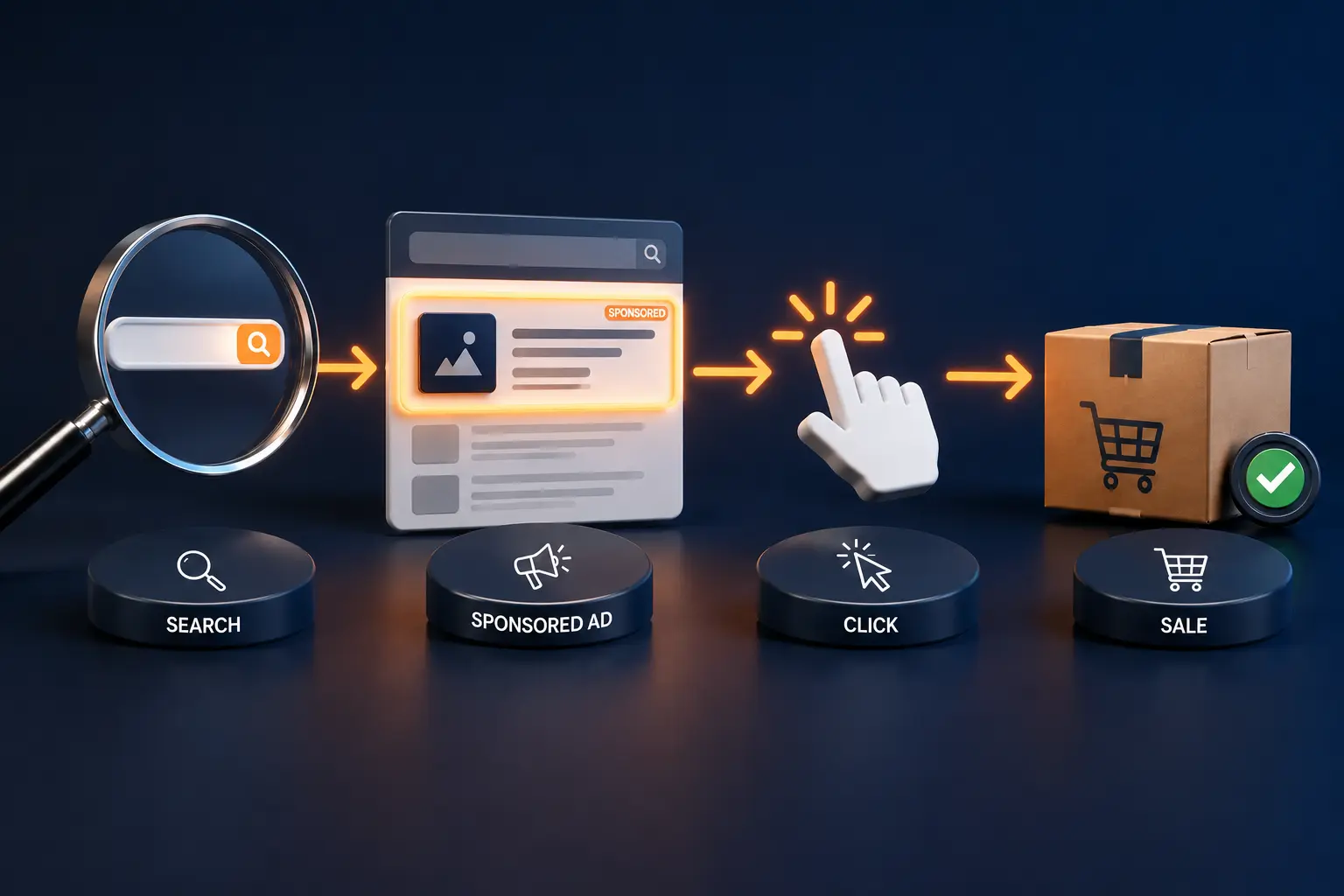
What Is Amazon PPC and How Does It Work
Read more
.png)
Amazon PPC drives brand discovery by turning paid clicks into organic visibility, stronger rankings, new-to-brand customers, and sustainable sales growth that continues after ad spend slows.
Summarize in ChatGPT
How pay-per-click advertising on Amazon builds discovery, rank, and repeat buyers in 2026, and the metrics that prove it is working.
Plenty of brand owners describe Amazon ad spend the same way: a faucet they can never turn off. Sales hold while the budget runs. The moment they pause, the store goes quiet.
The real question underneath is whether the spend is building a brand or just buying receipts.
It is the right question, and the answer in 2026 is more interesting than it was a year ago. Pay-per-click advertising on Amazon has quietly stopped being a pure sales tool.
Used well, it is now one of the most reliable ways to get a brand discovered by people who have never heard of it, and to convert that discovery into rank, repeat buyers, and momentum that holds after the campaign cools. Used badly, it is exactly the faucet they described.
This guide is about the difference. If you are new to the mechanics, our primer on what Amazon PPC is and how it works covers the auction and ad types first.
For years the game was simple. You bid on keywords, you showed up in search, you paid when someone clicked. The advertiser who understood match types and negative keywords usually won.
That logic still matters, but the ground moved. Amazon's systems shifted from matching your ad to a search term toward matching your product to a customer. Broad match and automatic targeting are no longer the lazy setting you graduate out of.
They are how you teach Amazon's recommendation engine who your buyer is, then harvest the winning terms into tighter campaigns. Most strong accounts now put real budget into discovery (broad and auto), defend it with strong negatives, and feed proven search terms into exact-match campaigns each week.
There is a new front door, too. Shoppers increasingly start with Rufus, Amazon's AI shopping assistant, asking it questions the way they would a knowledgeable friend.
Sponsored placements now appear inside those answers, and the scale is real: Amazon has said Rufus is on pace to drive over $10 billion in annual incremental sales, with roughly 250 million shoppers using it in 2025 and engaged shoppers about 60% more likely to buy.
For a brand nobody is searching by name yet, that is a genuinely new way to be found.
The scale underneath all this is hard to overstate. Amazon Ads is now one of the largest advertising businesses on earth, a position documented in public sources including Amazon's company profile on Wikipedia and its advertising revenue trend tracked by Statista.
When that much demand passes through one storefront, where your product appears stops being a vanity question. It is the whole game.
Here is the part most guides skip, because it is the part that actually answers that question.
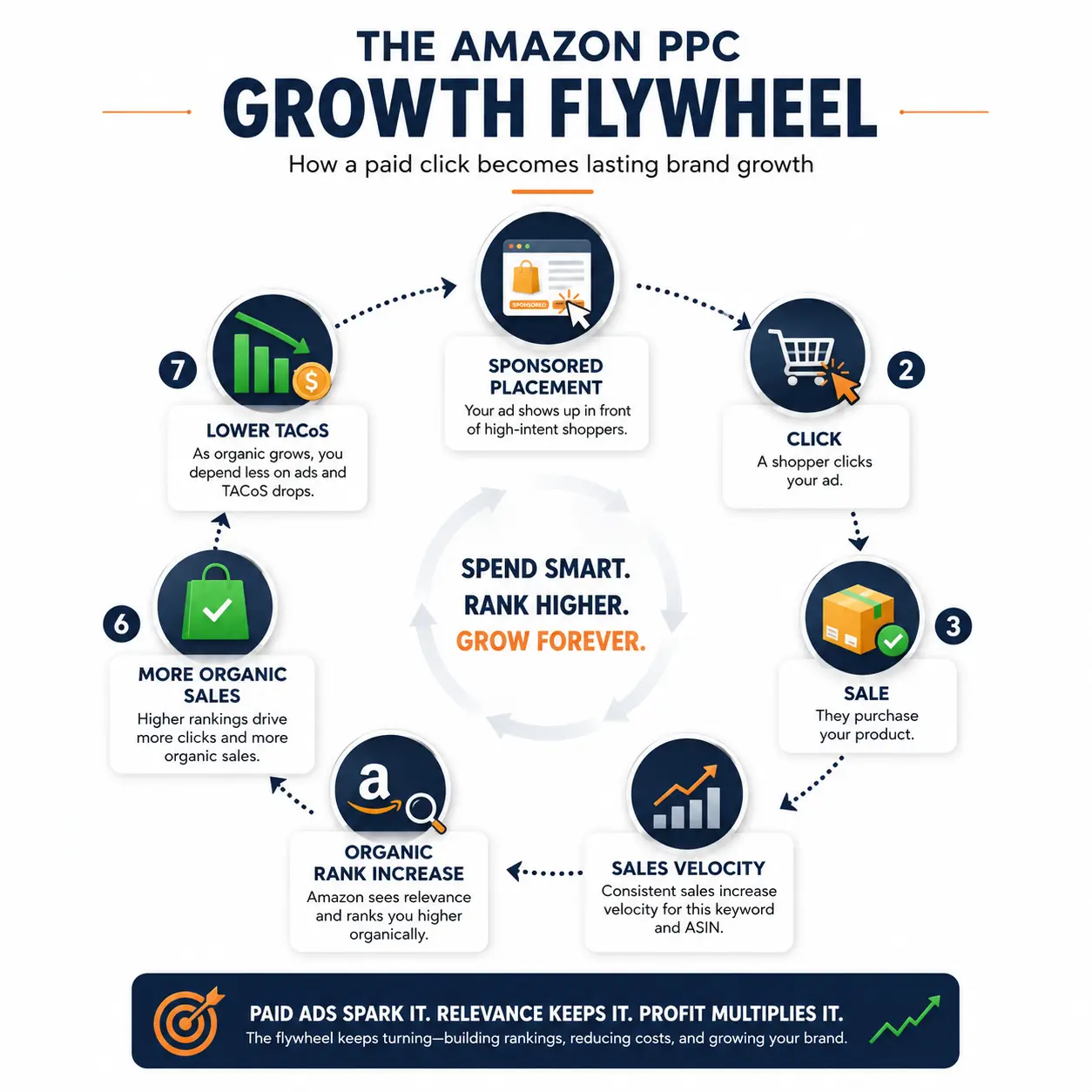
Amazon's organic search algorithm treats conversion and sales velocity as primary ranking signals. When a sponsored placement earns a sale, that sale does not just sit in your ad report. It feeds the same velocity signal the organic algorithm reads.
Win enough relevant, converting sales on a keyword, and your organic position for that keyword tends to climb. Brands that concentrate spend on their highest-converting terms for roughly 60 to 90 days commonly report meaningful organic rank gains on those terms, though the lift varies by category, competition, and listing quality.
As organic visibility strengthens, you can ease off the paid support, and your blended cost of advertising drops. That loop, paid feeding organic feeding lower paid dependence, is the closest thing Amazon has to a flywheel.
This only works when the traffic converts. Spend on a loosely related keyword that gets clicks but not purchases does nothing for your organic rank, and may even teach the algorithm that your listing disappoints.
Velocity has to be relevant velocity. Ads buy you the at-bat. The listing has to hit.
This is why discoverability, not raw sales, is the honest framing. The first job of a paid click is to put your product in front of a stranger. The second is to convert that stranger so the system learns your listing belongs there.
The sale is the proof, but the asset you are building is position: durable organic rank that keeps paying after the campaign ends.
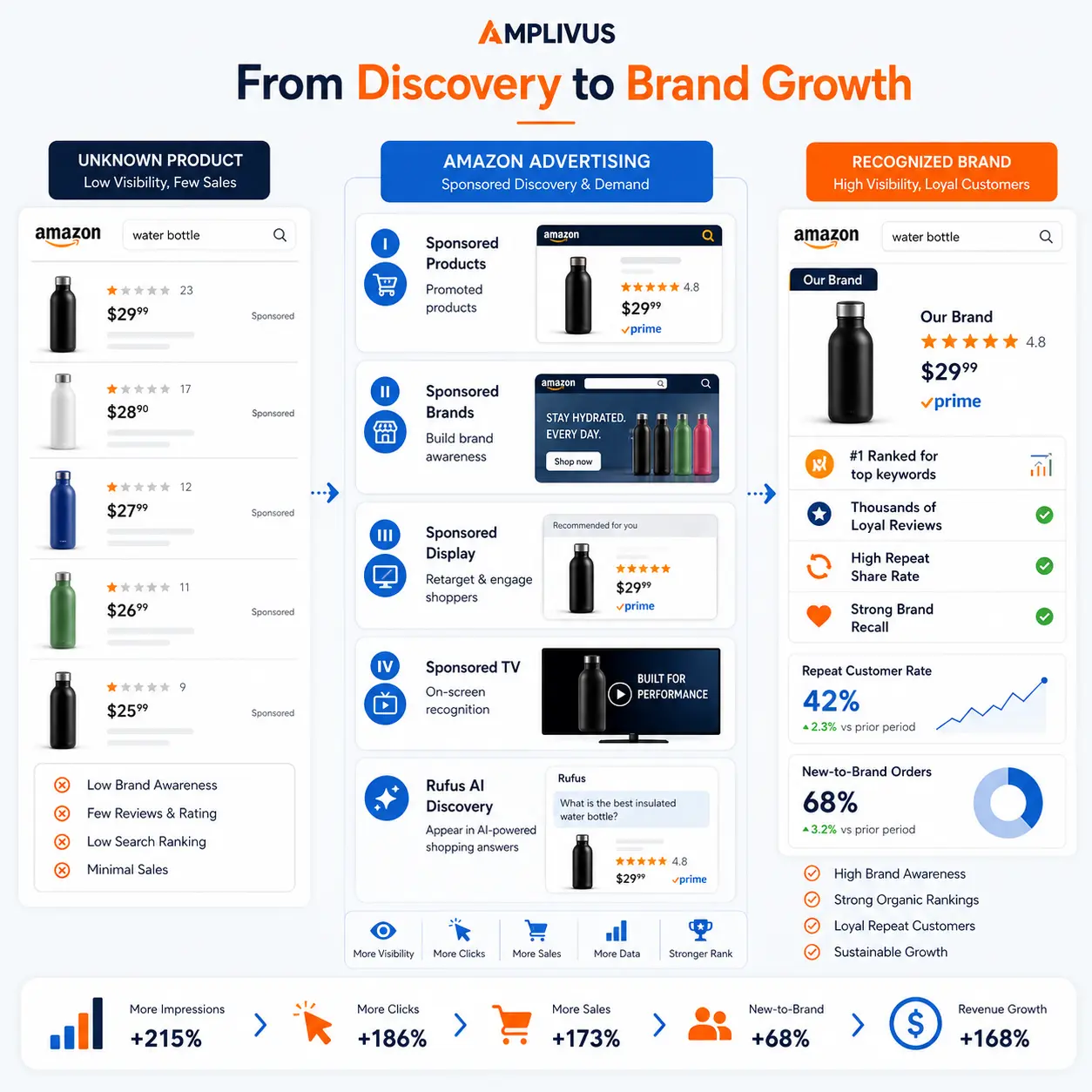
People ask which Amazon ad type is "best." It is the wrong question. They do different jobs at different stages, and here is how they line up.
Sponsored Products is where most accounts start, and rightly so. It meets demand that already exists and ties most directly to rank. But a brand that only runs Sponsored Products is harvesting a field it never planted.
Sooner or later the demand it captures is demand it did not create.
That is where Sponsored Brands, especially Sponsored Brands Video, earns its budget. Its click-through rate looks low next to Sponsored Products, which scares people off, but judge it correctly and the low CTR is irrelevant.
Sponsored Brands earns its keep two ways: defending your branded search so competitors cannot park their ad on your name, and bringing in first-time buyers.
Track its New-to-Brand order percentage monthly and you will see what it is actually doing. If competitors are already bidding on your name, our guide to branded traffic cannibalization in SQP shows how to spot and stop it.
Sponsored Display sits in the middle, following interested shoppers with retargeting on and off Amazon. Sponsored TV is the quiet 2026 story.
It is now fully self-serve, carries effectively no minimum for the self-serve tier, and no longer requires a Seller Central account. Targeting got sharper with lifestyle, in-market, and product-remarketing audiences, and attribution flows through Amazon Marketing Cloud.
Amazon Ads has reported that journeys combining streaming TV with other sponsored ads outperform sponsored-only journeys on New-to-Brand conversion.
Confirm the current figure on the official Amazon Sponsored TV page. Streaming used to be a brand-budget luxury. In 2026 it is a discovery channel with a real entry point.
If you cannot measure it, you cannot defend the budget, and "we got sales" is not the same as "we grew the brand." Three measures separate the two.
This is the cleanest signal that advertising is recruiting customers rather than recycling them. New-to-Brand tracks first-time buyers of your brand over the prior year, and in 2026 Amazon expanded Sponsored Brands attribution to report it by SKU, not only by campaign.
Available across Sponsored Brands and DSP, it turns the vague claim "ads build the brand" into a number you can put in a report.
When discovery is working, more people search your brand name directly. Brand Analytics and Search Query Performance (SQP) let you watch branded search volume and your share of clicks and purchases on those queries.
Rising branded search is one of the most honest indicators that paid discovery is converting strangers into people who remember you. If SQP is unfamiliar, our walkthrough on how to read your Amazon SQP report shows where to look.
Amazon Marketing Cloud (AMC) stitches together the full journey, and in 2026 AMC Audiences can feed bid adjustments on Sponsored Products and Sponsored Brands, or targeting on Sponsored Display.
You can re-engage someone who saw your streaming ad with a sponsored placement later, and measure the combined effect rather than guessing.
The practical move is to stop reading ACoS in isolation. Pair it with New-to-Brand rate and branded search trend. ACoS tells you efficiency. The other two tell you whether you are building anything.
The honest answer to "how much should I spend" is that it depends on your margin and your goal, but you do not have to fly blind. Current benchmarks give you guardrails.
As of mid-2026 benchmarks, average ACoS across Amazon sits around 30%, with most accounts landing in the 25% to 36% band depending on category and season. A "good" ACoS for a profitable account usually falls between 20% and 35%, but the right target is the one your margin can carry.
Average Sponsored Products Return on Ad Spend (ROAS) sits near 3.5x in these global benchmarks, and the math is clean: a 25% ACoS is a 4x ROAS.
Benchmark figures shift, so treat these as a reference point and check a current source before you set targets.
Cost-per-click has been climbing, with Sponsored Products CPC hitting record highs around mid-2026 in the run-up to Prime Day. That pressure is exactly why blended thinking matters.
If you only watch campaign-level ACoS, rising CPC looks like failure. If you watch TACoS (Total ACoS, ad spend against total sales including organic), a healthy account often shows TACoS holding or falling even as CPC rises, because the organic rank your ads built is now carrying more of the load.
A reasonable starting frame for a growing brand: fund discovery (auto, broad, and at least one upper-funnel format) as a fixed line you do not raid, set a target ACoS per campaign tied to your margin, and review TACoS monthly as the real scoreboard.
Structure is where good intentions compound or leak. A few principles hold up in 2026.
Keep auto and broad campaigns on with defined daily budgets, and treat them as research you pay for. Each week, pull the search-term report, move winners into exact-match campaigns, and add losers as negatives.
This harvesting loop is where most of the compounding comes from.
Do not let one campaign chase brand defense, competitor conquesting, and category discovery at once. Group by job so you can read and fund each cleanly. Negative Phrase, Negative Exact, and Negative Product Targeting are not housekeeping either.
They stop discovery campaigns from bleeding into irrelevant searches that drag your conversion signal down.
Sponsored Products offers four: Dynamic Up and Down, Dynamic Down Only, Fixed, and Rule-Based. Rule-Based bidding (toward a target ACoS or ROAS) is useful once you have data.
For upper-funnel recruitment, the Maximize New-to-Brand approach aligns the system with the outcome you want. Manage all of it from the Amazon Ads Console at advertising.amazon.com alongside Seller Central, where the newer audience, AMC, and Sponsored TV controls live.
The expensive errors are rarely dramatic. They are small, recurring, and easy to miss.
Judging Sponsored Brands by ROAS and killing it for "underperforming," when its job was new-to-brand acquisition you were not measuring.
Leaving auto campaigns to run for months without harvesting, so you pay full price for discovery and never bank the learning. Pouring spend onto loosely relevant keywords that click but do not convert, which buys sales today and teaches the algorithm to distrust your listing tomorrow.
Reading ACoS as the only number, missing that TACoS is flat and the brand is genuinely growing. And the quietest one: pausing everything the moment cash gets tight, which collapses the velocity signal and surrenders the organic rank you spent months earning.
None of these are exotic.
They are what happens when an account is run by reflex instead of by a measurement model, and they tend to reappear when a brand tries to scale, which is why our guide on how to scale Amazon PPC past $100K a month leans so hard on structure.
Plenty of brands run a capable program in-house, especially early on when the catalog is small and one person can own the weekly harvest. The honest test is not skill, it is attention.
This job rewards consistent weekly work: reading search terms, adjusting bids, tending negatives, watching New-to-Brand and TACoS trend lines. If that work is happening and the numbers are moving the right way, keep it in-house.
The case for help gets stronger as the catalog grows, the surfaces multiply (Sponsored TV, DSP, and AMC audiences add real complexity), and the cost of a misallocated budget climbs past what a part-time effort can catch.
There is no universal threshold, only the point where the time and the risk outgrow the in-house bandwidth.
If you are at that point, a structured audit is the low-risk way to find where a budget is leaking before committing to anything bigger.
As an Amazon PPC agency built around this measurement model, Amplivus offers a no-pressure PPC audit that maps where your spend is building rank and where it is quietly leaking.
See our Amazon PPC management service, or book a free strategy session to walk through your account together.

Find out where your Amazon advertising is driving rankings, discoverability, and new customers. Get a tailored PPC growth plan.
Discover whether your Amazon PPC campaigns are building organic rankings, brand visibility, and repeat customers or wasting ad spend.