
Finding Hidden Profit in Your Brand Analytics Dashboard
Read more
.png)
Baby brands scale past $100K/mo on Amazon PPC by setting product-level TACoS near 14-15%, funding 8-12 hero SKUs, harvesting search terms into exact match, and fixing conversion before spend.

Most baby brands do not stall because they spend too little. They stall because the machine they built at $30K/mo cannot carry $100K/mo of budget without leaking profit.
Bid tweaks, dayparting, and match-type shuffling get you to the plateau. They rarely get you past it.
This guide is for founders, in-house Amazon managers, and DTC operators already running paid ads on Amazon who have hit that ceiling.
You will get real category benchmarks, a named scaling framework, campaign structure that holds up under budget, and an honest read on when to keep building in-house versus when to hire out.
The goal is simple: more revenue that still keeps its margin. If your catalog leans toward toys, our Montessori toy brand PPC playbook covers the niche-category tactics that pair with this framework.
Scaling means growing sales while your total advertising cost of sale stays inside a range you chose on purpose.
It is not "turn budgets up." At higher spend, every structural weakness gets multiplied, so the real work is fixing the architecture that decides where each dollar lands.
Here is the shift that trips people up. Below $30K/mo, tactical moves feel like the whole game. Adjust a bid, add a negative, shift dayparts, and results wobble in response. Push the same account toward $100K/mo and those levers flatten out.
What matters now is how the account is built: which products you fund, how you separate proven search terms from exploration, and whether your targets are set per product instead of one blanket number.
Amazon's advertising business now reports tens of billions in annual revenue, and the platform gets more competitive each quarter, which is why sloppy structure costs more every year. Scaling well means your ad dollars increasingly feed organic rank, so paid and organic climb together.
That loop, built on the same flywheel logic Amazon runs its whole business on, is the whole point of spending at all. The mechanics of that paid-to-organic lift are covered in depth in our Amazon PPC halo effect playbook.
A workable baby-brand target sits near 25-35% ACoS on mature products and a product-level TACoS around 14-15% once your structure is in place.
That range keeps rank defended without bleeding margin, though your break-even ACoS depends on your own unit economics.
Here is the honest part most guides skip. Baby Products does not appear in the major 2026 benchmark tables at all.
The closest public anchors are directional: the Toys & Games category tends to run near 26 percent ACoS with a cost per click under a dollar, while Health & Household runs higher, near 36 percent ACoS with a cost per click closer to $1.40, reflecting more cautious, research-heavy buyers. Baby sits between these two worlds.
Safety-driven, research-heavy purchases (car seats, monitors) behave like Health & Household, with higher CPCs and cautious buyers.
Consumable and gifting items (wipes, bibs, toys) behave more like Toys & Games. Treat those as proxy ranges to sanity-check against, not targets to copy.
TACoS, total advertising cost of sale, is the number that actually tracks scaling health. Advertising Cost of Sale (ACoS) tells you how a campaign performs.
TACoS tells you what ads cost against your whole revenue, so it exposes whether paid growth is pulling organic sales up with it.
When TACoS drifts down while revenue climbs, the flywheel is working. When TACoS climbs alongside spend, you are buying sales you might already own.
Set targets per product, not per account. A launch needs a loose target because it is buying rank and reviews.
A mature hero needs a tight one because it is defending a position it already holds. One account-wide number forces both into the wrong strategy.
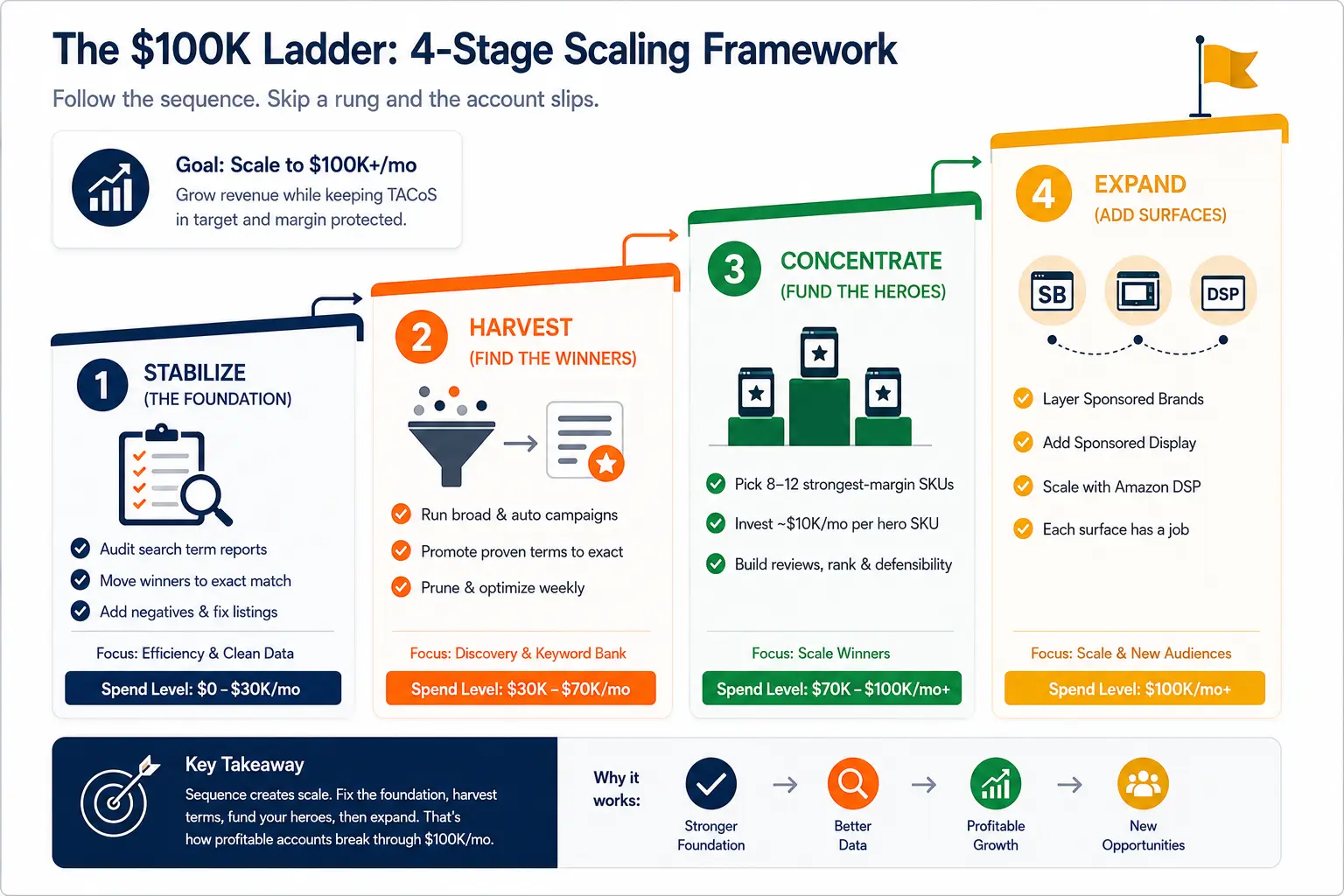
Think of the climb to $100K/mo as four rungs, each with a different job. Skipping a rung is why most accounts slip back down.
Before spending more, get your house in order. Audit search-term reports, isolate converting terms into exact-match campaigns, and push non-converters into negatives. Confirm your listings convert. This is the boring rung, and it is the one that decides everything above it.
Run broad and auto campaigns as a discovery layer, then promote proven search terms into tightly controlled exact campaigns.
This keyword harvesting workflow is how you build a bank of profitable, defensible terms instead of guessing, and the Search Query Performance report is where you read which terms actually convert. Prune weekly. Baby buyers use precise language ("newborn swaddle 0-3 months"), so exact match rewards you.
Pick your 8-12 strongest-margin SKUs and fund them hard. As a directional rule from managing accounts at this stage, a hero product often needs on the order of $10,000/mo in dedicated spend to build review velocity and hold rank.
Spreading thin budget across 50 SKUs is the single most common reason accounts stall in the $40K-$70K range.
Only after the first three rungs hold do you layer Sponsored Brands, Sponsored Display remarketing, and eventually Amazon DSP. Each new surface should answer a specific job, not fill a dashboard.
The Ladder works because it forces sequence. You do not add DSP to fix a conversion problem, and you do not scale spend on a SKU whose listing cannot close the sale.
Structure so that proven search terms are isolated from exploration, and every campaign has one clear job.
The cleanest scaling accounts separate discovery from performance so budget never funds the same click twice. A structure that holds at $100K/mo usually looks like this:
Amazon gives Sponsored Products four bid strategies (Dynamic Up and Down, Dynamic Down Only, Fixed, and Rule-Based), and at scale Rule-Based Bidding against a target ACoS or ROAS keeps thousands of keywords honest without manual babysitting.
Amazon Brand Registry opens access to Sponsored Brands, Sponsored Display, and AMC, so enrolling is step zero for any brand serious about scaling.
The mistake I see most: brands let one keyword run across auto, broad, phrase, and exact at once.
The campaigns bid against each other, CPCs inflate, and the search-term report turns to mud. Isolate, and the data gets clean enough to trust.
When that structure is more than one person can run cleanly, done-for-you Amazon PPC management is what keeps the layers separated day to day.
PPC plateaus almost always trace back to conversion rate, not bids. If your listing converts at 11 percent while the category runs 13 percent, every extra dollar of spend buys fewer sales, so scaling just pours budget into a leak.
Run the math. Lifting a listing from 12 percent to 16 percent conversion means the same ad spend produces about 33 percent more sales, and that gain compounds on every budget increase after it.
This is why the operators who scale cleanly fix conversion before they touch budget. Better main images, clearer titles, a stronger A+ layout, honest reviews, and a sharp price all move conversion rate more than any bid change.
The second plateau cause is ignoring organic rank. When you scale bids without checking where a keyword ranks organically, you pay to appear next to a listing you already own for free.
Track organic keyword position as part of ads management, not as a separate report. As paid drives sales velocity, organic rank rises, and you can ease paid pressure on terms you now hold, which frees budget for new ground.
That is the flywheel doing its job.
A practical way to catch both causes early is a short weekly review on a rolling 14-day window: total revenue, product-level TACoS, new-to-brand share, and organic rank on your top ten terms, read together rather than in isolation.
When paid spend climbs and organic rank climbs with it, you are buying durable growth and can keep scaling. When paid climbs and organic sits flat, you are renting sales, and the fix is upstream in the listing or the keyword choice, not in the bid.
The same discipline underpins our wider guide on how to scale Amazon PPC past $100K a month, which applies across categories.
Baby demand runs on a calendar, and generic PPC advice ignores it entirely. Registry cycles, seasonal gifting, and Q4 create predictable swings, so your budgets and bids should move on a schedule rather than in reaction.
Baby registries drive steady discovery demand, and expectant parents research months ahead of purchase, which rewards patient top-of-funnel spend that generic advice would cut.
Gifting peaks (baby showers, holidays) spike conversion on giftable SKUs. Q4 lifts CPCs across the board as every category competes for impressions.
Subscribe & Save changes the math on consumables like wipes and diapers, because a first conversion can carry months of repeat revenue, which justifies a looser acquisition ACoS on those items.
Plan the ramp. Raise budgets and loosen targets ahead of known spikes, then tighten on the way down. Sync ad budgets to your restock cycles too, because outrunning inventory triggers out-of-stock penalties that undo weeks of rank building.
The registry cycle deserves its own note, because it rewards patience in a way other categories do not: a parent who researches a stroller in the second trimester may not convert for two or three months, so a September click that looks unprofitable on last-click ACoS can be seeding a December purchase.
Judge those top-of-funnel campaigns on new-to-brand orders and blended TACoS across the window, not on the day, or you will cut the exact spend that was building your Q4 rank.
They earn a place once Sponsored Products is optimized and you need reach or insight it cannot give.
Adding advanced surfaces to fix a broken foundation just spends more money faster. Sponsored Display remarketing is the natural next step: it re-engages shoppers who viewed but did not buy, which suits the long consideration window of baby purchases. Amazon DSP fits brands ready to reach audiences off the search page and to run true upper-funnel and retargeting at scale
Amazon Marketing Cloud (AMC), now with self-serve access, lets you analyze new-to-brand behavior and path-to-purchase across campaigns, which is how mature brands find their next efficiency.
The gauge for all three is incrementality. If a dollar on DSP or Sponsored Display brings new-to-brand customers you would not have won on search, it is worth it.
If it just reshuffles sales you already had, it is not. New-to-brand percentage and AMC audience insights are how you tell the difference instead of guessing.
Keep it in-house when you have the time, a capable operator, and enough margin to absorb a learning curve.
Bring in an agency when the account has outgrown one person's attention or when the cost of slow decisions exceeds the fee.
At scaling spend, review cadence alone often forces the call. Accounts pushing toward $100K/mo usually need daily attention, and during major events the standard tightens to hourly. If nobody on your team can watch it that closely, a specialist team pays for itself.
As a focused Amazon PPC agency, Amplivus exists for exactly this stretch, when structure and cadence, not effort, are the bottleneck.
If you are unsure where your account leaks margin, a free Amazon PPC audit will usually surface it in an afternoon, and a short Amazon strategy session maps the next rung.
The point is not to hand over control. It is to see the gap clearly before you spend another dollar into it.

Talk with an Amazon PPC strategist to improve campaign structure, grow hero SKUs, and scale your baby brand while protecting profit.
Get an Amazon PPC audit to uncover scaling gaps, improve TACoS, and build a stronger campaign structure without sacrificing margin.