How Amazon PPC Drives Brand Discoverability and Sales in 2026
Read more
.png)
Amazon brands scale past $100K a month by steering on TACoS and margin, consolidating campaigns so the algorithm can learn, and adding new channels only once the base is profitable.
Summarize in ChatGPT

A framework for established Amazon brands that have plateaued at scale and need a structure that grows profit, not just revenue.
You did the hard part already. You built a brand that spends real money on ads every month, somewhere between $50K and $150K, and for a while the numbers cooperated.
Then they stopped.
You pushed more budget into your best campaigns and watched ACoS (Advertising Cost of Sale) drift up instead of holding. Revenue grew a little. Profit did not.
That plateau is not a sign you are doing something wrong. It is a sign you outgrew the playbook that got you here.
The tactics that work at $20K a month (tight match types, aggressive negatives, daily bid nudges) quietly turn into the thing holding you back at $100K.
Scaling pay-per-click, the auction that drives most of your paid sales, is less about working harder and more about changing your account's shape.
For the tactical, step-by-step version alongside this strategic one, our companion guide on how to scale Amazon PPC past $100K a month walks the mechanics. Here is what actually breaks, and how the brands that push through think about the climb.
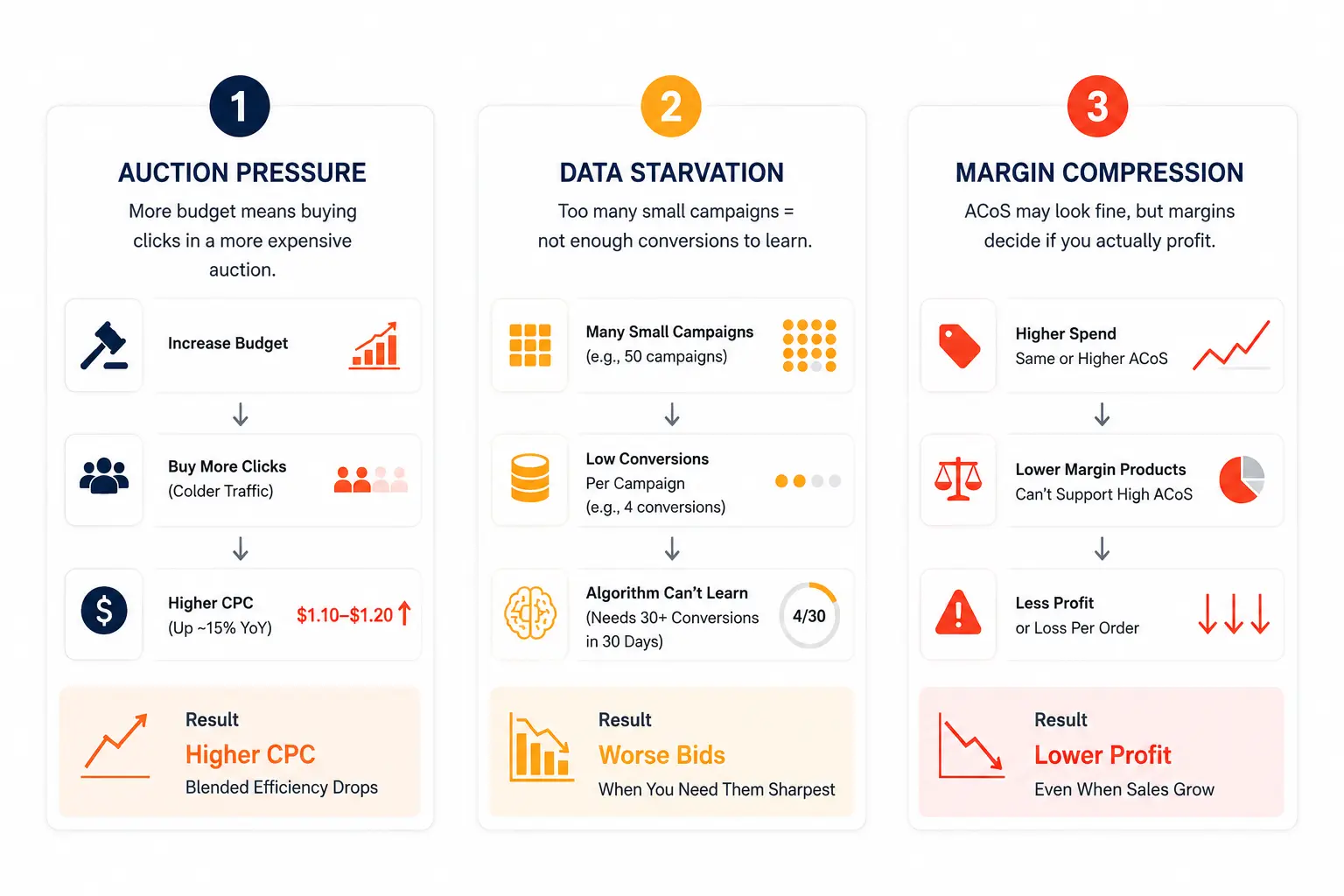
Most guides treat rising ACoS as a mistake you made. Usually it is not. Three forces stack up the moment you scale, and they are mostly structural.
To spend more, you have to buy more clicks, which means bidding into less efficient keywords and placements.
Your cheapest, highest-intent traffic is finite.
Every extra dollar reaches a slightly colder shopper, so your blended cost rises. Industry trackers have recently put average Sponsored Products CPC (cost per click) around $1.10 to $1.20, up roughly 15% year over year, and it keeps climbing.
Amazon's ad business is now one of its largest revenue lines, and the scale of that ad spend keeps pushing auction prices up across categories. You are scaling into a more expensive auction than the one you started in.
This is the force nobody warns you about. Amazon's bidding system needs volume to learn. Rule-based bidding wants at least 30 conversions in a 30-day window before it optimizes well.
If you have 50 tidy little campaigns splitting 200 monthly conversions, that is four conversions each. None of them clear the bar. The algorithm is guessing, so your bids get worse exactly when you need them sharp.
ACoS measures ad cost against ad-attributed sales, but it says nothing about whether you keep any money. A 35% ACoS on a 50% margin product is fine.
The same ACoS on a 25% margin product loses you cash on every order, and scale magnifies that gap fast. Rising ACoS at scale is rarely a bidding bug. It is auction physics, a starved algorithm, and margin math arriving at once.
ACoS is a campaign-level metric. At scale you need an account-level one, and that is TACoS (Total Advertising Cost of Sale): ad spend divided by total sales, paid and organic together.
ACoS tells you how a campaign is doing. TACoS tells you how dependent your whole business is on paid traffic.
That distinction matters because the goal of scaling is not lower ACoS. It is more total profit at a TACoS your margins can carry. A healthy range depends heavily on category, and the figures below are rules of thumb, not fixed targets.
Mature products often run 5 to 10%. New launches sit higher, 15 to 25%, because you are buying rank you do not have yet. Beauty and supplements tend to run hot, often 12 to 18%, where CPCs are punishing.
Tools and home improvement can sit nearer 5 to 10% where competition is lighter.
The number itself matters less than its direction. A TACoS of 12% that has fallen for six straight months is healthier than an 8% that is creeping up. The first means paid spend is building organic rank that carries sales for free.
The second means the opposite, a pattern our guide on how Amazon PPC drives brand discoverability unpacks in detail.
Underneath TACoS sits the metric that decides everything: contribution margin. That is revenue minus cost of goods, Amazon fees, fulfillment, and ad spend, per unit.
If you do not know contribution margin by SKU, you are scaling blind. Pull your cost data from Seller Central and your demand signals from Brand Analytics, set a minimum margin floor per product, and let that floor cap how hard you push.
Scaling that ignores margin is buying revenue at a loss in slow motion.
If data starvation is the problem, consolidation is the fix. The old advice to isolate every keyword in its own campaign made sense when Amazon matched ads to text strings.
It does not now. Amazon's COSMO system and its AI shopping layer read intent, not just keywords, and they reward campaigns fed with enough conversions to learn.
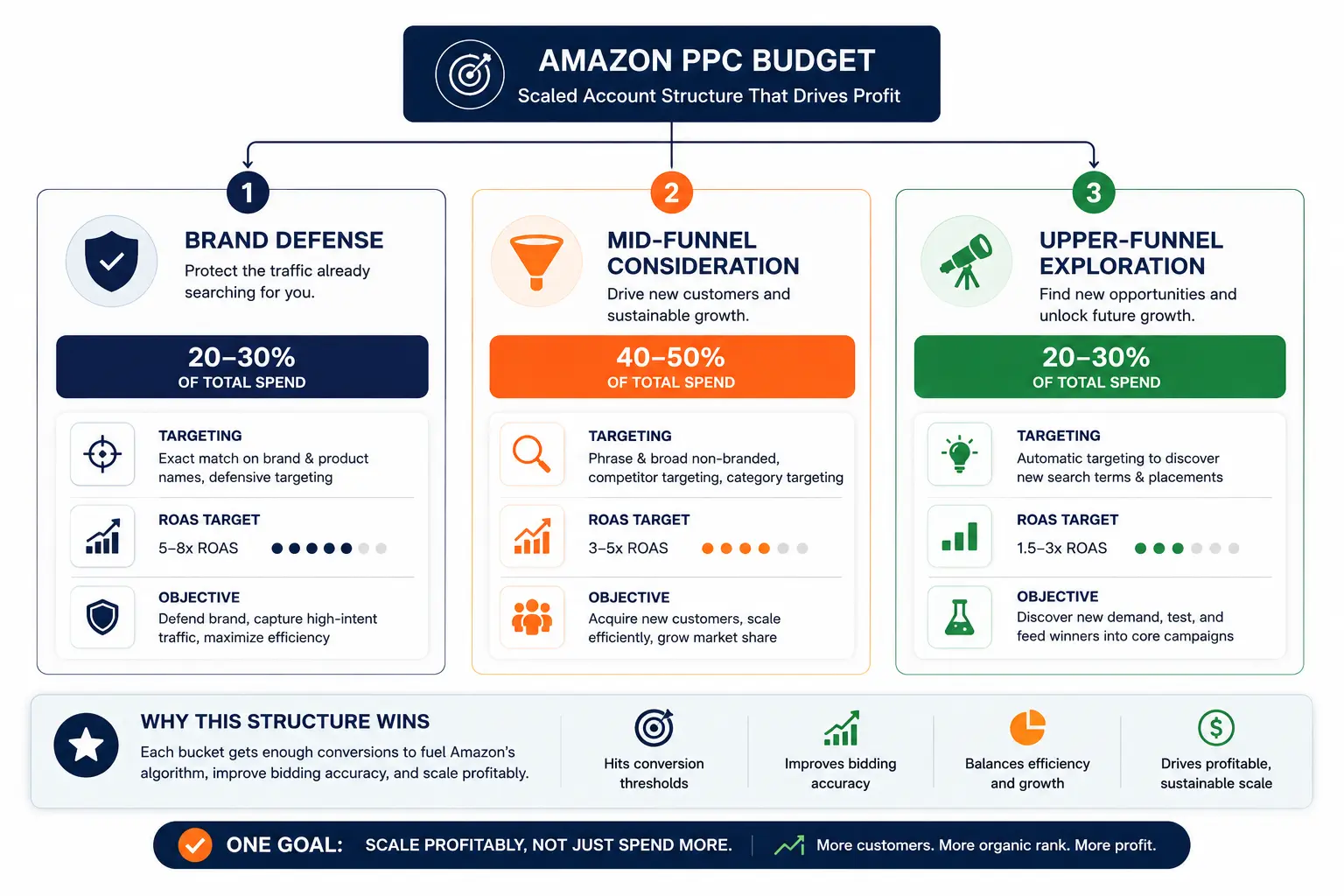
A structure that holds up at scale usually collapses into three intent buckets. This three-bucket model is one proven approach rather than an official Amazon rule, and the percentages below are starting points to adjust against your own data.
This bucket protects the traffic already searching for you. Run exact match on your brand and product names, plus defensive targeting on your own listings, at a tight efficiency target, often a 5 to 8x ROAS (Return on Ad Spend), because these shoppers already want you.
If competitors are bidding on your name, our guide to branded traffic cannibalization in SQP shows how to defend it, and our Sponsored Brands management work is built around exactly this layer.
This is your growth engine, and where most consolidation happens. Group phrase and broad non-branded terms, competitor targeting, and category targeting together, with rule-based bidding tuned for conversion value, aiming around 3 to 5x ROAS.
This is where new customers come from, so it earns the largest slice.
This bucket is your research lab. Automatic targeting hunts for new search terms and placements at a lower 1.5 to 3x ROAS target, since the payoff is discovery, not immediate profit.
Keep a strict cap so the experiment never eats the account.
Grouping this way means each bucket clears that 30-conversion threshold, so the algorithm finally has enough signal to bid well. You keep strategic control through spend caps and negatives, but you stop fighting how the platform actually works in 2026.
Sponsored Products, Sponsored Brands, and Sponsored Display are not separate decisions.
They are three slices of one budget, and the right slices depend on where a product sits in its life.
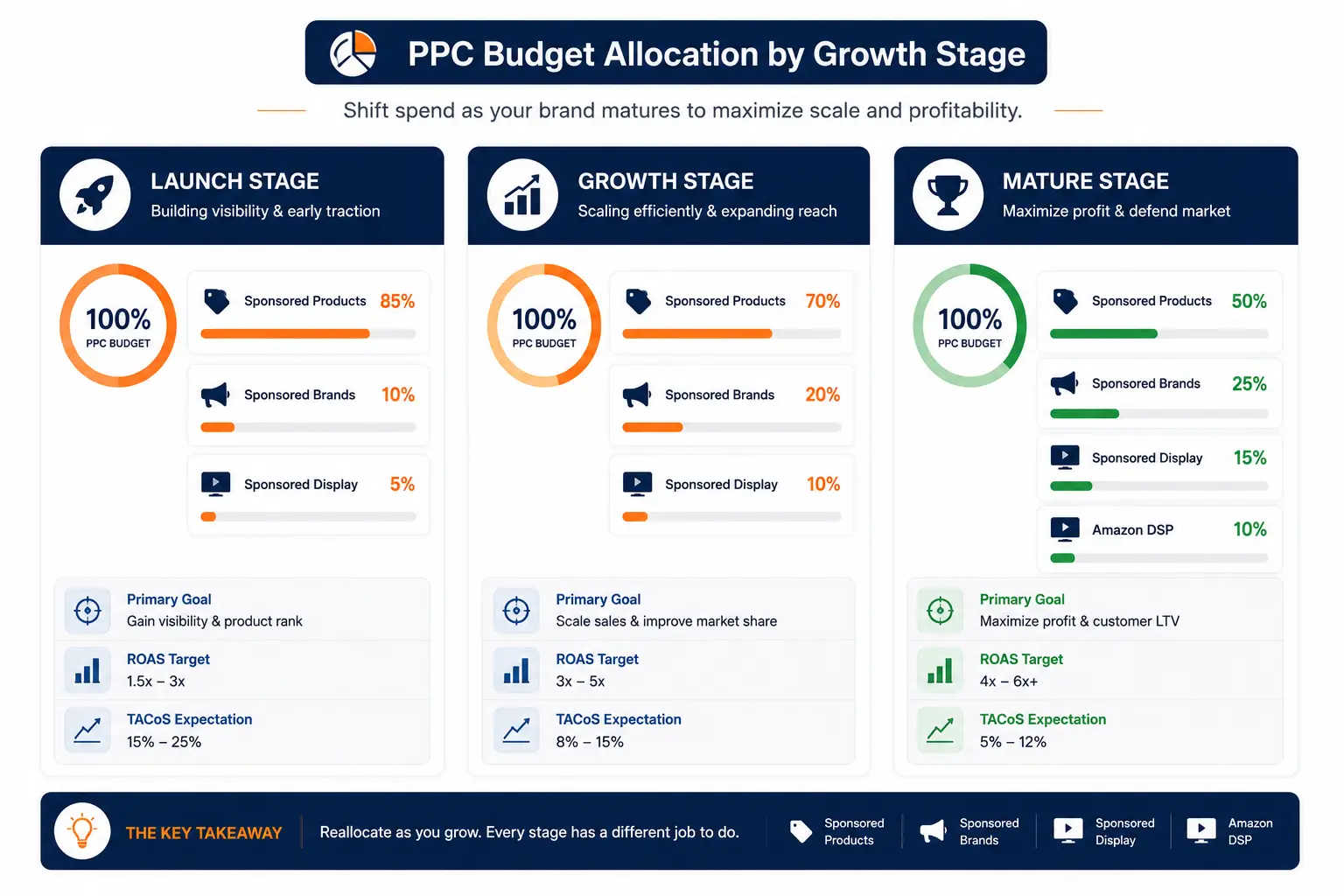
For an established product with steady sales, a widely used industry starting point (not an Amazon rule) is about 70% Sponsored Products, 20% Sponsored Brands, and 10% Sponsored Display.
Sponsored Products carries the immediate sales. Sponsored Brands defends your brand search and adds reach. Sponsored Display handles retargeting and quiet defense on your own and competitor pages.
For a new launch, that split inverts toward aggression. Put 80 to 85% of that product's budget into Sponsored Products for the first 30 to 60 days.
You are buying data and rank, not efficiency, and that is the correct trade early on.
As a brand matures and adds a full-funnel layer, the split widens again, often near 50% Sponsored Products, 25% Sponsored Brands, 15% Sponsored Display, and 10% DSP.
The point is not to memorize ratios. It is to match spend to the job each product needs done this quarter.
One honest limit belongs here. None of this rescues a listing that does not convert. If your detail page turns clicks into nothing, more budget just burns faster. Fix conversion fundamentals first: images, the A+ content, the price, the reviews.
A page that converts at 10% reaches the learning threshold on half the spend of one that converts at 5%, so conversion work pays for itself twice.
Every scaling brand eventually asks about Amazon DSP (Demand-Side Platform) and Amazon Marketing Cloud (AMC). The honest answer is that most ask too early.
DSP buys programmatic display and video across and beyond Amazon.
AMC is the clean room where you stitch full-funnel attribution together. Both are powerful, and both punish brands that bolt them on before the base is stable.
A workable readiness test (practitioner guidelines, not Amazon minimums) looks like this. Your Sponsored Products base is consistently profitable.
Your monthly ad budget is comfortably past roughly $30K, with annual Amazon revenue in the $1 to 2M range or higher. Your margins are healthy enough to fund awareness spend that will not pay back immediately.
If those three are not true, DSP will just spend faster.
When you do start, weight it toward proven returns first. Put roughly 60% of DSP budget into retargeting shoppers who already viewed your products, and send the other 40% to prospecting new audiences.
Sponsored TV sits inside this upper-funnel layer now as a self-serve option, which puts streaming placements within reach of mid-size brands for the first time.
AMC then tells you which of these touches actually drove the sale, so you stop guessing about the assist. DSP and AMC are the layer you add after the PPC engine runs clean, not the thing you hope will fix it.
Amazon search stopped being a keyword-matching machine. Its COSMO model and its AI shopping assistant (launched as Rufus, rebranded as Alexa for Shopping in 2026) read shopper intent the way a person would.
A buyer no longer types "waterproof boots men size 10." They ask which boots stay dry on a rainy hike, and the system answers from your full listing.
For scaling, that has two consequences. First, keyword stuffing is dead weight. Clear, natural listing copy that answers real questions now feeds both organic rank and ad relevance.
Second, your structure has to give the algorithm room to match intent, which is another reason hyper-segmentation backfires. Pair this with your own data sources, Search Query Performance and Brand Analytics, and you can align campaigns to the queries that actually convert.
Our walkthrough on how to read your Amazon SQP report shows where to start. This is the part of Amazon's advertising platform that separates 2026 operators from people still running a 2021 account.
Scaling is not a one-time restructure. It is a cadence you keep, week after week, so the account never drifts back into waste.
The brands that hold profit at $100K a month run a tight loop, and it is mostly unglamorous.
Each week, pull the search term report and do two things. Harvest the converting terms into your mid-funnel bucket, and add the wasteful ones as negatives.
This negative keyword harvesting is one of the highest-return habits at scale. It keeps your spend pointed at queries that actually buy, and it stops blended ACoS from creeping up while you are looking elsewhere.
Watch budget pacing, not just bids. A campaign that caps out at noon is leaving afternoon shoppers to competitors. If your data shows clear buying windows, dayparting (shifting bids by time of day) recovers margin that flat bidding gives away.
Then sit on your hands for everything structural. Amazon's bidding needs a learning window of at least four weeks before a consolidated campaign settles. Panic-editing after three days resets that clock and keeps the algorithm guessing. Steady beats busy here.
Run a weekly search-term and pacing review, a monthly structural review, and a quarterly look at budget reallocation across products. Write it down and run it like a checklist, because the moment it lives only in your head is the moment it slips.
Some brands push past $100K a month in-house. Many hit a point where the account needs more hours and more specialized judgment than one busy founder can give it.
A few honest signals: you are reacting to yesterday's numbers instead of running a steady weekly cadence; you cannot quickly say which campaigns are starved and which are wasteful; DSP, AMC, and Sponsored TV feel like doors you know you should open but keep postponing; and your TACoS is drifting up with no obvious levers left.
If two or more of those land, the constraint is no longer strategy. It is capacity and depth. There is no shame in that. It is what outgrowing a stage looks like.
As an Amazon PPC agency that manages accounts at your size every day, this is the exact moment Amplivus steps in.
If you want an outside read before committing to anything, a free Amazon PPC audit gives you a written look at your structure, your TACoS trend, and the one or two changes most likely to move profit.
You can also see how our Amazon PPC management approach works, or book a strategy session to walk through your account together.
Scaling Amazon PPC past six figures is not about a secret bid setting. It is about steering by the right metric, giving the algorithm enough data to do its job, splitting budget to match each product's stage, and adding channels only when the base can carry them.
Get that order right and the ceiling turns back into a climb.

We'll identify campaign bottlenecks, TACoS leaks, and missed growth opportunities so you can scale with confidence.
If revenue is growing but profit is stuck, we'll review your structure, budget allocation, and scaling readiness.