
How Beauty Brands Scale Past $100K/mo With Amazon PPC
Read more
.png)
The Amazon PPC halo effect is when paid ads create the sales velocity Amazon's algorithm rewards with higher organic rank, so your product earns free sales you no longer pay for.

Every beauty founder eventually asks the same uncomfortable question. If I turn off my ads tomorrow, does anything I built survive? You watch Advertising Cost of Sale (ACoS) creep up, you watch the daily budget drain, and you start to wonder whether paid sales are an asset or a habit you cannot quit.
Here is the part most guides skip. Your ads can buy something you keep. Not the click, the rank. When paid traffic sells your product fast enough, Amazon reads that speed as proof the product belongs at the top, and it starts handing you organic placements you no longer pay for.
That transfer, from paid velocity to earned position, is the halo effect.
This piece is written for owners and brand managers of US skincare, cosmetics, and personal-care brands who already run ads but cannot yet see how the paid and organic sides connect.
By the end you will have a repeatable method, a way to measure it, and an honest sense of how long it takes.
The Amazon PPC halo effect is the lift in organic ranking and organic sales that follows a well-run paid campaign. Ads generate sales velocity on a target keyword, Amazon's ranking algorithm treats that velocity as a relevance signal, and your product climbs the free results for the same terms you were paying to appear on.
The idea is older than Amazon advertising. Around 2001, Jim Collins, who wrote Good to Great, walked Jeff Bezos through the concept of a business flywheel: small pushes that compound into momentum.
Amazon built its whole model on it. The halo effect is that flywheel expressed in advertising terms. A paid sale is a push. Enough pushes and the wheel turns on its own.
What turns the wheel is sales velocity, the rate at which your product sells over a period. Amazon's search ranking (the A9 engine, and what many practitioners informally call A10) weighs how often a listing converts a search into a purchase, because a product that sells reliably for a query is, by definition, a relevant result to show.
Paid clicks feed that record. They do not get a separate ledger. A sale is a sale, whether the shopper arrived through a Sponsored Products ad or an organic link, and it all counts toward the sales history that decides your position.
Yes, indirectly, and the distinction matters. PPC does not reach into the algorithm and raise your rank. It creates the conditions the algorithm rewards: velocity, conversion rate (CVR), and a strong click-through rate (CTR) on a relevant keyword.
Amazon then decides, on its own logic, to give you more organic real estate.
Be careful with anyone who promises exact mechanics. Amazon does not publish the weights inside A9 or A10, and any page that claims a precise formula is guessing.
What sellers consistently observe in practice is simpler: concentrate paid sales on a keyword your listing genuinely fits, and organic rank for that keyword tends to follow.
Best Sellers Rank (BSR), the public popularity signal for a category, usually moves in the same direction as the velocity builds.
The caveat is relevance. Ads only lift rank when the shopper's search, your keyword, and your product actually match.
Buy clicks on a term your listing does not deserve and you get the worst of both worlds: money spent, a weak conversion rate, and a relevance signal that tells Amazon to leave you where you are. The halo effect is not a volume trick. It is a relevance amplifier. This is also why listing quality is not a side project.
It is the hinge the whole mechanism turns on, which is why serious operators pair ad strategy with disciplined Amazon PPC management rather than treating campaigns as a set-and-forget line item.
Most guides on this topic are written for every category at once, so they miss what makes beauty different. Beauty is where the halo effect compounds fastest, for three reasons.
First, the category is enormous and moving online. The US beauty and personal-care market was estimated at about 109.56 billion dollars in 2025, according to Grand View Research.
Online has become the center of gravity: industry trackers now put e-commerce at roughly 40 percent of US beauty sales, and Amazon ranks among the largest beauty sellers in the country (Circana). When rank moves in beauty, it moves in front of a lot of buyers.
Second, beauty buyers come back. A shampoo, a serum, or a foundation runs out. That repeat-purchase rhythm is the difference between a category where a ranked keyword is a one-time win and one where it is an annuity.
Every new customer your ads win has a chance to reorder organically, and Subscribe and Save turns some of them into standing revenue you never pay for again.
Amazon's new-to-brand (NTB) metrics, which flag a shopper who has not bought from your brand on Amazon in the past 12 months, let you see exactly how much first-time demand your ads are creating.
In a repeat category, NTB orders are the seed of organic momentum.
Third, beauty is crowded and review-driven. New brands launch daily, and shoppers lean hard on ratings before they buy. Early paid sales do more than build velocity.
They build the review base that lifts conversion rate for everyone who lands on the page later, organic or paid. The wheel turns faster because each turn also strengthens the listing itself.
The K-beauty surge shows the pattern in miniature. NIQ found US K-beauty sales reached 2 billion dollars, up 37 percent year over year, with 70 percent of those sales happening online.
Brands that used paid placement to win the early velocity are the ones now ranking organically for the terms their whole category is chasing.
This is the method. It is deliberately simple, because the teams that win are not the ones with the most clever campaign. They are the ones who run a clear sequence and do not flinch halfway through.
Do not spread the halo across a hundred terms. Choose a short list of high-intent keywords your product genuinely deserves to rank for, the ones a buyer types when they know roughly what they want.
A vitamin C serum brand targets "vitamin c serum," not just its brand name. Use Search Query Performance (SQP) in Brand Analytics and Search Frequency Rank (SFR) in the Amazon search reports to see which terms carry real demand and where you currently sit.
Rank potential lives in the gap between high search frequency and your low current position.
Isolate those flagship keywords into their own Sponsored Products campaigns so their budget is not competing with everything else. Bid for top-of-search placement, because that is where the clicks and conversions cluster, and top-of-search velocity is what the algorithm notices fastest. This is the phase where you accept a higher ACoS on purpose.
You are not buying profit today. You are buying rank you keep. Add Sponsored Brands to capture new-to-brand orders and defend your branded search, and use Sponsored Display to retarget shoppers who viewed the product but did not buy.
Velocity without conversion is just expensive traffic. Before you pour spend in, make the product detail page earn it: a main image that survives the thumbnail test, benefit-led bullets, A+ Content that answers objections, and enough genuine reviews to clear the trust bar in a skeptical category.
Conversion rate is the multiplier on every other step. A one-point CVR gain can do more for your rank than doubling the bid.
Now watch the handoff. For each flagship keyword, log organic rank weekly, and track organic sales share, the percentage of sales for that term that arrive without an ad.
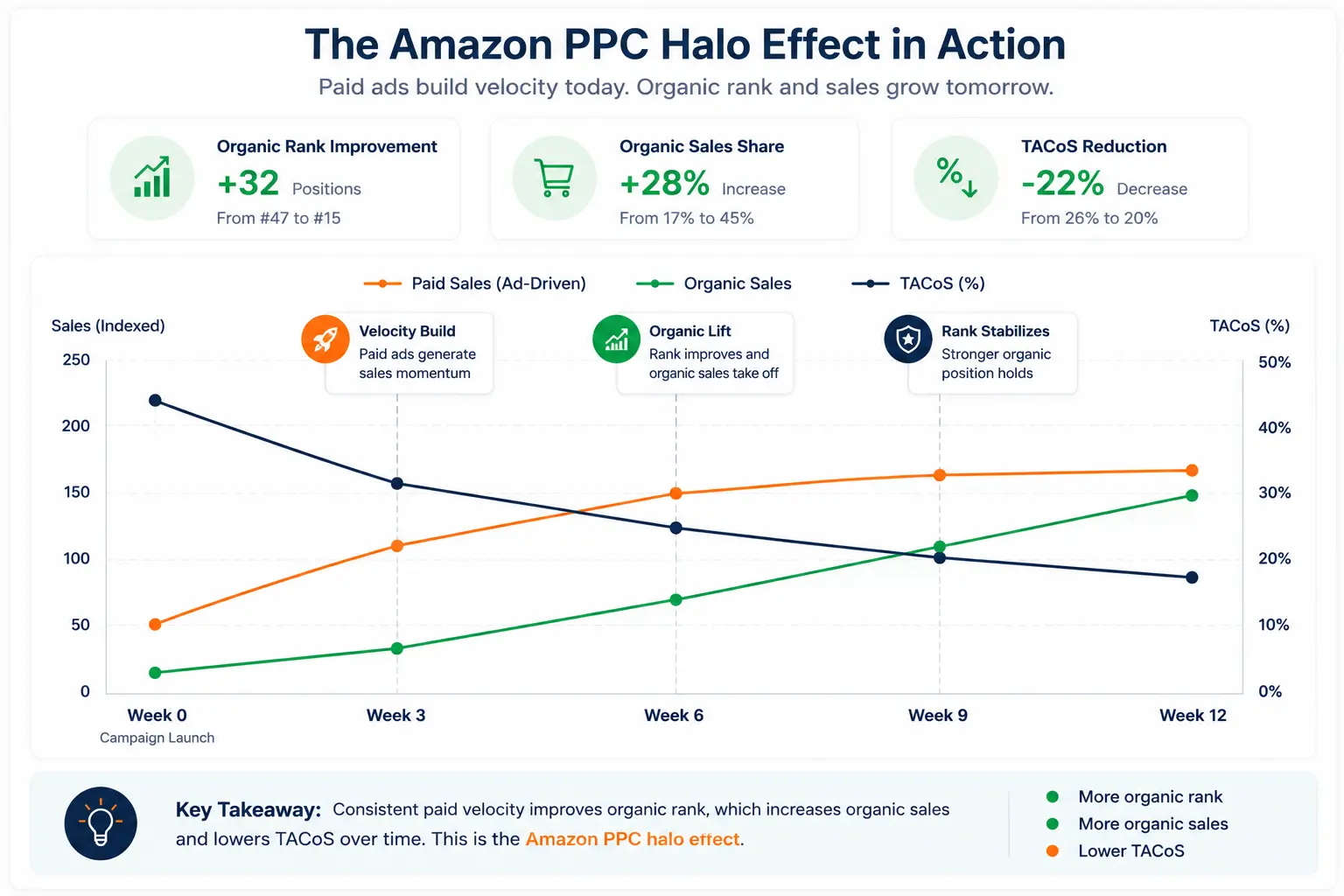
As the ads do their job, organic rank climbs and organic share rises. That rising organic share is the halo effect showing up in your own data, not a theory.
Once organic rank stabilizes near the top and holds for two to three weeks, ease spend back on that keyword and move the budget to the next flagship term. You are not turning ads off.
You are rotating the push to the next part of the wheel. Done right, your Total Advertising Cost of Sale (TACoS), which measures ad spend against total revenue including organic, drifts down over time even as revenue grows.
Here is the pattern in one illustrative view. The numbers below are a representative example for a single skincare serum keyword, not a specific client account, but the shape is what a healthy transfer looks like.
Rank climbs, organic share more than doubles, and the blended cost of your growth falls. That is a halo effect working as intended.
For most products in a moderately competitive beauty niche, expect measurable organic rank movement on a priority keyword within 30 to 45 days of disciplined spending, and genuine stability across a quarter.
Anyone quoting days is selling something.
The honest answer is that it depends on four things.
Competition on the keyword: a saturated term like "moisturizer" takes longer than a specific one like "ceramide moisturizer for dry skin." Your review base: a listing with 40 strong reviews converts and climbs faster than one with four. Inventory: a stockout mid-climb resets your momentum and can cost you the rank you paid to earn.
And your conversion rate: the higher it is, the less velocity you need to buy to move the needle. Beauty launches with a weak review base and a thin catalog sit at the slow end of that range. Established brands adding rank to a proven product sit at the fast end.
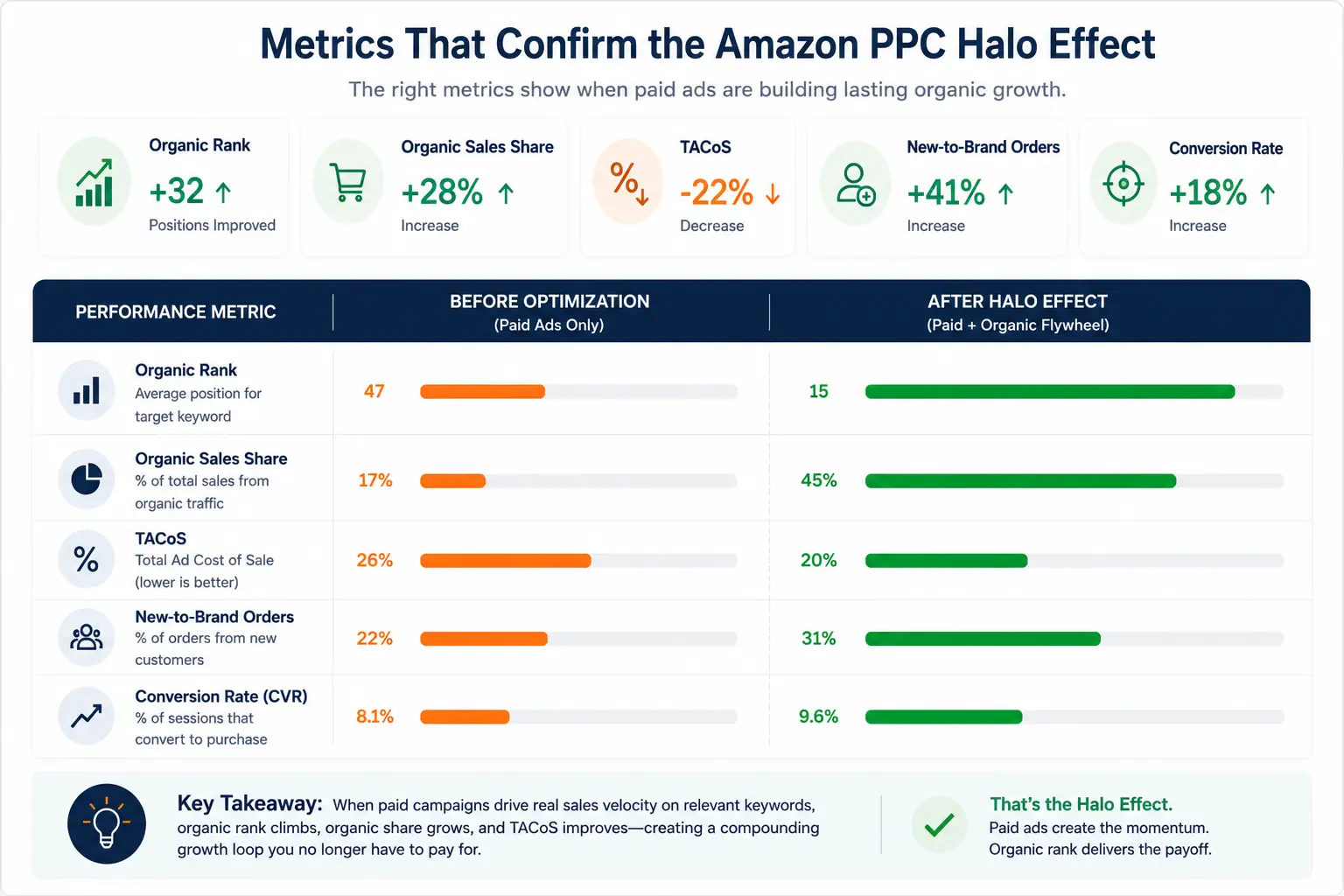
If you cannot measure it, you cannot defend the budget. Three numbers tell the real story, and two Amazon-native tools confirm it.
Total ACoS is the headline. When TACoS falls over several weeks while revenue holds or grows, your organic engine is carrying more of the load and the ads are doing their job.
When TACoS is flat or rising, the halo is not forming and something upstream (relevance, conversion, or keyword choice) needs a fix. Organic rank per flagship keyword is the second number, tracked weekly so you can see the transfer happen.
Organic sales share is the third, the clearest single proof that sales are shifting from paid to earned.
For teams that want to see the overlap between ad exposure and organic conversion in detail, Amazon Marketing Cloud (AMC) lets you analyze how paid touchpoints relate to eventual purchases across the customer path.
Pair it with Search Query Performance to see, keyword by keyword, whether your share of purchases is growing. Together they turn "the ads probably helped" into a documented account of what moved and why.
The failures are predictable, and every one of them is avoidable.
Cutting spend the moment ACoS looks high. The build phase is supposed to look inefficient. Pull the budget in week two and you kill the velocity before rank locks in, then blame the strategy.
Ignoring conversion rate. Brands pour budget into bids while the product page converts at two percent.
The traffic arrives, does not buy, and Amazon reads weak relevance. Fix the page before you scale the spend.
Running out of stock mid-climb. Nothing resets a hard-won rank like a stockout. In a repeat-purchase category, it also hands your reorder to a competitor.
Protect inventory on any product you are actively ranking.
Chasing the lowest possible ACoS. A very low ACoS often means you are only bidding on easy branded terms and starving the non-branded keywords that actually grow the brand.
Efficiency is a goal for mature keywords, not launch ones.
Skipping negative keywords. Without negatives, spend leaks onto irrelevant searches, which drags conversion data down and weakens the very relevance signal you are trying to build. Prune waste so your best keywords get the clean signal.
Spreading spend across everything. Ten keywords at a shallow depth move nothing. Three keywords at real depth move rank. Concentration is the whole point.
After enough accounts, a few things separate brands that build a durable halo from brands that just rent sales.
Patience beats cleverness. The mechanism is not complicated. The discipline to hold spend through the awkward build phase is where most teams fail. The ones who win decide the ranking budget in advance and treat it as an investment line, not a monthly panic.
Listing quality is not negotiable. In beauty, the page does the converting. You can buy every click on the search results page and still stall if the main image, the reviews, and the A+ Content do not close the sale.
The best ad account in the world cannot outspend a two percent conversion rate.
New-to-brand growth is the quiet compounder. Track NTB orders as closely as ACoS. In a repeat category, a first-time buyer today is organic revenue and Subscribe and Save income tomorrow.
Sponsored Brands earns its place here even when its ACoS looks less flattering than Sponsored Products, because it is buying customers, not just sales.
And know when the halo is not the right play. A product with poor margins, thin reviews, or unstable inventory should fix those first. Advertising into a leaky funnel accelerates the leak.
Honest strategists say so, which is exactly the kind of judgment a seasoned Amazon PPC agency is paid to bring.
The halo effect is not a hack. It is what happens when good ads meet a product that deserves to rank, measured with the patience to let the wheel turn.
Get the sequence right and each keyword you win makes the next one cheaper, until a meaningful share of your revenue arrives without an ad attached.
If you want a clear read on where your account sits and which flagship keywords are closest to tipping, start with a free Amazon PPC audit and build the plan from there.

Discover how to build organic rankings with a smarter Amazon PPC strategy that grows sales, reduces TACoS, and compounds over time.
See which keywords are closest to ranking with a 24-hour Amazon PPC Audit that reveals wasted spend and growth opportunities.

.png)
.png)


.png)
.png)