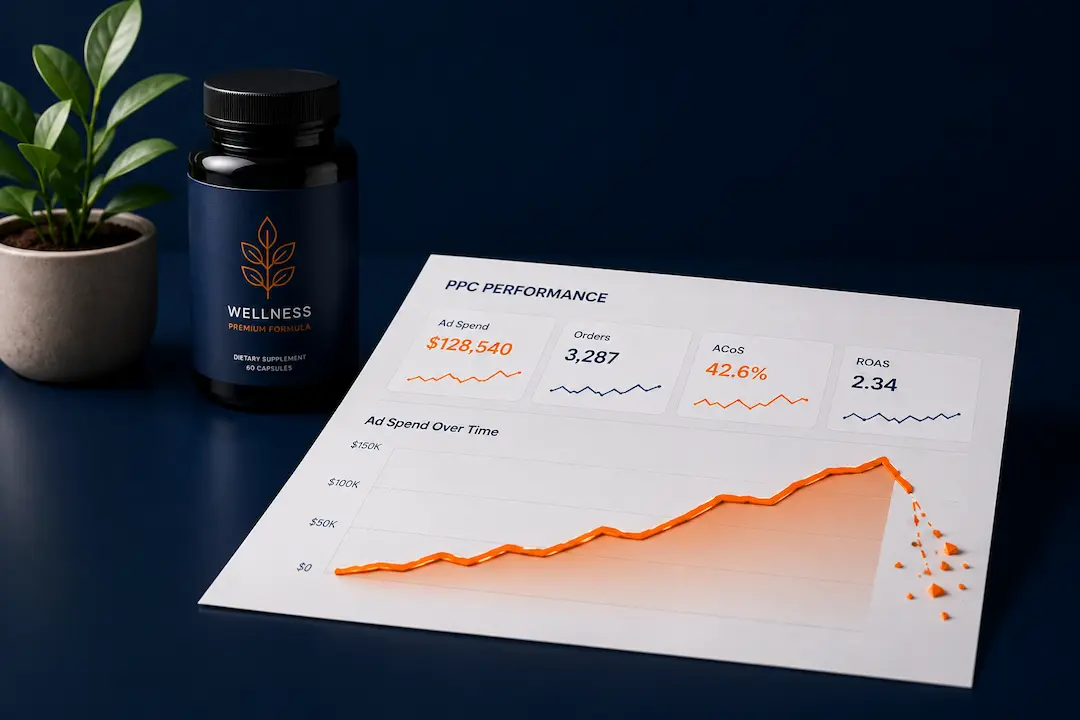
Why Wellness Brands Struggle With Amazon PPC Past $100K/mo
Read more
.png)
Biohacking brand PPC stalls because demand, not keywords, is capped. Shift from keyword bidding to category and ASIN targeting, AMC audiences, and off-Amazon demand to grow sales.
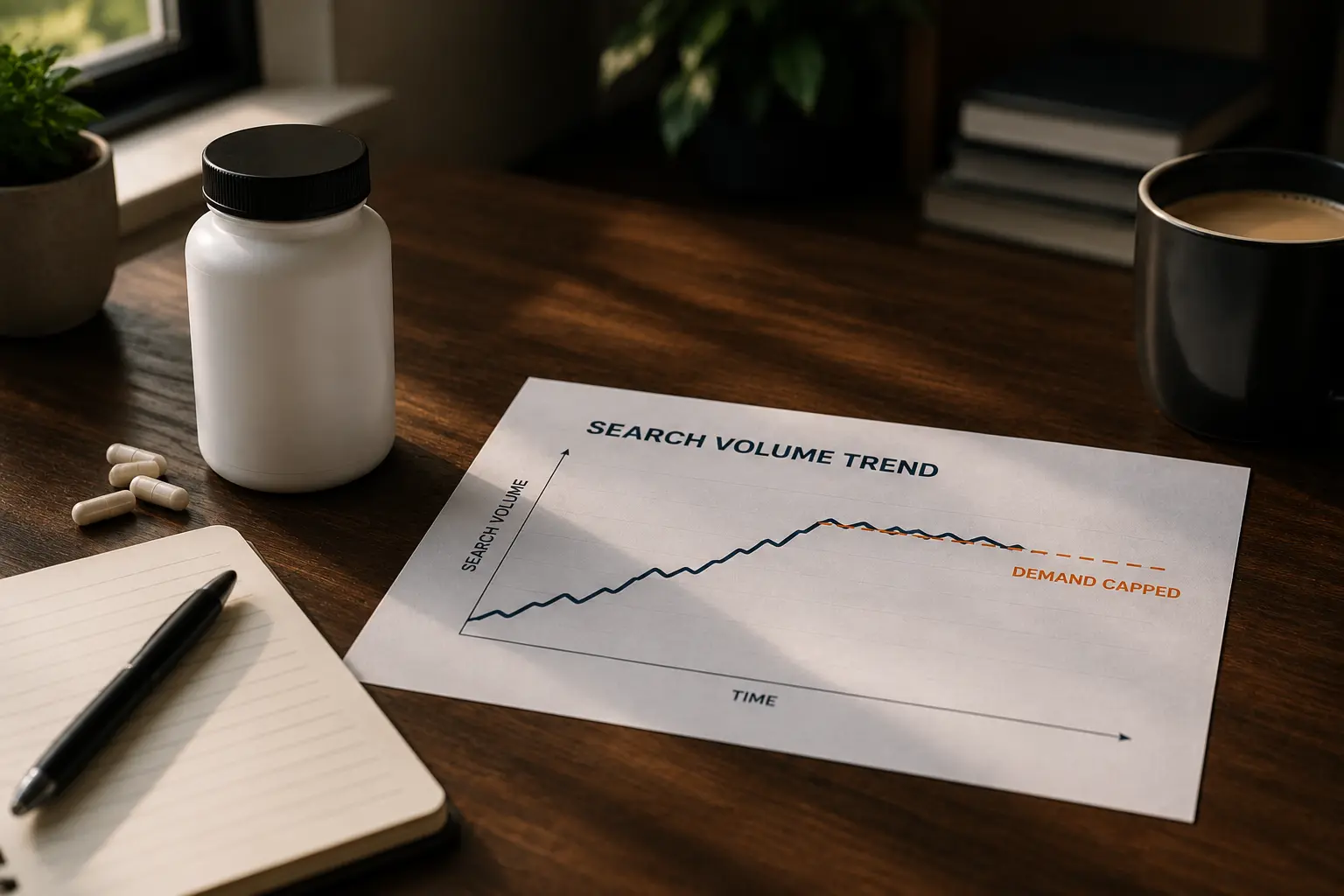
A framework for nootropic and longevity brands whose keyword pool is too thin to scale on Sponsored Products alone.
Most biohacking brands do not have a PPC problem. They have a demand problem wearing a PPC costume.
If you sell nootropics, longevity compounds, or functional supplements, you have probably watched it happen. Your keyword tool returns "no data" or a volume of 70.
Your bids creep up, your impressions sit still, and your advertising cost of sale (ACoS) climbs for no obvious reason. The instinct is to assume you are running the account wrong. Usually you are not.
You have simply hit the demand ceiling of a niche where few people search the terms yet.
This guide is for founders, growth leads, and in-house PPC managers at biohacking and supplement brands who feel that ceiling and want a real plan, not another "do keyword research" lecture.
We will cover why the ceiling exists, how to tell which problem you actually have, a five-move framework for capped-volume PPC, when Amazon DSP earns its place, and how to manufacture demand for a product the market has not learned to want.
Because the category is new faster than the search behavior is. Buyers do not search for ingredients they have never heard of, so your most differentiated products have the thinnest keyword pools.
The dietary supplements market is large and growing, projected to expand at roughly 9.5% a year through the early 2030s, and the nootropics segment faster still at around 12% annually, according to Grand View Research.
But that growth is concentrated in a handful of recognizable ingredients, with Lion's mane and L-theanine alone accounting for a large share of new launches.
So the category expands while search demand clusters around a few terms, leaving newer formulas with almost no keyword inventory to bid on.
This is the trap. Your generic terms ("nootropic," "focus supplement") are expensive and crowded with bigger brands. Your specific terms barely register in Search Query Performance (SQP) or Brand Analytics.
You are squeezed from both ends. The good news: a capped keyword pool does not cap your sales. It just means keyword bidding cannot be your only engine.
Demand capture means showing your product to people already searching for it.
Demand generation means creating the want in the first place. Capped-volume niches starve the first and reward the second.
Sponsored Products is a demand-capture tool, brilliant when shoppers type a term and you appear.
When few people type the term, it plateaus no matter how you bid, because pouring budget into a search nobody is running does not create searches. It just raises your cost per click (CPC) on the trickle that exists.
So before touching bids, answer one question honestly. Are you losing the searches that happen, or are the searches not happening at all? If competitors outrank you on terms with real volume, that is a capture problem you fix with better targeting and bids.
If the terms themselves are empty, that is a generation problem no bid strategy solves. Most biohacking brands have some of both, weighted heavily toward generation.
A quick way to diagnose it: pull a 30-day search-term report and sort by impressions. If your top terms deliver thousands of impressions but you sit in lower placements, you have headroom to capture and the fix is bids, creative, and conversion rate.
If your entire account scrapes together a few hundred impressions across every term, no amount of bidding rescues that.
The pool is the problem, which is why "raise your bids" advice has never worked here. You were given a capture tool for a generation problem.
You shift budget from keyword bidding toward placement-based and audience-based targeting, then build demand off-platform to feed it. Keywords become one input, not the whole account.
When the keyword pool is thin, three Amazon-native levers carry more weight than bidding harder on terms nobody searches.
Category targeting puts you on the product detail pages of an entire related category, which matters because it does not depend on search volume at all. It was built precisely for products that are not being searched yet.
Start category bids low and raise them only once a category proves it converts. Expect a higher ACoS at first, because you are casting wide.
Use that wide net to discover which specific ASINs convert, then graduate those winners into tight manual product-targeting campaigns where CPCs run lower and conversion runs higher.
That migration, from broad category to proven ASIN, is the single most reliable play in a capped niche.
One detail most guides skip: apply your competitor brand and your own brand as negatives inside the category campaign, so you are not paying to sit next to products you cannot beat.
Refinement filters tighten this further: show your ad only on products priced above yours or rated below 4 stars, and you concentrate spend where your offer wins on the merits.
ASIN targeting places you beside specific rival products where you have a clear edge on price, rating, or review count.
CPCs run lower than category targeting and conversion runs higher, because the shopper is already looking at a product like yours.
Prioritize competitors priced above you, rated below 4 stars, or carrying fewer reviews, since those are the comparisons you win. A structured competitor analysis is how you build that target list systematically rather than by guesswork.
Audience targeting through Amazon Marketing Cloud (AMC) lets you reach shoppers by behavior rather than by the words they type.
You can build audiences from people who viewed your detail page, bought a complementary product, or match the profile of your existing converters, then activate them through Sponsored Display or DSP.
This is how you keep growing once both keywords and category placements are tapped.
Here is the sequence we run for biohacking and supplement brands facing a thin keyword pool. Run the moves in order.
Notice that total advertising cost of sale (TACoS), not campaign ACoS, is the number that tells the truth here.
When external demand works, your organic sales rise and TACoS falls even if a single campaign's ACoS looks high.
You can model both against your margin with our ACoS and TACoS calculator.
Sometimes, but not first. Amazon DSP earns its place once your total Amazon ad spend is healthy enough that a retargeting layer adds reach without starving your Sponsored Ads. Below that, it becomes an expensive dashboard.
The honest threshold operators use: if total monthly Amazon ad spend sits roughly between $40K and $75K, a self-service DSP slice of $5K to $10K can pull its weight as 10 to 15% of spend.
The most reliable starting use case is narrow: retargeting shoppers who visited your product detail page and did not convert. That audience is warm, finite, and cheap to win back.
DSP's real value lives in AMC, where you build lookalikes from your converters and time retargeting to the reorder cycle.
One supplement case saw returns climb sharply after switching from broad in-market targeting to AMC-seeded lookalikes. But AMC without activation is just a report, and DSP without AMC is just a media buy.
If you cannot staff the analysis or hire it, hold off.
The decision is about operating maturity, not curiosity, and the same sequencing logic runs through our supplement-brand PPC strategy at the next tier up.
You build awareness off Amazon so people start searching, then capture that new search on Amazon. External traffic is the only lever that adds demand rather than splitting the demand that already exists.
This is where biohacking brands have an unfair advantage, and most waste it. The audience lives on podcasts, in longevity newsletters, in Reddit threads, on YouTube.
Send that traffic to your listing and two things happen: you make sales, and you teach Amazon's algorithm that your product converts, which lifts your organic rank and then lowers the ACoS on the paid side.
It is a loop, not a line, and the mechanics are covered in our guide on how Amazon PPC drives brand discoverability.
The new-to-brand (NTB) metric is your scoreboard here. In a capped niche, growth comes from new buyers, not from re-selling the same small pool. Watch your NTB rate and your incremental lift, not just blended ROAS.
A campaign that looks expensive on ACoS but drives a high NTB rate is often your most valuable one, because it is enlarging the market you get to capture later.
There is a compounding effect worth naming. The first time an influencer or newsletter sends a wave of buyers to your listing, Amazon reads the spike in conversion and sales velocity as a relevance signal, and your organic rank on the few terms that do exist climbs.
Now your Sponsored Products ads on those terms cost less per sale, because your listing is already ranking. The paid and organic sides stop competing and start reinforcing each other, a loop brands that only ever run on-Amazon ads never trigger.
One caution specific to this category. Supplement claims are regulated. The FDA draws firm lines around what you can say about structure, function, and disease.
Your off-Amazon demand generation has to respect those lines, because a compliance problem off-platform becomes an account problem on-platform fast.
Vet your affiliate and influencer language the same way you vet your own listing copy, since Amazon can and does act on claims made about a product anywhere.
The expensive errors are rarely dramatic. They are small, repeated, and invisible until you look.
The most common is treating low volume as a keyword-research failure and chasing ever-broader head terms, which just buys clicks from shoppers who do not want your product.
Another is judging every campaign by ACoS in isolation, which punishes the demand-generation campaigns doing the real work.
Many brands abandon category targeting after a week because the early ACoS looks ugly, before it has surfaced the converting ASINs.
Some forget branded defense and hand competitors a cheap path to their customers.
And plenty pour money into DSP before they have the spend base or AMC capability to use it, then conclude "DSP does not work" when the issue was timing.
The quietest mistake of all: going silent off Amazon. If you only capture demand and never create it, the ceiling is permanent by design.
A few moves separate brands that plateau from brands that climb.
Mine your competitors' reviews, not just their keywords, since the phrases buyers use to praise or complain about rival products are your next long-tail terms and ASIN targets.
Target adjacent categories where your buyer already shops (sleep, focus, recovery), not only your obvious one.
Set Rule-Based Bidding toward a target ACoS on proven terms so the account self-corrects while you focus on demand generation.
And lean on Sponsored Brands Video, which earns outsized engagement in education-heavy categories where buyers need to understand a novel ingredient before they trust it.
Above all, measure at the account level. Share of voice and impression share on the terms that do exist tell you whether you are winning your small pond.
TACoS tells you whether your off-Amazon work is compounding. Those two numbers together are worth more than any single campaign's ACoS.
The ceiling is real, but it is not the end of growth. It is the signal to change engines, from buying the searches that happen to building the searches that should.
Brands that make that shift early stop competing for scraps of existing demand and start owning the demand they create.
If you want a second set of eyes on where your capped-volume account is leaking budget or stalling on demand, Amplivus runs a free PPC audit built for this niche, or you can book a strategy session to map the next move.

When keyword demand is capped, smarter targeting wins. Book a strategy call to uncover new Amazon PPC growth opportunities.
Hit a search volume ceiling? Get a 24-hour Amazon PPC audit that uncovers new growth opportunities beyond keyword bidding.


.png)
.png)


.png)
.png)