
How Amazon Brands Scale Past $100K/mo With PPC
Read more
.png)
Q4 ACoS spikes for sleep brands as more advertisers crowd the auctions, lifting CPC faster than conversion. Pre-plan bids and budgets to protect margin.

Why holiday demand quietly eats sleep-brand margin, and the month-by-month plan that protects it.
Here is the trap most sleep brands fall into. You sell more mattresses in December than any other month, your top-line revenue looks great, and then you close the books and profit is thinner than October.
The culprit is rarely your product or your listing. It is an Amazon PPC Q4 strategy for sleep brands that was never built, so the holiday auction quietly ate the margin.
This guide is for mattress, pillow, bedding, and sleep-aid brands that already advertise on Amazon and feel the Q4 squeeze.
You will get the actual mechanism behind rising ACoS, real 2026 category benchmarks, and a month-by-month plan you can run before the next Prime Big Deal Days, Black Friday, and Cyber Monday.
The goal is simple: more units sold without giving back the profit.
ACoS rises in Q4 because cost per click (CPC) climbs faster than your conversion rate does.
More advertisers enter the same keyword auctions during peak, the clearing price for each click goes up, and unless a higher share of those clicks convert, your Advertising Cost of Sale inflates by simple math.
Walk the chain slowly, because the cause matters more than the symptom. Advertising Cost of Sale is ad spend divided by ad revenue, and your ad spend is roughly clicks multiplied by CPC.
When the holiday rush pulls thousands more shoppers and competitors into "memory foam mattress" or "cooling pillow," the second-price auction that sets your CPC has more bidders pushing the price up.
You pay more for the same position.
Conversion rate is the only lever that offsets that. Peak shoppers do buy at higher rates, gifting intent is strong, and deal-seekers are primed to purchase. But for sleep products the lift is capped.
A mattress is a considered, high-ticket purchase, and furniture and high-ticket home items convert in the 3-5% range, well below the 8-15% you see on impulse categories.
So your CPC can jump 25% while your conversion rate nudges up 5%, and ACoS climbs anyway. That is the part competitors skip.
The spike is not a sign your account broke. It is the predictable output of an auction with more money in it and a category that cannot convert its way out of the cost increase.
Once you see it that way, the response shifts from panic to planning.
Expect peak CPCs to run roughly 20-30% above your baseline in home and sleep categories, with gifting-heavy terms sometimes higher.
Average Amazon CPCs sat near $1.12 in 2025 and are tracking toward $1.18 to $1.25 in 2026, and Home & Garden advertisers already pay above the blended average before any seasonal lift.
The numbers worth anchoring to, pulled from 2026 benchmark data: the average advertising account runs around a 32% ACoS, with most accounts landing between 25% and 36%.
Home & Garden specifically shows an average CPC near $1.52 and a typical target ACoS of 25 to 35%, reflecting a crowded, higher-cost market.
The scale of that ad spend is visible in Statista's Amazon advertising data, and it only rises into peak.
Now layer the season on top. Q4 and Prime events push CPCs 20-30% higher in most categories, and some sources track even steeper jumps in electronics and toys. For a sleep brand, a $1.50 baseline click can realistically become $1.85 to $2.00 during Cyber Week.
If your break-even ACoS is 35% and your blended margin leaves little room, that single move can tip profitable campaigns into the red.
You can model your own break-even against margin with our Amazon ACoS and TACoS calculator before peak.
Here is the practical read.
Do not benchmark your November ACoS against your category's annual average. Benchmark it against your category's peak-adjusted number, then judge profit on Total ACoS (TACoS), which folds organic sales into the picture.
A 40% ad ACoS during Black Friday can still be healthy if the halo of organic and new-to-brand orders pulls TACoS down to something you can live with.
Start in August. The brands that protect margin do their structural work before CPCs inflate, because building organic rank in September costs a fraction of buying visibility in late November.
Treat the calendar as the strategy, not the tactics list.
The fixed 2026 anchor dates: Black Friday is November 27 and Cyber Monday is November 30, with Prime Big Deal Days expected in early-to-mid October (confirm Amazon's announced dates).
Everything below counts backward from those.
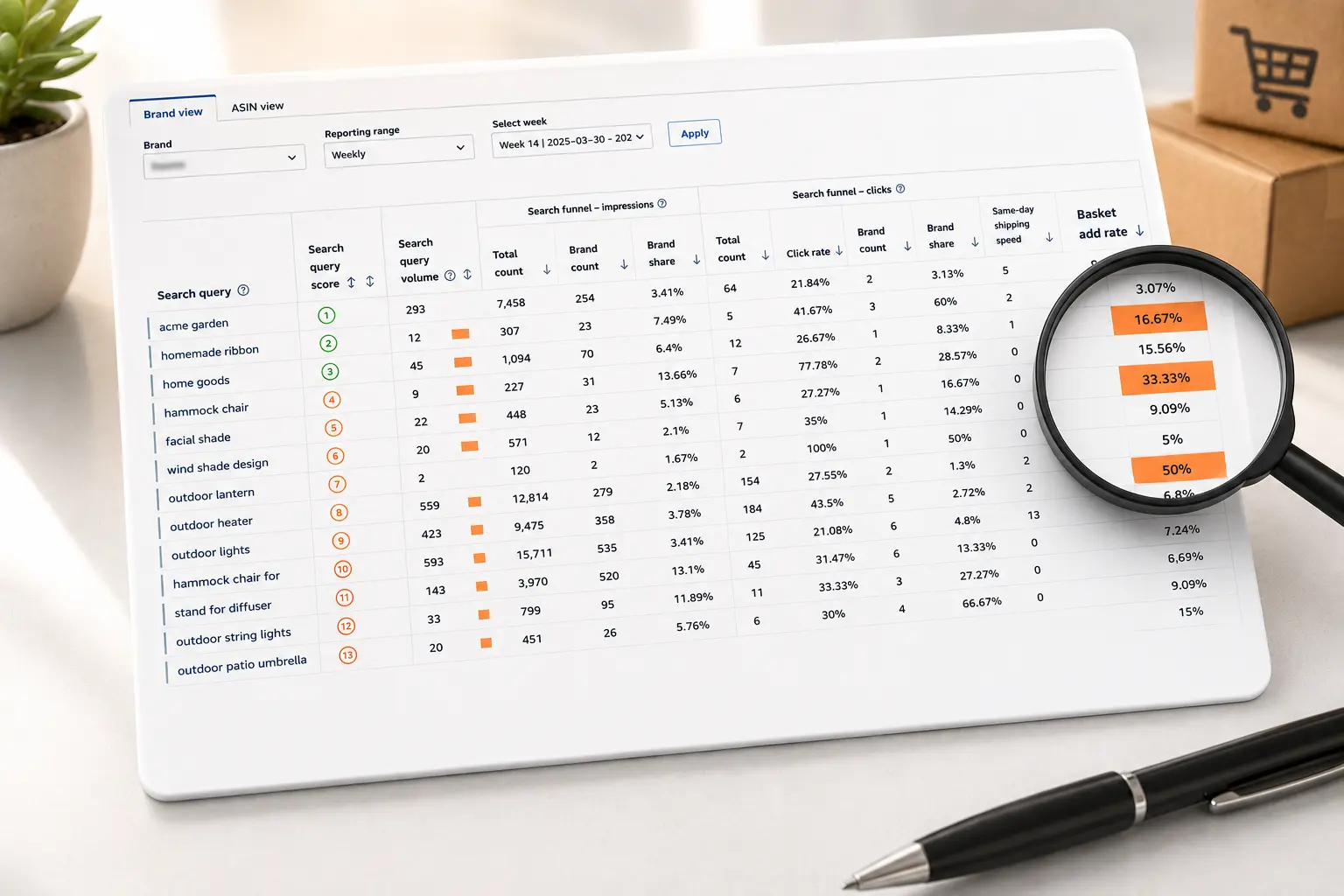
Audit account structure, tighten your negative keyword lists, and harvest converting search terms from Search Query Performance (SQP) and the search-term report.
Our guide on how to read your SQP report shows where to find them.
Push your best terms into dedicated exact-match campaigns now so they earn organic rank before the auction heats up.
Confirm inventory forecasts with your supply team, because the fastest way to waste Q4 ad spend is to advertise a product that sells out mid-event.
Run Sponsored Brands Video and any new creative while clicks are still cheap. Establish clean baselines for CPC, conversion rate, and ACoS by campaign so you can detect the seasonal delta rather than guess at it. Lock in inventory buffers for your hero ASINs.
One to two weeks before Prime Big Deal Days, set Amazon budget rules to lift daily budgets automatically, and stage your bid increases.
Many operators raise bids 25 to 50% on priority terms during event days; decide your ceilings now, in a calm room, not at 6 a.m. on event morning.
Hold your bid ceilings, let budget rules pace the spend, and watch share of voice on your top 10 terms daily. Resist the urge to chase every impression.
The goal is profitable presence, not maximum presence. For a deeper event-week checklist, Amazon's own advertising library is worth reading alongside this plan.
Protect margin by setting bid ceilings and budget rules before the event, then managing to Total ACoS instead of daily ACoS.
The brands that hold profit decide their maximum acceptable cost per click in advance and let automation enforce it, rather than reacting emotionally to a scary dashboard.
Three controls do most of the work.
Bid ceilings tied to break-even. Calculate your break-even ACoS from product margin, then set bid ceilings so even a peak CPC keeps priority terms inside profitability.
Rule-Based Bidding (target ACoS or target ROAS) can hold the line automatically during volatile event days, which beats manual edits when the auction is moving hourly.
Budget rules, not blank checks. Use Amazon's scheduled budget rules to raise daily caps 2 to 3x for the event window and drop them back afterward.
This prevents the classic failure where a campaign exhausts its budget by noon and goes dark during peak afternoon traffic, ceding the auction to competitors for the rest of the day.
Manage to TACoS. During peak, daily ACoS will look high and that is fine. What matters is whether total profit grew. Watch Total ACoS, new-to-brand (NTB) order share, and contribution margin.
A higher ad ACoS that drives a wave of new-to-brand customers and organic halo can be the most profitable November you have, as long as you measured the right number.
This is the same discipline that separates real scaling from vanity revenue in our guide on scaling Amazon PPC past $100K a month.
For sleep brands, Sponsored Brands Video and tightly targeted Sponsored Products carry peak season, supported by dayparting and audience data from Amazon Marketing Cloud (AMC).
Video earns disproportionate attention for considered purchases like mattresses, where shoppers want to see the product before committing. A few tactics punch above their weight in this vertical.
The brands that treat Q4 as a creative and data problem, not just a bidding problem, tend to come out ahead.
The single most expensive mistake is pausing campaigns when ACoS spikes.
Cutting ads mid-peak surrenders the organic rank you spent months building and hands the auction to competitors at the exact moment demand peaks.
ACoS looking ugly is not a reason to go dark; it is a reason to check your TACoS. Other recurring errors:
Each of these is avoidable with a plan written before the season, which is the entire point of pre-planning.
After Cyber Monday, CPCs and ACoS gradually normalize as competitors pull back and shopper volume falls, usually settling toward baseline through December and January.
This cooldown is an opportunity, not just a relief. Two moves matter most in the aftermath.
First, harvest. The peak generated a mountain of search-term data and a cohort of new-to-brand customers.
Pull your best-converting holiday terms into dedicated campaigns and add the noise to negatives, so January spend works harder than November spend did. Second, re-baseline.
Reset bids and budgets back to off-peak levels deliberately, rather than letting elevated event settings bleed into Q1 and quietly overspend.
There is also a retention play. Sleep brands acquire a lot of first-time buyers in Q4.
Use Sponsored Display and AMC audiences in January to re-engage them with complementary products (pillows for mattress buyers, sheets for pillow buyers), turning a one-time gift purchase into a repeat customer at a far lower acquisition cost.
The brands that win Q4 are not the ones who bid the hardest in November. They are the ones who planned in August, protected margin through the peak, and harvested the data in January.
If that sounds like more than your team can run alongside everything else, an outside Q4 PPC audit before September is the cheapest insurance you can buy.
As an Amazon PPC agency, Amplivus builds these seasonal plans for sleep and home-goods brands. Start with a free PPC audit, or book a strategy session while clicks are still cheap.

Holiday CPCs rise every year. Book a strategy call to build a profitable Q4 Amazon PPC plan before peak-season competition drives costs higher.
Avoid costly Q4 PPC mistakes. Get a 24-hour Amazon PPC audit with a clear action plan to protect margin before holiday CPCs surge.
.png)
.png)


.png)
.png)