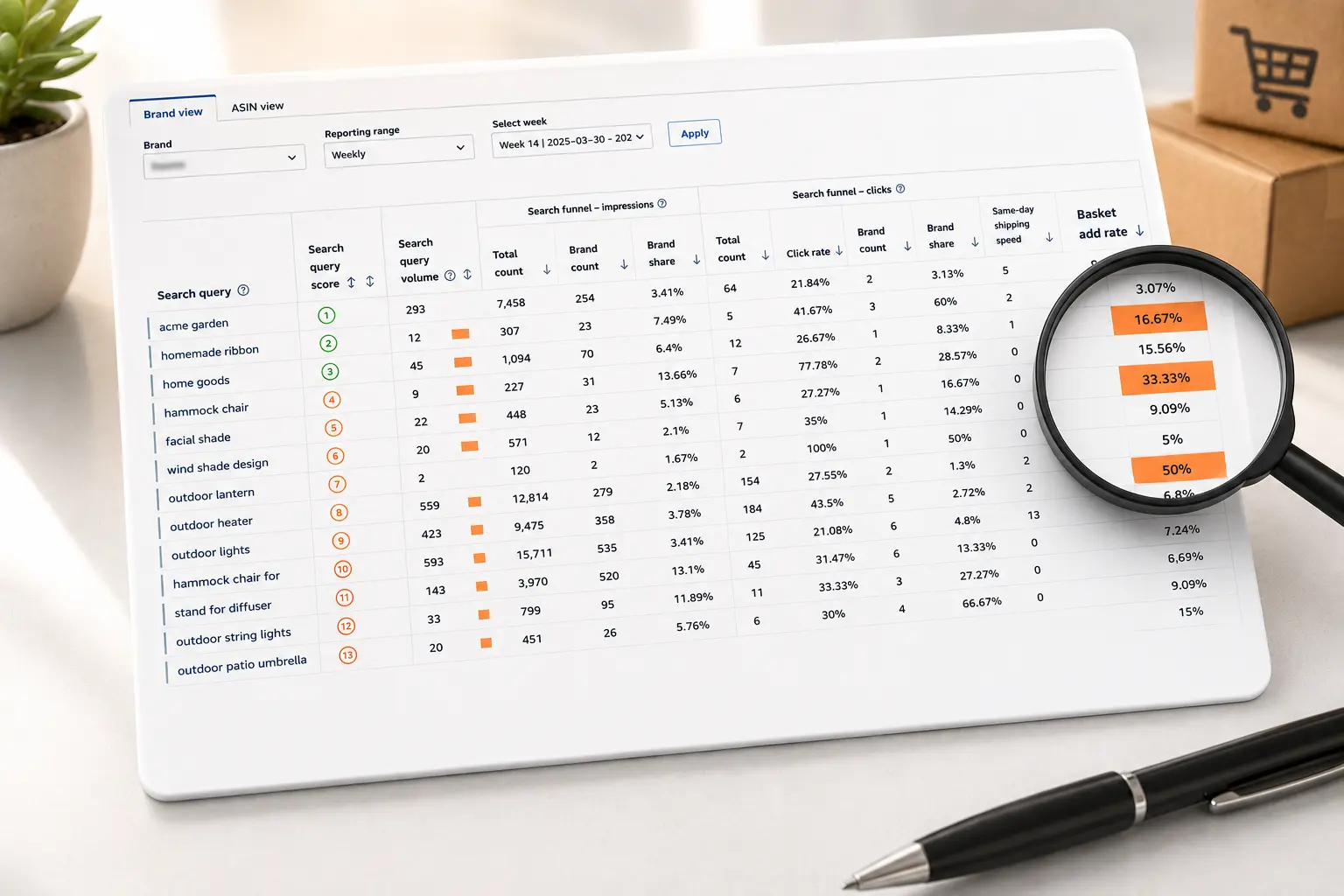
How Amazon Brands Scale Past $100K/mo With PPC
Read more
.png)
Wellness brands stall on Amazon PPC past $100K/mo when saturation, branded-search waste, low incrementality, and compliance push ACoS above sales growth.
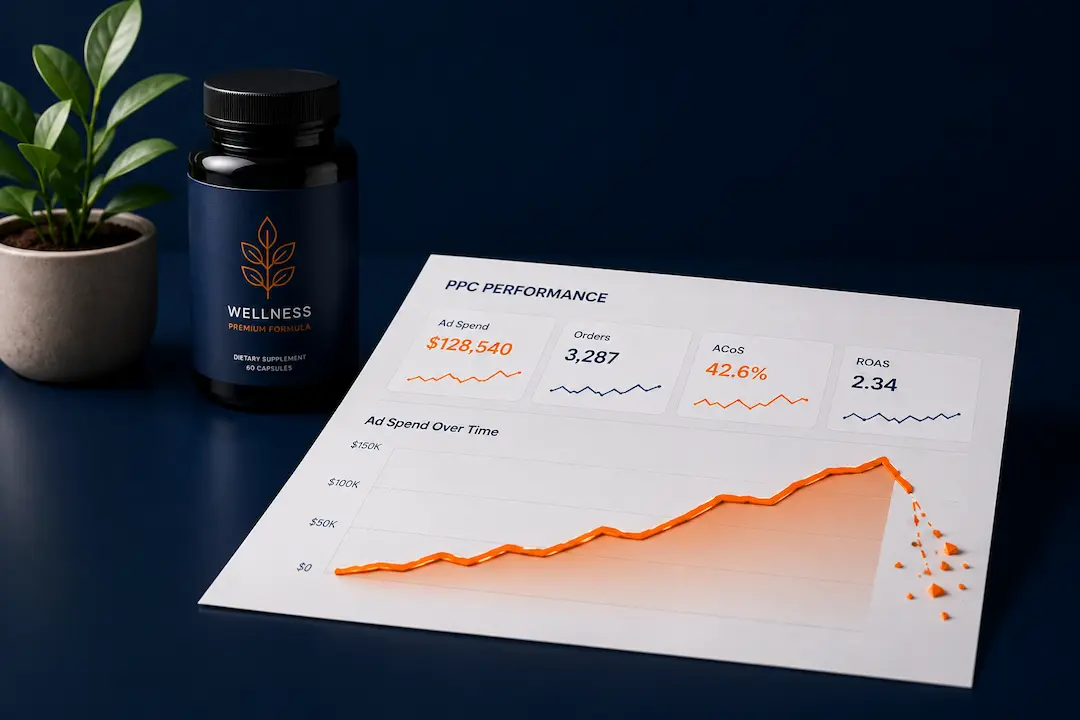
A diagnostic guide for supplement and wellness operators whose Amazon ads stopped scaling profitably between $100K and $500K a month.
Most supplement brands do not hit a wall on Amazon. They hit a slope.
Revenue keeps climbing, but every extra dollar of ad spend buys a little less than the last one did. ACoS creeps from 24% to 31% to 38%. Profit thins.
The founder, who scaled cleanly from launch to $100K a month, suddenly feels like the playbook broke. It did not break. The math underneath it changed, and almost nobody warns you when it does.
This guide is for founders, CMOs, and ecommerce leads running wellness brands between roughly $100K and $500K a month on Amazon. If you are still finding cheap keywords and growing without watching margin, you are not here yet.
If your spend is up and your growth is flat, this explains why, names what is breaking, and gives you a way to scale Amazon PPC for wellness brands without lighting your margin on fire.
The numbers below come from patterns we see repeatedly across supplement accounts we audit at Amplivus.
Amazon PPC gets more expensive at scale because of diminishing returns.
Your first ad dollars chase the cheapest, highest-intent searches. Once those convert as well as they ever will, the only way to spend more is to bid on worse traffic: broader terms, lower intent, higher cost per click.
Think of your keyword universe as a pond. Early on you are catching fish in clear, shallow water.
The terms are specific, the shopper already wants what you sell, and conversion is high, which is why launch-stage ACoS looks great.
As you scale, you fish out the easy water and wade into murkier terms, where shoppers are comparing, browsing, or only loosely related to your product. Cost per click rises, conversion drops, and ACoS climbs even though you are "doing the same thing."
This is keyword saturation, and supplements feel it harder than most categories. The category is crowded, cost per click is high, and many of the best terms are shared by dozens of brands selling magnesium, ashwagandha, or electrolytes.
Once you own your slice of the high-intent terms, incremental spend pushes into traffic that was always going to convert worse.
The trap is reading this as a tactics problem.
Founders respond by raising bids, adding keywords, and launching more campaigns, which increases spend against the same saturated pool and accelerates the ACoS climb.
The plateau is an economics signal, not a sign you optimized wrong, and it is the same wall covered in our guide on how to scale Amazon PPC past $100K a month.
A healthy supplement brand usually runs ACoS in the low-to-mid 20s at launch and accepts a higher blended ACoS as it scales, as long as total advertising cost of sale (TACoS) stays inside the margin.
There is no universal "good" number. A supplement with 60% margins survives a 40% ACoS that would bankrupt a thin-margin accessory seller.
Here is the directional pattern typical of supplement accounts at each tier.
Treat it as a calibration guide, not a guarantee, and validate against your own margins.
Notice the story the table tells. ACoS rising as you scale is normal.
The question is whether TACoS stays under your contribution margin. ACoS measures only the sales the ads claimed, while TACoS measures ad spend against all sales, including the organic and repeat orders your brand earns anyway.
When TACoS climbs while revenue flattens, your ads are buying sales you already had.
Wellness sits among the higher-CPC categories on Amazon, a scale visible in Statista's Amazon advertising data, which is exactly why TACoS discipline matters more here, and why our supplement-brand PPC strategy guide leans on it so hard.
Four things break, and they tend to break together. We call them the Four Ceilings. Naming them is half the fix, because each one has a different lever.
You have already captured the high-intent terms. New spend buys lower-intent traffic at higher cost. The lever is targeting precision and search term harvesting, not more budget.
As your brand grows, more people search your name. Bidding on them feels safe, but much of that spend captures sales you would have won organically.
The lever is measuring incrementality, not defending every branded click.
Past a point, ads start "capturing" demand instead of creating it. Your reports look busy, but few of those sales are genuinely new.
The lever is Amazon Marketing Cloud, which lets you compare exposed and unexposed audiences and see which campaigns drive real incremental sales.
Supplement rules restrict the claims you can make, which restricts the keywords you can bid on. Your usable keyword pool is smaller than a supplement-free category's, so you saturate faster.
The lever is creative and audience expansion through Sponsored Brands Video and DSP, not keyword brute force. Most stuck brands are fighting one ceiling while three others quietly drain profit.
Branded search eats budget because it bills you for shoppers who were already coming to buy. When someone searches your exact brand name, they usually intend to purchase.
If your organic listing would have won that sale anyway, the ad spend on it is not incremental. It is a tax you are paying to claim a sale you already had.
A modest amount of branded defense is reasonable, especially if competitors bid on your name, and a proper competitor analysis tells you whether that is happening.
But it is common for a meaningful share of "profitable-looking" branded spend to produce little real lift.
The tell is a falling new-to-brand (NTB) percentage: more spend, fewer genuinely new customers.
Brand Registry and Search Query Performance help you separate brand-name traffic from category traffic so you can size this honestly, a method our guide to branded traffic cannibalization in SQP walks step by step.
The fix is not zero branded spend. It is measuring whether each branded campaign actually adds sales you would have lost otherwise.
Compliance rules shrink the pool because you cannot legally or platform-permissibly target many of the highest-intent health terms.
The FDA's rules on supplement labeling and claims prohibit disease and treatment claims, and Amazon enforces parallel restrictions in ad copy and targeting.
A search like "cure anxiety" or "lower blood pressure" may convert beautifully, but you cannot build campaigns around it.
That smaller permissible pool is why supplement brands saturate faster than, say, a kitchen-gadget seller.
You reach the edge of the legal, high-intent terms sooner, then spend pushes into broad or loosely related searches.
Third-party certification adds nuance: an NSF International certified-for-sport mark can open trust-based and audience-based angles that pure keyword targeting cannot, which is one reason creative and audience expansion matter more in wellness than in unrestricted categories.
This is the single most overlooked cause of the supplement plateau, and almost no competing article connects compliance to the keyword pool at all.
Amazon DSP and Amazon Marketing Cloud (AMC) become worth it once repeat purchase, not the first sale, drives your unit economics.
Wellness is a refill business. If a customer reorders magnesium every month, the real value is lifetime value, and Sponsored Products alone cannot model or target that.
A practical rule of thumb (ours, not an Amazon requirement): once you are spending more than roughly $15K to $25K a month on Amazon Ads and your category has genuine repeat purchase, the DSP and AMC layer often starts to earn its place.
Amazon DSP access and minimums vary by self-serve versus managed service, so check current terms in your account.
AMC is the analysis engine, and Amazon has been expanding free querying and longer lookback windows in AMC, which makes incrementality and repeat-purchase modeling cheaper to run than it was; confirm the current terms in your own account before you plan around them.
You can build custom audiences from those queries and activate them in DSP to reach lapsed buyers and high-LTV lookalikes that search ads never touch.
Below that spend level, DSP is usually a distraction. Fix structure and incrementality first.
The goal is not lower ACoS for its own sake. The goal is profitable growth, measured by TACoS against margin. Here is the sequence that works, and it must run in order.
Skipping to step five before fixing step one is how brands spend more and earn less. Running the full sequence is the backbone of our Amazon PPC management for wellness accounts.
The most common mistake is treating a structural plateau as a bidding problem and responding by raising bids, which pours money into the saturated pool and speeds the ACoS climb.
A close second is judging the account on ACoS alone, since ACoS hides branded waste and ignores organic and repeat sales while TACoS tells the truth.
Third is over-defending branded search out of fear, which converts free sales into paid ones. Fourth is ignoring compliance as a strategic constraint instead of a legal footnote, which leaves brands brute-forcing a keyword pool that is smaller than they think.
Fifth is launching DSP too early, before the search account is clean, then blaming DSP when the numbers look ugly. None of these are beginner errors.
They are the mistakes capable operators make precisely because the early playbook worked so well.
Sometimes the honest answer is to stop pushing spend.
If your TACoS already sits near your contribution margin and incrementality is low, adding budget destroys profit to buy vanity revenue.
In that case the right move is to hold spend flat, fix structure, improve conversion rate on the listing, and grow through new products or subscription depth instead of more ads.
Scaling ad spend is only one growth lever, and on Amazon it is rarely the cheapest one past six figures.
A brand that protects margin and compounds repeat purchase usually beats a brand that chases top-line revenue at a 45% TACoS. The plateau is not a failure. It is the moment the game changes from acquisition speed to acquisition efficiency.
Brands that read it that way scale past it, and brands that keep raising bids stall there for years.
If you want a clear read on which of the Four Ceilings is costing you the most, Amplivus runs a free PPC scaling audit built to surface it in your own account data, or you can book a strategy session to walk it together.

Discover whether keyword saturation, branded waste, compliance limits, or low incrementality is stalling growth.
Find which scaling ceiling is hurting growth. Get a 24-hour Amazon PPC audit focused on TACoS, waste, and margin.