The Amazon PPC Halo Effect: How Beauty Brands Turn Ad Spend Into Organic Rank
Read more
.png)
Cooking brand PPC lifts organic rank through sales velocity, but taper paid on terms you already rank for so you stop paying for sales you would win free.
Summarize in ChatGPT
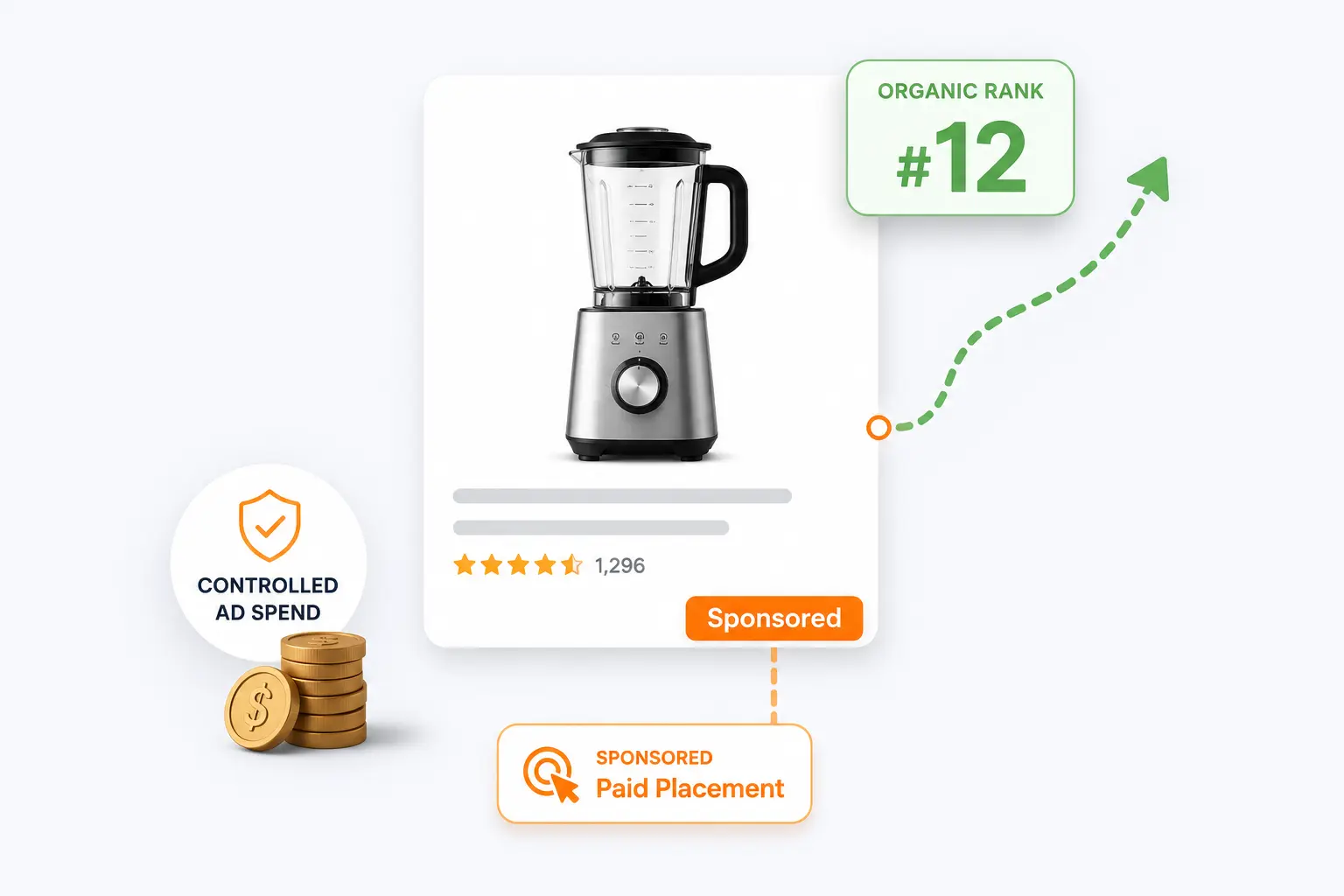
There are two true statements about Amazon PPC that sound like they contradict each other. The first is that paid ads build organic rank, so spending helps you earn free sales later.
The second is that paid ads can cannibalize organic sales, so spending pays for sales you would have won for free. Both are true at once, and the whole art of running PPC for a cooking brand is knowing which one is happening on each keyword.
This guide is for cookware, bakeware, cooking tool, and kitchen consumable brand owners and Amazon managers who already run ads and want their spend to build durable rank rather than quietly rent sales they already own.
You will learn how the flywheel actually works, where the cannibalization trap hides, and how to measure the difference so every dollar is either acquiring a new customer or building a position you keep. It applies the mechanism in our Amazon PPC halo effect playbook to the specific economics of the cooking aisle.
Start with the mechanism, because it governs everything. Amazon's search ranking rewards products that convert a search into a purchase, so a listing that sells reliably for a query is, by definition, a relevant result to show higher.
Paid clicks feed that record: a sale is a sale, whether the shopper arrived through a Sponsored Products ad or an organic link, and all of it counts toward the sales history that decides your position.
Concentrate paid sales on a keyword your product genuinely fits, and organic rank for that keyword tends to follow.
That transfer, from paid velocity to earned position, is the halo effect, and it is the same flywheel logic Amazon has run its whole business on: small pushes that compound into momentum.
Cooking brands get an extra turn of the wheel that many categories do not.
The purchase is often repeat-friendly, a good pan earns a second and third product from the same household, and the category is review-driven, so early paid sales build the review base that lifts conversion for everyone who lands on the page later.
The US cookware market keeps growing, which means more buyers behind every keyword you can rank for, so a position earned in cooking is a position in front of a lot of shoppers.
Each turn of the wheel strengthens the listing itself, which makes the next turn cheaper.
The relevance rule is what keeps this honest. Ads only lift rank when the shopper's search, your keyword, and your product actually match.
Buy clicks on a term your listing does not deserve and you get the worst of both worlds: money spent, a weak conversion rate, and a relevance signal that tells Amazon to leave you where you are.
So the flywheel is not a volume trick where more spend automatically buys more rank. It is a relevance amplifier that rewards concentrated spend on the terms your product genuinely fits, and punishes scattered spend on terms it does not.
For a cooking brand with a wide catalog, that means picking the flagship keywords each product deserves to win and funding those, rather than spreading a thin budget across every term a broad campaign happens to surface.
Here is the part the flywheel story leaves out. If your product already ranks number one organically for a term, and you also bid on that term, a large share of the shoppers who click your ad would have found and bought you anyway through the organic result directly below it.
You paid for a sale you already owned. That is cannibalization, and it hides inside a "good" ACoS, because the sale looks efficient on paper while the truth is you spent money to move a customer from a free channel to a paid one.
Cooking brands are especially exposed to this for two reasons. First, they often build strong organic rank on branded and long-tail terms, so a lot of their easiest ad sales are on keywords they already lead on.
Second, the instinct to "defend" every branded term leads brands to bid heavily on their own name, where the organic result is already theirs.
Some branded defense is worth it, because a competitor bidding on your name will intercept the shopper if you leave it open, but there is a difference between a small, cheap branded campaign that holds the placement and a large one that pays full freight for traffic that was always coming to you.
The line between the two is exactly where most cooking brands overspend, and our guide on spotting branded cannibalization in SQP shows how to find it in the data.
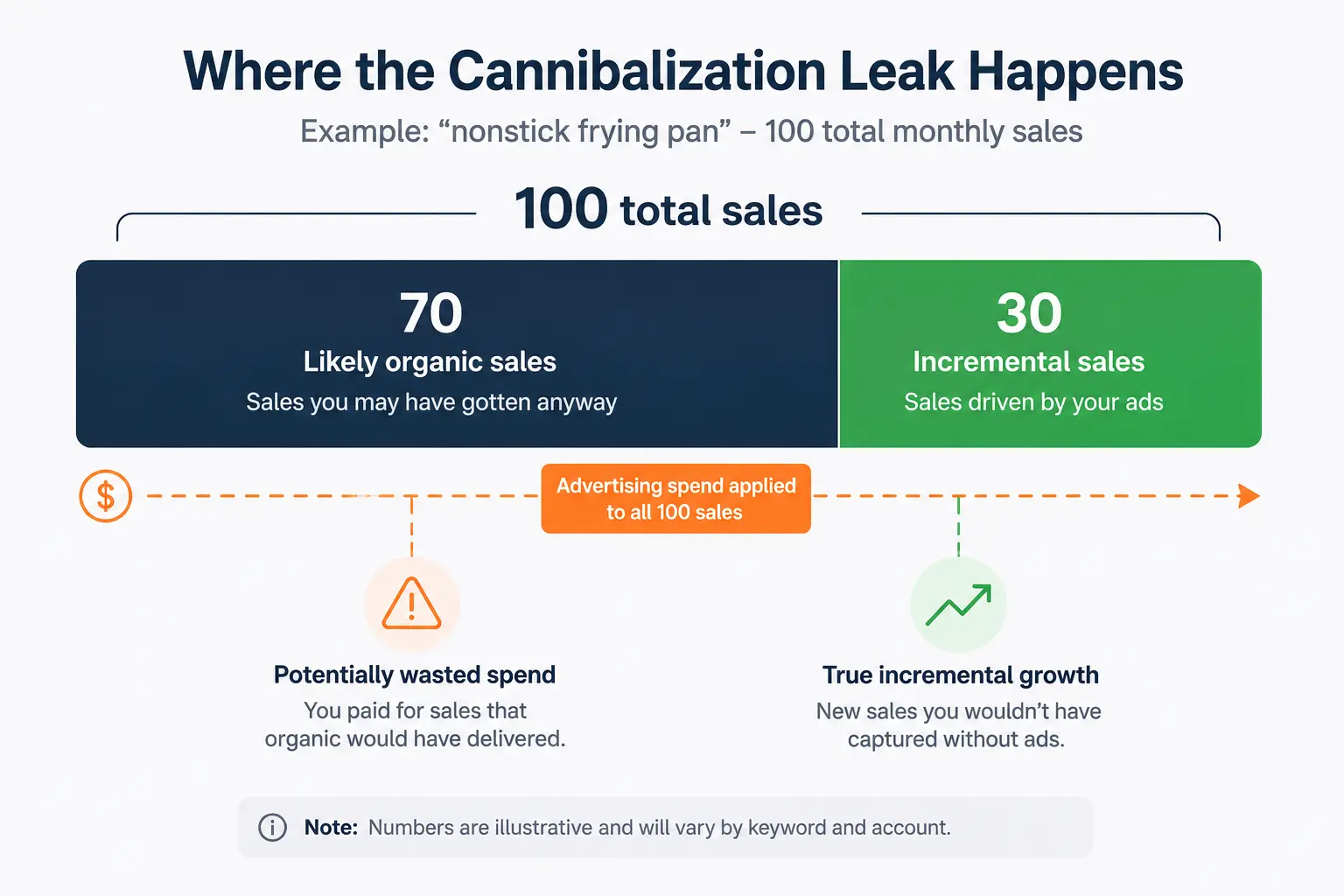
Picture the math on a single term. Say "nonstick frying pan" sends you 100 sales a month, and you rank second organically for it while also running an ad.
If you switched the ad off, perhaps 70 of those sales would still arrive through the organic result, and 30 were genuinely incremental clicks the ad captured that organic would have missed.
Paying full ad cost on all 100, when only 30 needed buying, is the leak. The account that never asks "how many of these would I have gotten anyway" cannot see it, because every one of those sales reports as an efficient ad order.
Seeing it requires looking past ACoS to organic rank and incrementality, which is the discipline the rest of this guide is built around.
The whole game is separating the spend that acquires new customers from the spend that reshuffles sales you already had.
Four signals do it.
Organic rank per keyword, tracked weekly, tells you which terms you already own. If you rank in the top few organic results for a term, aggressive paid bidding on it is mostly cannibalization, and the budget belongs on a term you do not yet rank for.
New-to-Brand share tells you whether a campaign is bringing first-time buyers or reselling to households you already have; a campaign with a high New-to-Brand rate is doing real acquisition.
Branded versus non-branded split tells you where your ad revenue really comes from: if most of it is people typing your name, your ads are harvesting demand you built, not creating new demand.
And incrementality, the hardest and most honest signal, tells you whether a dollar of spend produced a sale that would not have happened otherwise.
Amazon Marketing Cloud lets you analyze this by comparing shoppers exposed to your ads against those who were not, which is the closest Amazon gets to a true read on whether the spend was incremental.
Once you can see the difference, the strategy writes itself. Four plays keep the flywheel turning while the cannibalization stays low.
Spend to acquire on non-branded category terms. This is where new customers live and where the real halo forms, because ranking on a competitive category term ("cast iron skillet," "silicone baking mat," "stainless steel cookware set") is what pulls in shoppers who did not know you.
It costs more and converts lower than a branded term, and that is exactly the point: you are buying rank and customers you do not have yet. Run these as exact-match Sponsored Products campaigns built from your converting search terms, and treat a higher ACoS here as an investment in position.
Defend branded terms, but cheaply. Keep a small branded campaign live so competitors cannot buy your name, but do not pour budget into a term where your organic result already wins.
The job is to hold the placement, not to re-buy every customer who searches for you.
Taper paid once you rank organically. This is the play that separates disciplined accounts from wasteful ones.
When a term you were spending to rank on climbs into the top organic results and holds, ease your paid pressure on it and move that budget to the next term you do not yet own.
You keep the rank the ads bought, and you stop paying for sales the organic listing now delivers free. A specialist Sponsored Products management approach runs this taper continuously, because knowing exactly when to pull back on a term is the difference between a falling and a flat Total ACoS.
Harvest and prune weekly.
Promote converting search terms into exact match, add negatives where spend found no sales, and keep the account clean so the flywheel spins on your best keywords rather than leaking budget across junk.
The mechanics of that harvest live in our guide on how to read your Amazon SQP report.
Run these four plays as a loop, not a one-time cleanup, because the account is always moving: terms you funded last month climb into organic rank this month and become taper candidates, new category terms surface in the search-term report that you do not yet own, and a competitor may start bidding on your name and force a branded-defense adjustment.
A cooking catalog with dozens of SKUs has this happening on many terms at once, so the weekly rhythm is what keeps the whole account tilted toward acquisition rather than drifting back into paying for sales it already owns.
Miss a few weeks and the taper never happens, spend piles up on ranked terms, and the TACoS that should be falling quietly flattens.
The single metric that exposes cannibalization is Total Advertising Cost of Sale (TACoS), ad spend measured against total revenue including organic.
When TACoS falls over several weeks while revenue holds or grows, your organic engine is carrying more of the load and the ads are building the business. When TACoS is flat or rising while sales sit still, you are spending to hold ground you already own.
Watch it alongside organic sales share, the percentage of sales for a term that arrive without an ad, which is the clearest single proof that your rank is doing the work the ads used to.
Both of these live in Brand Analytics and Search Query Performance, which require Amazon Brand Registry, so enrolling is the prerequisite for measuring any of this properly.
Amazon's scale as a retail platform, documented in Statista's Amazon overview, means these shifts happen at real volume, so a small, sustained TACoS improvement across a cooking catalog is meaningful money.
Track organic rank on your top ten terms weekly so you can see the transfer happen and know exactly when to taper each one.

Telling acquisition from cannibalization across a full cooking catalog takes time and clean data, and it is exactly the read most in-house teams do not have hours for.
If your ACoS looks fine but your growth has stalled, or your TACoS has been flat for months while spend climbs, a structured review of your branded versus non-branded split, organic rank, and search-term data usually finds the leak faster than another round of guesswork.
As a specialist Amazon PPC agency, Amplivus runs this halo-and-incrementality work through ongoing Amazon PPC management for cooking and kitchen brands every day, separating the spend that acquires from the spend that reshuffles.
If you would rather see the gaps first, a free Amazon PPC audit will show where your spend is cannibalizing rather than acquiring, and a short Amazon strategy session will map the first taper-and-acquire moves.
The broader scaling framework this fits into is covered in our guide on how kitchen brands scale past $100K a month, which puts the halo mechanism inside a full catalog-scaling plan.

Speak with an Amazon PPC strategist to reduce cannibalization, improve keyword strategy, and turn paid sales into lasting organic growth.
Get an Amazon PPC audit to find wasted spend, reduce keyword cannibalization, and build stronger organic rankings with confidence.