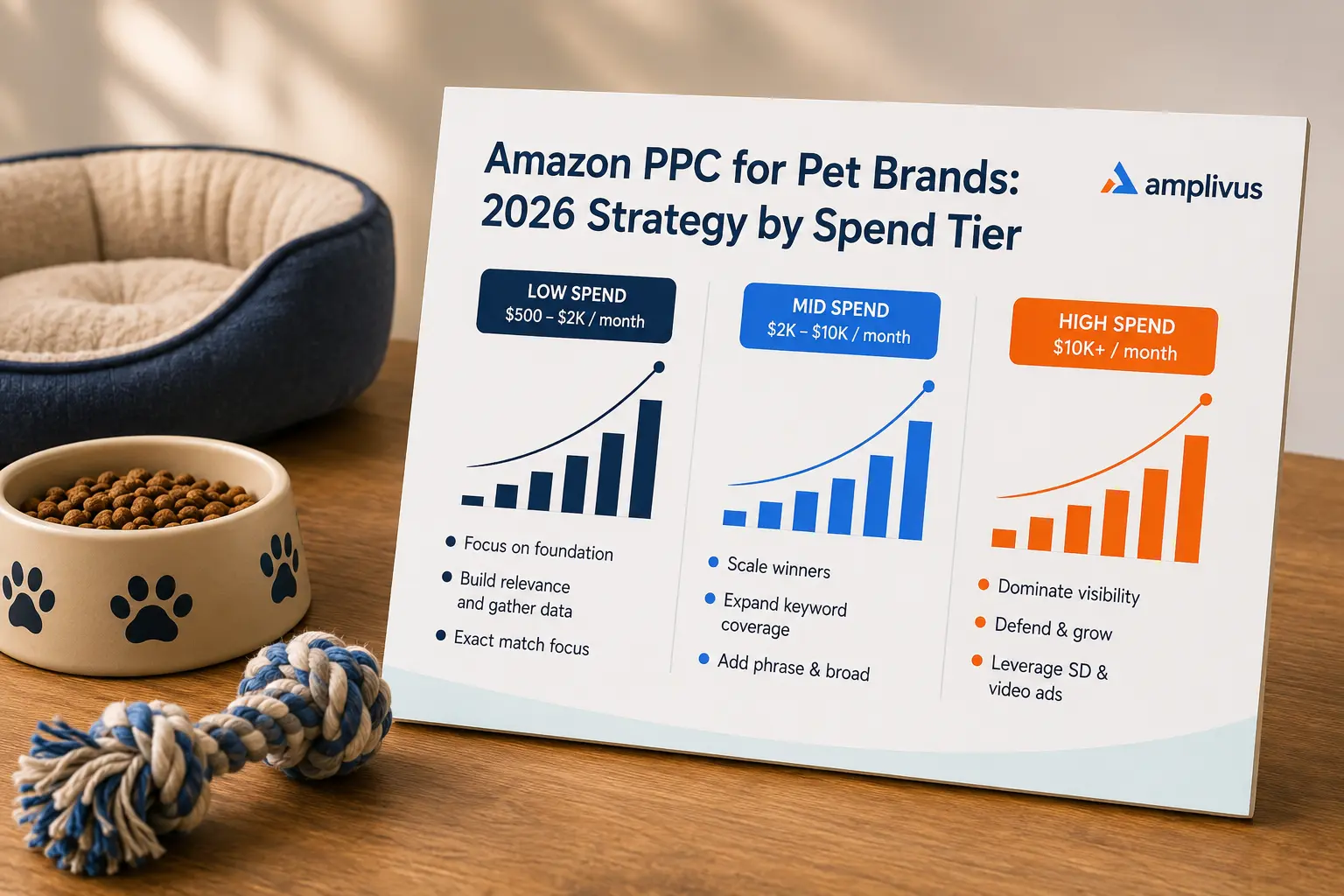
Amazon PPC for Pet Brands: 2026 Strategy by Spend Tier
Read more
.png)
The best Amazon PPC keywords for pet supplement brands are benefit and ingredient terms like hip and joint, calming, and probiotic, kept claim-safe.
Summarize in ChatGPT
Pet supplement brands win on Amazon by bidding on benefit and ingredient searches, not the expensive head term, and by keeping ad copy inside FDA claim limits.
The best keywords describe a specific benefit or a named ingredient, because that is how pet owners actually shop. Someone typing "hip and joint supplement for dogs" or "calming chews for dogs" has already decided what problem they want solved.
That intent converts far better than a broad word like "dog vitamins," where the shopper could want anything and the click still costs you.
Head terms in the pet supplement category are crowded and priced accordingly. Established brands and private-label sellers all fight for "dog supplements," so the cost per click runs high and the conversion rate stays soft.
The money sits one layer down, in the benefit and ingredient searches that signal exactly what the buyer needs. The category is expanding fast, with the global pet supplements market valued at USD 2.8 billion in 2025 and forecast to reach USD 4.6 billion by 2033, which means more brands bidding for the same buyers and more reason to target precisely.
There is a second reason keyword selection matters more here than in most categories. Pet supplements sit on a legal line between food and drug, and the words you choose to target and to publish both carry compliance weight.
A strong keyword strategy for a supplement brand is inseparable from the FDA-compliant approach that governs supplement advertising. Choose the wrong phrasing in a title and you can lose the listing.
Benefit keywords match the shopper's goal. A buyer searching "skin and coat supplement for dogs" wants a shinier coat and less shedding, and your product either speaks to that or it does not.
When the ad copy and the search agree, the click turns into a sale, and Amazon rewards that relevance with better placement over time.
Ingredient keywords work because informed pet owners shop by input. Glucosamine, omega-3 fish oil, probiotics, turmeric, and l-theanine are all searched by name, often by repeat buyers who know what worked before.
These terms attract a shopper who is comparing formulas, not just browsing, so they reward a clear supplement facts panel and honest sourcing.
Amazon's keyword targeting lets you reach these searches through broad, phrase, and exact match. Amazon's own guidance describes exact match as showing your ad only when a shopper searches your keyword precisely, which makes it the right container for your proven benefit and ingredient terms once the data is in.
Broad match belongs in a discovery campaign where you are still finding the phrases buyers use.
Pricing tells the same story. A head term might cost well over two dollars a click with a low conversion rate, while a specific term like "large breed dog joint supplement" costs less and converts at a much higher rate.
The specific term returns more revenue per dollar even though it has less search volume, which is the trade every profitable supplement account makes.
Repeat purchase behavior changes the math again. Supplements are consumed and reordered, and many buyers move to a subscription after the first bottle, so a single conversion can carry months of revenue behind it.
That lifetime value is why a supplement brand can afford to bid up on a proven benefit term that a one-time-purchase category never could, as long as the first sale is measured against the reorder, not the single order.
Pet supplement demand splits into a handful of intent tiers. The table below groups the terms worth building campaigns around, with the buyer signal each one sends.
Benefit and ingredient tiers deserve the largest share of budget because they carry the clearest intent. Life stage and breed long-tail terms are where efficient brands quietly build margin, since a phrase like "senior large breed dog hip supplement" has few competitors bidding and a buyer who knows exactly what they want.
Form terms deserve a note of their own. A shopper who types "dog joint chews" wants a chew, not a powder or a liquid, so matching the keyword to your actual format keeps the click honest and the return rate low.
Cats are quietly underserved across most of these tiers, and a brand with a real feline formula can own terms like "cat calming" or "cat hairball supplement" at a lower cost than the crowded dog equivalents.
Comparison terms that start with "best" are worth targeting, but they convert on proof rather than persuasion. A shopper searching "best dog joint supplement" is going to trust review count, rating, and price before your headline.
Support those keywords with a listing that earns the click, and treat them as a place where your pet supplement PPC strategy connects to organic search rank.
This is the part most keyword guides skip, and it is the part that can cost a pet supplement brand its listing. Federal supplement law, the framework that governs human vitamins, does not apply to animals.
The FDA determined in 1996 that this law does not cover products for use in animals, a decision upheld in court, so a pet supplement is regulated as either a food or a drug depending on what it claims.
The line is the claim. Under the Federal Food, Drug, and Cosmetic Act, a product intended to diagnose, cure, mitigate, treat, or prevent disease is a drug.
So a joint chew marketed to support mobility is a food, while the same chew marketed to "treat arthritis" or "cure hip dysplasia" becomes an unapproved animal drug in the eyes of the FDA.
That reclassification is what triggers listing takedowns and legal exposure.
Here is the practical rule that keeps brands safe. Targeting a keyword is not the same as making a claim.
You can bid on the search "dog arthritis supplement" because that is where your buyer is, but your title, bullets, and Sponsored Brands headline must stay in structure and function language: supports joint health, helps maintain mobility, promotes a normal inflammatory response.
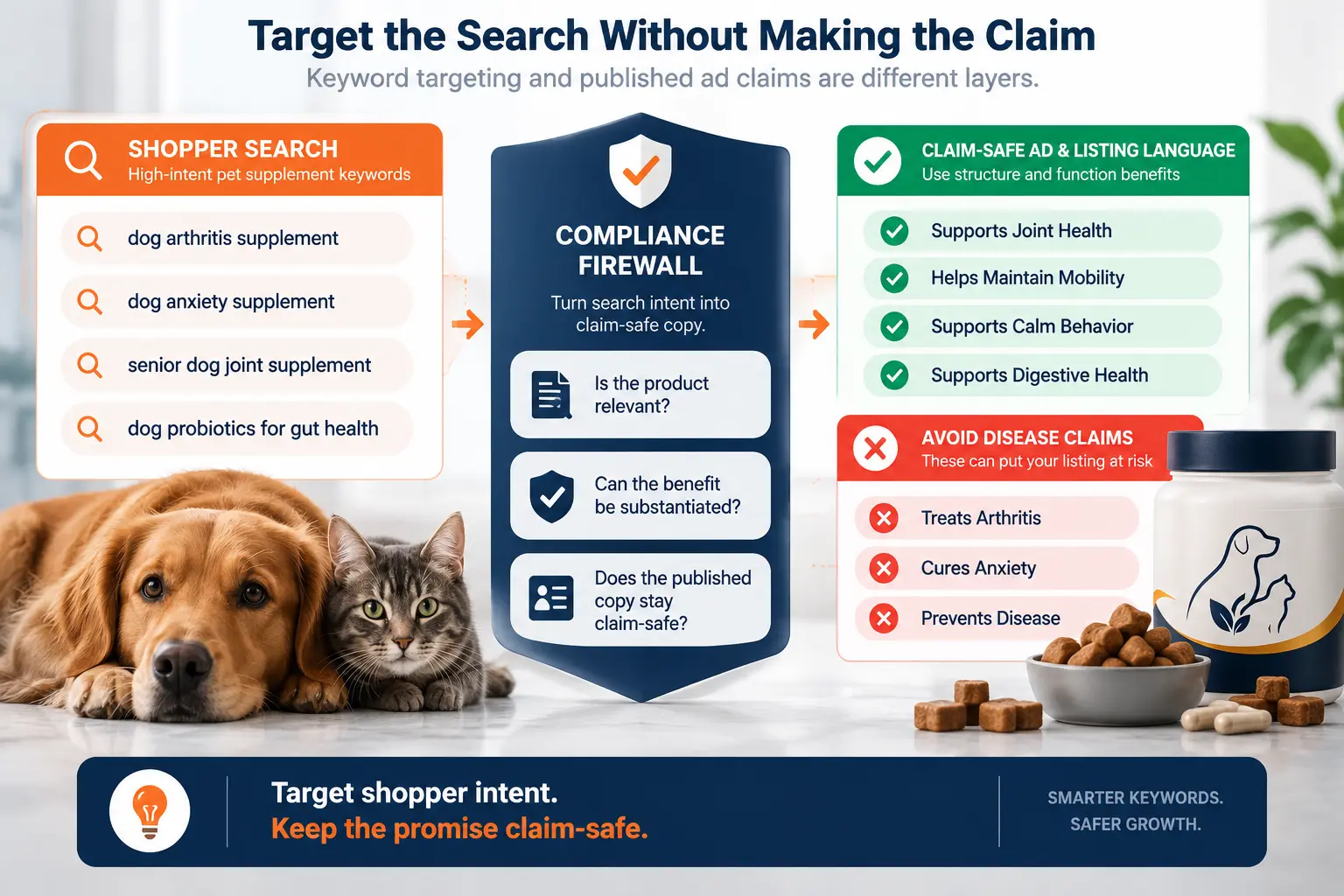
The keyword lives in your campaign; the claim lives in your copy, and only the copy is regulated.
Advertising claims carry a second layer of oversight. The Federal Trade Commission requires that health and benefit claims be backed by solid scientific proof, a standard it applies to marketers of health products broadly.
For a pet supplement brand, that means every benefit you publish in ad copy should be one you can substantiate, not one you borrowed from a competitor's label.
Quality signals can turn compliance into a conversion advantage. The National Animal Supplement Council awards a Quality Seal to member companies that keep written quality procedures, monitor adverse events, follow labeling rules, and pass an independent audit.
Featuring that seal where policy allows gives comparison shoppers a reason to choose you, and it pairs naturally with the trust-led creative that already works in pet category advertising.
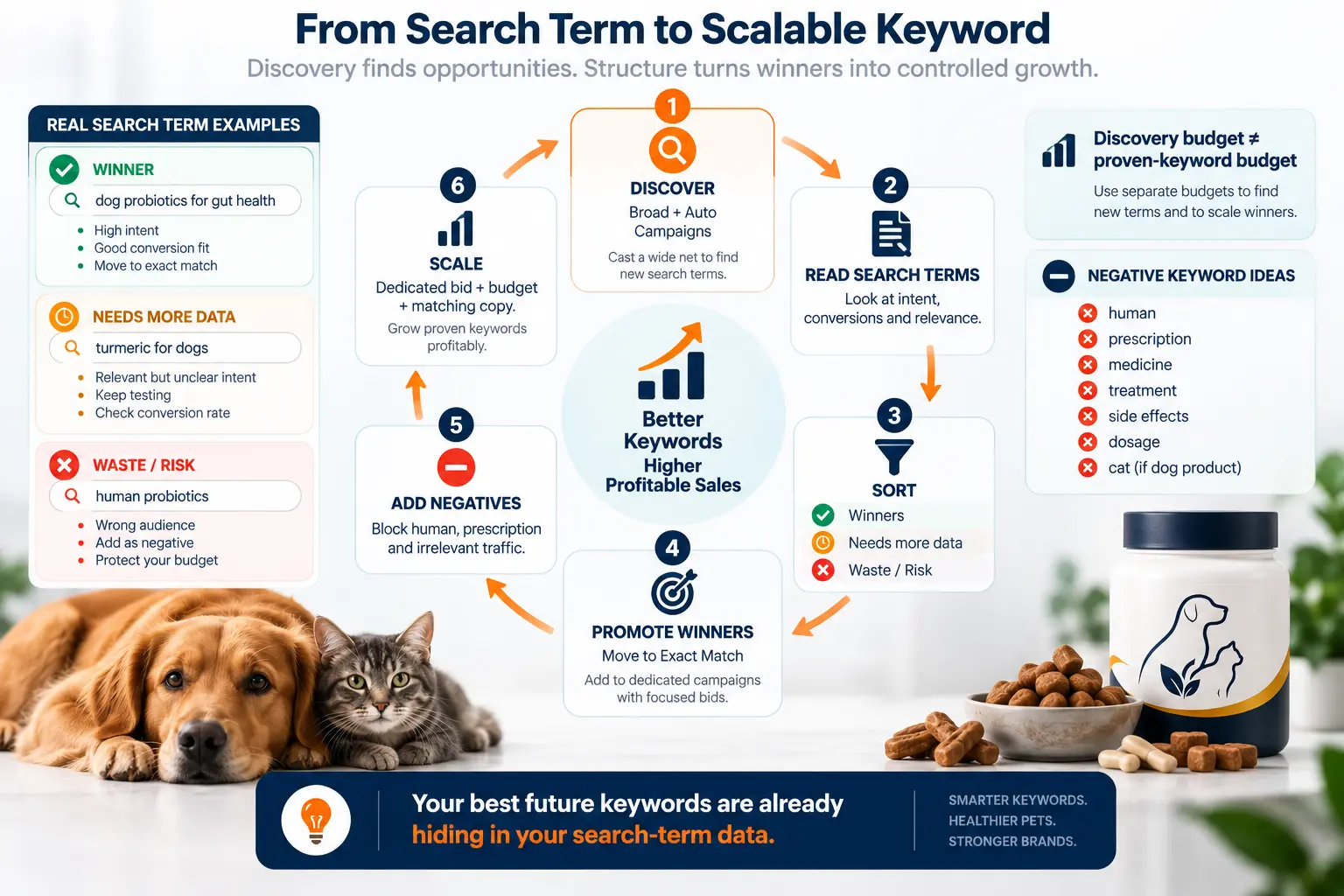
Negative keywords matter as much as the terms you bid on. Pet supplement searches sit next to human supplement searches, prescription queries, and disease-specific phrases you cannot safely claim, and every one of those is a click you do not want to pay for.
Add "human" and "for people" as negatives so your dog probiotic does not show for someone shopping their own vitamins.
Add "prescription" and "vet prescribed" if your product is over the counter, since that shopper wants something you do not sell.
Add "recall," "lawsuit," and "side effects" to keep spend away from research-only queries that almost never buy.
Disease terms deserve special handling. You may choose to bid on a phrase like "dog arthritis" in a controlled exact-match campaign, but many brands make it a negative instead, keeping their ads out of query pools that invite drug-claim scrutiny.
Auditing these wasted and risky terms is exactly the work a structured PPC audit surfaces before the spend adds up.
Your best future keywords are hiding in your current search term report. Amazon's keyword strategy guidance points sellers to run an automatic campaign, read which real searches converted, and promote those winners into manual campaigns as exact match. That harvesting loop is how a supplement account grows its keyword list without guessing.
Run a broad discovery campaign on your core benefit terms, then review the search term report weekly.
When a phrase like "dog probiotics for gut health" converts more than once, move it to its own exact-match keyword and set a bid that matches its value. Add the queries that spent without converting as negatives in the same pass.
Give each promoted winner its own tight ad group, ideally one keyword to one ad group for your top terms. That structure lets you set a bid and a piece of copy that speak only to that search, instead of averaging across a dozen unrelated phrases.
It costs a little more setup time, and it is the difference between a supplement account that holds its target cost and one that slowly drifts as volume grows.
Search behavior data sharpens this further. Reading how demand shifts across the funnel, using the search query performance metrics Amazon exposes to brand-registered sellers, shows which benefit terms are gaining share and which are fading.
That signal tells you where to move budget before your competitors notice the same trend.
Seasonality plays a role too. Calming and anxiety terms spike around known noise events and the fourth quarter, which is why calming supplements reward a seasonal calendar built around pet anxiety demand. Joint and mobility terms stay steadier through the year, so your bid strategy should not treat every keyword tier the same.
The first mistake is overspending on the head term. "Dog supplements" feels like the keyword to own, but it drains budget at a high cost per click and a low conversion rate.
The efficient move is to let the specific benefit and ingredient terms carry the account and treat the head term as a small, capped experiment.
The second is putting the keyword in the claim. A brand bids on "dog anxiety supplement," then writes "cures anxiety" in the title to match, and turns a legal food into an unapproved drug claim.
Keep the keyword in the campaign and keep the copy in structure and function language, always.
The third is running one giant ad group. When calming, joint, and skin terms share a single group, the bids and the copy cannot fit all of them, and relevance suffers. Build tight ad groups around one benefit each so the keyword, the copy, and the landing image all agree.
The fourth is ignoring the search term report. Brands set campaigns and forget them, missing both the converting phrases worth promoting and the wasteful ones worth blocking.
A weekly review of real search terms is the single highest-return habit in a supplement account, and it feeds directly into a sound supplement PPC strategy.
The fifth is skipping competitor and ingredient research. If you do not know which formulas rank for "best dog joint supplement," you cannot position against them, and a focused competitor analysis shows exactly which terms and claims are winning the category.
A pet supplement keyword plan works when three things line up: the terms carry real buyer intent, the copy stays inside FDA structure and function limits, and the search term report keeps feeding new winners into the account.
Miss any one and you either overpay, risk the listing, or stall.
Start with benefit and ingredient terms, expand into life stage and breed long-tail, and defend the whole thing with disciplined negatives. That is the pattern behind every profitable pet supplement account, and it scales as your catalog grows.
Brands that want the full build handled can bring in dedicated Amazon PPC management rather than piecing the account together in-house.
Prefer to start with a plan? Book an Amazon strategy session to map your keyword tiers and compliance guardrails before you spend a dollar.
You can browse the full library of category playbooks at Amplivus when you want the deeper reference for your niche.


Build a pet supplement keyword strategy around buyer intent, proven ingredients, claim-safe copy, and the search terms your products can truly win.
See which benefit, ingredient, and long-tail terms deserve more budget and which costly searches should be blocked.