
How Wellness Brands Scale Amazon PPC Past $100K/mo
Read more
.png)
At $500K+/mo, supplement PPC must be compliant first: keep ad claims to substantiated structure-function language, then scale with DSP, AMC, and subscriptions.
Summarize in ChatGPT
A supplement brand doing $500,000 a month is a different kind of business from one doing $50,000, and the difference that matters most is not the budget, it is the exposure. At scale you are visible: to Amazon's enforcement systems, to the FTC, and to competitors who will report you.
A single overreaching claim in an ad or a listing can suppress your bestsellers or invite a regulator, and at this revenue that is not a paused campaign, it is an existential risk to the whole operation.
That is why, for a large supplement brand, compliance is not the boring part of PPC; it is the foundation that everything else is built on, because the fastest way to lose a $500,000-a-month business is to advertise a claim you cannot defend.
This guide covers how to run supplement advertising at scale while staying inside FDA and FTC rules, then how to scale that spend without compounding the risk.
It builds on the wider approach in our guide on Amazon PPC for supplement brands and applies the enterprise moves from our guide on PPC strategy for 7-figure brands to a category where the claims environment sets the rules.
The first thing a scaled supplement seller has to understand is that two agencies govern what you can say, and they cover different ground.
The FDA regulates your product labeling and permits structure-function claims while forbidding disease claims, a line drawn in its guidance on structure-function claims.
The FTC regulates your advertising, and your PPC ad copy, your Sponsored Brands Video scripts, and your headlines are advertising. That means the FTC's Health Products Compliance Guidance applies directly to the words in your campaigns, not just the text on your bottle.
Many sellers police their listing and forget that every ad is a separate claim surface the FTC can hold them to, which is exactly the gap that gets large brands into trouble.
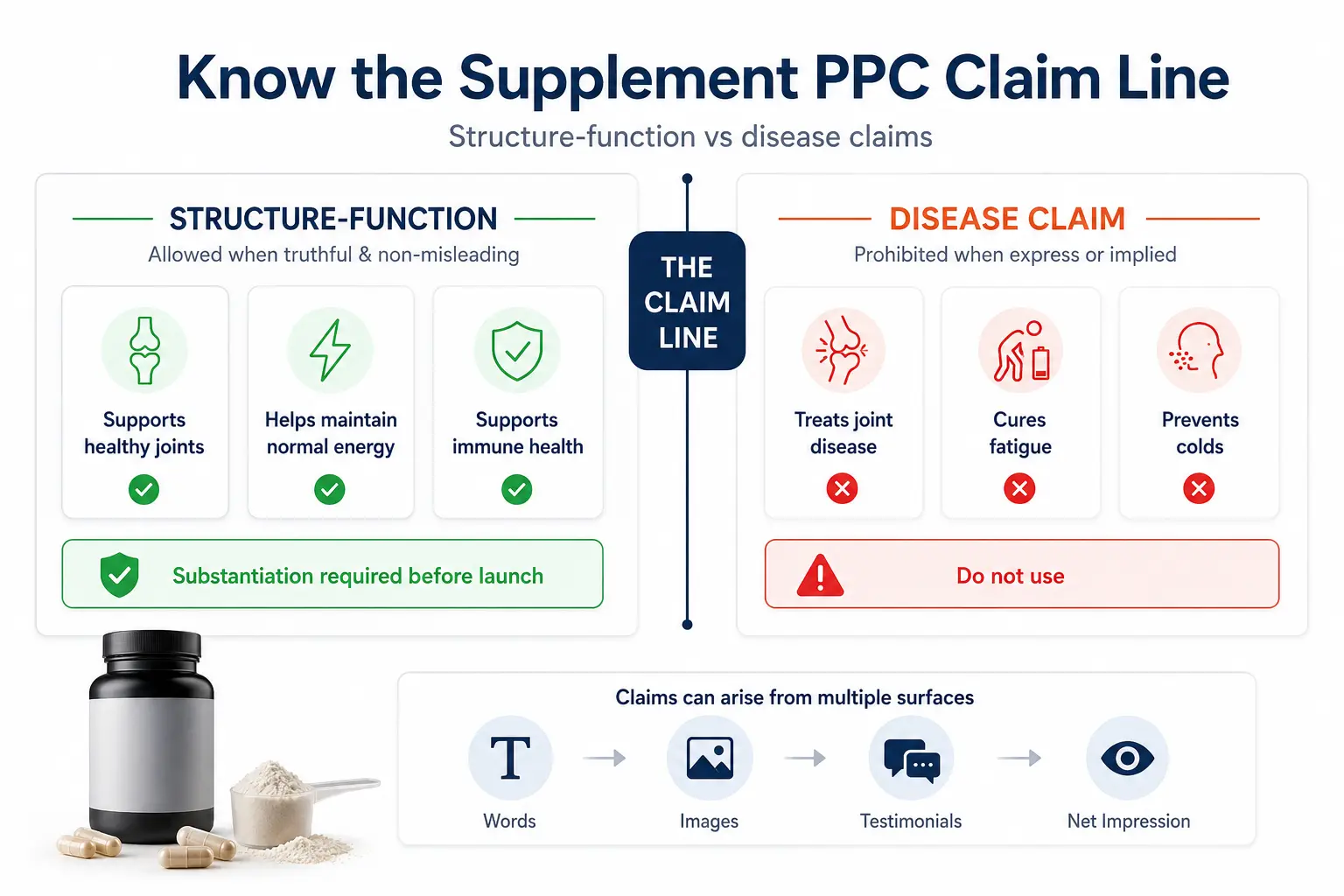
Every headline, image, and product name in a campaign can carry a claim, and the FTC judges claims by how a consumer perceives them, not by what you intended.
That means an implied benefit, a suggestive image, or a testimonial can be a claim you have to substantiate just as much as an explicit sentence.
At $500,000 a month you are running many ads across many products, so the surface area for an accidental claim is large, and it has to be managed deliberately rather than left to whoever wrote the campaign.
The consumer-perception standard is the part that catches sophisticated sellers off guard, because it does not matter that you never wrote the disease claim in words.
If a headline pairs your product with an image of someone visibly relieved of a symptom, or a product name evokes a condition, the net impression can be a claim the FTC will read even though no sentence states it.
That is why compliance at scale is about the whole ad, the words, the images, the name, the implication, and not just a keyword scan for forbidden phrases.
A brand that only checks for banned words will still ship implied claims it cannot defend, and at this revenue those are the ones that draw attention.
Two rules govern what a supplement ad can say: what kind of claim is allowed, and what evidence you need behind it.
A supplement ad can describe supporting a normal structure or function of the body, "supports healthy joints," "helps maintain normal energy," and it cannot claim to diagnose, treat, cure, or prevent a disease.
That line is the single most important rule in the category, and it applies to every word in your PPC, including the ones you did not think of as claims. "Supports immune health" may be permissible with support; "prevents colds" is a disease claim that is not.
At scale, write your campaigns from a pre-approved vocabulary of compliant phrasings rather than letting each ad reinvent the language, because consistency is what keeps a large account inside the line.
The FTC standard is competent and reliable scientific evidence, and it must exist before the ad runs, not be assembled after a challenge.
For a health benefit that generally means well-conducted human clinical evidence; the guidance is clear that animal or in-vitro studies alone, anecdotes, and consumer surveys do not meet the bar.
Crucially, this covers implied claims and the underlying message of a testimonial, so an endorsement that implies your product works must be backed by evidence that it does, and any material connection with the endorser must be disclosed. Before you scale spend behind a claim, confirm you can defend it to that standard, because the bigger the budget, the more attention the claim draws.
A claim that ran quietly on a small account can become a liability the moment you put a large media budget behind it, since scale is exactly what turns a marginal claim into a visible one that competitors and regulators notice.
At $500,000 a month, compliance cannot be a person spot-checking ads; it has to be a process built into how campaigns are made.
Run every new ad, video script, and A+ module through a claims review before it launches, against your approved vocabulary and your substantiation file.
Keep a record of the evidence behind each claim you make, so if a claim is challenged you can produce the support the FTC expects you to have had all along.
Treat Sponsored Brands Video with particular care, because a script, a voiceover, and on-screen text are three separate claim surfaces, and an image of a symptom relieved can imply a disease claim the words avoided.
A disciplined Amazon PPC management process is where that review lives as a standing step rather than an afterthought.
The practical form of this is an approved-claims library: a maintained list of the exact benefit phrasings you have cleared and substantiated, paired with the evidence behind each.
Campaign writers pull from it rather than inventing language, new claims go through review and into the library before they run, and anything not in the library does not ship.
This sounds bureaucratic, but at $500,000 a month it is far cheaper than the alternative, which is discovering after a suppression or a challenge that a dozen ads carried a phrasing no one had cleared.
The library also speeds the team up, because most campaigns can be built from pre-approved language without waiting on legal review, and only genuinely new claims need the slower path.
Handle social proof carefully, because it is a claim surface too. You are responsible for the implied claims in a testimonial you feature, and you cannot use a customer review to say something you could not say yourself.
Disclaimers help but do not rescue a fundamentally misleading claim; the FTC is explicit that a disclaimer cannot cure a deceptive message, so the fix is to make the claim compliant, not to bury a caveat under it.
At scale, standardize how reviews and endorsements are used across the catalog so one product's aggressive testimonial does not put the brand at risk.
With the compliance base solid, the enterprise growth moves are the same as any large brand's, and they work better on a clean foundation.
Supplements are consumables, so a first sale is the start of a reorder stream, and Subscribe & Save turns acquisition into recurring revenue.
That means you can bid to lifetime value rather than first-order Advertising Cost of Sale (ACoS), accepting a looser acquisition target on products with strong subscription attach because the reorders repay it.
Push Sponsored Products to build velocity and rank, read TACoS to confirm paid spend is lifting the whole business, and fund the compounding products harder.
Track subscription attach rate by product, not just ACoS by campaign, because that is what tells you which acquisition spend builds a recurring base and which merely buys a one-time sale, and at this scale the difference between those two is most of your future revenue.
The subscription and lifetime-value discipline that drives this is covered in our guide on scaling wellness brands on Amazon PPC.
At this scale, Amazon DSP and Amazon Marketing Cloud earn their place. AMC audiences let you reach a customer before their bottle runs out, exclude recent purchasers from acquisition, and model look-alikes of your best subscribers, while DSP reaches new customers before they search. Judge this spend on new-to-brand sales and lifetime value rather than a search ACoS, because it works earlier in the decision. The same compliance rules apply to every one of these surfaces, so your DSP creative and audiences carry the same claim discipline as your search ads, with no exceptions for being further up the funnel.
The wellness buyer's mindset that these campaigns target is explored in our guide on biohacking brand PPC. What that buyer wants is credible specifics, not louder promises, which is one more reason the compliant path and the high-converting path point the same way at this scale.
It is worth reframing compliance from a constraint into an edge, because at scale it genuinely is one.
Supplement buyers are skeptical, and a brand that makes honest, specific, substantiated claims reads as more credible than one making loud promises.
Compliant marketing is not weaker marketing; it is more believable marketing, and in a category built on trust that converts. A specific, modest claim a shopper believes outperforms a sweeping one they discount, because the modern supplement buyer has been burned by overpromising and reads a big claim as a warning sign.
The compliant brand that says exactly what its product supports, and backs it, earns the trust that the loud competitor spends its credibility trying to fake. The brands that overreach may win a short-term click, but they carry a suppression and enforcement risk that can erase years of growth in a single action, while the compliant brand compounds.
At $500,000 a month you have too much to lose to gamble the business on a claim, and the discipline that protects you also differentiates you.
Knowing where competitors are pushing claims they cannot defend is the kind of read a structured Amazon PPC competitor analysis can surface, so you can compete on substance rather than matching their risk.
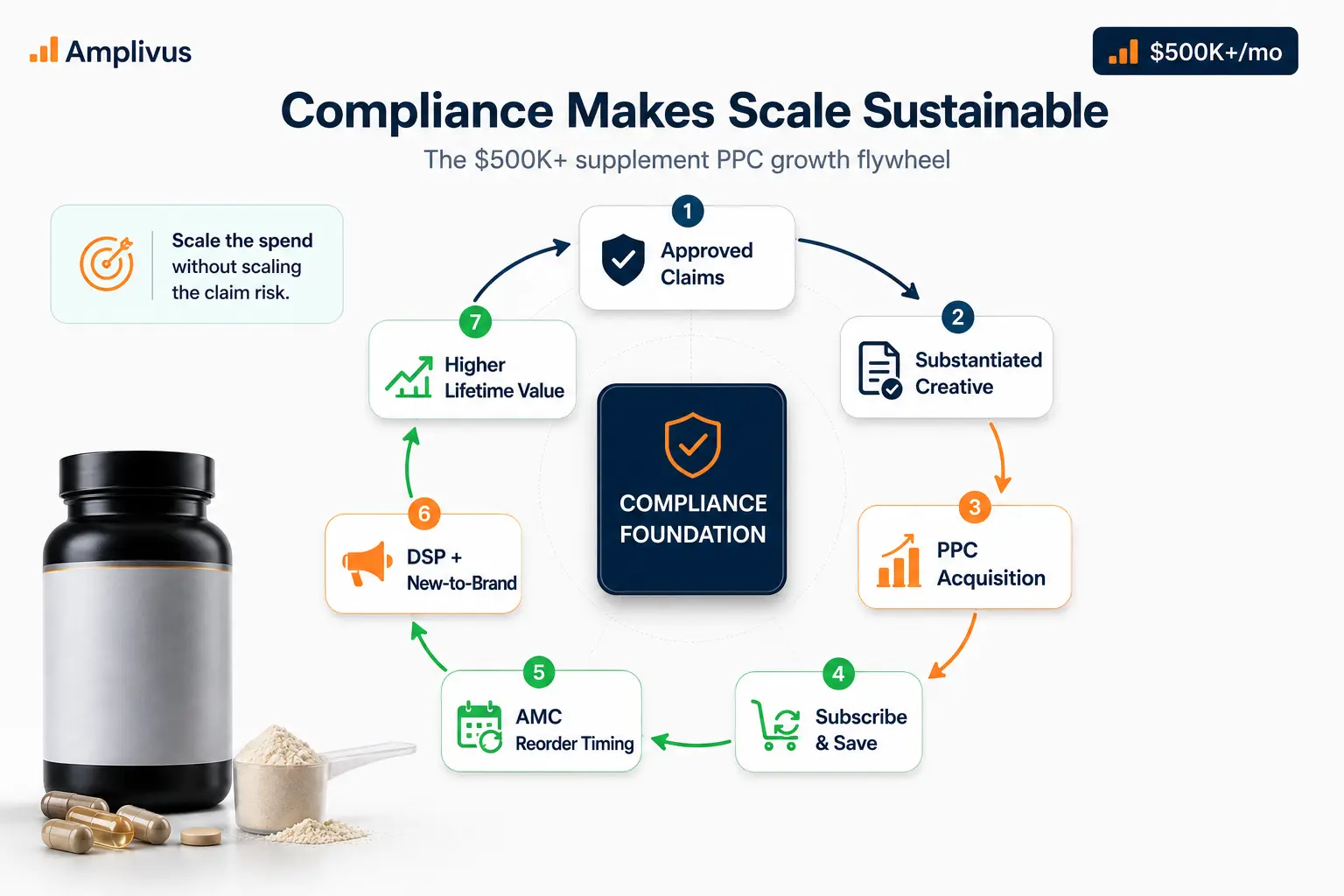
At $500,000 a month the risk and the opportunity both hide in the same place: the claims across hundreds of ads, videos, and modules that no one has reviewed as a system.
A compliance-aware audit reads the campaigns for claim exposure and the account for the usual scaling leaks at once, so you fix what is risky and what is inefficient together.
That is a specialist's job, and at this scale the cost of getting it wrong dwarfs the cost of the review.
As a specialist Amazon PPC agency, Amplivus reads supplement accounts for both compliance exposure and growth, not one at the expense of the other.
A free Amazon PPC audit reviews your account for claim risk and the missed levers at your scale, and a short Amazon strategy session maps the highest-value, lowest-risk moves for the year.

Grow your Amazon supplement brand without compounding claim risk. Get a clear plan for compliant PPC, DSP, AMC, and smarter scaling.
Book a strategy call to review your claims, PPC structure, and the safest growth moves for your supplement brand safely.
.webp)
.png)
.png)


.png)
.png)