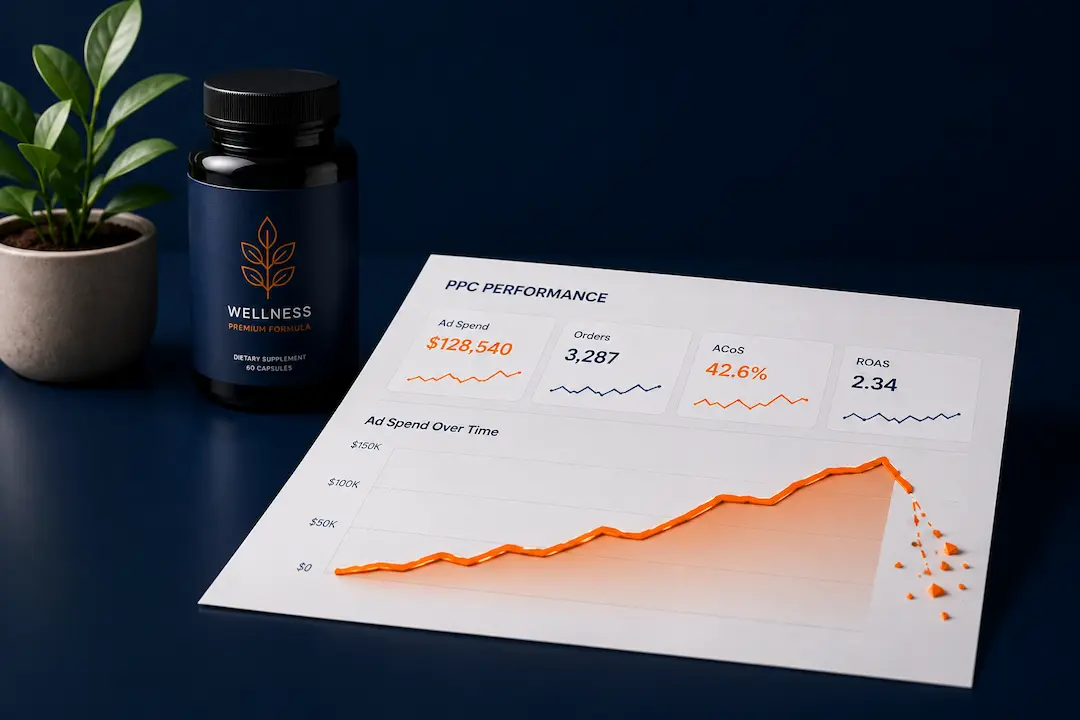
Why Wellness Brands Struggle With Amazon PPC Past $100K/mo
Read more
.png)
Amazon PPC for wellness brands works best when ad mix matches budget: Sponsored Products at low tiers, adding Sponsored Brands, Display, then DSP as spend grows. Stage ACoS by product life.
.webp)
How to match your Amazon ad mix to your budget tier, so a small wellness brand and a large one run the right plan for their spend.
Your budget, not your ambition, should decide your ad mix. A wellness brand spending $1,000 a month and one spending $25,000 are not running smaller and larger versions of the same plan.
They are running different plans. That single idea fixes most of the waste I see in supplement accounts.
This guide is for supplement and wellness brand owners, direct-to-consumer (DTC) founders, and in-house marketers who already run Amazon ads or are about to.
You will get spend-tier benchmarks, staged Advertising Cost of Sale (ACoS) targets, a budget-to-ad-type matrix, and the compliance rules that quietly shape every campaign here.
Amazon PPC for wellness brands rewards discipline over aggression in 2026, mostly because clicks cost more than almost anywhere else on the platform.
The brands that win are not the ones with the biggest budgets. They are the ones whose spending, structure, and claims all point in the same direction.
Spend enough to win share on your core terms, but never more than your margin can absorb.
For most supplement brands, that means starting Amazon advertising spend at roughly 10% to 15% of Amazon revenue, then adjusting by your Total Advertising Cost of Sale (TACoS).
The number that matters is not your ad budget. It is your break-even ACoS, which comes straight from your profit margin.
If your supplement carries a 35% margin after Fulfillment by Amazon (FBA) fees and cost of goods, your break-even ACoS is about 35%.
Anything below that is profit. Anything above it is investment you need a reason to make. You can model your own break-even against margin with our Amazon ACoS and TACoS calculator.
Supplements have a second lever most categories ignore: repeat purchase. A 45% ACoS on a first order can still be a winner if that buyer subscribes and reorders for a year.
This is why TACoS, which measures ad spend against total sales rather than just ad-attributed sales, is the truer health metric for wellness brands.
ACoS tells you how efficient a campaign is today; TACoS tells you whether your ad investment is building a business or just renting sales.
Set the budget to the tier you can fund consistently for 90 days.
Stop-start spending teaches Amazon's algorithm nothing, and in a thin-margin category the temptation to pause hard at the first scary ACoS reading is strong.
Resist it. Decide your monthly number before you log in, not in the dashboard at 11pm, because reactive budgets almost always drift upward, and wellness clicks are too expensive to drift with.
A good ACoS for supplements depends on the product's stage, but 25% to 40% is the realistic profitable band for established listings in this category.
Health and wellness is one of the most expensive categories on Amazon. According to 2026 benchmarks, cost-per-click in some wellness segments runs close to $3, with category return on ad spend (ROAS) near 2.5x, so a 40% ACoS reflects competition, not failure.
Across the platform, average ACoS ran near 25% to 30% in 2025 and is expected to climb toward the low-to-mid 30s in 2026 as cost-per-click keeps rising.
Reported average Amazon CPC sits in the $1.00 to $1.25 range in 2026, with Sponsored Products clicks around $0.85 to $1.30 and Sponsored Brands reaching toward $2.50 in competitive niches.
The scale of that spend is visible in Statista's Amazon advertising data.
Stage your targets instead of chasing one number.
Top-performing accounts hold blended ACoS around 22% to 26%, roughly 4x to 4.5x ROAS. Treat that as the bar to aim for, not the starting line.
Here is the trap.
A new seller sees a 60% ACoS on a launch campaign, panics, and slashes bids. Rank stalls, reviews stop coming, and the listing never reaches page one where organic sales would have carried it.
A seller who understands staging accepts that 60% for 60 days, climbs, then pulls back to a profitable 25% once organic traffic flows. The discipline is refusing to judge a launch by mature-stage math.
Here is the part competitors skip.
Match your ad mix to your monthly budget, because spreading a small budget across every ad type is the fastest way to learn nothing and spend everything.
Run Sponsored Products only. One exact-match campaign for your proven keywords, one broad or auto campaign to discover new terms. Mine search terms weekly, push winners to exact, and add negatives ruthlessly.
At this budget, focus beats spread.
A single-SKU magnesium brand with $1,200 a month should not touch Sponsored Brands yet: every dollar belongs on the eight to ten keywords that actually convert, owned at exact match, with a tight negative list keeping irrelevant clicks out.
Keep Sponsored Products as the engine, then add Sponsored Brands to defend your own name and capture category headers.
This is where keyword harvesting pays off: Sponsored Products feeds you the search terms that make Sponsored Brands efficient.
You also gain enough data to split campaigns by intent, with discovery campaigns finding new terms and control campaigns holding proven winners at tight bids, which stops a few expensive experiments from dragging down your whole account's ACoS.
Now you can afford the full funnel. Sponsored Display retargets shoppers who viewed your detail page but did not buy, which suits supplements where people compare before committing.
Sponsored Brands Video earns outsized attention in a crowded wellness shelf, and because few sellers produce good video, it often wins placements efficiently.
This is also where dayparting starts to matter: with enough volume, you can see that your evening clicks convert better and weight bids toward them, rather than paying the same for a 3pm browser and a 9pm buyer.
Amazon DSP (Demand-Side Platform), Sponsored TV (the self-serve streaming tier), and Amazon Marketing Cloud (AMC) for cross-channel measurement and audience building.
Until your Sponsored Products and Sponsored Brands campaigns are fully built out and consistently profitable (for most wellness brands, a five-figure monthly budget), these formats tend to starve your bread-and-butter search campaigns.
Once that foundation is solid, they extend reach you cannot get any other way, including retargeting off Amazon and reaching new-to-brand shoppers through streaming.
The honest rule: do not graduate a tier until the current one is profitable and stable, a discipline our guide on why wellness brands struggle past $100K reinforces at the higher end.
Sponsored Products does the heavy lifting at every tier because it captures shoppers at the moment of search intent, including on competitor detail pages where many supplement comparisons happen.
Sponsored Brands works hardest on defense and discovery.
Bid on your own brand name so competitors cannot cheaply intercept your buyers, then use category terms to introduce new shoppers to your range.
That branded defense is worth measuring carefully, since it can quietly claim sales your organic listing would win anyway, a trap our guide to branded traffic cannibalization in SQP breaks down.
Sponsored Display earns its keep through retargeting. Wellness shoppers rarely buy on first view: they read the label, check reviews, compare two vitamin D options, and leave.
Display brings them back. Amazon documents each format inside the Amazon Ads Console, which now sits alongside Seller Central as the modern management path.
Amazon DSP and Sponsored TV belong to brands that have already saturated search.
For a clean-label brand with a strong reorder rate and a real budget, they build audiences and lift New-to-Brand (NTB) sales. For a $2,000-a-month account, they are a distraction.
A simple rule: if a converting keyword still has impression share left to win on Sponsored Products, that dollar goes there before any awareness format. Capture demand before you try to create it.
Compliance is not a legal afterthought in wellness PPC. It directly shapes your click-through rate, your conversion rate, and whether your listing stays live.
Amazon flags therapeutic language. Phrases like "clinically proven to treat" or "FDA-approved" (when untrue) can suppress or deactivate listings, and enforcement has been tightening.
You cannot bid your way around a non-compliant listing.
The Food and Drug Administration allows structure/function claims when they are truthful and substantiated, paired with the required Dietary Supplement Health and Education Act (DSHEA) disclaimer, and the FTC's health products guidance adds that every claim must be substantiated.
So "supports a calm bedtime routine" is workable. "Cures insomnia" is not.
What this means for your ads: lead with lifestyle and ingredient benefits, not disease outcomes. "Vegan vitamin D3 5000 IU for everyday immune support" is compliant, specific, and high-converting, so the compliance constraint and the conversion best practice point the same direction here.
This is also why long-tail, ingredient-led keywords outperform: "vitamin D 5000 IU vegan" has lower volume but far higher purchase intent, and keeps you inside the claims you are allowed to make.
Build your negative list with compliance in mind too: if a term implies a medical condition you cannot address, negate it.
Scale the winners, not the budget. Increase spend by 15% to 20% on campaigns that stay profitable on a daily basis, then promote your best keywords into their own campaigns with dedicated budget.
Use Rule-Based Bidding (target ACoS or target ROAS) to hold efficiency as you grow, and Maximize New-to-Brand bidding when reach is the goal.
Watch impression share on your top terms: if you own only 20% of available impressions on a converting keyword, there is profitable room to climb.
For subscription supplements, judge scaling by NTB metrics and customer acquisition cost (CAC) against lifetime value, not by a single order's ACoS.
A buyer acquired at a 50% ACoS who reorders six times is one of the cheapest customers you will ever have.
Pull data from Amazon Brand Analytics, Search Query Performance (SQP), and Amazon Marketing Stream to see which terms drive first-time buyers versus repeat ones, so you know where to add budget and where to cap it.
SQP in particular shows how you convert on a query relative to the wider category, which our guide on how to read your SQP report walks through.
Scale in steps, not leaps: a 20% weekly increase on a profitable campaign compounds and gives the algorithm room to adjust, while doubling a budget overnight spikes cost-per-click and resets efficiency.
For the seven-figure end, our $200K+ supplement PPC strategy picks up where this leaves off.
Daypart around your buyer. Wellness purchases often spike evenings and early mornings, so if your data shows it, weight bids toward those windows rather than running flat.
Separate branded and non-branded campaigns from day one, because blending them hides your true cost to acquire a new customer; branded clicks are cheap and convert high, so they mask weak non-branded performance if you let them.
Treat your product detail page as part of the campaign, since the best bid cannot fix a thin page.
Clear benefits, the DSHEA disclaimer placed properly, strong reviews, and ingredient specifics do more for ACoS than another round of bid tweaks.
Build a small negative-keyword library you reuse across launches, since most supplement brands waste the same clicks on the same irrelevant terms every time.
Finally, review weekly and restructure monthly, because daily tinkering starves campaigns of the data they need to stabilize.
Your spend tier is the decision that makes every other decision easier.
Pick the tier you can fund for 90 days, run the ad mix it calls for, stage your ACoS by product life, and let compliance shape copy toward the lifestyle language that also converts.
Get those four right and you protect margin while you build rank, which is the whole game in a category where clicks are not getting cheaper.
If you want a second set of eyes on where your budget is leaking, Amplivus reviews wellness and supplement accounts tier by tier. Start with a free PPC audit, or book a strategy session to map your next tier before you spend another dollar.

Get a spend-tier PPC strategy built for wellness brands using staged ACoS targets, ad mix planning, and margin protection at every scale.
ee how wellness brands scale Amazon PPC by matching spend tiers to ad mix and staged ACoS targets that protect margin while driving growth.
.png)
.png)


.png)
.png)