Amazon Ads in 2026: What Changed for Established Brands
Read more
.png)
Capture Q4 pet anxiety demand by building rank in Q3 before the auction heats, then pacing budget, dayparting around triggers, and defending branded search.
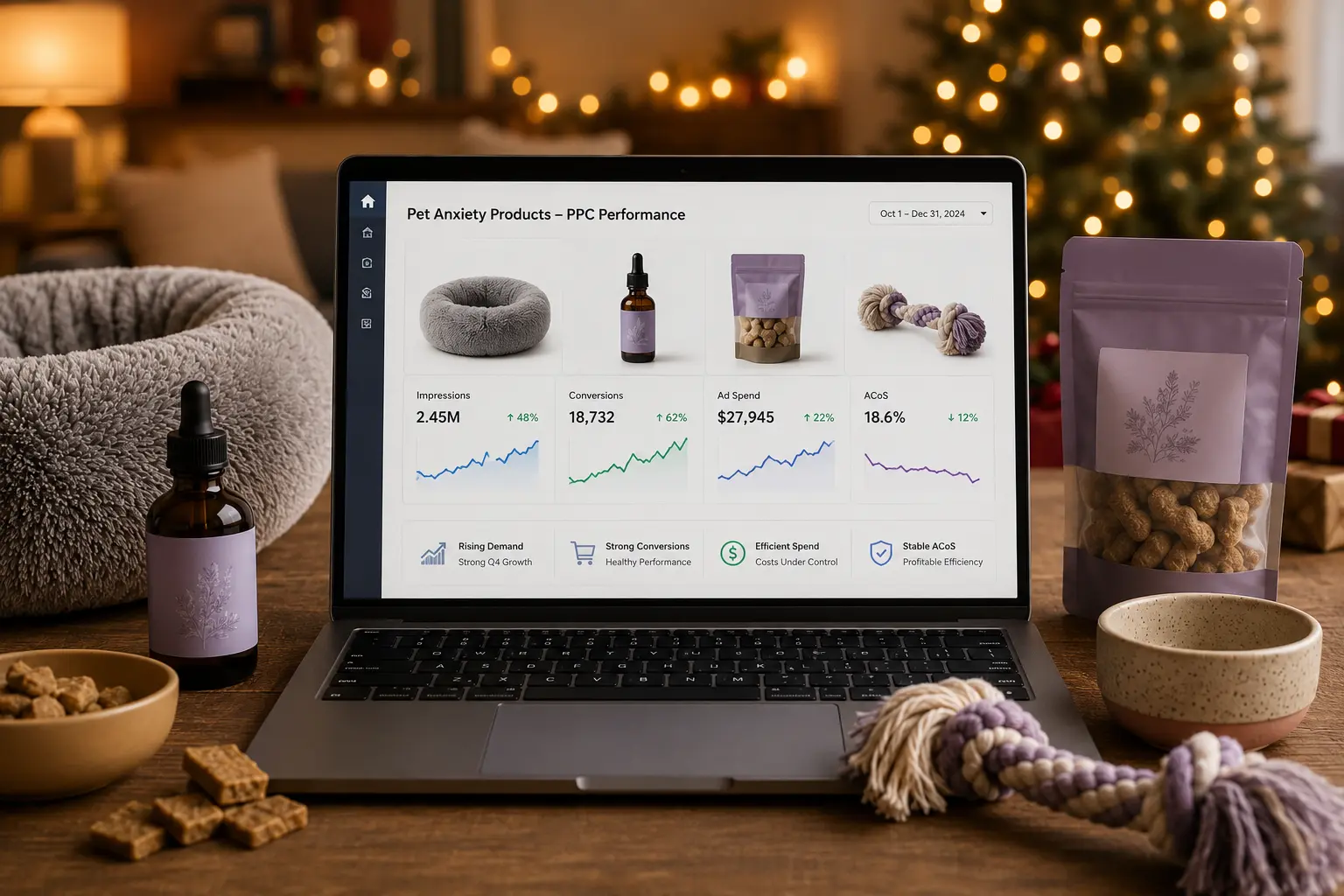
The pet anxiety and calming category is one of the fastest-growing corners of pet, and it carries a sharp seasonal pattern that catches many brands off guard. The pet calming products market was about $17 billion in 2024 and is projected near $24 billion by 2030, and a disproportionate share of that demand lands in the fourth quarter.
The problem is not finding the demand, it is capturing it without watching your Advertising Cost of Sale (ACoS) balloon, because the same season that brings the buyers also brings every competitor bidding for them.
This guide is about that balance: how a calming-product brand captures the Q4 anxiety surge without letting cost per click run away with the margin.
It covers why the demand concentrates when it does, why ACoS spikes if you do nothing, and the pre-season and in-season moves that hold efficiency steady. It builds on the seasonal thinking in our guide on the economics of how pet brands scale past $100K a month, applied to a category with a much sharper calendar.
Before the tactics, it helps to see why this category peaks when it does, because the timing shapes every budget decision.
Most people associate pet anxiety with summer fireworks, but the fourth quarter stacks several triggers on top of each other.
Holiday gatherings fill the house with strangers and noise, owners travel and leave pets with sitters or in boarding, routines break, and the year closes with New Year fireworks that rival any July display.
The American Animal Hospital Association notes that thunderstorms, fireworks, and unfamiliar household noise are among the most common triggers of noise aversion, and Q4 delivers all of them in a compressed window.
For a calming brand that means demand is not a single spike but a rolling season from late November through the first days of January.
The person shopping for a calming product is usually worried in the moment, reacting to a pet that panicked last year or bracing for a trip they cannot cancel.
That urgency is useful, because it converts, but it also means the shopper is comparing several products quickly and buying on reassurance. Understanding that emotional, in-market state is the same discipline covered in our guide on why emotion-driven pet creative converts better, and it matters even more in a category defined by worry.
Here is the mechanism that catches brands out, and understanding it is what lets you avoid it.
When search volume climbs in Q4, so does the number of advertisers bidding, and cost per click rises with the competition. If you simply leave your campaigns running and raise budgets to catch the volume, you pay more for every click at the exact moment you are buying the most of them, and your ACoS climbs even though sales are up. The trap is subtle because revenue looks healthy while profit quietly thins.
A brand that only watches top-line sales during the peak can finish Q4 with record revenue and disappointing margin, having funded its competitors' price war without meaning to.
It is worth being concrete about how fast this compounds. If your cost per click runs a dollar in the quiet months and climbs to a dollar-fifty at the peak while your conversion rate holds flat, your ACoS rises by half without a single thing going wrong in your account, purely from the auction heating up.
Layer on a lower conversion rate from colder, gift-driven traffic, and the gap widens further. That is why raising budgets alone is not a strategy for the peak; it is a way to buy the same rank at a worse price.
The brands that hold efficiency are the ones that changed the shape of the problem before the auction ever got expensive, so they enter Q4 needing fewer paid clicks per sale in the first place.
The way out is to stop thinking of Q4 as the time to buy rank and start thinking of it as the time to harvest rank you already built. A listing that is already ranking organically and converting well needs far less paid support to capture a seasonal search than one trying to buy its way up inside the expensive window.
That is why the most important calming-season decisions are made in Q3, and why a steady Amazon PPC management cadence through the quiet months pays off in the loud ones.
The pre-season is where the margin is protected. Everything you do here lowers what Q4 costs.
Use the quieter third quarter to build organic rank and accumulate reviews on your calming products while clicks are cheap. Push efficient Sponsored Products on your core anxiety keywords, harvest converting search terms into exact-match campaigns, and let a lower-cost period do the rank-building work.
Reviews matter especially here, because an anxious buyer will not trust an unproven product with a panicking pet, so seed and earn reviews before the season when the buyer is most skeptical and most rushed.
A calming product with a handful of reviews converts far worse than one with a strong, specific review base, and reviews take time to accumulate, so a listing you want ready for November needs the work started in summer.
There is simply no fast way to buy that kind of trust inside the peak itself. Enrolling in Brand Registry ahead of the season gives you the Sponsored Brands and video formats you will want when competition peaks, and getting the enrollment and creative approved early avoids scrambling to launch them when demand is already climbing.
Plan your budget against the actual dates, not a vague sense of the holidays. Mark the travel-heavy stretches around major holidays, the boarding surges, and New Year's Eve, and build a pacing plan that lifts budgets ahead of each and eases them after.
Going in with a calendar means you are concentrating spend where intent is highest rather than reacting late and overpaying to catch up.
This is the same seasonal pacing logic that governs how parents and other anxious shoppers search ahead of a known event, covered in our guide on reading seasonal search demand through SQP.
The pet calming products market was about $17 billion in 2024 and is projected near $24 billion by 2030
With the base built, the in-season job is to capture demand at controlled cost rather than chasing every click.
Anxiety searches concentrate around specific moments, the days before travel, the evening of a fireworks event, the run-up to a holiday. Rather than bidding flat across the quarter, lift bids and budgets in the windows where intent is highest and pull back in the dead stretches between them.
Dayparting into those peaks captures the urgent buyer at the moment of worry and avoids paying peak-season prices on quiet afternoons when the searcher is only browsing. The more precisely you match spend to the trigger, the less of your budget the auction wastes.
The buying pattern in this category also runs slightly ahead of the event, which is useful to plan around. A prepared owner shops a few days before a trip or a known fireworks night, not during it, so the intent window opens before the trigger date and closes shortly after.
Lifting bids two or three days ahead of each marked event, and letting them settle once it passes, catches that anticipatory demand while it is cheapest.
A brand that waits until the night of the event is bidding against every rival who also waited, at the highest prices of the season, for a buyer who in many cases already purchased.
Two disciplines hold ACoS steady when competition is fiercest. First, keep a low-cost branded campaign live so that a returning customer searching your name in a panic is not intercepted by a competitor bidding on it, which is cheap insurance on your most valuable traffic.
Second, hold a firm break-even line: know your margin after cost and fees on each calming product, and do not let a seasonal bidding war push your cost per click past what the sale can bear.
Retargeting the many shoppers who compare and leave, through a Sponsored Display campaign, recaptures the long consideration window this category carries without paying top search prices twice.
The calming category runs straight into compliance, and getting the copy wrong wastes the whole seasonal push.
A worried buyer wants to believe your product will help, and it is tempting to promise more than you can. The FDA's animal food labeling and pet food claims guidance permits nutrition and structure-function language but forbids disease claims, so a calming supplement can say it "supports relaxation and calm behavior" but cannot claim to "treat anxiety" or "cure" a condition.
Crossing that line risks listing suppression that would cost you the whole peak. The skill is selling calm and comfort convincingly while staying inside permitted language, and video that shows a settled, relaxed pet often communicates the reassurance more powerfully than any claim, as our guide on Sponsored Brands Video for dog brands lays out.
The most common post-peak mistake is treating the season as over on December 26. It is not.
New Year's Eve fireworks drive a second, sharp anxiety spike right at the turn of the year, and the days after bring owners who resolved to solve a problem they watched their pet suffer through.
Cutting budgets the day after Christmas misses that tail entirely. Ease spend down gradually through early January instead of switching it off, and keep your calming keywords funded through the New Year event.
The brands that hold presence a week longer than their competitors capture demand at a lower cost, because many rivals have already pulled back and the auction has cooled.
That early-January window is also when new customers are unusually cheap to acquire. An owner who just watched their pet panic through fireworks is highly motivated to buy, competition has thinned, and the reviews you built in Q3 are now doing their work on a receptive shopper.
Treat the first two weeks of January as a distinct, planned opportunity with its own small dedicated budget, not as the exhausted end of the holidays, and you often pick up loyal subscribers at a cost the expensive peak itself could never match.
A guide gives you the calendar and the moves. What it cannot see is whether your account is ready for the season, and in this category the readiness work has a deadline.
If your rank is thin going into Q4, your break-even is fuzzy, or your campaigns are not structured to daypart around the triggers, the peak will find those gaps and charge you for them.
That is a specific, time-sensitive problem, and it is far cheaper to fix in Q3 than to absorb in Q4. Every week you wait as the season approaches is a week of rank you could have built at a lower price, so the readiness work rewards starting early.
As a specialist Amazon PPC agency, Amplivus reviews seasonal readiness before the auction heats.
A free Amazon PPC audit checks your rank, structure, and margins ahead of the peak, and a short Amazon strategy session maps the pacing plan for the season.

Talk with an Amazon PPC expert to build rank before the peak, control seasonal bids, and protect profit through the Q4 anxiety surge.
Get a free Amazon PPC audit to build rank early, protect margins, and capture more Q4 pet anxiety demand without a costly ACoS spike