Amazon PPC for Baby and Toddler Brands: 2026 Strategy by Spend Tier
Read more
.png)
Search Query Performance shows the terms parents type and where your baby listing loses them, so you harvest converting queries, cut waste, and defend rank.
Baby buyers do not shop the way most Amazon shoppers do. A parent buying a car seat or a monitor is cautious, research-heavy, and specific, and they rarely buy an unknown brand on the first click.
That behavior shows up in the exact words they type, and those words are sitting in a report most baby brands never open: Search Query Performance.
This guide is for baby and toddler brand owners and in-house Amazon managers who already run ads and want to spend against how parents actually search, not against a guess.
You will learn what SQP shows, how parent search behavior differs from other categories, and how to turn the report into weekly PPC decisions that protect margin.
If you want the full mechanics of the report itself, our guide on how to actually read your Amazon SQP report covers the columns in detail; here the focus is the baby-specific read.
Search Query Performance is an Amazon Brand Registry report, available through Brand Analytics, that breaks a search term into a funnel:
How many times it showed your product (impressions), how many clicks it earned, how many added to cart, and how many purchased, alongside your share of each against the whole category.
Where a standard search-term report tells you what your ads did, SQP tells you what the whole query did, paid and organic together, and how much of it you captured.
That matters more in baby than in most categories, for one reason: the purchase is considered. A parent compares safety, materials, reviews, and price across several visits before buying.
So the gap between "we get the click" and "we get the sale" is wider here, and SQP is the only native tool that shows you exactly where in that gap a listing leaks.
A brand that reads SQP is steering by the shopper's real path. A brand that reads only ACoS is steering by the last click and missing most of the story.
The stakes rise as the category grows. The US baby products market keeps expanding toward tens of billions in annual sales, which pulls more advertisers into the same searches every year.
When cost per click climbs across a crowded shelf, the brands that win are not the ones bidding hardest on the obvious head terms.
They are the ones reading the query-level data to find the precise, high-intent searches competitors overlook, and to catch the listing leaks that are quietly wasting spend. SQP is where that edge lives, and it is free to any brand willing to open it.

Generic PPC advice treats every shopper the same. Parents are not the same, and four patterns in their search behavior should shape how you bid.
A parent does not type "swaddle." They type "newborn swaddle 0-3 months" or "swaddle with arms out." Baby needs are tied to a child's exact age and stage, so the highest-intent queries are long and precise.
That is good news for a smaller brand, because these long-tail terms carry fewer competitors and convert better than the generic head term that everyone bids on. SQP shows you which staged variants carry real volume and where you already sit on them.
Words like "breathable," "non-toxic," "BPA-free," and "certified" appear constantly in baby search, because the buyer is screening for reassurance before price. If your listing and creative do not answer that screen, SQP will show it as a healthy click share collapsing into a weak purchase share.
The fix is on the page, not in the bid.
Registry and pregnancy timelines mean a parent may research a stroller months before purchase.
A query that looks unprofitable on last-click ACoS in the second trimester can be seeding a later sale, which is why baby brands should read SQP over a window rather than a day, and judge top-of-funnel terms on new-to-brand orders rather than immediate conversion.
Much of baby shopping happens on a phone, often one-handed while holding a child, and consumables like wipes and diapers get reordered through Subscribe & Save.
Amazon's scale as a retail and advertising platform, documented in Statista's Amazon overview, means that mobile-first, reorder-driven behavior plays out at enormous volume in this category.
That mix has two consequences. Your main image and first line have to survive a small screen, because a parent scanning search results on a phone decides in a second or two.
And a first conversion on a consumable can carry months of repeat revenue, which changes what a "good" acquisition ACoS looks like on those SKUs: you can afford to bid harder to win the initial customer because the reorders recover the cost.
The mistake most brands make is scanning SQP for big numbers. Read it as a funnel instead, one query at a time, and the leaks reveal themselves.
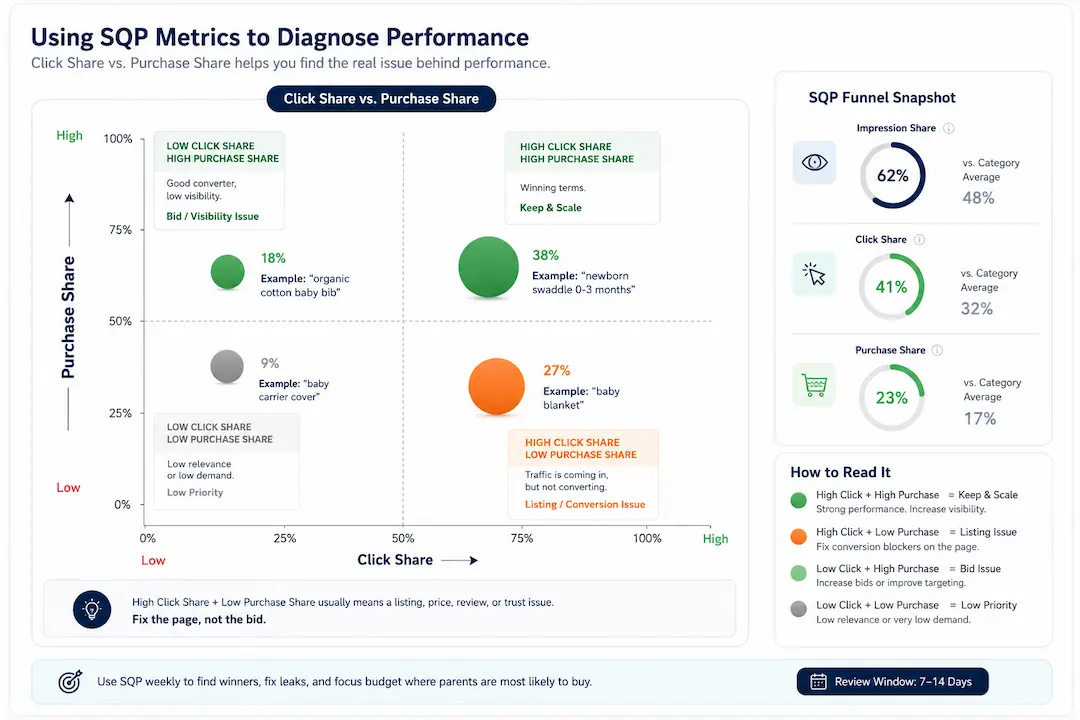
Strong impression share with weak click share means your listing is being shown but not chosen: the main image, title, price, or star rating is losing the scan. Strong click share with weak cart-add or purchase share means the click was earned but the product detail page did not close it, which in baby usually traces to thin reviews, a missing safety cue, or a price that lost the comparison.
The mechanics of that cart-add-to-purchase gap are worth studying closely, and our guide on the SQP cart-add-to-purchase drop-off walks through the diagnosis.
The point is that SQP separates a bidding problem from a listing problem. If you are winning impressions and losing purchases, no bid change will fix it, and pouring budget in just pays to send more parents to a page that cannot convert them. Fix the page first, then scale the spend.
Picture the query "breathable crib mattress" in your SQP export. Your impression share is a healthy 18 percent, so the category is showing your product often.
Your click share, though, is only 6 percent, which means parents are seeing you and choosing a competitor. That is not a bid problem, it is a scan problem: your main image, star rating, or the word "breathable" in your title is losing the half-second comparison.
Now picture a different query, "organic cotton swaddle 0-3 months," where your click share is a strong 14 percent but your purchase share falls to 4 percent. Here the click was earned and the page lost the sale, which in baby usually means thin reviews or a missing certification cue.
Two queries, two different fixes, and neither one is a bid. You pull both reads from the same export in the Amazon Ads Console or Seller Central, which is why a weekly pass through SQP is worth the twenty minutes it takes.
Not every query is worth winning. The ones that reward a baby brand cluster into three groups.
Age-stage queries ("0-3 months," "6-12 months," "toddler," "newborn") are precise, high-intent, and cheaper than the head term, so they are the fastest path to profitable rank.
A parent typing an age range has already narrowed their choice and is close to buying, which is why these long-tail terms convert well even though their individual volume looks small next to a generic head term.
Win a handful of them and the combined volume often beats one contested head keyword, at a fraction of the cost.
Problem-based queries ("colic," "reflux," "sleep," "teething," "on the go") are where parents describe the job they need done rather than the product they want.
Matching that exact language in your title, bullets, and ad copy converts far better than a generic feature list, because it tells the parent you understand their specific problem.
These queries also tend to carry strong emotional intent, since a parent searching "reflux" at 2 a.m. is motivated to solve it now.
Safety and material queries ("organic cotton," "breathable," "non-toxic," "certified") screen for trust, and if your product genuinely meets the claim, owning these terms captures a buyer who has already decided what they want.
The caveat is that your listing has to back the claim visibly, with the certification mark and the material spelled out, or the click converts poorly.
SQP tells you which of these three groups you already win, which you only rent through ads, and which you are missing entirely, so you can spend against the gaps instead of overpaying on terms you already hold.
Insight only matters if it moves a bid. Build a short weekly loop around the report. Harvest the queries where your purchase share is healthy but you are relying on broad or auto campaigns, and promote them into tightly controlled exact-match Sponsored Products campaigns where you control the bid.
Negate the queries where you spend and never convert, so broad discovery stops feeding the junk that drags your data down.
Defend the branded terms parents already type, because a competitor bidding on your name is buying a customer who was already coming to you, and SQP shows any erosion in your branded click share before ACoS alone would.
That branded-defense read is exactly what our guide on spotting branded cannibalization in SQP is built around.
Once that loop is running cleanly, the same SQP data feeds your other surfaces.
Retarget the shoppers who viewed but did not buy through Sponsored Display, which suits baby's long consideration window, and use the age-stage and problem-based queries to shape Sponsored Brands headlines and video that speak the parent's language directly.
Running this consistently across a growing catalog is where a done-for-you Amazon PPC management engagement earns its place, since the weekly discipline, not a one-time cleanup, is what compounds.
Two signals in SQP mean something particular in this category. The first is seasonality in query volume: baby-shower and holiday gifting lift certain SKUs, and registry cycles create steady, patient demand that rewards top-of-funnel spend generic advice would cut.
Watch query-level volume climb ahead of those windows and ramp before the auction heats up. The second is the repeat-purchase signal on consumables.
When a wipes or formula query shows a rising purchase share and you know Subscribe & Save is active, that first conversion is worth more than its ACoS suggests, so you can afford to bid harder to win the initial customer.
Both signals show up in SQP earlier than they show up in your sales reports, which is the whole advantage of reading the query rather than the outcome. This ties directly into the wider framework in our guide on how baby brands scale past $100K a month.
Reading SQP well takes time, and turning it into weekly action across a full catalog takes more.
If your ACoS has crept up, your sales have gone flat, or you cannot tell whether a weak query is a bid problem or a listing problem, an outside read usually finds the answer faster than another round of guesswork.
As a specialist Amazon PPC agency, Amplivus runs this SQP-driven work for baby and toddler brands every day.
If you would rather see the gaps before you decide anything, a free Amazon PPC audit will surface where your queries are leaking, and a short Amazon strategy session will map the first few moves to fix them.

Talk with an Amazon PPC strategist to uncover hidden search opportunities, improve campaign efficiency, and grow your baby brand profitably.
Get an Amazon PPC audit to uncover high-converting search queries, eliminate wasted spend, and improve your baby's brand SQP performance.