How Parents Search on Amazon: SQP Insights for Baby Brand PPC
Read more
.png)
The best Amazon PPC keywords for wearable breast pump brands are hands-free and use-case terms, not the generic, insurance-driven searches for basic pumps.
Summarize in ChatGPT
The best Amazon PPC keywords for a wearable breast pump brand are not the obvious ones. Fighting for the generic term breast pump means competing against basic, insurance-covered pumps that most new parents get for free, on a search that rarely converts for a premium wearable.
The efficient keywords are the ones the wearable category actually owns.
This guide is a keyword strategy for wearable breast pump brands on Amazon in 2026: the keyword categories that matter, why the insurance-covered buyer shifts intent, the claims to handle carefully as a medical device, and how to find your own best terms. It is a framework for building your keyword set, not a generic word dump.
Own the hands-free and use-case terms the category defines, and let your own data decide the specifics, rather than chasing the generic head term. The framework matters more than any single word.
Wearable pumps sit in a fast-growing, premium corner of the baby category, so the right keyword approach depends on your product and price, a progression mapped in our guide to Amazon PPC for baby brands.
The category is worth owning. The global wearable breast pump market was valued at USD 646 million in 2025 and is projected to grow at 8.6 percent a year through 2033, so demand for the category-defining terms is rising, not fading.
The mistake is fighting for breast pump alone. That head term is broad, contested, and heavy with insurance-covered basic pumps, so a wearable brand usually wins by owning the terms that describe what makes it different.
Start from your product's strengths, not the category as a whole. A quiet, discreet pump and a high-output workhorse win different searches, so the same keyword list rarely fits two wearables. What your pump does best decides which terms you can honestly own.
Competition also shapes the plan. A newer brand usually wins by owning specific feature and use-case terms first, then expanding toward the broad category terms as reviews and rank build behind it.
The main categories are category-defining, feature, use-case, problem, and branded or competitor terms, each with a different intent and value. Sort your list this way first.
Category-defining and feature terms are usually the most efficient. A shopper searching wearable breast pump or hands-free pump has already chosen the category and wants exactly what you sell, which a generic term cannot match.
Use-case terms are where the long tail pays off. Phrases like breast pump for working moms or discreet pump for the office are specific, less contested, and convert well, because the shopper has told you exactly why they want a wearable.
Problem terms sit close to the sale. A search like pumping at work or discreet pumping names a real need your product solves, so these convert strongly, as long as your listing speaks to that exact situation rather than a generic pitch.
The richest terms stack attributes. A phrase that combines a feature and a use case, such as quiet wearable pump for the office, is specific, less contested, and often the cheapest efficient conversion in the whole account.
Point each keyword at the feature your pump genuinely leads on, because a wearable competes on specific strengths, not the category in general. Honesty here lifts conversion.
If your pump is unusually quiet, own quiet and discreet terms. If its edge is battery life or portability, lean into travel and all-day terms. If it connects to an app, feature terms about tracking and control fit best.
The goal is alignment between the search, the ad, and the product. A shopper who lands on a term your pump truly satisfies converts far better than one drawn in by a broad claim the product cannot back up, so match keywords to strengths rather than chasing every term.
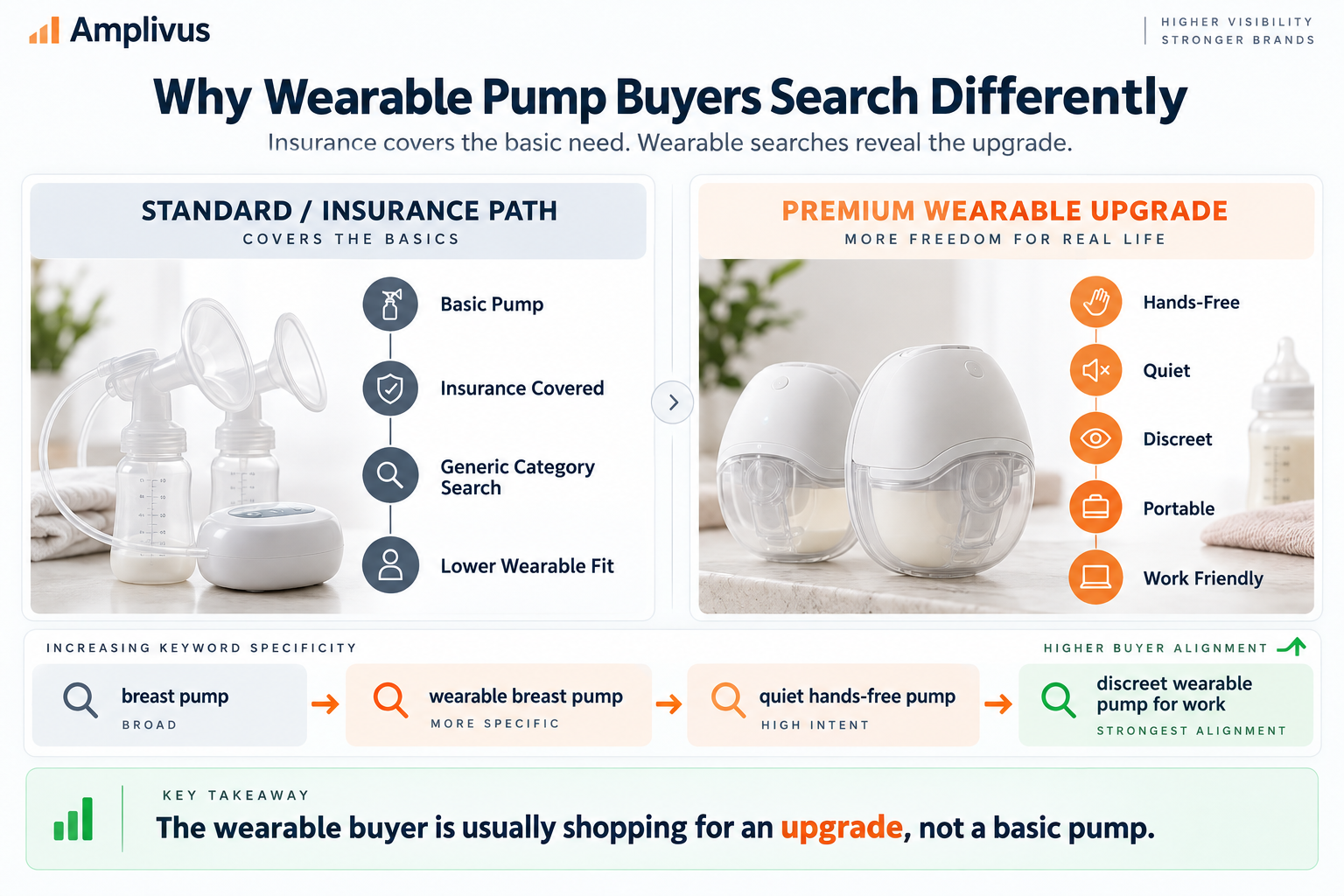
Because insurance covers standard pumps, most wearable buyers pay out of pocket to upgrade, so their searches skew to premium, discreet, and lifestyle terms rather than the basic head term. The free-pump path reshapes intent.
Under the Affordable Care Act, most health plans must cover a breast pump, so a large share of parents get a basic electric pump at no cost. That changes who is actually searching to buy.
The wearable shopper is usually an upgrader. They already have, or could get, a free basic pump, and they are searching for something better, so terms about convenience, discretion, and lifestyle signal a buyer ready to pay, while the bare term breast pump skews toward free-through-insurance intent.
Understanding that intent is half the battle, which is why reading how parents actually search matters, a discipline we cover in our guide on how parents search on Amazon.
You can see this in the search terms themselves. Wearable buyers rarely search the bare category word; they search for the benefit, the setting, or the feature, which is a clear signal to weight budget toward those terms over the generic head term.
It also shapes how you should read cost. Because this buyer has chosen to pay rather than take a free pump, a somewhat higher cost per click can still be efficient when the conversion and order value are strong, so judge these terms on profit, not a raw CPC.
Handle output and medical claims carefully, because breast pumps are FDA medical devices, and lean on hospital-grade with caution since it is not an FDA-defined term.
Compliance and efficiency point the same way here.
Breast pumps are regulated. The FDA treats breast pumps as medical devices, and it explicitly says the term hospital-grade is not recognized by the FDA and has no consistent definition, so building a keyword and listing strategy around it is risky.
Output claims need the same care. Terms and copy that promise more milk or a specific medical outcome are performance claims a regulated device must be able to substantiate, so describe the benefit honestly rather than overpromising.
Safe phrasing is a skill worth building. Describing measurable, provable features keeps you clear of regulated medical claims, while promising a specific health or output result invites both compliance and trust problems. The same discipline shapes your listing and your keyword choices.
The safer, more effective path is to compete on what you can prove: comfort, discretion, quiet operation, portability, and fit. Those benefits are both compliant and exactly what the wearable buyer is searching for.
Amazon's own policies add a layer, too. Beyond FDA rules, Amazon restricts certain medical and health claims in listings and ads, so a compliant keyword and copy strategy also keeps your account clear of the policy flags that can suspend a device listing.
Find them in your own data: read Brand Analytics and harvest converting terms from broad and auto campaigns, rather than copying a list. The best keywords are already in your account.
Your best keyword source is your own account. Brand Analytics and Search Query Performance show the exact searches shoppers use to reach products like yours, and which ones you already win.
Read those searches by intent and conversion, not just volume. The metric-by-metric discipline in our guide to Search Query Performance metrics applies directly to choosing which pump terms to fund.
Then let discovery do the work. Broad and auto campaigns surface terms you would never guess, and Amazon's own Sponsored Products best practices point to harvesting the winners into exact match while cutting the rest.
Make the search-term report a habit, not a one-off. New converting phrases appear as the category grows, so a brand that mines the report every week keeps finding cheap, high-intent terms competitors have not noticed yet.
Timing shapes demand, too. Much pump buying clusters around due dates, registries, and the return to work, so watching when your best terms spike helps you weight budget toward the moments a wearable buyer is actually shopping.
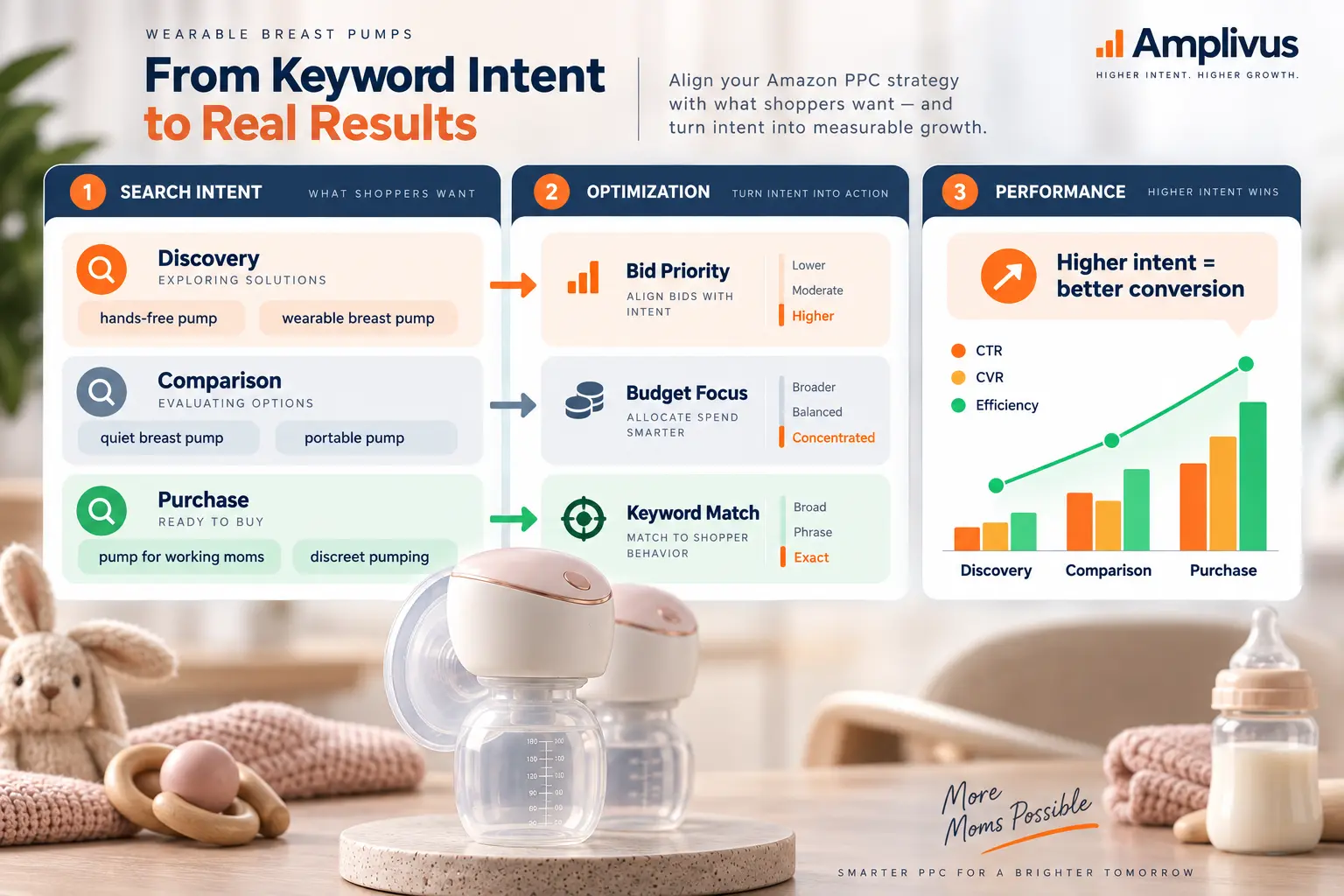
Group keywords into intent tiers, give the high-value ones their own campaigns, and separate branded, category, and competitor terms. Structure is where a list becomes a strategy.
On Sponsored Products, isolate your best category and use-case terms into their own campaigns so you can bid them deliberately instead of burying them in a broad average.
Control follows separation.
Match types do the sorting. Broad campaigns discover new phrases, exact campaigns convert the proven ones at a controlled bid, and keeping them separate is how you scale the good terms without losing control of cost.
Negatives protect the budget. Generic pump searches pull in insurance and unrelated traffic, so steady negatives keep spend on the wearable buyer, a discipline that scales with the account as covered in our guide to building a baby brand PPC strategy at $200K a month.
For your highest-value terms, tight ad groups pay off. Giving a proven keyword its own small, themed group lets you set a precise bid and budget for it, which is where a growing pump account recovers the control a broad campaign loses.
Budget should follow intent, not habit. Your proven category and use-case terms deserve the headroom to scale, while discovery terms run on a smaller, controlled budget, so the account funds what converts and still keeps finding new winners.
Defend your branded terms and selectively conquest competitor terms, because both are efficient in a category with a few well-known names. Neither should be left to chance.
Once shoppers search your brand, competitors will bid on it, so branded defense protects your cheapest, highest-intent conversions. Leaving your own name undefended hands ready-to-buy shoppers to a rival at the moment of purchase.
Conquesting is the mirror image. Appearing on a rival's terms where your pump genuinely wins on comfort, price, or reviews can pay off, and a structured Amazon PPC competitor analysis shows which competitor keywords are worth the spend and which are not.
Measure branded spend honestly. Because loyal buyers search your name and would often find you anyway, test whether branded ads add sales or simply shift them from organic, and defend hardest where the test shows you are genuinely under attack.
The common mistakes are chasing the generic head term, ignoring the insurance-driven buyer, leaning on hospital-grade, and skipping branded defense. Each one wastes budget on the wrong searches.
The first is pouring budget into breast pump, a broad term crowded with insurance-covered basics that rarely convert for a premium wearable. The second is ignoring that the wearable buyer is usually an out-of-pocket upgrader with premium intent.
The third is building the strategy around hospital-grade, a term with no FDA definition and real compliance risk. The fourth is leaving branded terms undefended, which quietly funds competitors bidding on your own name.
A fifth mistake is setting the keywords once and walking away. A fast-growing category shifts constantly, so a list left untouched for a quarter is already behind the searches shoppers are actually using.
As a specialist Amazon PPC agency, Amplivus builds wearable pump keyword strategy from your own data, your buyer, and your compliance position, not a borrowed list, so every term you fund is one your product can win and keep.
Day to day, that means disciplined Amazon PPC management that harvests new keywords, structures them by intent, and defends the terms that matter to your brand.
If you want to see which keywords are already working and which are leaking budget, a free Amazon PPC audit maps it, and a short Amazon strategy session turns it into a plan for the year.

Build a wearable pump keyword strategy around category fit, buyer intent, compliance, and the search terms your product can actually win.
See which category, feature, and use-case terms can drive more efficient wearable pump sales from your Amazon PPC now.