
How Parents Search on Amazon: SQP Insights for Baby Brand PPC
Read more
.png)
At $200K+/mo, baby brands grow by bidding on lifetime value up the age ladder, timing the next stage with AMC and DSP, and measuring new-to-brand.

Crossing $200,000 a month in the baby category is a different problem from getting there. Below that level the work is finding keywords that convert and buying rank.
Above it, the account already works, and growth comes from questions a smaller brand cannot afford to ask: how to move a customer up the age ladder before they drift to a competitor, how much a parent is worth across three years rather than one order, and how to reach new parents before they even start searching.
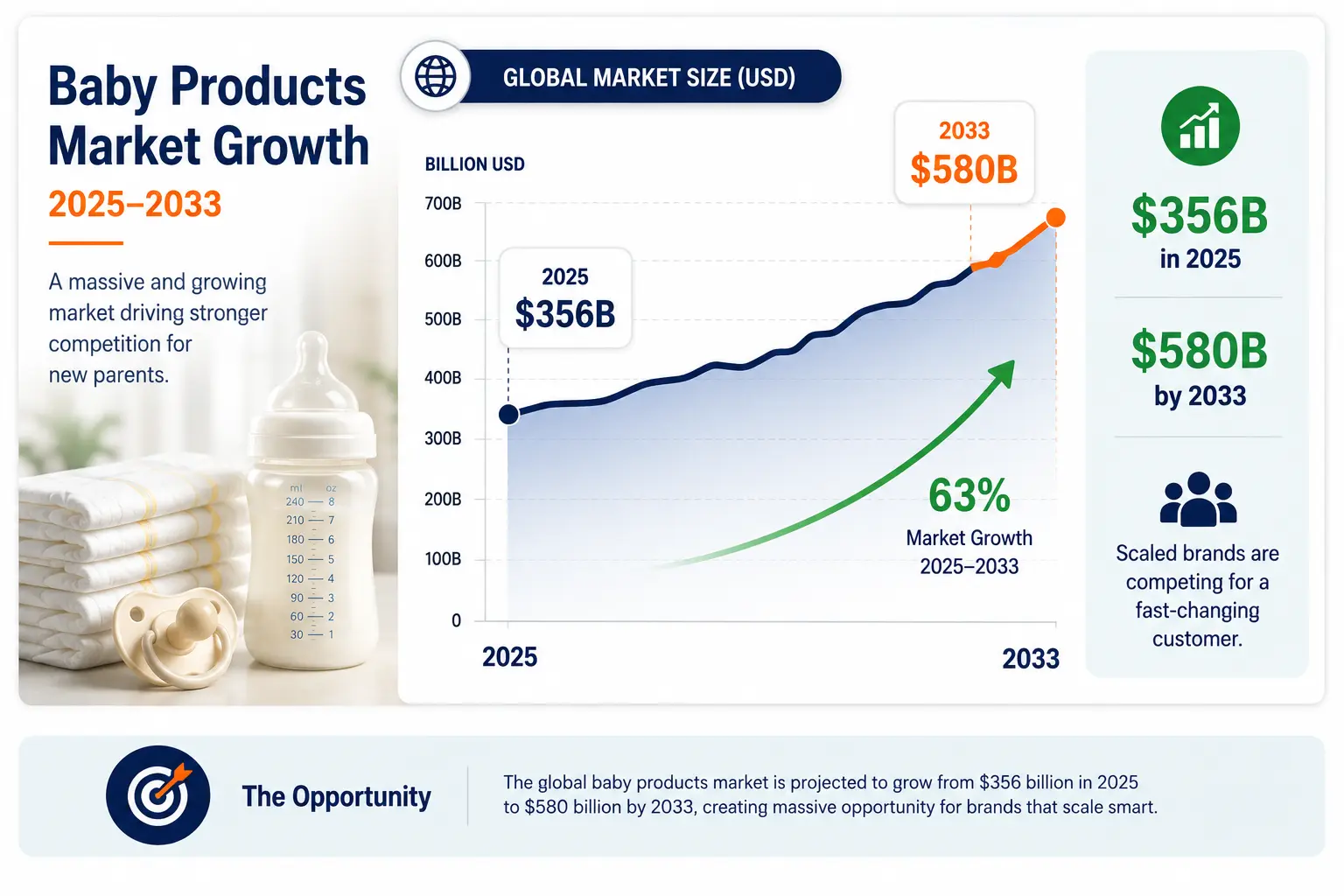
The global baby products market reached roughly $356 billion in 2025 and is projected near $580 billion by 2033, and at this scale you are competing with sophisticated incumbents for a customer whose needs change every few months.
The brands that keep growing change the questions they ask, not just the bids they set.
This guide is a practical playbook for baby brands already at $200,000 a month and up.
It covers the lifecycle cross-sell that drives growth, the subscription and lifetime-value math that should set your bids, the trust and safety discipline the category demands, and how Amazon Demand-Side Platform (DSP) and Amazon Marketing Cloud (AMC) earn their place at this size.
It builds on the tier framework in our guide on Amazon PPC by spend tier for baby and toddler brands, and applies the advanced moves in our guide on PPC strategy for 7-figure brands to baby specifically.
The defining feature of the baby category is that the customer is a moving target, and that changes where growth comes from at scale.
A baby outgrows a product in months. The newborn swaddle gives way to the sleep sack, the infant seat to the convertible, the stage-one toy to the stage-two.
That churn looks like a problem, but at $200,000 a month it is the biggest growth lever you have, because a parent who bought your newborn product is the warmest possible audience for your next-stage one.
The job is to move that customer up your own age ladder before a competitor catches them at the transition. Build campaigns and audiences that anticipate the next need rather than waiting for the parent to search for it fresh, and you turn a churning customer into a repeat one across years, not months.
The transitions themselves are the moments that decide it. A parent whose baby is about to outgrow the infant seat is, for a few weeks, actively in the market for the next one, and whoever reaches them in that window usually wins the sale.
Miss it, and the parent researches from scratch and may land on a competitor who happened to show up first.
That is why the age ladder rewards anticipation over reaction: the brand that knows roughly when its newborn customers will need the next stage, and is there at that moment, compounds a single acquisition into a sequence of purchases, while the brand that waits for each fresh search pays full acquisition cost again and again for a customer it already had.
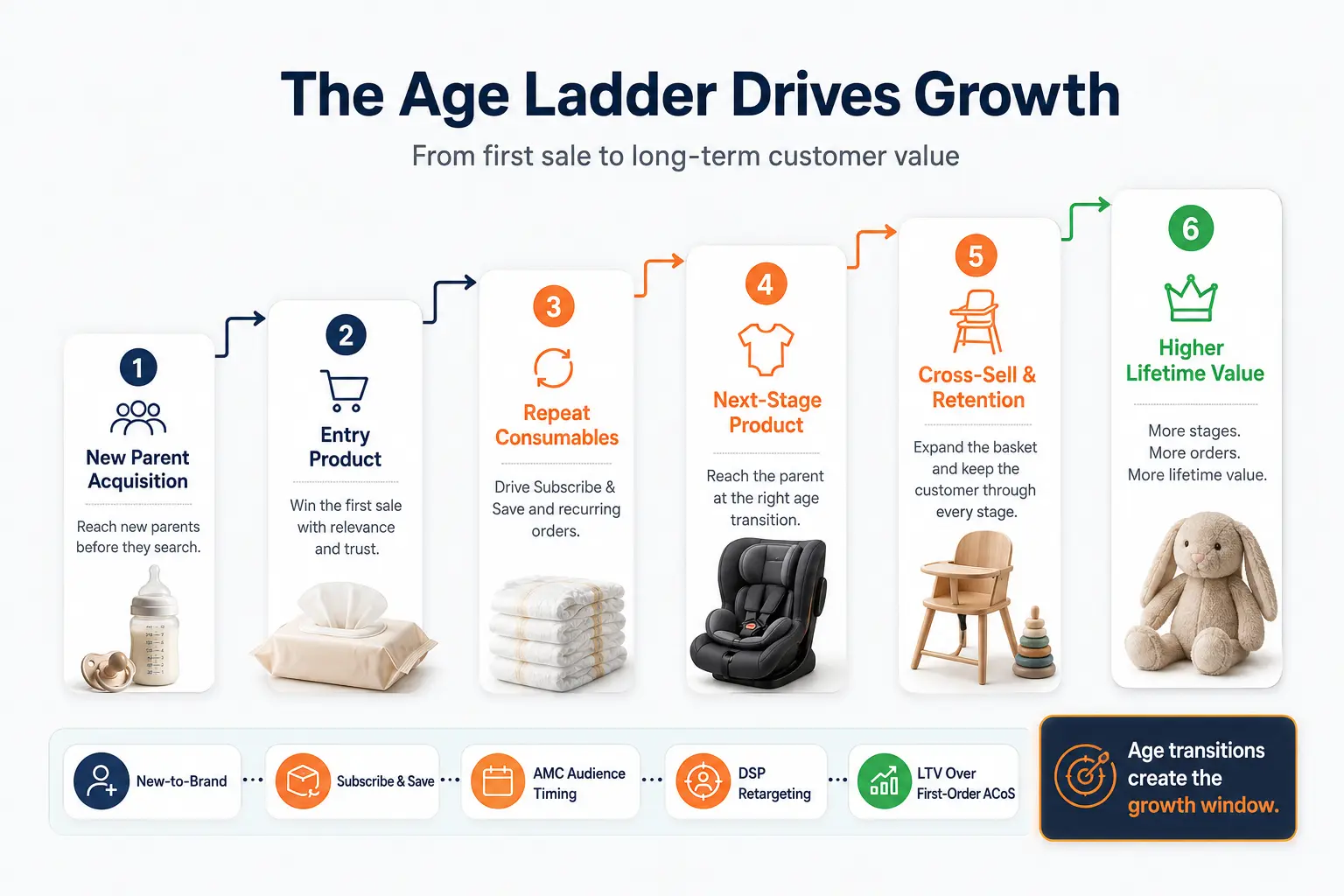
At this scale you are managing a portfolio, not a product line, and the organizing principle in baby is the age journey. Know which products are entry points that acquire new parents, which are the next rungs that retain them, and which are the consumables that recur throughout.
Fund each role differently: spend to acquire on the entry products even at a thin first-order margin, then rely on lifecycle marketing to capture the higher-margin next stages.
Reading how parents search at each stage, covered in our guide on how parents search Amazon and what it means for PPC, tells you which entry points actually lead somewhere.
If the age ladder is the engine, lifetime value is the fuel gauge, and it should drive your bids far more than first-order ACoS.
Diapers, wipes, and other baby consumables run on repeat purchase, and Subscribe & Save turns one acquisition into a stream of reorders that cost nothing further in ad spend.
That means a first sale is a down payment on a subscription, not the whole return, so a baby brand can accept a looser acquisition Advertising Cost of Sale (ACoS) than a one-off seller, because the customer value stretches across months of reorders.
Judge the campaigns that drive high-subscription-attach products on lifetime value, not the first-order ratio, or you will switch off the spend that is quietly building your most valuable asset.
The number worth watching, then, is not just ACoS by campaign but subscription attach rate by product, because that is what tells you which acquisition spend compounds into an annuity and which simply buys a one-time sale.
Two products can post the same ACoS while one quietly builds a base of subscribers and the other does not, and only the attach rate reveals the difference.
At $200,000 a month you have enough data to see this clearly, so use it: fund the products that convert to subscriptions harder than their first-order economics alone would justify, because the reorders repay the aggression many times over.
Total Advertising Cost of Sale, ad spend against total revenue including organic and repeat, is the metric that shows whether the engine is working.
When TACoS holds steady or falls while total sales climb, your paid spend is buying new parents who then reorder and move up the ladder organically.
When TACoS rises and sales stall, new spend is not converting into retained customers, and the fix is upstream in the listing or the targeting.
Push Sponsored Products to build the velocity that feeds this loop, and read the whole picture rather than the narrow campaign surface.
In no category does trust matter more than baby, and at scale a single lapse can erase a quarter of growth, so it belongs in the strategy, not the compliance folder.
Parents research obsessively and buy on trust, so reviews, safety certifications, and honest, specific claims do the converting that a discount cannot.
Many baby products are safety-regulated, and the CPSC's guidance on durable infant and toddler products sets mandatory standards that your listings and ad claims must respect.
Surface your certifications and testing prominently, keep claims accurate and substantiated, and never imply a safety benefit you cannot support.
Getting this right is not just compliance; it is the single strongest conversion asset you have with a cautious parent.
The flip side of a trust category is fragility.
A compliance slip, an overreaching safety claim, or a quality problem does not just risk suppression; it can damage the brand reputation that your whole premium position rests on.
At $200,000 a month you have a brand worth protecting, so treat claim discipline and safety compliance as a growth strategy, because the cost of getting them wrong is measured in lost trust, not just a paused campaign.
Protecting a brand at this scale is part of what a steady Amazon PPC management practice is built to watch.
Below this scale, Sponsored Products and Sponsored Brands do most of the work. At $200,000 a month, with a real base of customers and a lifecycle to manage, programmatic tools start to pay off.
Amazon DSP runs programmatic display and video on and off Amazon, and in baby its best use is timing.
Amazon Marketing Cloud audiences let you build segments from your own purchase data, so you can reach a parent who bought a newborn product a few months ago just as they enter the market for the next stage, or exclude recent purchasers from acquisition campaigns to stop paying for sales you already have.
That timing is the mechanism that turns the age ladder from a hope into a system, because it puts the next-stage product in front of the parent at the moment their need changes.
The other job for DSP at this scale is demand creation. New parents enter the category constantly, often before they know which brands exist, and upper-funnel display and video reach them earlier than search can.
Because the baby category has a steady stream of first-time buyers, the brand that introduces itself early, during pregnancy and the newborn weeks, wins the customer for the whole journey that follows.
Judge this spend on new-to-brand sales and lifetime value, not a search-style ACoS, or you will cut the very spend that fills the top of your funnel.
Once you own the demand already searching for you, growth has to come from new households, and the metric changes to match.
New-to-brand sales measure the share of your purchases going to customers who have not bought you in the past year, and in a category with constant new entrants it is the clearest read on whether you are growing the base or recycling it.
A high new-to-brand rate means your spend is genuinely acquiring the next cohort of parents, which is exactly what a scaled baby brand needs, because your existing customers are aging out of the category on a fixed clock.
Read it alongside lifetime value, because a new parent acquired at a high first-order cost is a good trade when they buy up the ladder for years.
This is the same growth lens laid out for large accounts in our guide on why educational toy brands convert on Amazon, applied here to the parent lifecycle.
Baby carries a demand source most categories lack: gifting.
Registries, showers, and gift-buyers purchase on someone else's behalf, often at higher price points and with different search language, so build campaigns that capture that intent around the terms and seasons gift-buyers use.
A gift purchase also introduces your brand to a new parent who may become a direct customer, so treat registry and gifting demand as both a sale and an acquisition channel, and fund it deliberately rather than letting it fall through the gaps between your everyday campaigns.
The parent who receives your product as a gift and loves it becomes exactly the warm audience your lifecycle campaigns are built to move up the ladder, so a gift sale is very often the first rung of a long customer relationship rather than a one-off.
At $200,000 a month the gains are no longer obvious, and they hide in places a busy team rarely has time to dig: acquisition judged on the wrong metric, a lifecycle that leaks customers at each transition, or AMC data sitting unused while parents drift to rivals.
An outside review that reads lifetime value, the age journey, and the full funnel rather than the ACoS column tends to find both waste to cut and growth to fund.
That is a specialist's job, and at this scale the return on getting it right dwarfs the cost of the review.
As a specialist Amazon PPC agency, Amplivus works with scaled baby brands on exactly these questions, and a structured Amazon PPC competitor analysis shows where incumbents are taking share you could hold.
A free Amazon PPC audit reviews your account for the leaks and missed levers at your scale, and a short Amazon strategy session maps the highest-value moves for the year.

Get a focused PPC review that uncovers lifecycle leaks, weak new-to-brand growth, wasted DSP spend, and missed age-stage cross-sells.
Build bids, budgets and audiences around repeat purchases, age-stage cross-sells, and profitable new-parent acquisition.


.png)
.png)


.png)
.png)