Amazon PPC for Baby and Toddler Brands: 2026 Strategy by Spend Tier
Read more
.png)
Educational toy brands convert better because parents buy the developmental benefit, not the toy. Match by leading with that benefit in listings and PPC.
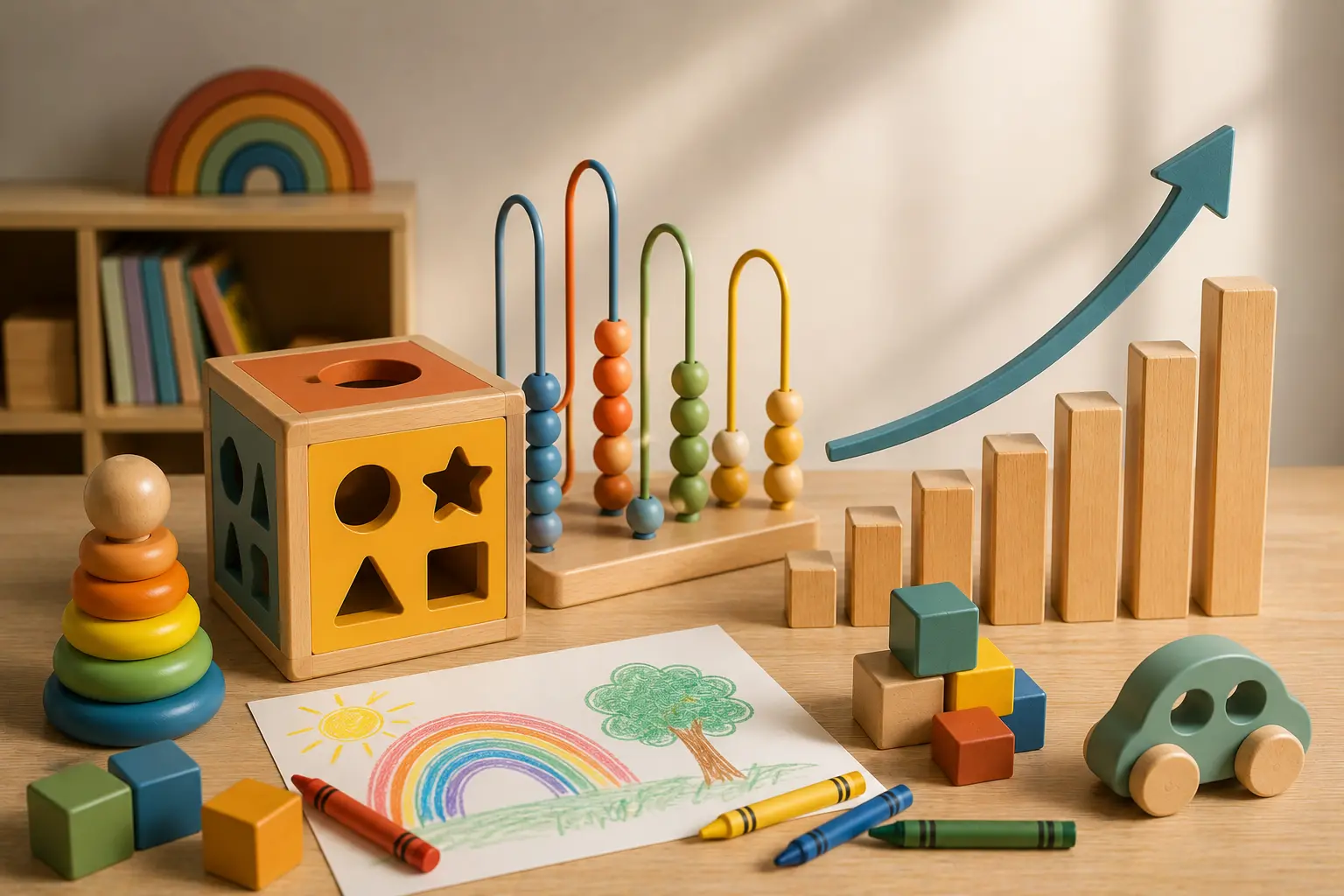
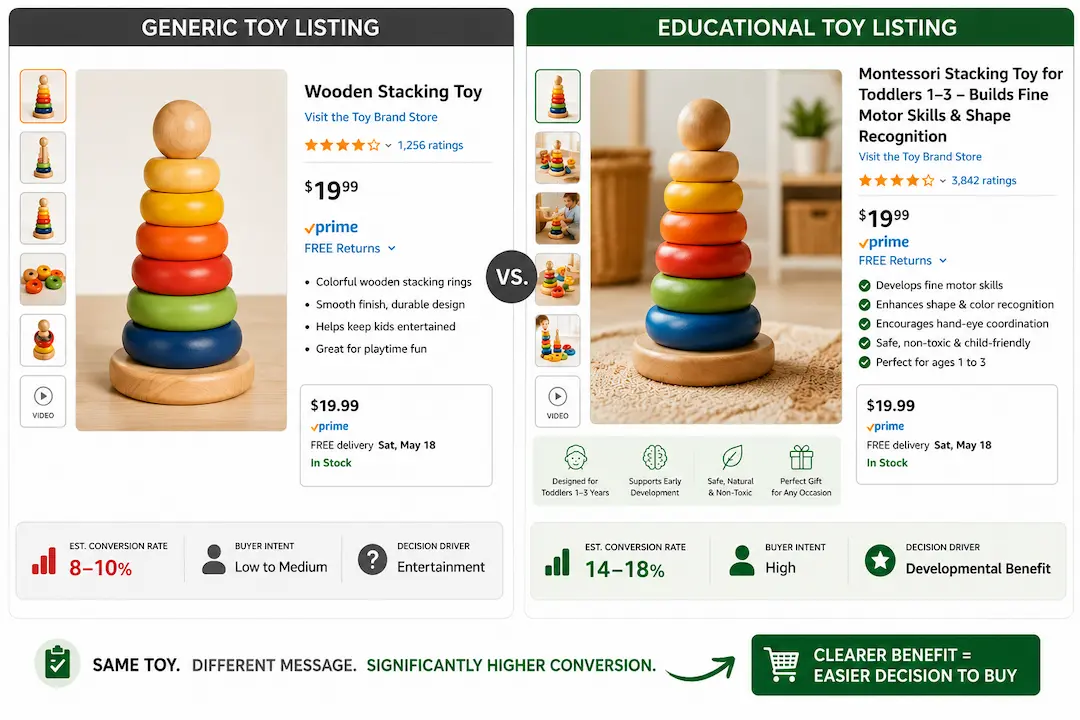
Two toys can sit side by side on Amazon at the same price, with the same star rating, and convert at wildly different rates. One is described as a "colorful stacking toy."
The other is a "Montessori stacking toy that builds fine motor skills and shape recognition, ages 1 to 3." Same object, in many cases. Very different result.
The second one sells the outcome a parent is actually shopping for, and that is the whole reason educational toy brands tend to convert better on Amazon.
This guide is for toy, baby, and juvenile brand owners running Amazon ads who want to understand that gap and close it, whether or not their product is strictly "educational."
You will learn why the developmental angle converts, what that higher conversion does for your PPC economics, and the specific moves that let any well-made toy match the effect.
For a deep dive on one niche that does this exceptionally well, our Montessori toy brand PPC playbook shows the category-specific version; here the lens is the conversion driver itself.
The short answer is that parents buy educational toys with a justification already in mind, and a justified purchase converts faster than an impulse one.
A parent shopping for a plain toy is browsing. A parent shopping for a toy that "builds early math skills" or "develops hand-eye coordination" is solving a problem they feel responsible for solving.
The US educational toys market keeps growing precisely because that motivation is durable: parents consistently pay for products they believe help their child develop. The benefit is not a marketing gimmick either.
The value of learning through play is well established in child development, which is why the framing resonates rather than feeling like a stretch.
Underneath that sit three emotional drivers that a listing can speak to directly. There is aspiration: every parent wants to give their child an edge, and an educational toy feels like an investment in the child's future rather than a purchase.
There is guilt relief: in a screen-heavy world, a toy that promises hands-on, screen-free engagement lets a parent feel good about the buy. And there is gift confidence: educational toys are the safe, thoughtful gift for a birthday or a shower, because they signal care.
When your listing answers those drivers, a shopper who was comparing five products stops comparing and buys. That is conversion rate moving, and it moves for reasons a generic toy listing never touches.
There is a structural reason the effect is strong on Amazon specifically. The toy industry is enormous and crowded, and a crowded shelf is exactly where a clear reason-to-buy separates one product from ten look-alikes.
When a parent lands on a search results page showing a dozen similar stacking toys, the one that names a developmental outcome gives the brain a shortcut: this is the responsible choice, stop looking.
That shortcut is worth more the more crowded the category gets, which is why the benefit angle tends to outperform even when the underlying product is comparable. It is not that educational toys are better toys. It is that they give the shopper a faster, cleaner decision, and a faster decision is a higher conversion rate.
Most sellers treat conversion rate as a listing concern and bids as the PPC concern.
They are the same concern.
Your effective cost per sale is your cost per click divided by your conversion rate, so a listing that converts at 16 percent pulls a third more sales from the same clicks as one at 12 percent, at the same ad spend.
That gap compounds on every budget increase you make afterward.
It also feeds rank. Amazon rewards products that convert a search into a purchase, so the educational toy that converts better on a keyword climbs the organic results for that term faster, which lowers how much paid pressure you need to hold the position later.
That is the flywheel, and it is why conversion is the single most valuable thing you can fix before scaling spend.
We break the mechanism down fully in our Amazon PPC halo effect playbook, but the takeaway for a toy brand is simple: a better-converting listing makes every ad dollar cheaper, and pouring budget into a listing that cannot close the sale just pays to send more shoppers to a page that loses them.
This is also the difference between a brand that plateaus at $40K a month and one that keeps climbing, a pattern our guide on how baby brands scale past $100K a month traces in full.
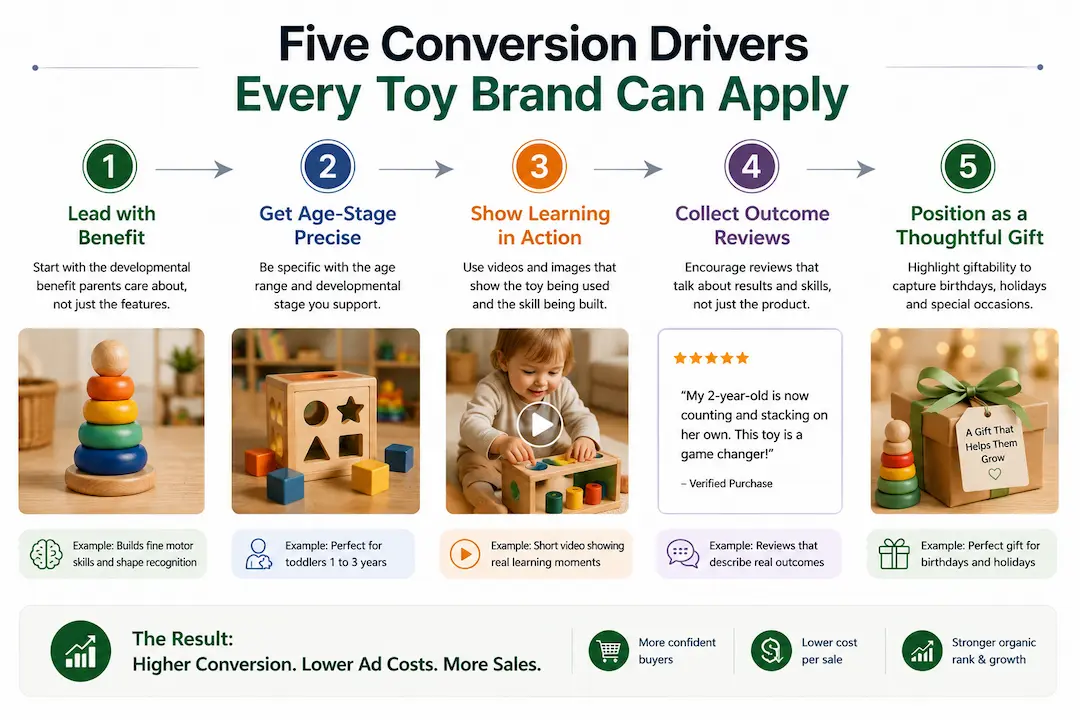
You do not need to relabel your product as "educational" to capture this effect. You need to surface the developmental benefit that is probably already there. Five moves do most of the work.
"Wooden stacking rings" is a feature. "Wooden stacking rings that build fine motor skills and color recognition for ages 1 to 3" is a benefit tied to an outcome a parent wants.
Rewrite your title, first bullet, and main image copy so the developmental payoff is the first thing a shopper reads, not a detail buried in the fifth bullet. The feature earns the click; the benefit closes the sale.
Parents shop by their child's exact stage, so "ages 1 to 3" or "18 months and up" is not a detail, it is a qualifier that filters out the wrong buyer and reassures the right one. Precise age-stage framing raises conversion because it removes the "is this right for my kid" hesitation that kills a considered purchase.
It also opens cheaper, higher-intent keywords, which our guide on how parents search on Amazon covers in detail.
A photo shows the toy. A short Sponsored Brands Video shows a child using it, which answers the question a parent cannot resolve from a static image: what does the play actually look like, and will my child engage with it.
Fifteen seconds of a toddler stacking, sorting, or building does more to convert a cautious parent than any bullet point, and video earns cheap, high-intent clicks at the top of search.
Video ads require Amazon Brand Registry, so if you have not enrolled, treat that as step zero, because it also opens Sponsored Display and the brand-defense formats you will want later.
The clip does not need a studio: natural light, a real child, and a clear view of the developmental action beat a polished but abstract product montage every time, because the parent is buying the engagement, not the production values.
A review that says "great toy, good quality" is fine. A review that says "my two-year-old learned her colors with this in a week" is a conversion machine, because it is social proof of the exact benefit you are promising. Prompt buyers through Amazon's legitimate follow-up programs to describe what their child learned or did, not just whether they liked the toy, and the review base itself starts closing sales.
Educational toys are the default responsible gift, so make the gift case explicit.
Signal the occasion (birthday, baby shower, holiday), the age fit, and the "feels good to give" angle in your imagery and copy, and you capture the large share of toy purchases that are gifts rather than self-buys, especially heading into Q4.
A gift buyer converts differently from a parent buying for their own child: they are less price-sensitive, more reassured by reviews and certifications, and more likely to buy on the first visit if the listing removes doubt about age fit.
Answer those specifics and you win a shopper who was never going to spend an hour comparing.
You do not have to take any of this on faith. After you rewrite a listing around the benefit, watch conversion rate and click-through rate on your priority keywords over the next few weeks.
A rising conversion rate on the same traffic is the benefit angle working, and a rising click-through rate on your ads means the promise is landing in the search results before the click. If both move and your Total Advertising Cost of Sale drifts down while revenue holds, the change is paying for itself.
If click-through rises but conversion does not, the ad is over-promising what the page delivers, and the fix is on the page. Reading the two numbers together tells you exactly where the story breaks.
Once the listing sells the benefit, your ads should feed it the right traffic.
Bid on the benefit-and-problem queries parents actually type ("learning toys for toddlers," "fine motor skills toy," "screen-free toys," "STEM toys ages 4 to 6") rather than only the generic head term, because those queries carry the exact intent your listing now answers, at a lower cost per click.
Use Sponsored Products exact-match campaigns built from the age-stage and developmental terms your search-term data shows converting, and negate the generic "toy" traffic that browses without buying.
Layer Sponsored Brands Video on your category head terms to introduce the brand to new shoppers with the play in motion, and use Sponsored Display to retarget the parents who viewed but did not buy, since a gift purchase often takes more than one visit.
Running that loop consistently, with the ad copy and the listing telling one coherent benefit story, is where a done-for-you Amazon PPC management engagement earns its keep, because the coherence between ad and page is what lifts the whole account's conversion rate.
Toys live and die by the gifting calendar, and educational toys especially, because the responsible-gift buyer shows up in force around birthdays, baby showers, and Q4. Demand and cost per click both climb from October through December as every toy brand competes for the same impressions, so the brands that win build reviews and rank in the quiet months, then raise budgets and defend their benefit-rich keywords through the peak.
The quiet stretch from January through the summer is not downtime, it is your build window: that is when clicks are cheapest, when you should be harvesting new age-stage keywords, and when a listing rewrite has time to earn the reviews and rank you will cash in during the fourth quarter.
Gift sets and bundles deserve their own Q4 campaigns, because holiday shoppers search "gift" intent that your everyday age-stage keywords miss.
Sync ad budgets to your restock cycles too, because selling out mid-December on a hero SKU loses the rank you spent all year building.
A guide gets you the strategy. What it cannot do is look inside your account and tell you which keyword is leaking or which listing is losing the click.
If your ACoS has crept up, your sales have gone flat, or you are about to scale spend into Q4, a structured review of your search-term reports, listing conversion, and campaign structure usually finds money faster than another round of guesswork.
As a specialist Amazon PPC agency, Amplivus runs this benefit-first work for toy and baby brands every day.
If you would rather see the gaps first, a free Amazon PPC audit will show where your conversion and spend are leaking, and a short Amazon strategy session will map the first moves to close them before the gifting season starts.

Talk with an Amazon PPC strategist to improve conversion rates, strengthen your PPC strategy, and grow toy sales with less wasted spend.
Get an Amazon PPC audit to improve listing conversion, attract higher-intent shoppers, and lower wasted ad spend across your toy catalog.