How Amazon Brands Scale Past $100K/mo With PPC
Read more
.png)
In 2026, Amazon Ads shifted toward precision. CPCs rose 8-12%, Sponsored TV and DSP opened up, and AMC Audiences now power smarter bidding across ad types.
Summarize in ChatGPT
A practitioner's read on what genuinely changed in Amazon Ads in 2026, and what an established brand should adjust.
If you run a mature Amazon catalog, you have probably felt it.
The same campaigns cost more, the dashboards look different, and every "trend" post says something big shifted without telling you what to do about it. So let us cut through it.
This is a practitioner's read on Amazon Ads 2026: what genuinely changed, what is noise, and what an established brand should adjust.
If you are launching your first product, most of this still helps, but it is written for brands with a real catalog, existing rank, and ad spend they cannot afford to waste.
For that reader, the danger is rarely a dramatic failure. It is slow erosion: costs creeping up while an old playbook runs on autopilot.
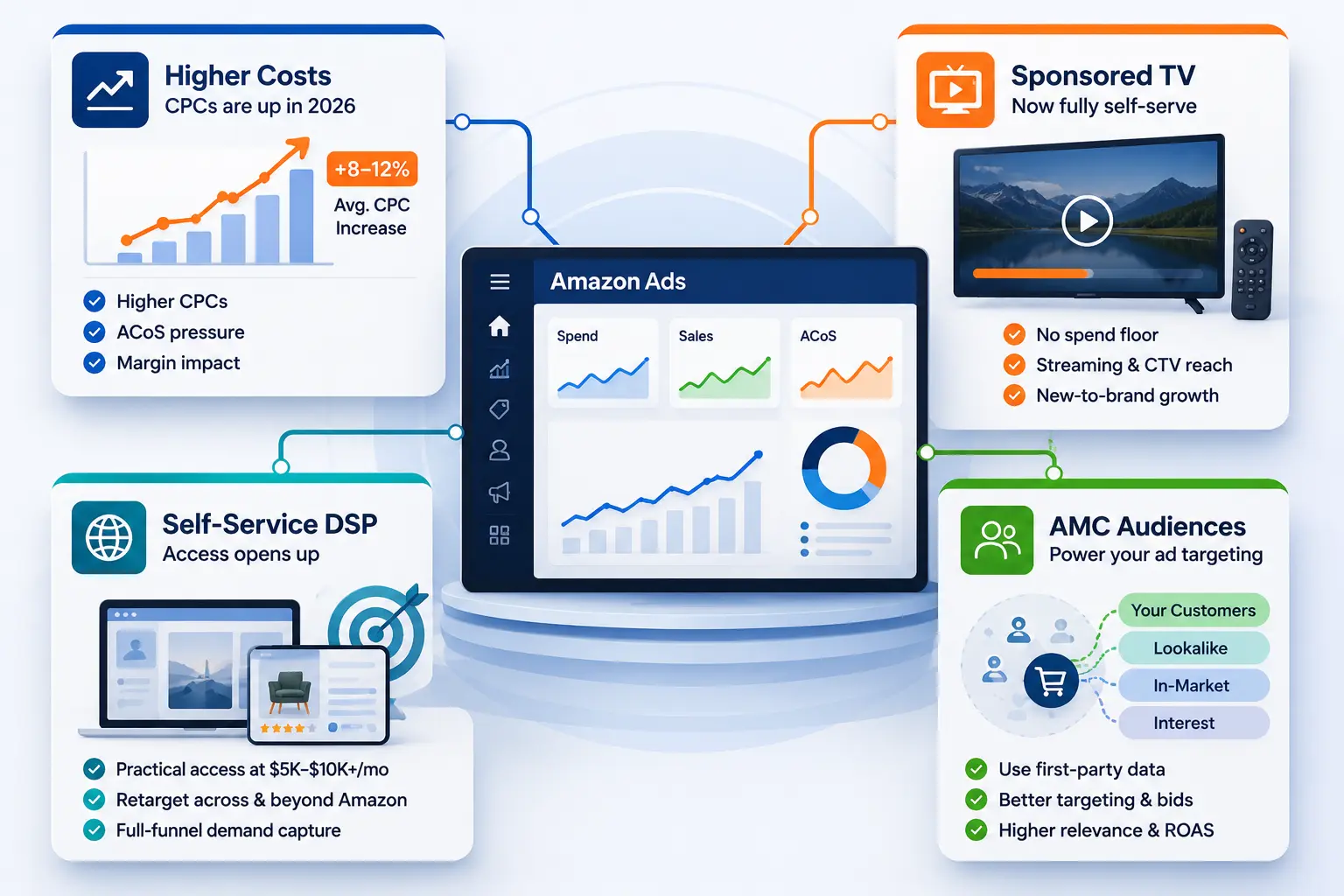
Four things matter most this year. Costs went up, with average CPC rising roughly 8 to 12% over 2025 and competitive categories climbing far more.
Sponsored TV went fully self-serve with effectively no spend floor, opening streaming to brands that were locked out. Self-service Amazon DSP opened up, with practical access reported around $5,000 to $10,000 a month (most practitioners recommend $10,000-plus), versus the older managed-service minimums.
And AMC Audiences now feed your Sponsored campaigns, so first-party data can adjust bids and targeting directly.
Everything else is a variation on those four.
A quick self-audit. If your account still runs on the left column, you have catching up to do.
The headline number: ad costs climbed. Many accounts now see CPCs around $1.00 to $1.25 on average, up 8 to 12% year over year across 2026 benchmark studies, part of the broader rise in Amazon's advertising revenue tracked by Statista.
Competitive categories got hit hardest, with steep CPC inflation in categories like beauty, while steadier categories such as industrial B2B stayed close to flat.
A rough 2026 baseline for a healthy account looks like this: ACoS in the 20 to 40% band, ROAS of 2.5x to 5.0x by category, and CPCs anywhere from $0.75 to $3.50 depending on what you sell.
As a rule of thumb, an ACoS in the high 20s tends to beat the category average, while a figure in the mid 30s or higher usually points to something structural worth a look. Treat these as directional, not absolute.
Why does this matter for established brands specifically? Because more validated brands moved onto Amazon, bidding up the exact high-intent keywords you rely on. Your defensive terms now cost more to hold.
There is a margin trap hiding in this: if your CPC climbs 10% and your conversion rate stays flat, your ACoS climbs with it, quietly, on the same campaigns you have run for years.
So the first job is not a new campaign. It is a re-baseline. Pull your trailing 90-day CPC and ACoS, then compare against the current ranges before you decide anything is "working" or "broken."
Watch Total ACoS (TACoS) too, not just campaign ACoS, since TACoS measures ad spend against total sales and shows whether your ads are pulling organic rank or just renting it, a mechanic our guide on how Amazon PPC drives brand discoverability covers in full.
The takeaway is not "spend less." It is "spend with more precision," which is what the rest of this year's changes make possible.
This is the change most established brands underuse. Sponsored TV, now folded into Amazon's streaming TV ads offering, became fully self-serve with effectively no enforced spend floor.
You can run streaming and connected-TV style ads without the old managed-service barrier.
The 2026 version also brought native targeting (lifestyle, in-market, and ASIN-remarketing audiences that used to require workarounds), and attribution improved with AMC reporting and on-Amazon conversion lift.
So should you run it? Say yes to all three, and it is worth a structured test:
If your unit economics are thin or your creative is weak, fix those first. Streaming amplifies what you already have.
It does not rescue a shaky offer. Picture a household kitchen brand with a strong bestseller and steady reviews, whose growth flattened because everyone in the niche bids on the same words.
That is the right profile: not buying awareness blind, but extending a proven offer to shoppers who have not met the brand yet, then watching new-to-brand orders and detail-page traffic for lift.
Set it up like an experiment, not a campaign. Hold your other spend steady, give it a fixed budget and window, and judge it on new-to-brand growth and halo on your hero ASIN, not on last-click ROAS alone, since streaming rarely shows its value in a last-click view.
Prime Video Ads placements now include the home-screen Feature Rotator, Sponsored Tiles inside content rows, and profile-page carousels.
These sit closer to brand and DSP work, so treat them as part of an upper-funnel plan, not a quick-win lever.
Amazon DSP, the Demand-Side Platform for programmatic display, video, and audio, historically meant a large commitment through managed service only.
In 2026, self-service DSP is practical for brands in the $5,000 to $10,000 a month range, with no formal floor on the self-serve tier, though most practitioners recommend at least $10,000 a month to gather enough data to optimize.
Managed service still carries the larger minimums, commonly reported at $50,000, for hands-off buying and premium inventory like Prime Video.
For an established brand, DSP earns its place when you want to retarget shoppers who viewed but did not buy, reach audiences off the product detail page, and build measurable new-to-brand reach.
A sensible first build looks like three lines: one campaign to retarget detail-page viewers who did not buy, one to retarget past purchasers for repeat and cross-sell, and one small prospecting line using an AMC or in-market audience.
Keep the prospecting budget the smallest of the three at first. Retargeting your own warm traffic almost always returns faster, so let it prove the channel before you widen reach.
The honest caveat: self-service DSP rewards operators who watch it. Left on autopilot, it can spend without returning. Start narrow, retarget your own detail-page visitors first, and expand only when the data holds.
This is the same discipline our guide on scaling Amazon PPC past $100K a month applies to every new surface.
Amazon Marketing Cloud (AMC) used to be a measurement room you visited after the fact. In 2026, it became an input to your live campaigns.
You can now build AMC Audiences (rule-based or lookalike) and apply them directly to Sponsored Display targeting, or as bid boosts inside Sponsored Products and Sponsored Brands.
Build a rule-based audience of shoppers who bought a complementary product in your catalog but never bought your hero ASIN, and apply it as a Sponsored Products bid boost.
You now bid harder for people most likely to convert, and softer for everyone else. Second, build an audience of recent purchasers and apply it as a negative or lowered bid on prospecting campaigns, since there is little point paying top dollar to reach someone who bought yesterday.
Third, build a lookalike from your highest-value repeat buyers and feed it into Sponsored Display or DSP prospecting, pointing spend at shoppers who resemble your best customers rather than the broad market.
That is full-funnel logic running inside campaigns you already manage, and it is the single biggest "do this now" item for brands sitting on real first-party data.
Amazon has also been rolling out a rule-based bidding option for Sponsored Products (reported as a beta) that automatically optimizes ROAS within the campaign budget, adjusting bids through the day.
Confirm availability in your own account before relying on it. Paired with AMC Audiences, it gives you automation with a brain.
Targeting is only as good as the signals behind it.
Three sources deserve a weekly look. Brand Analytics gives you search terms, click and conversion share, and demographic context to find where you are losing the click.
Search Query Performance (SQP) shows query-level funnel data (impressions, clicks, purchases) against the category, and our walkthrough on how to read your Amazon SQP report shows where to start.
Amazon Marketing Stream adds near-real-time hourly signals, useful for dayparting and fast budget shifts. Most established teams own this data and never open it. That is free advantage left on the table.
With more brands crowding your category, defense matters more than it did a year ago.
Your own brand searches are the cheapest, highest-converting clicks you have. If a competitor is bidding on your brand name and you are not, you are handing them warm shoppers at a discount.
Run a Sponsored Brands campaign on your own brand terms so your storefront and best products own the top of that page. It is low cost and protects ground you already earned.
Then watch Brand Analytics for terms where your click and conversion share is slipping, because a falling share on a core term is an early warning, usually cheaper to fix now than after a quarter of drift.
Our guide to branded traffic cannibalization in SQP shows how to read that signal. Defense is not glamorous, but for a mature catalog it often protects more revenue than any new format.
Seller Central still shows campaigns, but the Amazon Ads Console is the fuller home for modern features: Sponsored TV, AMC, DSP, and richer reporting.
If your team still lives only inside Seller Central, you are working with a partial view. Move day-to-day management to the Ads Console and use Seller Central for catalog and order operations.
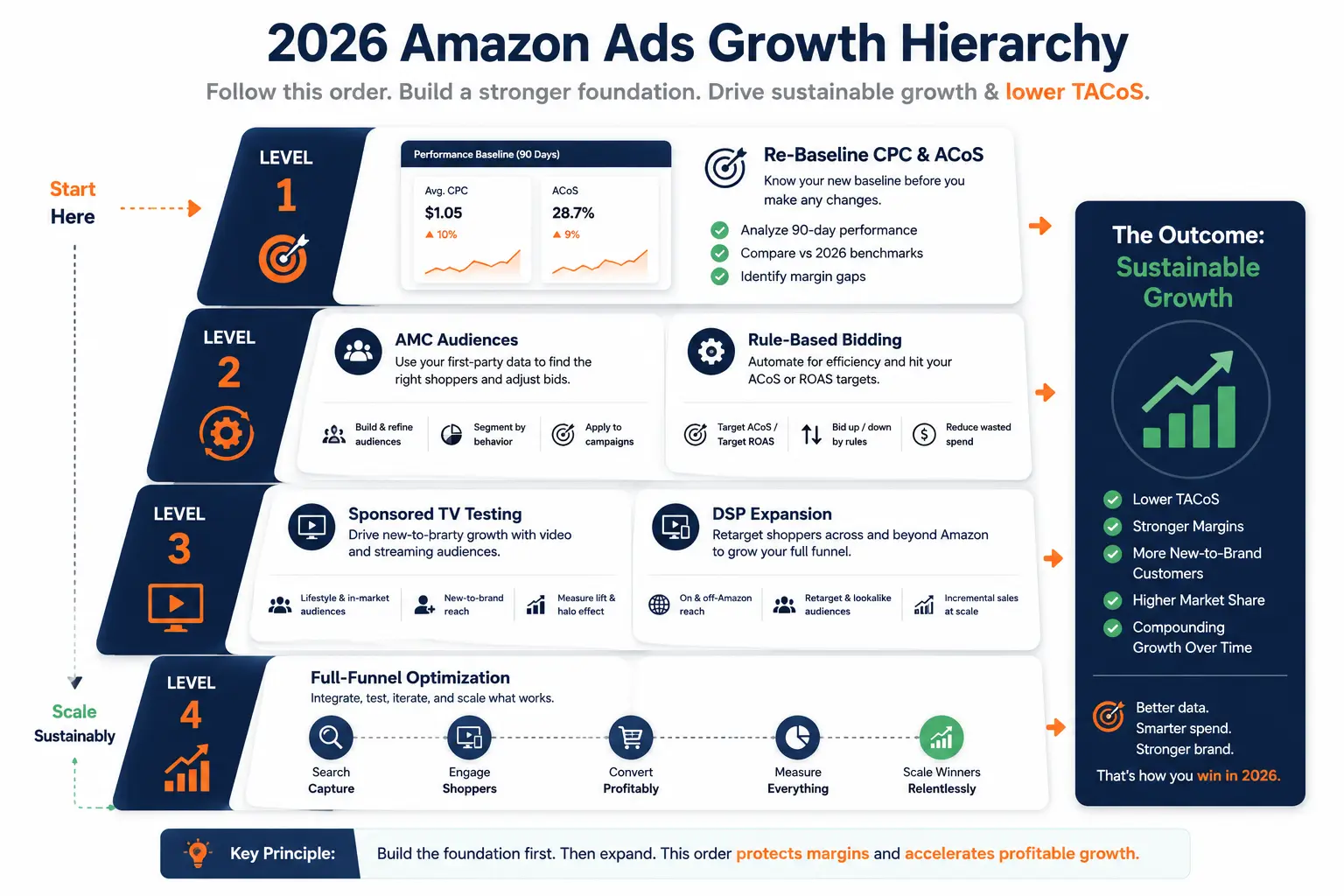
A practical order of operations for the next quarter. Work it in this order, because re-baselining first stops you from "fixing" campaigns that were fine and chasing ones that were quietly bleeding.
You do not need all six live in week one. Pick the first two, prove them, then add the rest. Momentum from a clean baseline beats a dozen half-run experiments.
The expensive errors this year are quiet, not dramatic. Assuming nothing changed is the biggest risk, letting drift compound while costs climb. Judging 2026 campaigns by 2024 ACoS targets.
Dabbling in Sponsored TV with a one-week test that tells you nothing. Running self-service DSP unattended, when it needs an operator. Ignoring first-party data while AMC and Brand Analytics sit right there. Chasing every new format at once.
Skipping brand defense and inviting competitors to buy your warm traffic. And judging upper-funnel ads on last-click ROAS. The brands winning this year are not doing everything.
They are doing a few new things well, with discipline.
Amazon Ads in 2026 did not reinvent itself. It matured. The tools got smarter, the data got closer to the campaign, and the cost of standing still went up.
For an established brand, the move is simple to say and harder to do: spend with more precision, use the data you already own, and test the new surfaces that fit your offer.
If you want a second set of eyes on where your account stands against these 2026 changes, Amplivus runs structured audits and full-funnel management for established Amazon brands.
Start with a free PPC audit, review full-service PPC management, or book a strategy session to map your quarter. The year rewards the brands that adjust early. The playbook is on the table.

Higher CPCs, AMC audiences, DSP, and Sponsored TV require a smarter playbook. See exactly where your account should evolve.
Turn 2026 ad changes into profit with expert Amazon PPC management built for established brands.