
Amazon PPC for Baby Brands: How to Scale Past $100K/mo Without Losing Margin
Read more
.png)
Dog brands win with Sponsored Brands Video by pairing vertical creative and a tight shot list with split targeting, measured on click-through and new-to-brand.
Dog products are one of the best fits on all of Amazon for Sponsored Brands Video, and most dog brands still underuse it.
The category is large, the buyer is cautious, and the single question holding back a sale, will my dog actually use this, is exactly what a three-second clip answers better than any bullet point.
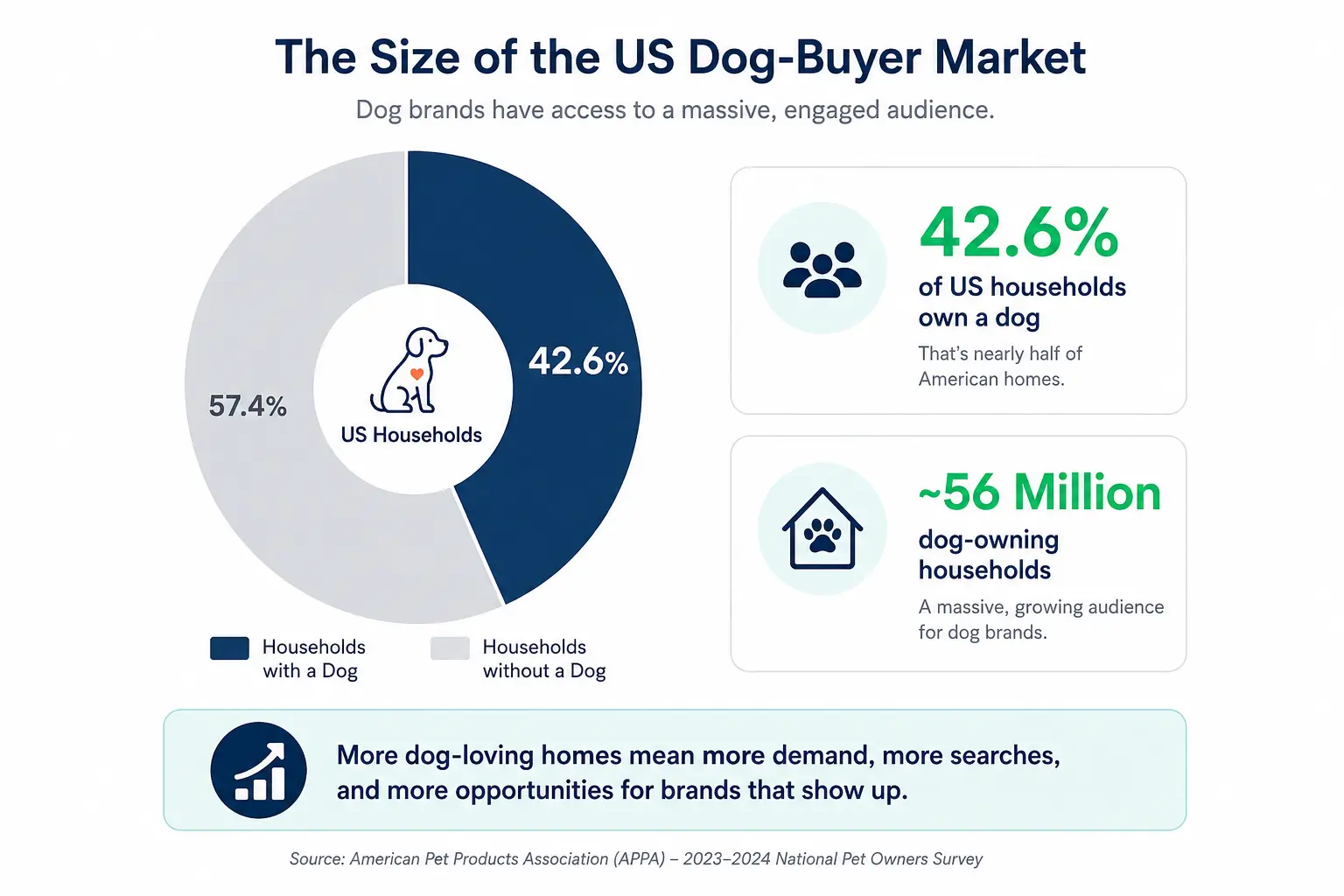
With 42.6 percent of US households owning a dog, roughly 56 million homes, the audience is enormous, and the brands that show their product in motion, a dog settling into the bed, eating the food, chewing the treat, pull ahead of the ones still relying on a static image.
This guide is a practical Sponsored Brands Video playbook built for dog brands in 2026.
It covers the new vertical creative options, the shot list that makes a dog video convert, how to structure and target the campaigns, the plays for each dog segment, and the metrics that actually tell you whether the video is working.
It pairs with our broader guide on why emotion-driven pet creative converts better, which covers listings and images across all pet, while this one goes deep on the video format for dogs.
Before the tactics, it is worth being clear on why this format earns a dedicated budget in dog when it might not in a simpler category.
A dog owner reading a listing is weighing a quiet worry: my dog is picky, my dog destroys everything, my dog is old and stiff, will this actually help?
A static image cannot resolve that. A short video of a real dog eating eagerly, chewing happily, or climbing the ramp without hesitation shows the outcome instead of claiming it, and seeing is what convinces a cautious buyer.
That is why Sponsored Brands Video tends to attract a more qualified click and lift conversion, not just impressions. The video does the reassurance work that reviews and copy can only partly do.
Sponsored Brands Video appears in the search results as a motion unit that stops the scroll, taking up more space and attention than a standard product tile. In a crowded category where a shopper compares a dozen near-identical listings, motion is an advantage on its own.
The format sits with the other Sponsored Brands placements, so you need Brand Registry to run it, which is the same enrollment that gives you A+ Content and your Amazon Store.
Paired with a strong Sponsored Brands management structure, that premium placement becomes a consistent source of qualified traffic rather than a one-off test.
Many dog brands treat video as an occasional experiment and never give it a steady budget line, which is exactly why the ones that commit to it pull ahead: the format rewards iteration, and iteration needs a standing place in the plan.
The most useful recent change for dog brands is the arrival of vertical video creatives, and it lowers the cost of doing video well.
Amazon now supports vertical video creatives for Sponsored Brands Video, uploaded through the advertising console, featuring one to three products, with clicks routing to your Amazon Store or to product detail pages depending on the element clicked.
For a dog brand this matters because the vertical, mobile-first format is exactly the shape of the content you may already have: phone footage of dogs, social clips, user-style moments.
You can repurpose that authentic, phone-shot material rather than commissioning a studio horizontal spot, which means more brands can run video, and run more variations of it, without a large production budget.
The advantage of vertical, phone-style video is authenticity, so do not sand it away with over-production. A clip that looks like a real owner filmed their real dog often outperforms a glossy commercial in this category, because it reads as honest.
Shoot in good light, keep it steady enough to watch, but let the dog be the star and the moment feel real. Save the polish for the product close-up, and let the dog footage carry the warmth.
The same principle of authentic, benefit-first video applies across categories, as our guide on Sponsored Brands Video for hair growth oil brands shows in a different vertical, and the dog buyer rewards it more than most because the subject on screen is a family member.
There is a practical benefit to keeping production light beyond cost. Cheap, fast video means you can make several versions and let the data pick the winner, rather than betting a large budget on a single studio spot that may or may not connect.
Film three openings, three payoffs, and a couple of product beats, assemble a few variants, and run them against each other. In a category this emotional, small changes in the first frame can swing click-through more than any bid adjustment, and you only find the best opening by testing real ones.
Whether vertical or horizontal, a converting dog video follows a structure. Random footage stitched together underperforms a deliberate sequence, because the first two seconds decide whether the shopper keeps watching.
Open on the dog, not the logo. A scrolling shopper stops for a dog, not a brand mark, so the first frame should be the animal and the moment: the eager eater, the happy chewer, the dog relaxing into the bed.
Next, show the product in real use so the shopper sees exactly how it works and what they get. Then deliver the emotional payoff, the calm, the health, the relief, because that is what the owner is buying.
Only at the end bring in the brand and the offer, once you have earned the attention. That order, dog, product, payoff, brand, is the reliable spine; the craft is in making each beat quick and clear.
The same demonstration discipline is covered in our guide on Sponsored Brands Video for product launches, and the dog footage layers emotion on top of that structure.
Many shoppers watch without sound, so the video has to work silent. Use on-screen text to name the benefit and the moment, keep the visual story legible without narration, and treat audio as a bonus rather than the carrier. A dog video that only makes sense with sound loses most of its audience in the first second.
Great creative aimed at the wrong shopper wastes the budget. In dog, split your video targeting into clear jobs so each campaign reads and optimizes cleanly.
Run branded defense as its own low-cost video campaign, so a loyal owner searching your name meets your video and not a competitor who bid on it.
Run category and keyword targeting to reach in-market shoppers searching for the product type, where video's reassurance does the most work on a first-time buyer. Run complementary-product and category targeting to appear on related detail pages, the food buyer who might add a supplement, the new-puppy shopper building a kit.
Keeping these in separate campaigns, rather than one blended video budget, lets you read what each job returns and fund the winners. This structural discipline is what a steady Amazon PPC management cadence is built to maintain as you add creatives.
The same video should not serve every target. A branded-defense viewer knows you and needs a reason to stay, so lead with your differentiator.
A cold category viewer does not know you and needs the doubt answered, so lead with the dog and the demonstration. Build two or three creative variants and match them to the campaign job rather than running one clip everywhere, because the shopper's starting knowledge is different in each case.
Dog is not one market, and video earns its place differently across the segments. Fund each to the moment it needs to show.
Food and chews are where video converts hardest, because the whole question is whether the dog will actually eat or engage with it, and footage of an eager dog settles that instantly. Lead with the moment of enthusiasm.
Supplements carry the best margins and the most rules: the FDA's animal food labeling and pet food claims guidance permits nutrition and structure-function language but forbids disease claims, so a supplement video can show a comfortable, active dog and say "supports healthy joints," but cannot promise to cure anything.
The economics behind funding these repeat-purchase segments are covered in our guide on how pet brands scale past $100K a month.
Toys and gear sell on durability and fit, both of which video shows well: the toy surviving an enthusiastic chewer, the harness adjusting to the dog, the ramp a senior dog uses without help.
These are often single-purchase, considered buys, so the video should answer the practical doubt, will it hold up, will it fit, will my dog use it, rather than lean only on cuteness.
A clear demonstration that proves the product under real, everyday use is what finally converts the skeptical gear buyer. Size and breed matter here too: a clip that shows the product working for a small dog and a large one, or that names the size range on screen, removes the fit worry that otherwise sends a shopper back to the reviews to check.
The more the video answers before the click, the fewer buyers you lose to hesitation.
The most common mistake with Sponsored Brands Video is judging it on first-order ACoS, the same yardstick used for a bottom-funnel search ad. Video works earlier in the decision, so it needs different metrics.
Watch click-through rate first, because a strong video should lift it well above your static benchmarks, and a weak one shows up here immediately.
Watch new-to-brand share, since video's real job is often bringing new households in, and a high new-to-brand rate means the format is doing acquisition work that a branded search ad cannot.
Watch detail-page views and downstream conversion, because video that drives qualified traffic pays off a step later than the click. Judged only on same-session ACoS, good video looks expensive; judged on the traffic quality and new customers it brings, it usually earns its slice.
Reading that full path is easier once your account structure keeps the video campaigns clean and separate from your bottom-funnel search, so the two are never judged by the same single number.

A playbook gives you the plays. What it cannot see is which one your account is missing, and with video the gap is often between good creative and the targeting or measurement around it.
A brand may have a strong clip running against the wrong shoppers, or judge a winning video as a loser because it is measured on the wrong number and gets cut before it compounds.
That is a specific, findable problem, and it is far cheaper to fix than to keep pouring budget into video that is aimed or measured wrong. As a specialist Amazon PPC agency, Amplivus reviews the whole picture, creative, targeting, and measurement together, not just the bids.
A free Amazon PPC audit shows where your video spend is leaking or being mismeasured, and a short Amazon strategy session maps the creative and targeting fixes worth making first.


Talk with an Amazon PPC expert to strengthen video creative, fix targeting leaks, and grow new-to-brand sales more efficiently on Amazon.
Get a free Amazon PPC audit to improve listing conversion, strengthen creative, and turn more pet shoppers into loyal customers.