How TikTok-Trending Beauty Brands Win Amazon PPC: 2026 Playbook
Read more
.png)
Sponsored Brands Video helps hair growth oil brands demonstrate scalp application and results in 15 seconds, driving higher new-to-brand share and better conversion than static Amazon ads.
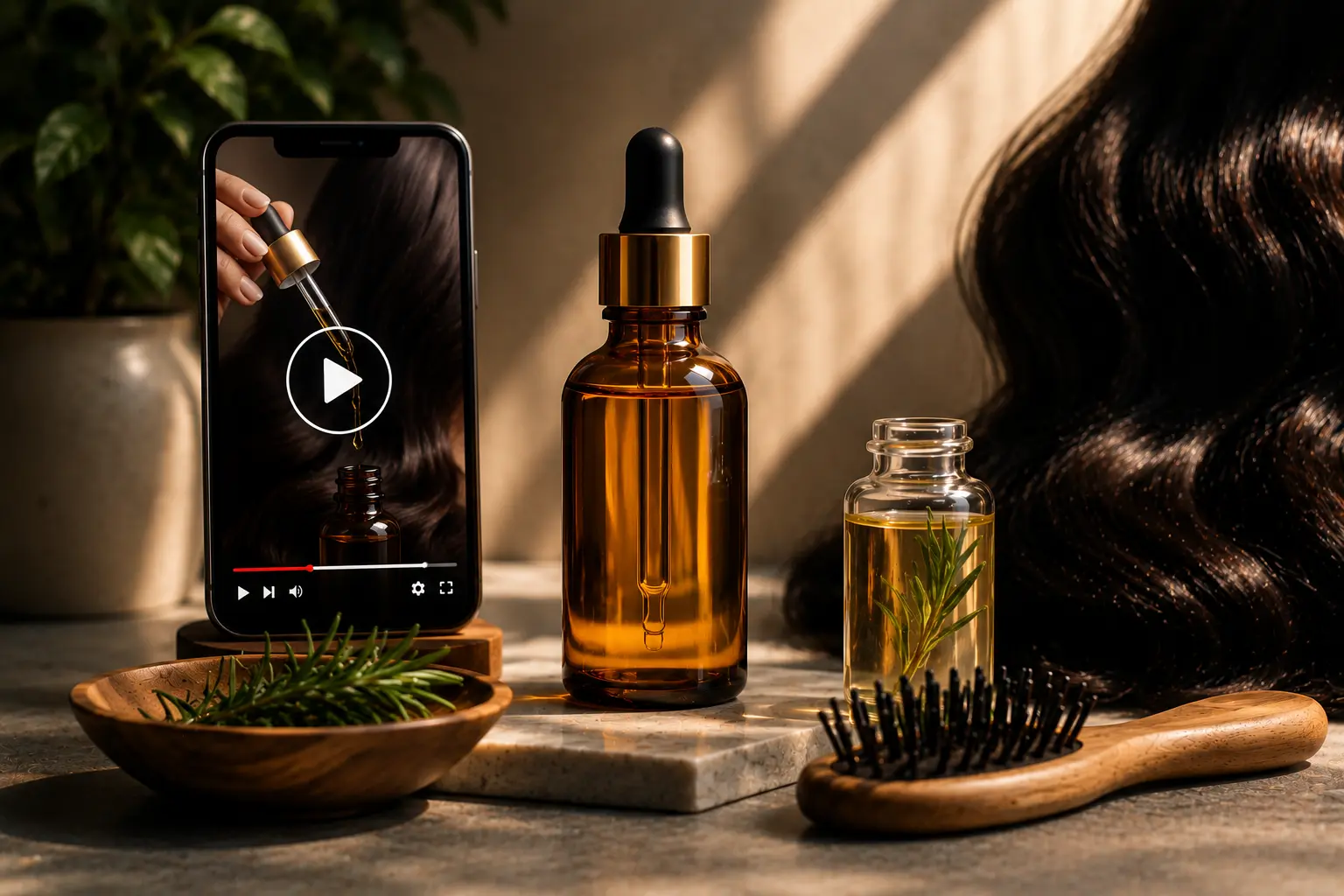
If your hair growth oil listing is getting clicks but not converting, the problem usually is not your price or your reviews. It is that a still image cannot show a scalp application, a texture, or a before-and-after result in the two seconds a shopper spends scanning search results.
Sponsored Brands Video can.
That is the entire strategic case for this format, and almost nobody has written about it specifically for this category.
This guide is for hair growth oil and scalp care brand owners, the Amazon sellers and vendors running their own PPC, and the agency managers handling beauty accounts who need a plan that goes beyond "turn on video ads."
By the end, you will know what to put in the first three seconds of your creative, how to keep ACoS under control while building new-to-brand share, and what actually needs approval before you spend a dollar.
It also helps that the timing works in your favor. The global hair loss and hair growth treatment market continues to expand year over year, which means more shoppers are actively searching this category on Amazon, not fewer.
Sponsored Brands Video is a cost-per-click ad format inside the Amazon Ads Console that runs a short video in top-of-search and product detail page placements, alongside your brand logo and a custom headline.
Unlike Sponsored Products, which can only run static images pulled from your listing, this format lets you build a purpose-made 15 to 30 second clip.
For a hair growth oil brand, that difference is not cosmetic. Your product's entire value proposition, application ritual, oil absorption, scalp massage technique, is something a photo genuinely cannot communicate. Video can.
Enrollment in Amazon Brand Registry is required before you can run Sponsored Brands Video, per Amazon's own Sponsored Brands eligibility requirements.
If you have not enrolled yet, that is step zero. Full application review commonly takes around 10 business days, though it can move faster when your trademark details, product images, and account information all line up cleanly. Once approved, enrollment itself finalizes within one to three days.
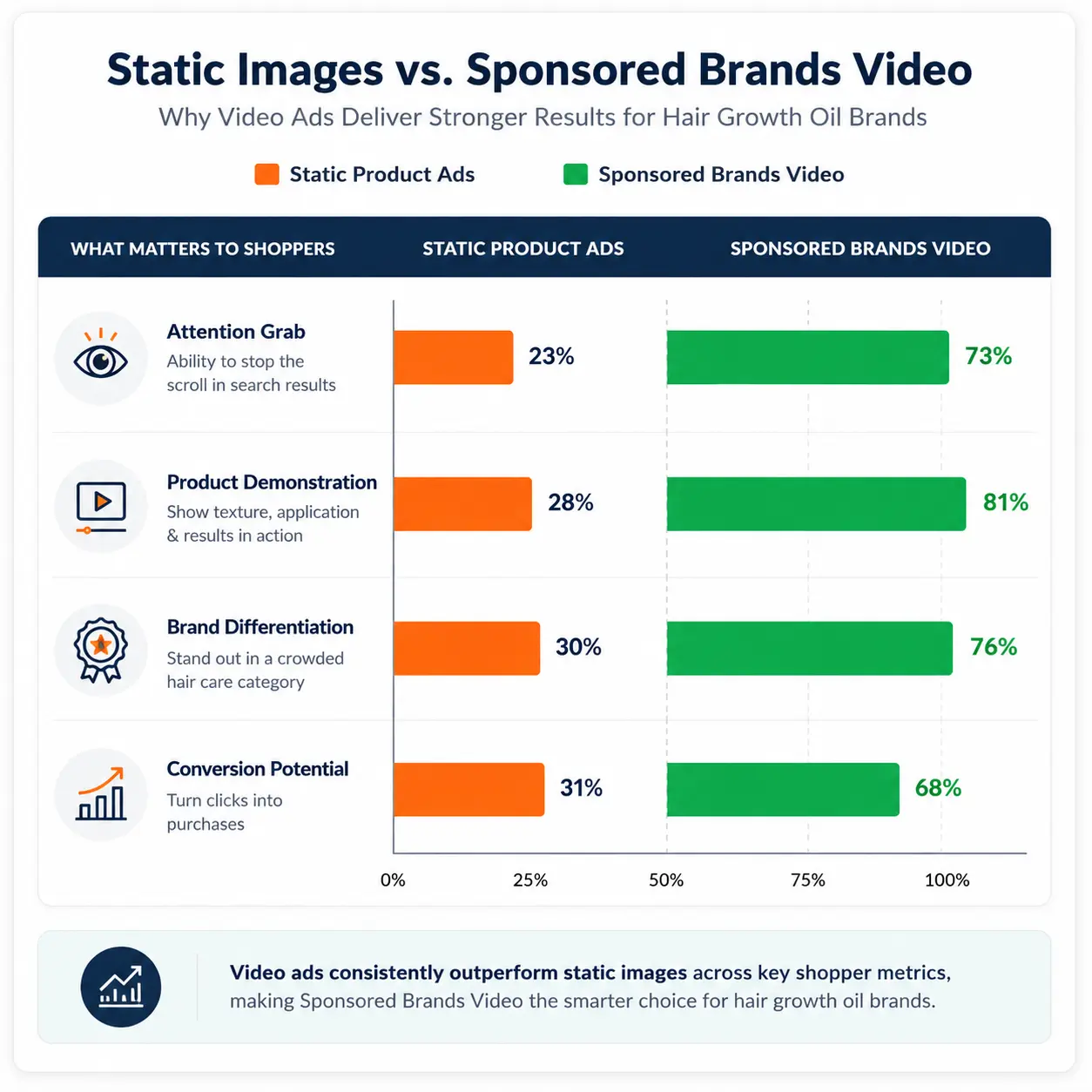
Most hair growth oil listings compete in a visually flat category. Amber bottles, dropper caps, similar typography. A shopper scrolling search results cannot tell your product apart from ten others in half a second, which is roughly the attention window a static thumbnail gets.
This is where ACoS creep usually starts. You are winning the click because your title and price are competitive, but you are losing the conversion because nothing in the ad explained why your oil is different from the one three rows down.
Video closes that gap by demonstrating, not describing.
There is a second issue specific to this category: hair growth and scalp treatment claims sit close to regulated language.
A photo of a bottle says nothing risky. A video showing "before and after" results has to be handled carefully, which is exactly why the compliance section below matters more here than in almost any other Amazon category.
This is the gap almost every competing article leaves wide open. Generic creative advice ("show your product in use") does not help a founder who has never storyboarded an ad before. Here is what actually works for this category, based on what performs across scalp and hair care video creative:
Social advertisers call this the thumb-stop rate, the share of viewers who pause scrolling when a video starts playing. Amazon does not report this metric by name, but the same principle drives what happens in that first three-second window on Amazon too.
Test at least two opening frames before committing spend.
This is the section nobody else in the current search results addresses, and it is the one that protects your ad account the most.
Hair growth and hair loss claims sit under Federal Trade Commission (FTC) scrutiny in the United States, particularly anything implying a drug-like effect. Minoxidil (topical) and oral Finasteride are the only two ingredients with FDA-approved hair regrowth claims.
If your product contains neither, avoid language implying clinical regrowth results. Amazon's own ad policy backs this up directly: it prohibits claims that a product can diagnose, cure, mitigate, treat, or prevent a disease without FDA backing, and requires health-related claims to be supported by documented, reliable evidence.
Practical guardrails:
Sponsored Brands Video supports keyword targeting (broad, phrase, and exact match) and category targeting with refinement filters. For hair growth oil specifically:
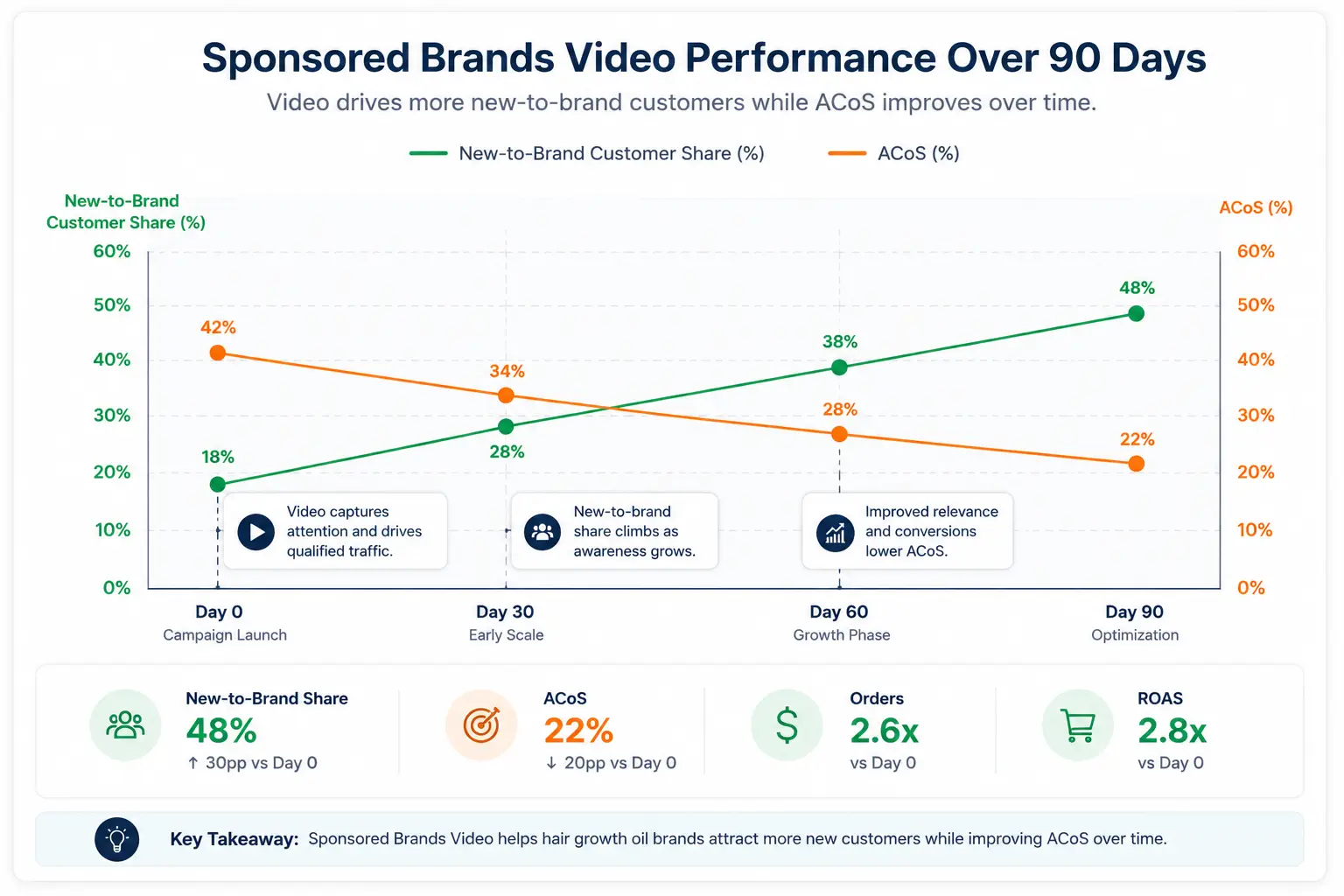
New-to-brand (NTB) metrics measure the share of ad-attributed orders coming from shoppers who have not purchased from your brand on Amazon in the prior 365 days.
This is the number that tells you whether Sponsored Brands Video is actually acquiring customers, not just re-selling to people who already knew you.
Two campaigns can post identical ACoS and mean completely different things. A campaign with a mediocre ACoS but a high NTB share is doing real acquisition work.
A campaign with a great ACoS but a low NTB share is mostly just collecting orders from people who would have bought anyway.
Amazon's own rule-based bidding documentation describes "if/then" conditions, for example, increasing bids automatically when a keyword's conversion rate or NTB rate crosses a threshold, rather than adjusting bids manually every week.
For a hair growth oil brand still building brand recognition, weighting rules toward NTB rate rather than raw ACoS in the first 60 to 90 days usually produces a healthier long-term trajectory, even if short-term ACoS looks less impressive on a spreadsheet.
For most hair growth oil brands, the honest allocation is Sponsored Products carrying the bulk of spend on proven keywords, Sponsored Brands Video introducing the brand to new shoppers at the top of search, and Sponsored Display retargeting the traffic both formats generate but do not immediately convert.
Current Sponsored Brands Video requirements: MP4 or MOV format, under 500MB, 16:9 horizontal aspect ratio, 1080p resolution recommended, 15 to 30 seconds in length with 15 seconds as the sweet spot for completion rate.
Closed captions are required creative, not optional, because the format autoplays muted.
One 2026 change worth building into your strategy: Sponsored Brands Video inventory is now eligible to surface inside Alexa for Shopping, Amazon's AI shopping assistant (rebranded from Rufus in May 2026).
It can surface your video creative in response to conversational shopping queries, which expands your reach beyond exact keyword matching into more natural, question-style searches like "what oil helps with a dry itchy scalp."
Amazon advises submitting creative at least a week before launch to leave room for review and possible resubmission. Third-party reporting puts typical turnaround around one to three business days.
Claims-sensitive creative, which most hair growth oil ads are, can take longer if the review team flags language for a compliance check. Build that buffer into any launch timeline.
Production does not require a studio. A smartphone-shot video with a simple tripod, natural light, and a low-cost captioning tool can meet spec and perform competitively, especially for a first test.
Brands investing in a semi-professional shoot typically land in the low thousands of dollars for a batch of two to three creative variations, which supports the rotation schedule mentioned above.
On the ad spend side, small hair care brands in our experience see reasonable early signal on daily budgets in the low double digits dedicated specifically to Sponsored Brands Video, run for at least two to three weeks before making rotation or bid decisions.
These figures are Amplivus's general observation from working small beauty accounts, not a published industry benchmark, and they shift with review count, price point, and how saturated your specific subcategory is at the time. Treat them as a starting point for testing, not a target.
A realistic first-90-day plan: two creative variations, keyword targeting pulled from your existing Search Query Performance data, rule-based bidding weighted toward NTB rate, and a mid-cycle check at day 30 to catch creative fatigue early rather than after ACoS has already climbed.
Getting this sequence right without spending three months figuring it out through trial and error is exactly the kind of gap an experienced Amazon PPC partner closes.
If you want a second set of eyes on your current account before you commit budget to video, an Amazon PPC audit is the fastest way to see what is actually happening in your data before you change anything.

Turn Sponsored Brands Video into profitable growth with a tailored Amazon PPC strategy that improves targeting, lowers ACoS, and grows new-to-brand sales.
Get a 24-hour Amazon PPC Audit to uncover wasted spend, targeting gaps, and opportunities to improve Sponsored Brands Video results.

.png)
.png)


.png)
.png)