How Amazon PPC Drives Brand Discoverability and Sales in 2026
Read more
.png)
Kitchen gadget launches succeed with Sponsored Brands Video that clearly demonstrates the problem solved, then scale profitably using Sponsored TV, AMC insights, and full-funnel Amazon PPC campaigns.
Summarize in ChatGPT
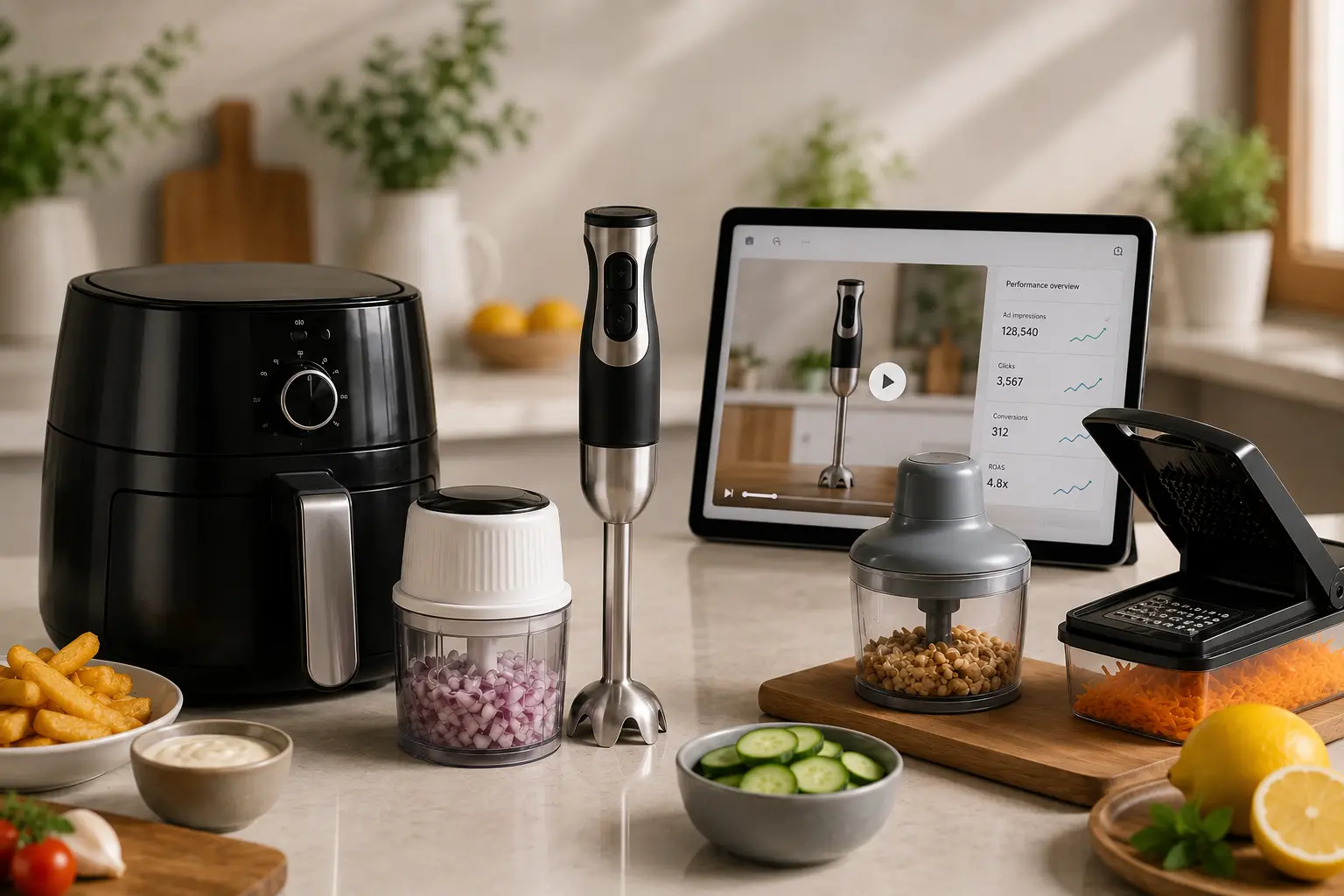
A new kitchen gadget launches into the hardest starting position on Amazon: no reviews, no Best Sellers Rank, no sales history to tell Amazon who to show it to, and a shelf full of near-identical listings that have sat there for years.
A static ad drops your thumbnail into that row and gives the shopper no reason to pick the unknown one. Sponsored Brands Video is the format that changes the odds, because a kitchen gadget is defined by a demonstration, and video is the only ad that runs the demonstration at the top of search.
This guide is for kitchen gadget and small-appliance brand owners and Amazon managers launching a new product in 2026, and it covers two things most guides miss: the video structure that fits a gadget specifically, and the new 2026 ad surfaces that change how a launch scales.
It sits inside our broader guide on how kitchen brands scale past $100K a month; here the focus is the launch and the format.
Sponsored Brands Video is a Sponsored Brands ad format that runs a short, auto-playing clip near the top of search and sends the click to a product page you choose.
It requires Amazon Brand Registry, so enrolling is step zero. For a launch, the format does not just add a lift, it changes the math, because a new listing has none of the trust signals Amazon's ranking leans on and no velocity to earn an organic position.
A kitchen gadget has a further problem the video is uniquely suited to solve. Every gadget exists because some kitchen task is annoying: the garlic is fiddly, the onion makes you cry, the avocado is a mess, the herbs take forever to chop.
The whole value of the product is that it makes that annoyance disappear, and you cannot show an annoyance disappearing in a photo. You can show it in fifteen seconds of video.
There is a trust dimension too.
A gadget shopper has been burned before by a product that looked clever in photos and was useless in the kitchen, so they are skeptical by default, and a new brand with no reviews has none of the social proof that would normally settle that doubt.
A demonstration is the only thing that answers skepticism at the moment of the click, because it shows the gadget actually working rather than claiming it does.
The US small kitchen appliances market keeps growing and the gadget shelf keeps getting more crowded, which means the demonstration is not a nice-to-have at launch, it is the thing that separates your new product from the wall of look-alikes a shopper is scrolling past.
Generic advice says "show your product in use." For a kitchen gadget, that is not enough, because the persuasive unit is not the product, it is the problem it removes.
The structure that converts a gadget follows the annoyance, not the feature list, and it fits inside fifteen seconds.

Open on the annoyance, not the product. The pile of garlic cloves, the tears from the onion, the messy hand-mashed avocado, the herbs scattered on a board.
This is your muted thumb-stop, and because Sponsored Brands video autoplays without sound, the problem has to be instantly readable and captioned.
A shopper who recognizes their own kitchen frustration in the first three seconds stops scrolling, because you just named a pain they have.
Now the product enters, doing the one job it exists for, fast and clean. The press crushing the garlic in a second, the chopper dicing the onion in three pumps, the tool cleanly halving the avocado.
This is the demonstration window, and it is where the shopper decides. Show speed and ease, because "faster and less mess" is what a gadget promises, and video proves it in a way a bullet point claiming "efficient design" never can.
End on the payoff: the finished dish, the tidy counter, the empty tool ready to rinse. Add the ease-of-cleaning shot if it applies, since that is a top objection for kitchen gadgets.
Close on your logo and brand name with a clean final frame, keep one product per video so the click lands where you expect, and caption throughout.
The arc is complete: here is your problem, here is the fix, here is the result, and that three-beat story is what makes a shopper stop, watch, and buy a product they had never heard of a moment earlier.
This is the part that dates most launch advice, because the surfaces available to a new product expanded meaningfully in 2026, and a gadget launch that uses them starts from a stronger position.
Self-serve Sponsored TV now runs with no minimum spend and no Seller Central requirement, which puts streaming placements on Prime Video and Fire TV within reach of a launching brand.
For a demonstration-driven gadget, being on a screen during someone's evening streaming, showing the exact problem-to-solution clip, is a genuine top-of-funnel edge that used to be reserved for large advertisers.
Amazon Marketing Cloud audiences can now be used directly inside Sponsored Products, with audience bid boosting, so you can raise bids for the shoppers who saw your streaming or video ad but have not bought yet, connecting the awareness surface to the conversion surface in a way a launch could not do cheaply before.
Amazon's shopping assistant, which moved toward Alexa for Shopping during 2026, increasingly answers conversational, situation-based queries, and video creative can surface in those answers, which rewards a launch that speaks in problem language rather than product jargon.
And Amazon Marketing Stream delivers near-real-time performance data, so a launching gadget can react to what is working the same day rather than the next.
You do not have to run all of these on day one.
But knowing they exist changes the plan, because a 2026 launch can build awareness on Sponsored TV, capture it through Sponsored Products informed by AMC audiences, and read the whole thing in near-real-time, which is a fuller funnel than a launch had access to even a year ago.
The measurement layer that ties it together is Amazon Marketing Cloud, which shows whether the awareness surfaces actually drove the later search purchase.
The order matters as much as the tools. Start with Sponsored Products and Sponsored Brands Video from day one, because they capture the shoppers already searching and give you the New-to-Brand signal to steer by.
Once the video is converting and you have a few weeks of data, layer Sponsored TV to widen the top of the funnel with the same problem-to-solution clip, then use AMC audiences to retarget the awareness those placements create back into Sponsored Products.
Switching everything on at once during a launch just spreads a thin budget too far to learn anything, and the learning is the point of the first month.
Run the surfaces in sequence and each one feeds the next: search proves the creative, streaming widens the reach, and AMC closes the loop between them.
A new gadget has no brand recognition, so bidding on your product name captures nobody, and the branded-defense play that protects an established brand does nothing for a product no one is searching for yet.
Target the problem and the situation the shopper types instead. Problem queries ("chop onions without crying," "peel garlic fast," "no-mess avocado tool," "quick herb chopper") carry the exact buyer your video was built to convert, at a lower cost per click, and they match the conversational way the shopping assistant now surfaces products.
Run the proven converters as exact-match Sponsored Products alongside the video, harvest new problem phrasings from your search-term data weekly, and negate the queries for adjacent products a shopper will not cross-buy.
Layer the video on your category head terms to introduce the brand at the top of search, where the demonstration does the most work against the incumbents.
Here is why launch teams reach for this format. New-to-Brand (NTB) is an Amazon metric that tags each ad-attributed order as a first-time buyer of your brand or a repeat one, and it reports on Sponsored Brands, including video, but not on Sponsored Products.
During a launch the number that matters is not raw sales, it is how many came from people who had never bought from you, because that is what a launch is for. Sponsored Brands Video is how you see and grow that number, so weight your bidding toward acquisition early and test Maximize New-to-Brand on the video campaign.
Expect a higher Advertising Cost of Sale (ACoS) at launch, often 40 to 60 percent while you buy reviews, rank, and first-time buyers, and plan for it rather than panicking.
As reviews accumulate and conversion climbs, the same video gets cheaper per order and ACoS settles into a sustainable band.
Fund a defined launch window instead of judging the campaign on day-three math, and steer by Total ACoS and new-to-brand orders rather than last-click ACoS alone.
Running that discipline consistently, with fresh creative rotated before it fatigues, is where a specialist Sponsored Brands management approach earns its place.
Timing a gadget launch to the calendar matters, because kitchen gadgets have two demand peaks.
The fourth quarter drives heavy gifting, as small gadgets are among the most-given stocking-filler gifts, and cost per click climbs as every brand competes. January brings a second surge, as cooking, meal prep, and healthy-eating resolutions concentrate demand into the new year.
The strongest launch timing is often eight to ten weeks before one of those peaks, so your reviews and rank are built by the time demand and cost per click both climb.
Launching cold into the middle of a peak means paying the highest cost per click while Amazon is still learning who to show your ad to, which is the most expensive way to start.
Because gadgets can also go viral on social video, the same demand can spike without warning, which our guide on bidding for viral kitchen products covers in full.

Producing a decent gadget video is the easy part. The harder work is the structure around it: the problem-based targeting, the New-to-Brand-weighted bidding, the 2026 surfaces, and reading the data while inventory is on the line.
If your launch is stalling or your video is running without moving the numbers, a structured review usually finds the leak faster than another round of guesswork.
As a specialist Amazon PPC agency, Amplivus runs this launch work for kitchen and gadget brands through ongoing Amazon PPC management across the full 2026 surface set, from Sponsored Brands Video to Sponsored TV and AMC.
If you would rather see the plan first, a free Amazon PPC audit will show where a launch is likely to leak, and a short Amazon strategy session will map where video and the new surfaces belong before you go live.
For the product-specific version of these plays, our portable blender Sponsored Brands Video guide and our Sponsored Brands Video launch guide for fitness brands are worth reading alongside this one.

Talk with an Amazon PPC strategist to build high-converting Sponsored Brands Video campaigns and scale your kitchen gadget launch.
Get an Amazon PPC audit to improve Sponsored Brands Video, target the right shoppers, and launch your kitchen gadget with confidence.