Amazon Sponsored Ads Explained: A Plain-English Guide for Sellers (2026)
Read more
.png)
Portable blender brands win Amazon PPC with Sponsored Brands Video that shows real blending, portability, USB charging, and the final pour, turning skeptical shoppers into new customers.
Summarize in ChatGPT
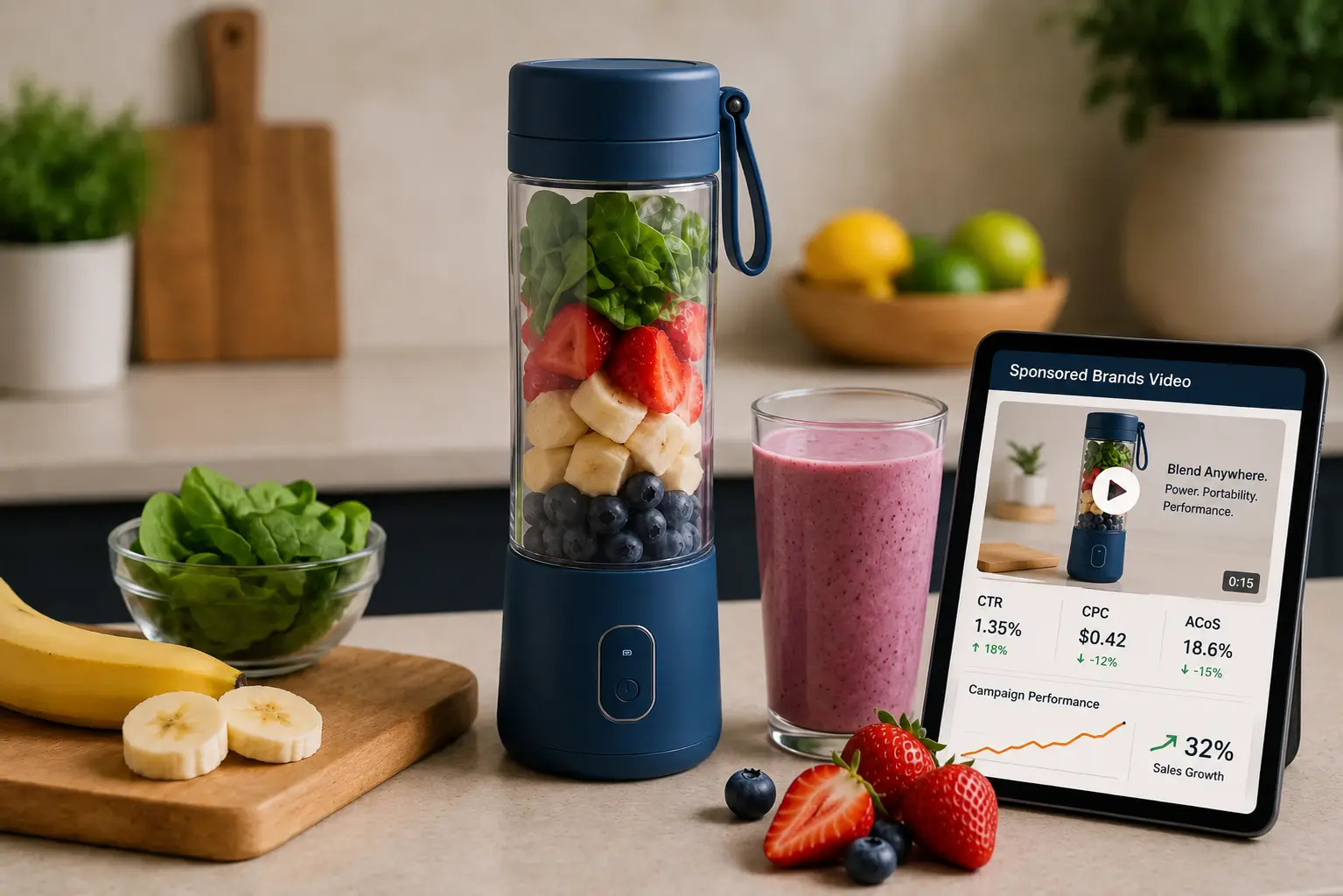
A portable blender is one of the hardest products to sell from a photo and one of the easiest to sell from a video.
The still image shows a small cup with a lid. It cannot show the vortex when the blades spin, how the whole thing fits in a hand or a gym bag, that it charges over USB with no cord, or the moment the drink pours into a to-go cup.
Those four things are the entire reason a shopper picks one portable blender over the ten near-identical ones next to it, and Sponsored Brands Video is the only ad format that shows them at the top of search.
This guide is for portable blender and personal-blender brand owners and Amazon managers who want the specific Sponsored Brands Video plays for this product, not a generic "use video" tip.
You will get the shot list, the 2026 specs, the targeting, and the bidding that turn a video into new customers.
It sits inside our broader guide on how kitchen brands scale past $100K a month; here the focus is one format and one product.
Sponsored Brands Video is a Sponsored Brands ad format that runs a short, auto-playing clip near the top of search results and sends the click to a product page you choose.
It requires Amazon Brand Registry, so enrolling is step zero. For a portable blender, the format changes the math, because this is a category built entirely on demonstration and social proof.
The portable blenders market is growing fast, which means the shelf is crowded and price-sensitive, and most listings look identical in a thumbnail: a colored cup with a lid, on a white background.
A static Sponsored Brands or Sponsored Products ad puts your thumbnail in a row of those, and the shopper has no reason to pick yours. Video breaks the pattern.
It takes more vertical space, it moves, and it answers the question the photo leaves open: does this actually blend a frozen smoothie, or does it just stir? In a category where the cheap ones under-deliver and buyers know it, showing a real, full blend is the single most persuasive thing you can do.
There is a second reason video matters more here than in most categories. A portable blender buyer is skeptical, because the market is full of underpowered units that leak, stall on ice, or die after a month, and reviews are littered with those complaints.
A shopper landing on your listing is already braced for disappointment. A photo cannot answer that skepticism, but a fifteen-second clip of your blender crushing frozen fruit and pouring a genuinely smooth drink does, because it shows rather than claims.
That is why the format tends to carry a higher New-to-Brand rate than static ads in this category: it converts the doubtful first-time buyer that a photo leaves undecided.
This is the part most guides skip. "Show your product in use" does not help a founder who has never storyboarded an ad. Here is what actually converts for this product, in order, and it fits inside fifteen seconds.
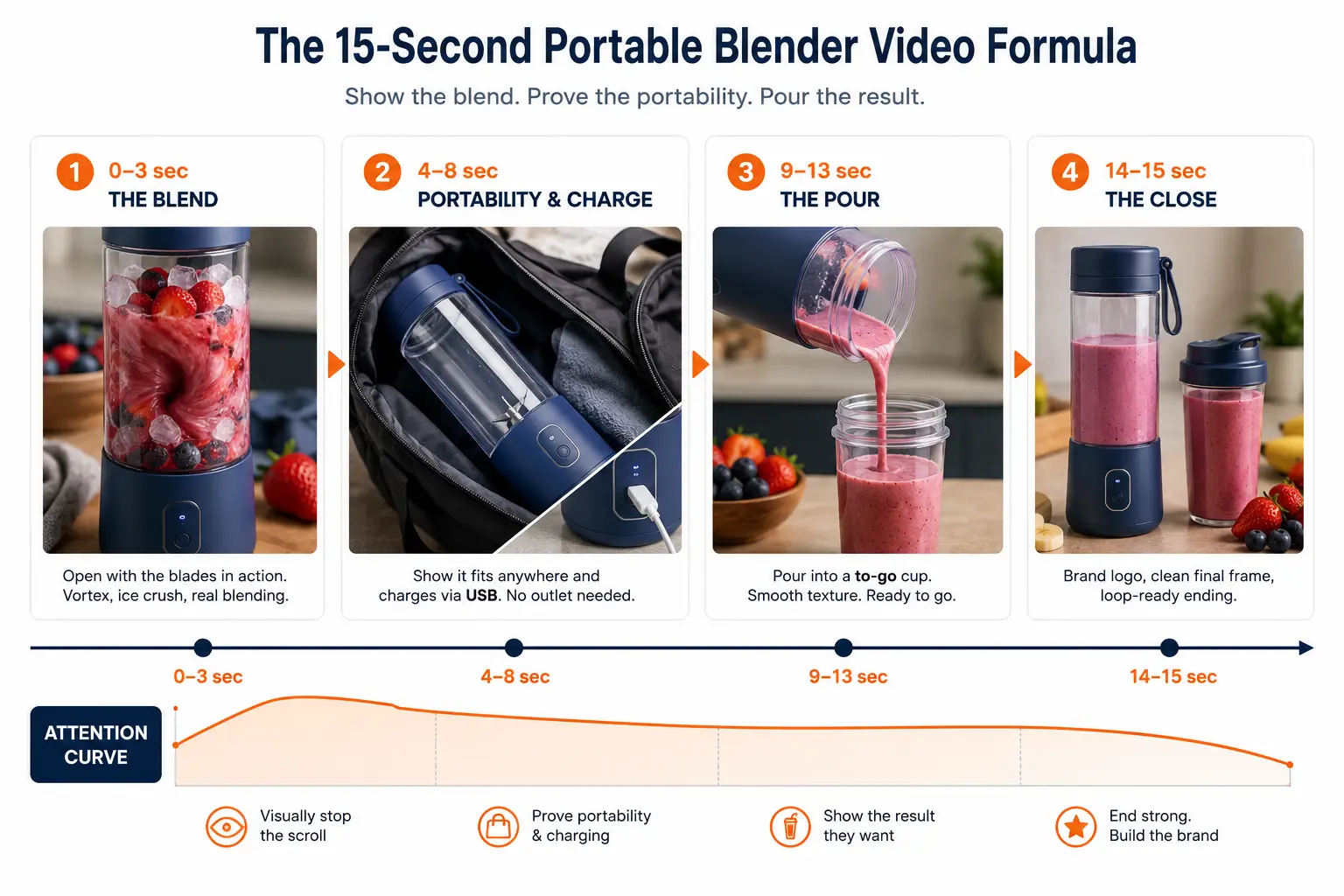
Open on the blades spinning and the vortex pulling fruit and ice down into a smooth drink. Because the video plays muted, this has to read without sound, so no logo animation and no slow fade.
The blend is your thumb-stop, and independent studies put muted mobile viewing well above two thirds of viewers, so closed captions are not optional.
If your blender genuinely crushes ice or frozen fruit, that is the shot, because it is the exact thing the cheap dupes cannot do.
Now answer "where does it go." Show the blender in a hand, in a gym bag, on a desk, in a car cupholder. If it is cordless and charges over USB, show the cable clicking in and the battery indicator, because "no outlet needed" is a core reason people buy this over a countertop blender.
This is the demonstration window competitors' generic guides never address, and it is where the on-the-go buyer decides.
Show the finished drink pouring into a to-go cup, or the lid clicking on and someone drinking straight from it. This closes the story the shopper was picturing: make the smoothie, take it with you.
A texture shot of a genuinely smooth drink does more than any bullet claiming "powerful motor."
End on your logo, the brand name, and a clean final frame, with the loop designed so there is no awkward black cut when it restarts.
Keep one product per video so the click lands where you expect, and use large, legible captions throughout.
Save the cinematic intro for your listing video; here the job is clarity, fast, and every second has to move the shopper one step closer to picturing the blender in their own routine.
The best video in the category cannot save a listing that does not convert, and this is where a lot of portable blender ad budget quietly leaks. Video gets the click; the product page has to close it.
If your main image is another look-alike cup on white, your reviews are thin, or your bullets lead with motor wattage instead of "blends frozen fruit smooth on a single charge," the ad is paying to send an already-interested shopper to a page that loses them.
Before you scale spend behind a video, make the page earn it: a main image that survives the thumbnail test, images and A-plus content that repeat the blend, portability, and charge story the video told, and enough genuine reviews to clear the trust bar in a category where cheap dupes have burned buyers.
Conversion rate is the multiplier on every dollar of video spend. A listing that converts at 15 percent pulls far more sales from the same clicks than one at 8 percent, and better conversion also lifts organic rank, so the video and the page compound on each other.
The practical rule is simple: fix the page first, then pour spend into the video, because a great ad in front of a weak page just spends faster.
Confirm against Amazon's Sponsored Brands video page before you upload, since the specs update, but the current shape is: 6 to 45 seconds allowed, with 15 to 30 seconds converting best; 16:9 horizontal, no letterbox bars; 1080p a safe default; MP4 or MOV under 500 MB; auto-plays muted, so captions and on-screen text are required creative; and no black or blank frames at the start or end, which is a common rejection reason.
Amazon reviews most video within about 72 hours, so build that buffer into your launch timeline rather than uploading the night before.
The generic head term "blender" is expensive and full of shoppers who want a countertop machine, so it is not where a portable blender wins.
Target the intent that matches your product.
On-the-go and use-case terms ("portable blender for smoothies," "travel blender," "gym smoothie blender," "protein shake blender bottle") carry the exact buyer your video converts, at a lower cost per click.
Feature terms ("USB rechargeable blender," "cordless personal blender," "mini blender for shakes") screen for the buyer who already knows what they want.
Pull your seed list from your search-term data, run the proven converters as exact-match Sponsored Products alongside the video, and negate the countertop and commercial queries that will never buy a personal blender.
Layer the video on your category head terms to introduce the brand at the top of search where the demonstration does the most work.

Here is the reason serious launch teams run this format, and it rarely appears in the guides. New-to-Brand (NTB) is an Amazon metric that tags each ad-attributed order as a first-time buyer of your brand or a repeat one, and it reports on Sponsored Brands, including video, but not on Sponsored Products.
During a launch, the number that matters is not raw sales, it is how many came from people who had never bought from you, because that is what a launch is supposed to do.
Sponsored Brands Video is how you see and grow that number, so weight your bidding toward acquisition early, and test Maximize New-to-Brand on the video campaign if winning new households is the goal.
Expect a higher Advertising Cost of Sale (ACoS) at launch, often 40 to 60 percent while you buy reviews, rank, and first-time buyers, and do not panic.
As reviews accumulate and conversion climbs, the same video gets cheaper per order and ACoS settles toward a sustainable band. Fund a defined launch window rather than judging the campaign on day-three math, and steer by Total ACoS and new-to-brand orders rather than last-click ACoS alone.
Running that discipline consistently is where a specialist Sponsored Brands management approach earns its place, because the format rewards steady creative rotation and NTB-weighted bidding, not a one-time setup.
Portable blenders have two demand windows worth pacing for. January brings the resolution surge, as smoothies, protein shakes, and healthy eating concentrate demand into the new year, and cost per click climbs as every blender brand competes.
Summer brings a second lift, driven by travel, gym, and on-the-go use. The brands that win build reviews and rank in the quiet months, then raise budgets and defend their proven keywords through both windows.
Gift sets and bundles deserve their own fourth-quarter campaigns, because portable blenders are a common giftable item and holiday shoppers search "gift" intent your everyday keywords miss.
Because this product can also go viral on social video, the same demand can spike without warning, which our guide on bidding for viral kitchen products covers in full.
Sponsored Brands Video works the same way across product types, and the plays that win in adjacent categories transfer cleanly.
Our Sponsored Brands Video launch guide for fitness brands covers the launch sequence and the New-to-Brand economics in depth, and our hair growth oil Sponsored Brands Video guide shows the muted-first creative discipline in a beauty context.
The through-line is the same: lead with the demonstration in the first three seconds, keep one product per clip, caption everything, and judge the format on new customers rather than on a polished production.
For a portable blender, that demonstration is the blend, the portability, and the pour, and no other format can show all three at the top of search.
Producing a decent video is the easy part. The harder work is the structure around it: the targeting, the New-to-Brand-weighted bidding, the creative rotation, and reading the data while inventory is on the line.
If your video is running but the numbers are not moving, or a launch has stalled, a structured review usually finds the leak faster than another round of guesswork.
As a specialist Amazon PPC agency, Amplivus runs this video-led work for kitchen and home brands every day through ongoing Amazon PPC management.
If you would rather see the gaps first, a free Amazon PPC audit will show where your video and targeting are leaking, and a short Amazon strategy session will map where video belongs in your plan before your next launch or peak.

Talk with an Amazon PPC strategist to build high-converting Sponsored Brands Video campaigns that grow new customers and sales.
Get an Amazon PPC audit to improve Sponsored Brands Video, increase new-to-brand orders, and convert more portable blender shoppers.