Amazon Ads in 2026: What Changed for Established Brands
Read more
.png)
Pet brands win rank by using PPC to build sales velocity that lifts organic rank, then reading TACoS, harvesting winners, and letting repeat buyers hold it.
Most pet brands run Amazon PPC and Amazon SEO as if they were separate departments, one chasing clicks and the other chasing keywords. They are not separate.
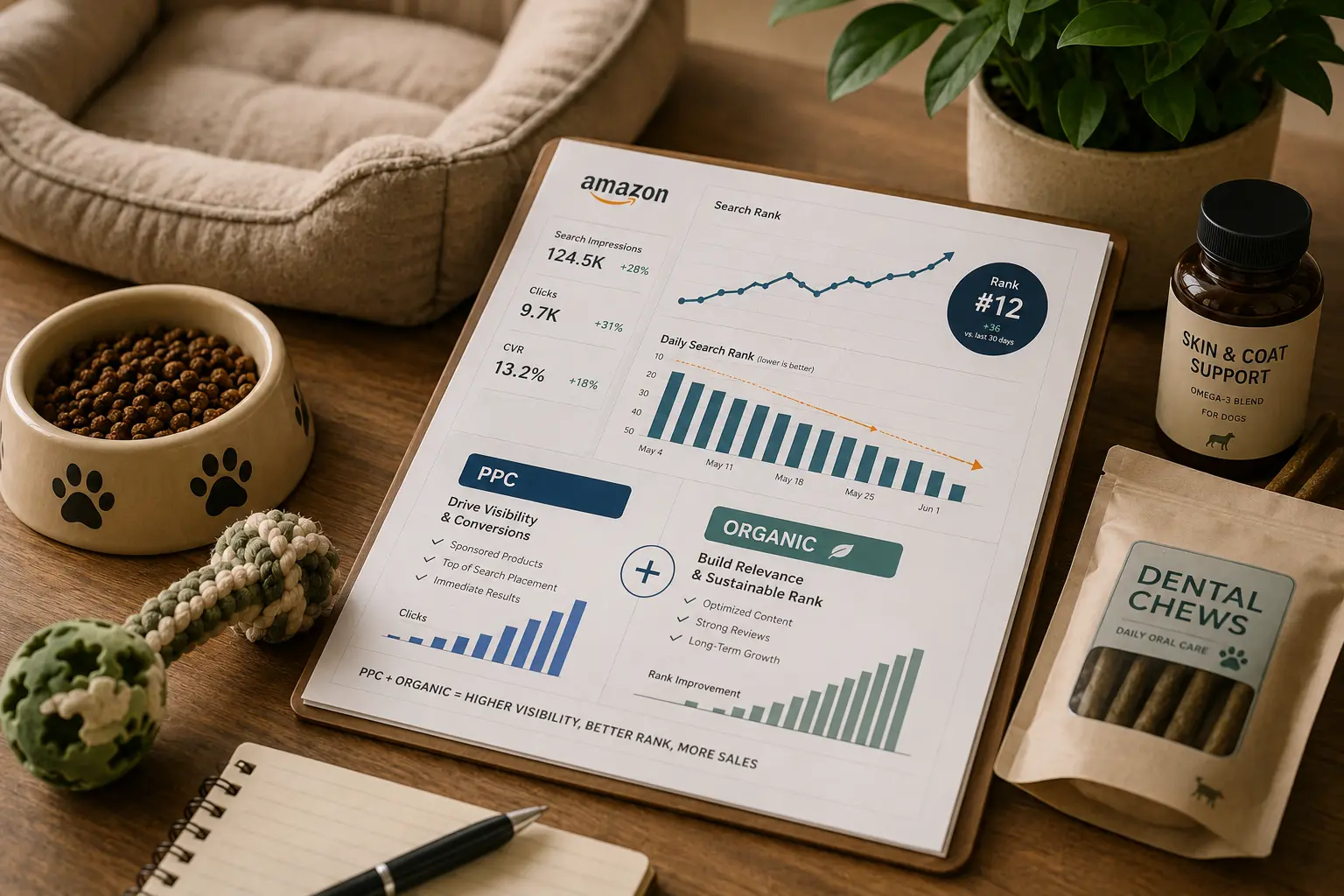
They are two halves of the same engine, and the brands that win search rank in pet are the ones that treat them that way: paid advertising builds the sales velocity that pushes a product up the organic results, and a strong organic position then lowers what paid has to spend to hold it.
Get the loop turning and each side makes the other cheaper and stronger. Ignore it and you overspend on paid while your organic rank stalls.
This guide explains how that loop works in pet specifically, why the category's repeat-purchase economics make it compound faster than most, and the practical moves that keep it turning without wasting spend.
It builds on the general mechanism laid out in our guide on how PPC powers organic rank without cannibalizing spend, and applies it to the way pet buyers actually shop and reorder.
Start with the mechanism, because every tactic below follows from it.
Amazon's own guidance on improving product search rankings points to sales performance, relevance, listing quality, and conversion as the levers, and it notes that Sponsored Products can help offers rise through search results.
Amazon does not publish the exact weighting, so treat this as directional, but the pattern is consistent: a product that suddenly sells more for a given keyword tends to climb the organic results for that keyword. Paid traffic that converts is one of the fastest ways to manufacture that sales velocity on a new or stalled listing.
So a well-run Sponsored Products campaign is not only buying today's sales, it is sending Amazon the demand signal that lifts tomorrow's organic position, which is the real return that a click-only view of PPC misses.
The lift is not one-directional. Once a product ranks organically for a term, it earns sales that cost nothing in ad spend, and those free sales keep the velocity signal strong, which helps hold the rank.
That means every keyword you push into a strong organic position lowers your blended cost of sale and frees budget to attack the next term.
The flywheel is the point: paid builds rank, rank earns free sales, free sales hold rank, and the freed budget compounds the whole thing forward.
The compounding is what separates brands that pull ahead from those that plateau. A brand that treats each keyword as a one-time paid purchase spends the same money every month to hold the same positions and never gets ahead.
A brand that treats paid as an investment in organic rank keeps converting expensive paid sales into cheap organic ones, then rolls the savings into the next term, so its cost of sale falls over time while its rank rises.
Same budget, opposite trajectory. The difference is entirely in whether the two halves of the engine are managed as one.
The flywheel exists in every category, but pet spins it faster, and understanding why changes how aggressively you should feed it.
In a one-off category, a sale is a single pulse of velocity that fades. In pet, a first sale of food, treats, or a supplement is often the start of a reorder stream, and every reorder is another sale feeding the velocity signal that holds organic rank. Subscribe & Save makes this automatic, turning one acquisition into a steady drumbeat of sales that keeps a listing ranking without further ad spend.
That is why winning organic rank in pet is more valuable than in a disposable category: the rank you buy is held up by a base of repeat buyers, not by continuous paid support. The economics of funding that repeat base are covered in our guide on how pet brands scale past $100K a month.
Rank is only half the battle; the listing still has to convert the traffic, and conversion feeds back into rank. Pet is a trust-heavy category where an owner will not risk an unproven product on a family member, so reviews and strong creative lift conversion, which lifts velocity, which lifts rank.
The creative side of that conversion work is covered in our guide on why emotion-driven pet creative converts better. A listing that converts well turns the same paid clicks into more sales, so the flywheel spins faster for the brand that has done the trust work than for the one that has not.
If paid and organic are one system, you cannot judge them with a metric that only sees paid. That metric is ACoS, and leaning on it alone hides the whole benefit.
Advertising Cost of Sale measures ad spend against ad-driven sales only, so it is blind to the organic sales your ads helped create. A campaign that looks mediocre on ACoS may be quietly building the rank that drives a flood of free organic orders. Total Advertising Cost of Sale, TACoS, measures ad spend against total revenue including organic, so it captures the whole picture.
When TACoS falls while total sales rise, your paid spend is buying durable organic rank, and that is exactly the signal you want. When TACoS climbs while sales stay flat, the loop is not turning and something upstream needs fixing.
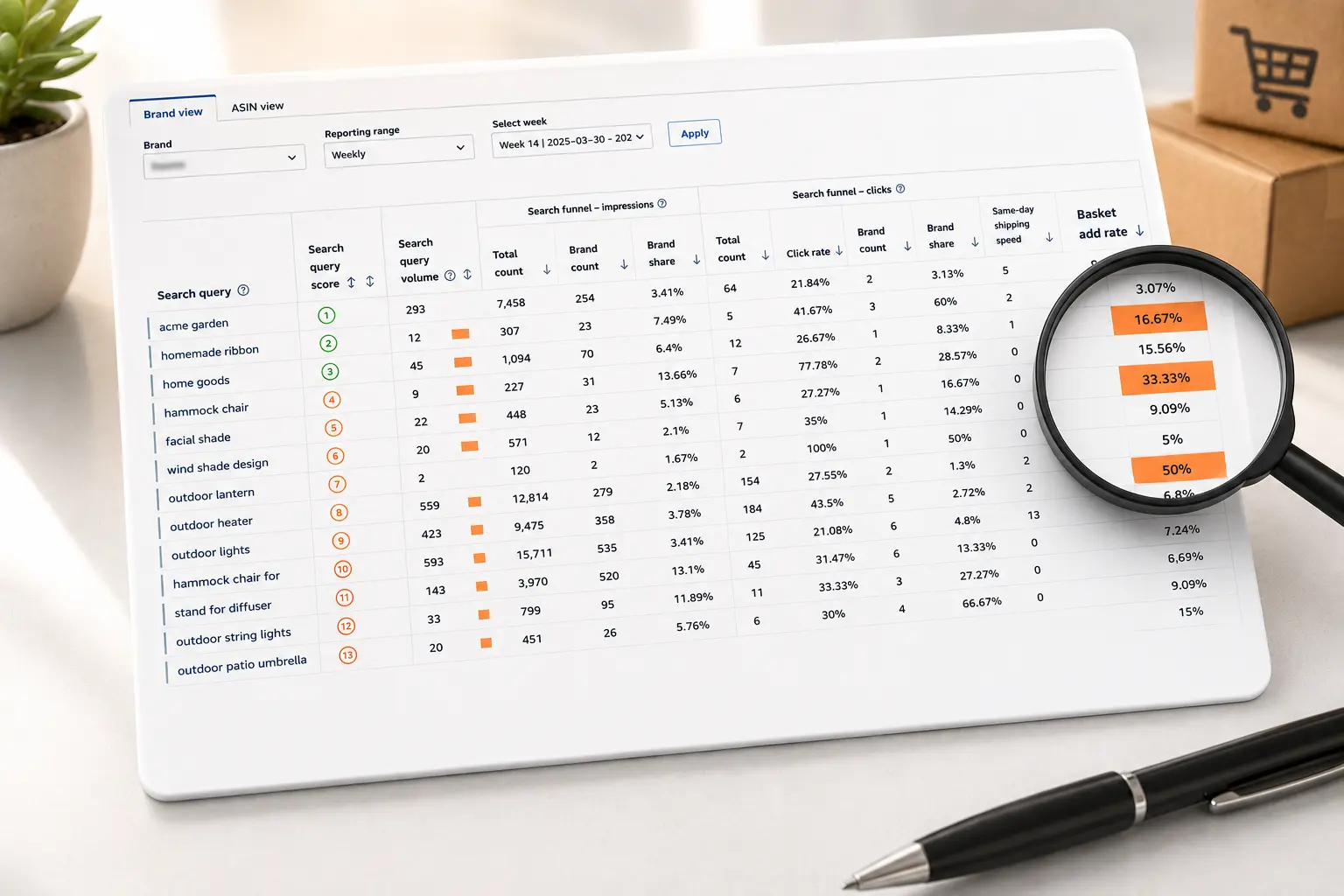
To manage the loop you have to watch organic position, not only campaign metrics. Amazon's Brand Analytics, available once you have enrolled in Brand Registry, and the Search Query Performance data within it show how your products perform on specific queries, including the share of clicks and purchases you win, so you can see a keyword's organic rank improving as your paid velocity does its work.
Reading that movement is how you know when a term is ready to hand off from paid to organic, so the position you fought for keeps earning after the ad steps back.
The discipline of reading those reports is covered in our guide on how to read the Amazon Search Query Performance report. Watch two things together as you manage the loop: the keyword's organic rank and its share of purchases. When your organic rank on a term is climbing and your paid share of that term's sales is falling, the handoff is working, the listing is winning sales without needing the ad.
When organic rank stalls no matter how much paid you pour in, the problem is not spend, it is usually conversion, and the fix is in the listing rather than the bid. Reading the two signals side by side keeps you from throwing money at a term that a better image or a stronger review base would win more cheaply.
The practical heart of combining paid and organic is knowing when to push and when to pull back, keyword by keyword.
Treat each important keyword as a campaign with a lifecycle. Push paid hard to build velocity and win the organic position, then, once the listing ranks strongly and organic sales are steady, ease the paid bids back and let organic carry the term. The budget you free redeploys to the next keyword you want to win.
This rolling harvest, win a term, hand it to organic, move on, is how a disciplined account climbs across a whole keyword set instead of paying to hold every term forever. A steady Sponsored Products management cadence is what keeps this handoff deliberate rather than accidental.
The most common waste in combining paid and organic is overpaying to advertise on keywords you already rank for organically, above all your own brand name. If a shopper searching your brand would find and buy you organically, a high paid bid on that term often just adds cost to a sale you would have won free.
The nuance is that some branded defense is worth it when competitors bid on your name, but that should be a low-cost hold, not an aggressive spend.
Read your search terms to find where paid and organic overlap on already-won positions, and pull paid back to a defensive level there so the budget goes to terms you have not yet earned. Avoiding this double-payment is the anti-cannibalization core of the whole strategy.
There is a simple test for whether a paid dollar on a given term is working: would you win the sale without it? On a term where you rank first organically and no competitor is bidding, the answer is usually yes, so heavy paid there is waste.
On a term where you sit on page two and rivals hold the top spots, the answer is no, so paid is buying you a position and the velocity to climb toward it.
Sorting your keywords by that one question, already won versus still contested, tells you where to pull spend and where to press it, and it is the fastest way to find budget hiding in plain sight.
The loop looks different at launch than at maturity, and matching your paid pressure to the stage keeps it efficient.
At launch a product has no organic rank, so paid does almost all the work, and you accept a higher cost of sale to manufacture the velocity that starts the climb. As organic rank builds, shift from buying every sale to defending the positions you have won and attacking the next tier of keywords.
At maturity, with strong organic rank and a base of repeat buyers, paid becomes a lighter layer that protects rank, launches new variations, and reaches new-to-brand shoppers, while organic and Subscribe & Save carry the core volume.
The trap at maturity is complacency. Organic rank is not permanent; a competitor pushing hard with paid can build the velocity to overtake a position you stopped defending, and a rank you let slip is expensive to win back.
So a mature pet listing still needs a maintenance layer of paid, enough to defend the terms that matter and to keep feeding some velocity, even when organic is carrying most of the sales. A consistent Amazon PPC management cadence is what keeps that defense deliberate rather than something you notice only after rank has already fallen.
The compliance line that governs pet copy at every stage, the FDA's animal food labeling and pet food claims guidance permitting structure-function but not disease claims, applies throughout, because a suppressed listing ranks nowhere.
A guide explains the loop. What it cannot see is where your account is breaking it, and the leak is usually specific: paid spend piled on already-won branded terms, campaigns cut before organic could hold, or a strong listing judged on ACoS and starved before it built rank.
Each of those quietly costs rank or cash, and none of them shows up if you look at paid and organic separately.
That is a findable problem, and fixing it usually frees budget rather than needing more, because most of the fixes involve pulling spend off work it should not be doing and pointing it at terms you have not yet won.
As a specialist Amazon PPC agency, Amplivus reviews paid and organic together, the way the algorithm actually treats them.
A free Amazon PPC audit shows where the loop is leaking, and a short Amazon strategy session maps the harvest-and-handoff plan for your keyword set.

Talk with an Amazon PPC expert to reduce cannibalized spend, improve TACoS, and turn paid traffic into durable organic rankings over time.
Get a free Amazon PPC audit to uncover wasted spend, strengthen organic rank, and build a smarter paid-to-organic growth engine today.