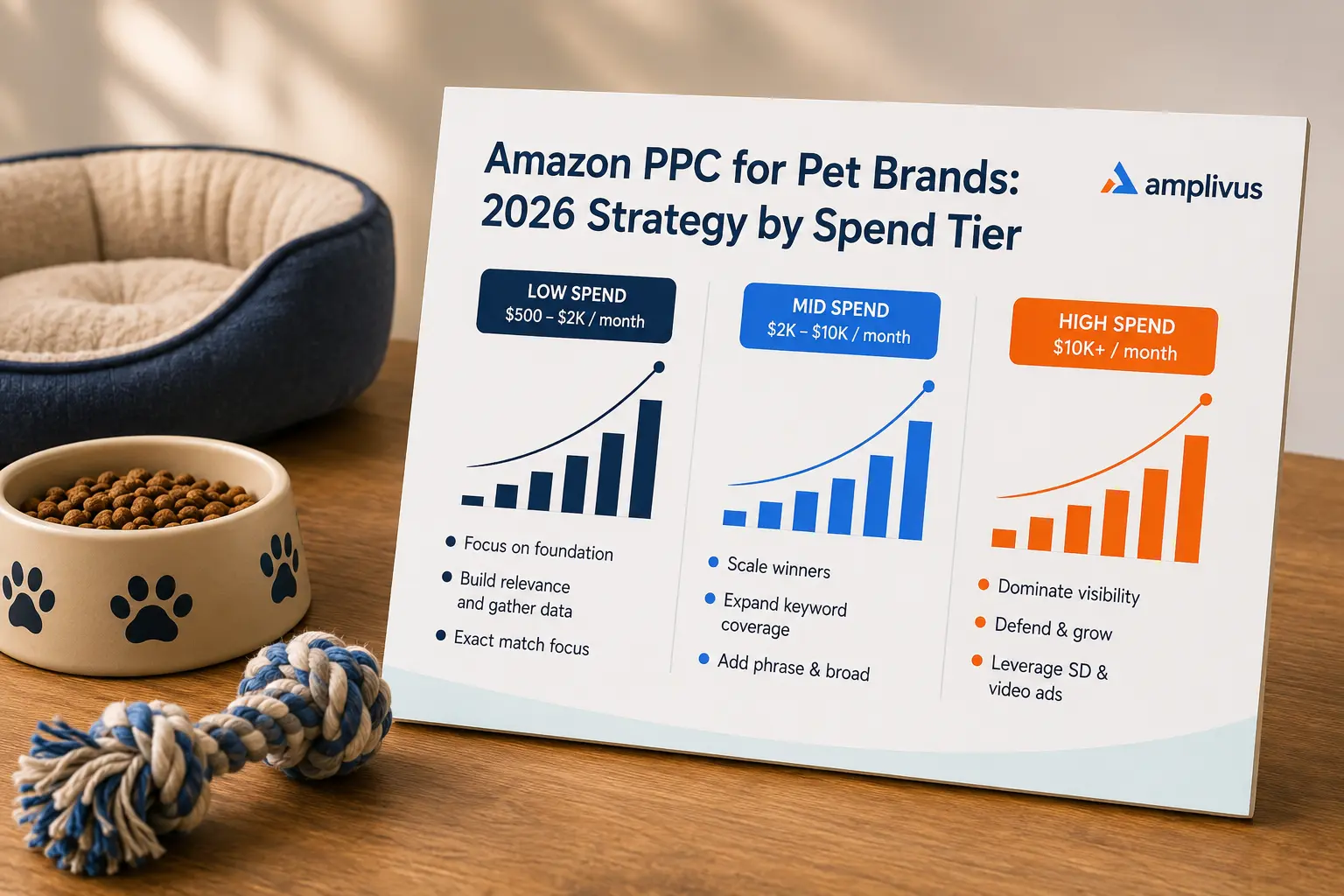
Amazon PPC for Pet Brands: 2026 Strategy by Spend Tier
Read more
.png)
At $200K+/mo, dog brands grow by bidding on a decade of lifetime value, cross-selling stages, defending subscriptions, and timing reorders with AMC and DSP.
Summarize in ChatGPT
Crossing $200,000 a month with a dog brand is a different problem from getting there, and what makes it distinct is the length of the relationship you are buying. A dog is part of a household for ten to fifteen years, and across that span the owner buys food, treats, supplements, and gear again and again.
With 42.6 percent of US households owning a dog, roughly 56 million homes, and the pet industry at about $158 billion in 2025 heading toward $165 billion in 2026, the market is enormous and the customer, once won, can be yours for a decade.
Below $200,000 a month the work is capturing demand efficiently; above it, the growth comes from a longer game: keeping a customer across years, moving them up the life-stage ladder, and reaching new owners before a competitor does.
This guide is a practical playbook for dog brands already at $200,000 a month and up.
It covers the decade-long lifetime value that should set your bids, the life-stage and breed segmentation that organizes the catalog, defending the subscription base, and how Amazon Demand-Side Platform (DSP) and Amazon Marketing Cloud (AMC) earn their place at this scale.
It builds on the economics in our guide on how pet brands scale past $100K a month and applies the advanced moves from our guide on PPC strategy for 7-figure brands to the dog category specifically.
The single biggest shift at scale is what you optimize toward, and in dog the case is unusually strong because the customer stays so long.
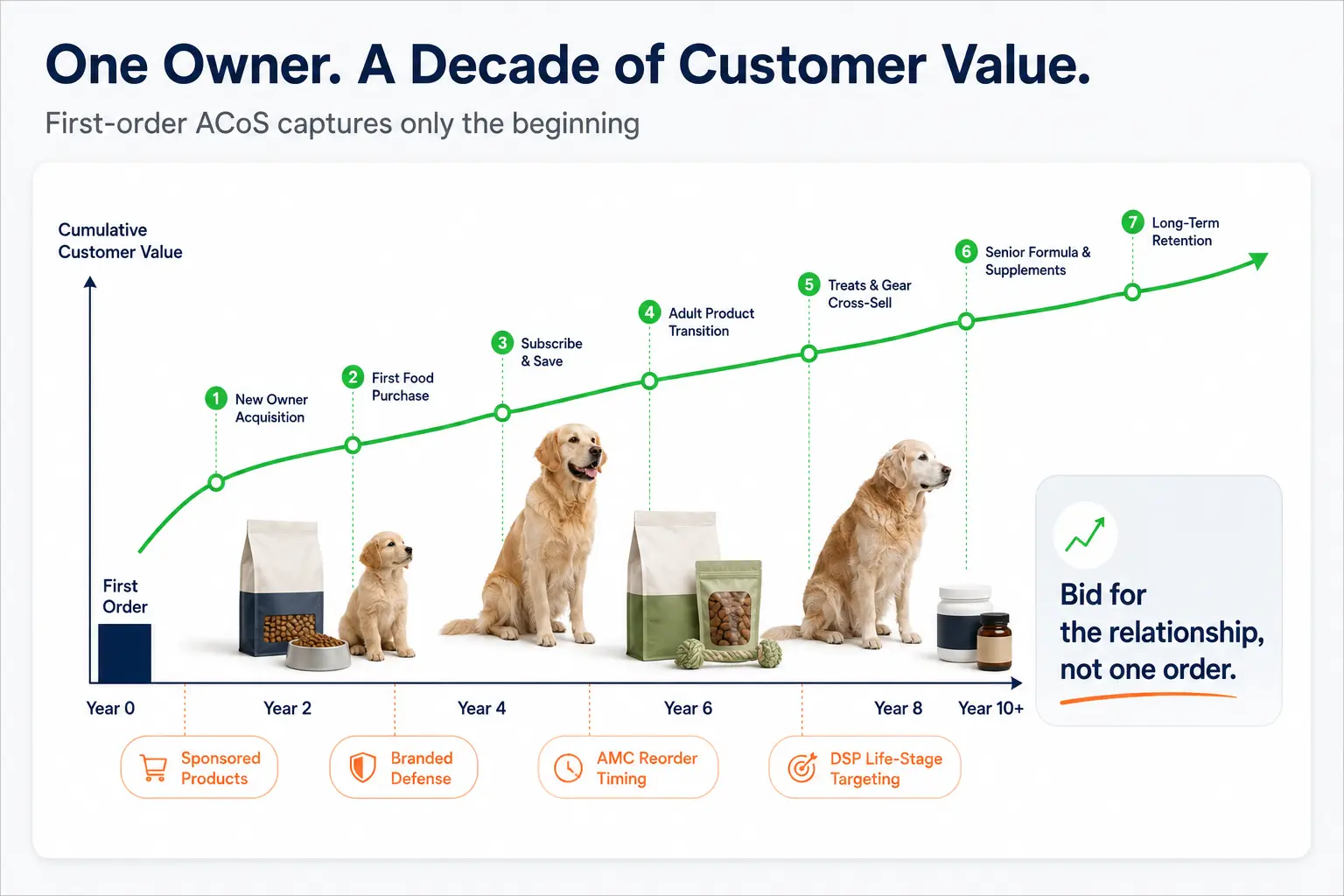
A dog owner who buys your food does not buy once; if the dog does well on it, they reorder for years, add treats and supplements, and replace gear as the dog grows. The true return on acquiring that owner is a decade of purchases, not a single sale, so a first order that breaks even on Advertising Cost of Sale (ACoS) can be an excellent decision when the customer is worth many times that over the relationship.
The brands that keep growing at this scale make this shift first: they calculate what a dog owner is worth across years, then decide how much they can pay to acquire one, and that number is almost always higher than a single-sale target would allow.
Bidding on the first order alone leaves your most valuable customers to a competitor willing to see the whole relationship.
The length of the dog relationship makes this more extreme than in most repeat categories. A baby ages out of a category in a few years and a gadget buyer may never return, but a dog owner can buy from you for a decade or more, which means the gap between the first-order value and the true lifetime value is enormous.
A brand that bids as if the first sale is the whole prize is not just leaving a little on the table; it is systematically underpricing a customer worth ten or more purchases, and it will lose the auction to any competitor who has run the real arithmetic.
At this scale the arithmetic is not optional, because the difference between first-order and lifetime bidding is the difference between capturing the category and watching it walk to a rival.
Total Advertising Cost of Sale, ad spend against total revenue including organic and repeat, is the metric that shows whether acquisition is turning into retention. When TACoS holds or falls while total sales climb, your paid spend is winning owners who then reorder and buy up the ladder organically. /
Push Sponsored Products to build the velocity that feeds this, and read the whole picture rather than a single campaign's ACoS, because in a decade-long category the first sale is the least important part of the customer's value.
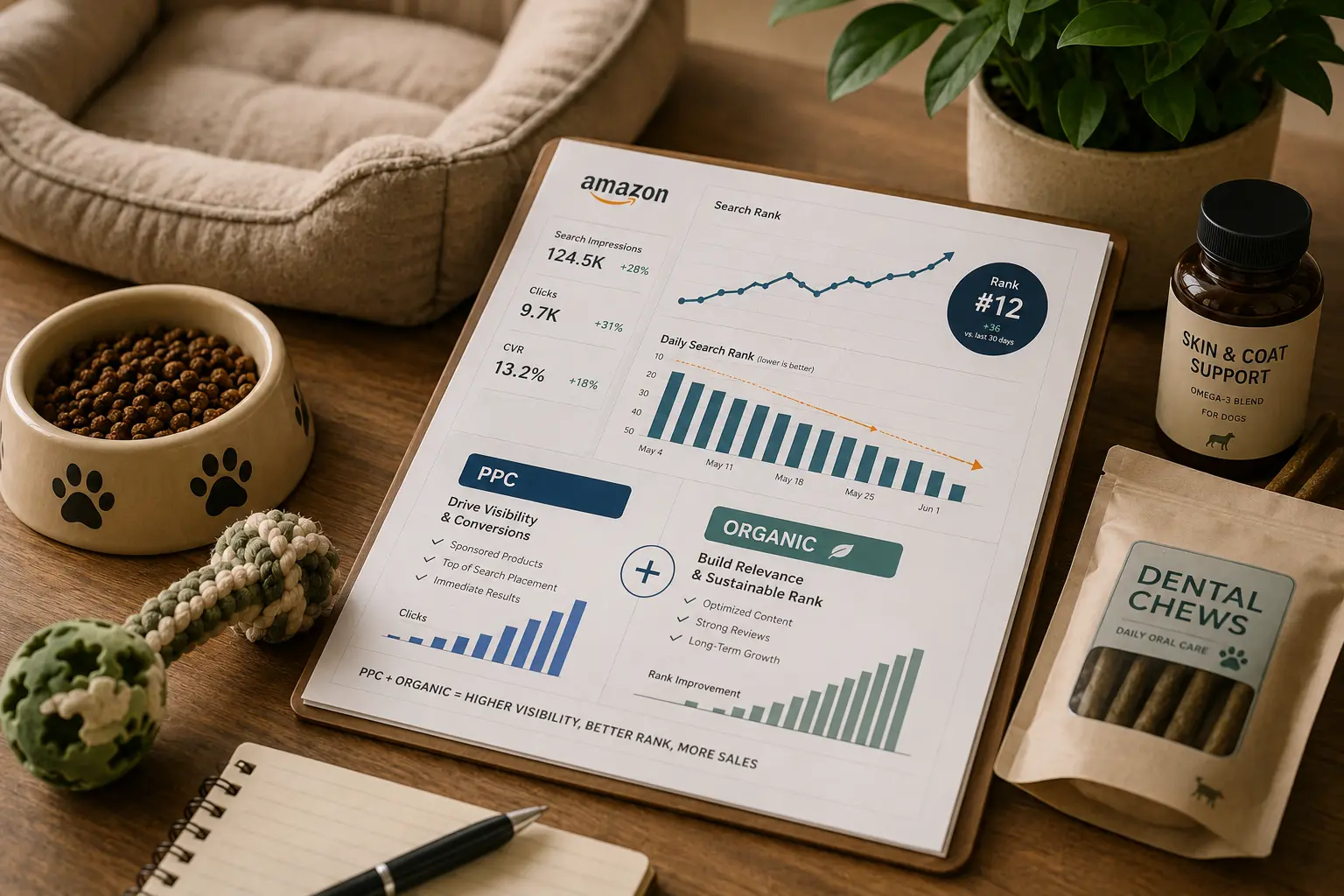
The mechanism by which that paid velocity compounds into organic rank is covered in our guide on how pet brands combine PPC and organic to
win search rank.
A dog's needs change as it ages, and that progression is the clearest growth lever you have at scale.
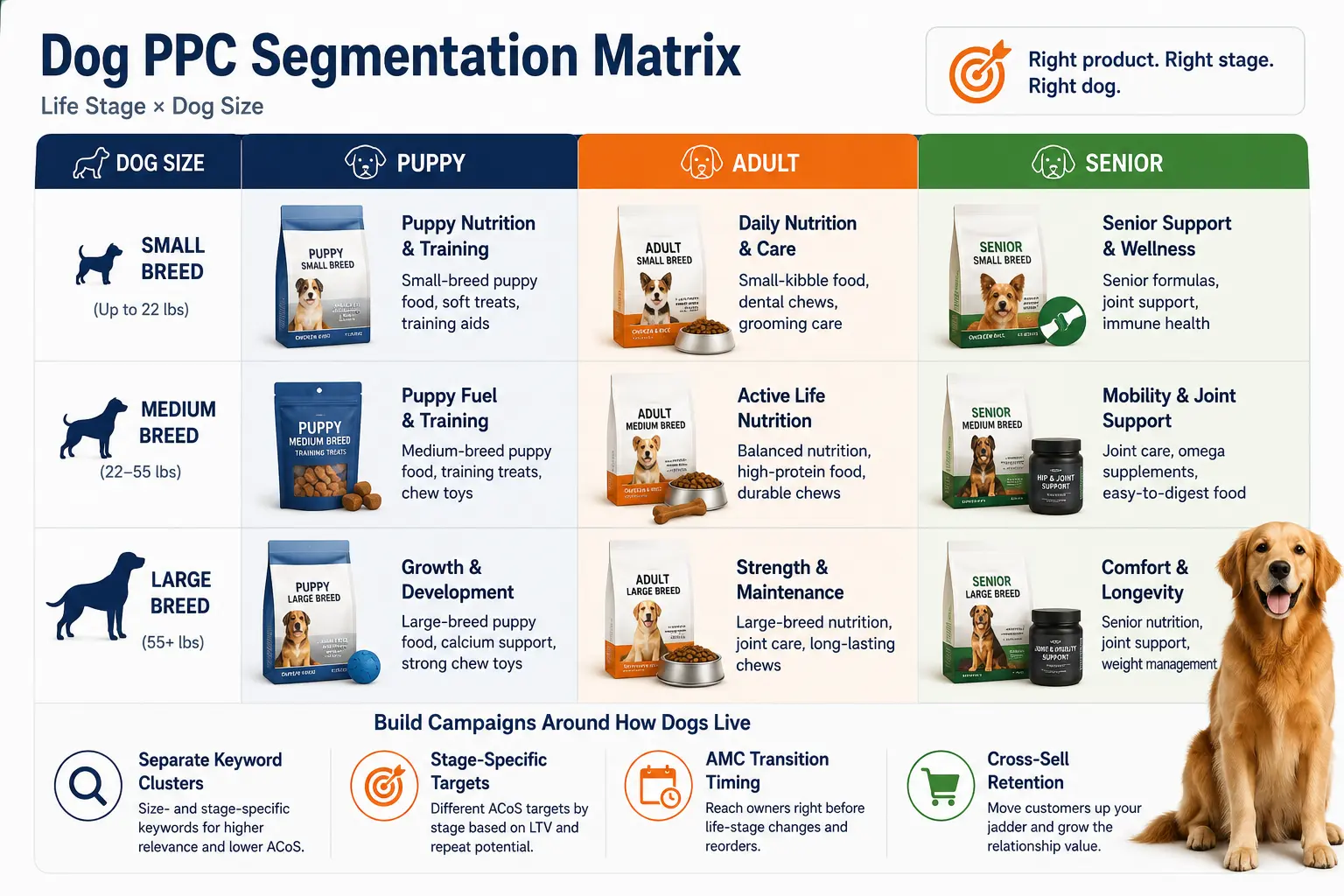
A puppy needs different food, training treats, and gear than an adult, and an aging dog needs joint support, softer food, and senior formulas. Each transition is a moment when the owner is actively in the market for the next product, and whoever reaches them then usually wins the sale.
The job is to move your own customer up your life-stage ladder rather than letting a competitor catch them at the switch, so build campaigns and audiences that anticipate the next stage instead of waiting for a fresh search.
A brand that carries the owner from puppy food through senior supplements captures years of purchases from a single acquisition, which is the compounding that separates a scaled dog brand from one that wins the first sale and loses the customer.
Dog is not one market; a small-breed owner and a large-breed owner buy almost different catalogs. Portion sizes, food formulas, gear dimensions, chew durability, and health needs all vary by size and breed, and a blended target across them wastes spend by forcing different buyers into one plan.
At $200,000 a month you have the data to segment by size and breed profile and fund each to its own economics, matching the product and the message to the dog.
This is the portfolio discipline the pet tier framework describes in our guide on Amazon PPC for pet brands by spend tier, applied to the specific dimensions that split a dog catalog.
The two dimensions compound. A large-breed puppy and a small-breed senior are almost opposite customers with opposite needs, and a catalog that maps both the size axis and the life-stage axis has far more precise cross-sell paths than one that treats dogs as a single group.
The owner of a large-breed puppy is a candidate for large-breed adult food in a year and joint support later, a sequence you can anticipate and campaign against.
Missing that specificity is how spend gets wasted at scale: a generic dog-food ad shown to every owner converts worse than a large-breed formula shown to large-breed owners, and the data to make that match is sitting in your account waiting to be used.
If lifetime value is the goal, subscriptions are the machine that delivers it, and at scale protecting that machine matters as much as feeding it.
Food, treats, and supplements run on repeat purchase, and Subscribe & Save turns one acquisition into a stream of reorders that cost nothing further in ad spend.
That means the products with strong subscription attach deserve more acquisition budget than their first-order economics alone would justify, because each reorder repays the aggression for years.
Track subscription attach rate by product, not just ACoS by campaign, because that is what tells you which spend compounds into an annuity and which merely buys a one-time sale. Fund the compounding products harder, and let the reorders carry the return.
At scale, defending existing subscribers is as valuable as winning new ones. Keep a low-cost branded campaign live so a loyal owner searching your name to reorder is not intercepted by a competitor bidding on it, and use retargeting to cross-sell the supplement to the food buyer or the next size up to the growing puppy.
A steady Amazon PPC management practice keeps these retention and cross-sell campaigns funded rather than neglected in favor of chasing new acquisition, which is the more common and more expensive mistake at this scale.
Below this scale, Sponsored Products and Sponsored Brands do most of the work. At $200,000 a month, with a base of customers and a lifecycle to manage, programmatic tools start to pay off.
Amazon DSP runs programmatic display and video on and off Amazon, and in dog its best use is timing.
Amazon Marketing Cloud audiences let you build segments from your own purchase data, so you can reach a food buyer just before their bag runs out, a puppy owner as the dog approaches the next life stage, or exclude recent purchasers from acquisition campaigns to stop paying for sales you already have.
That timing turns the life-stage ladder and the reorder cycle from a hope into a system, because it puts the right product in front of the owner at the moment their need changes.
The other job for DSP at this scale is demand creation. New dog owners arrive constantly through puppies and adoptions, often before they know which brands exist, and upper-funnel display and video reach them earlier than search can.
Because the category has a steady stream of first-time owners, the brand that introduces itself early wins the whole decade of buying that follows.
Judge this spend on new-to-brand sales and lifetime value, not a search-style ACoS, or you will cut the very spend that fills the top of your funnel.
New-to-brand is the scoreboard at this scale: the share of sales going to owners who have not bought you in the past year is the clearest read on whether you are growing the base or recycling it.
Dog owners buy for a family member, and at scale one claims slip can undo the brand trust that carries a premium.
Supplements and functional foods carry the most rules. The FDA's animal food labeling and pet food claims guidance permits nutrition and structure-function language but forbids disease claims, so your listings and ad copy can describe supporting healthy joints or digestion but cannot promise to cure or treat a condition.
Overreaching risks suppression and, worse, the trust a cautious owner pays for, so treat claim discipline as a growth strategy rather than a compliance chore.
At $200,000 a month you have a brand worth protecting, and the cost of a claims problem is measured in lost trust, not just a paused campaign. Knowing where competitors are pushing claims or taking share is the kind of read a structured Amazon PPC competitor analysis is built to produce.
At $200,000 a month the gains hide in places a busy team rarely has time to dig: acquisition judged on one order instead of a decade, a life-stage ladder that leaks customers at each transition, or AMC data sitting unused while owners drift to rivals.
An outside review that reads lifetime value, the life-stage journey, and the full funnel rather than the ACoS column tends to find both waste to cut and growth to fund.
That is a specialist's job, and at this scale the return on getting it right dwarfs the cost of the review.
As a specialist Amazon PPC agency, Amplivus works with scaled pet and dog brands on exactly these questions, reading the whole picture rather than the campaign surface.
A free Amazon PPC audit reviews your account for the leaks and missed levers at your scale, and a short Amazon strategy session maps the highest-value moves for the year.

Get a focused PPC review that uncovers weak lifetime-value bidding, missed life-stage cross-sells, subscription leaks, and AMC audience gaps.
See where lifecycle gaps, weak retention, and poor audience timing cost you repeat sales and long-term customer value.
.png)
.png)


.png)
.png)