Amazon PPC for Pet Brands: 2026 Strategy by Spend Tier
Read more
.png)
At $200K, optimize a pet account to lifetime value and subscription, not a single-order ACoS, because repeat purchase is where pet profit lives.
Summarize in ChatGPT

A $200K pet account rarely needs more budget to improve. It needs its targets re-based on the one thing that makes pet profitable, which is repeat purchase. Optimize a subscription and consumable business on a single-order ACoS and you will cut the exact spend that was acquiring your best, most loyal customers.
This guide is a practical optimization playbook for pet brands past $200K a month: how to re-base targets on lifetime value, where to cut waste, how to optimize branded spend without cannibalizing organic reorders, and how to defend the customers you already have. It assumes a working account that needs sharpening, not a launch.
It means raising the profit your existing spend produces by measuring it against lifetime value and subscription, not a single-order ACoS. The metric is the whole game here.
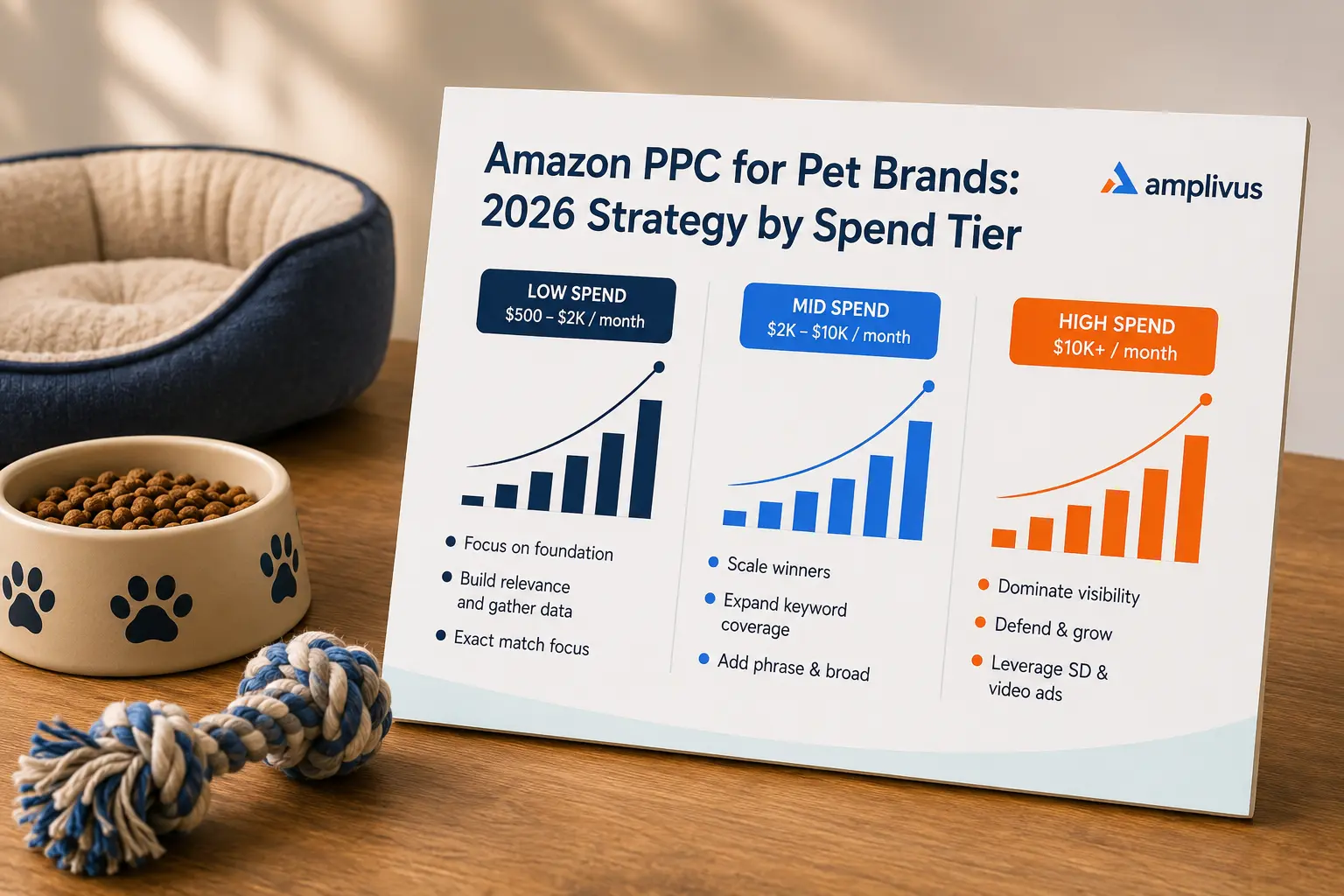
Optimization at this tier is about efficiency, not just growth, and the right approach depends on where you sit, a progression mapped in our guide to Amazon PPC for pet brands by spend tier.
The defining feature of pet is repeat. Food, treats, supplements, and litter get reordered for years, so the value of a customer is many times the first order, and any optimization that ignores that will improve the wrong number.
That single shift changes everything downstream. Once lifetime value is the yardstick, a bid, a budget, and a branded decision all look different from how they look on a single-order ACoS.
It also differs from scaling. Scaling adds budget to grow revenue, while optimization sharpens the spend you already have so more of it builds repeat value. A $200K pet brand usually needs both, but confusing them is how brands overspend on growth while their efficiency quietly slips.
The account is also more complex than it looks. Multiple products, subscription and one-time buyers, and several campaign types mean more moving parts than a single-SKU account, which is usually where brands move from casual management to a deliberate optimization routine.
Because pet customers reorder for years, break-even should be set on lifetime value, and spend judged on the subscribers it acquires, not one order. A first-order view understates almost everything.
A single-order ACoS is easy to hit by cutting spend, and in pet that is often a mistake. Measuring lift and repeat is what separates real efficiency from shrinking the business, and Amazon Marketing Cloud connects acquisition to repeat behavior across the account.
Ground the work in your own numbers. Brand Analytics and Search Query Performance, your repeat-rate data, and new-to-brand metrics together tell you whether spend is acquiring loyal customers or just repeating ones you already had.
The economics of that repeat engine are the foundation of scaling, which is why they run through our guide on how pet brands scale past $100K a month.
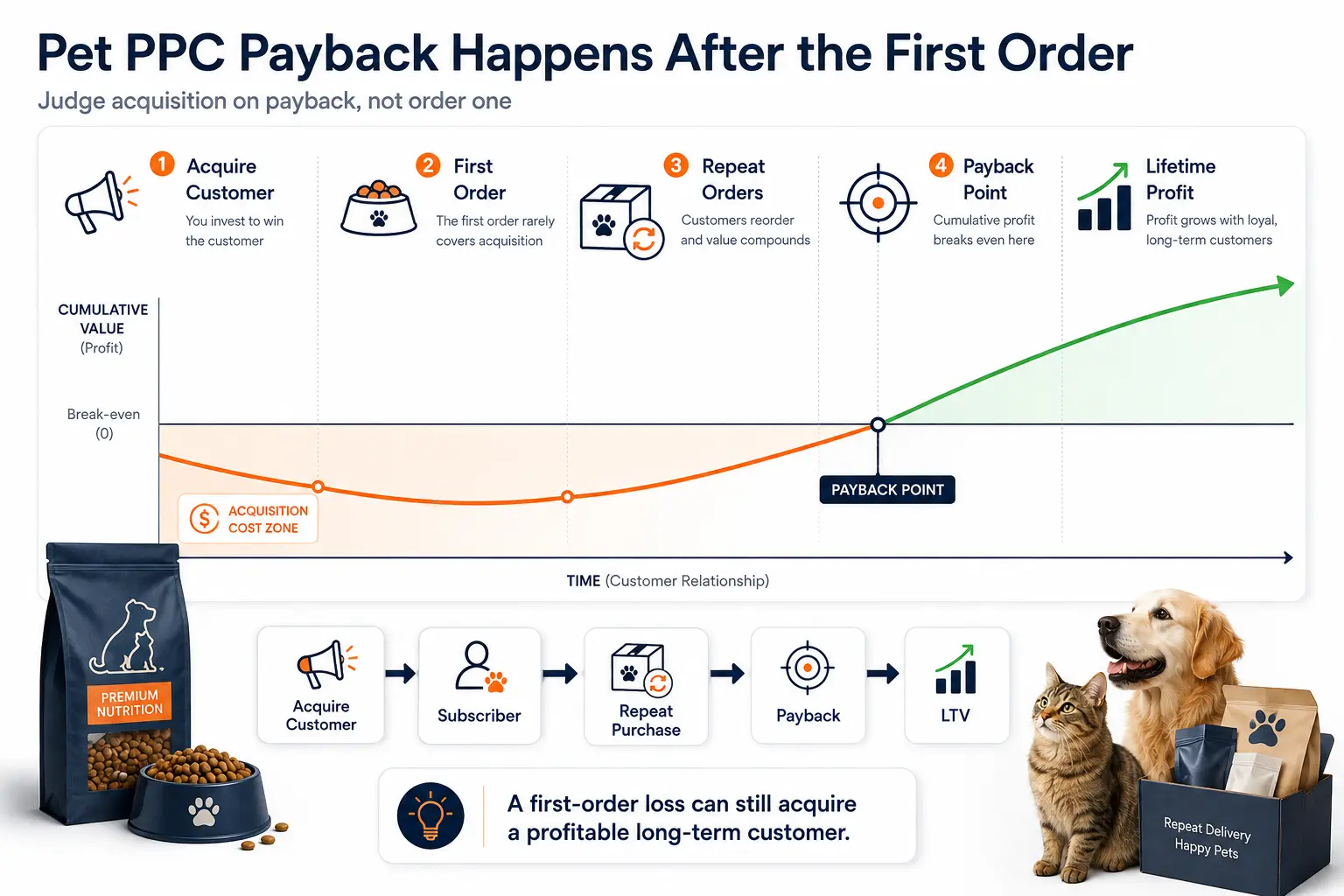
A simple example shows why. If acquiring a food subscriber costs more than the first bag returns, the math still works once that customer reorders every month for a year. Judged on the first order it looks like a loss; judged on the year it is one of your best customers.
Payback period is the number to watch. How many months it takes for a customer's repeat orders to cover their acquisition cost tells you how aggressive you can safely be, and it is far more useful for a pet brand than a single-order ACoS.
Treat subscriber acquisition as a goal in its own right, then protect and grow that base rather than re-buying it. Subscription is the compounding engine of a pet brand.
Subscribe and Save turns one sale into a recurring one, so the spend that lands a subscriber is worth far more than a single-order ACoS suggests. Optimization means recognizing that value, not clipping the campaigns that create it.
Protect the base you build. A subscriber who reorders automatically should not be re-acquired through aggressive ads every month, so the optimization is to spend on new subscribers and defend existing ones, not pay twice for the same customer.
The signal to watch is your mix of new versus returning buyers. If most of your ad-driven sales are people who would have reordered anyway, the spend is not adding what the revenue line implies.
Measure subscription attach as a core metric, not a footnote. Knowing what share of new customers convert to a recurring order tells you which products and campaigns build the compounding base, so you can shift budget toward the ones that actually create subscribers.
Mind the discount math, too. The recurring discount that drives subscription lowers your margin per order, so the break-even you optimize against has to use the subscription price, not the one-time price. Optimizing to the wrong margin quietly overstates how efficient your spend really is.
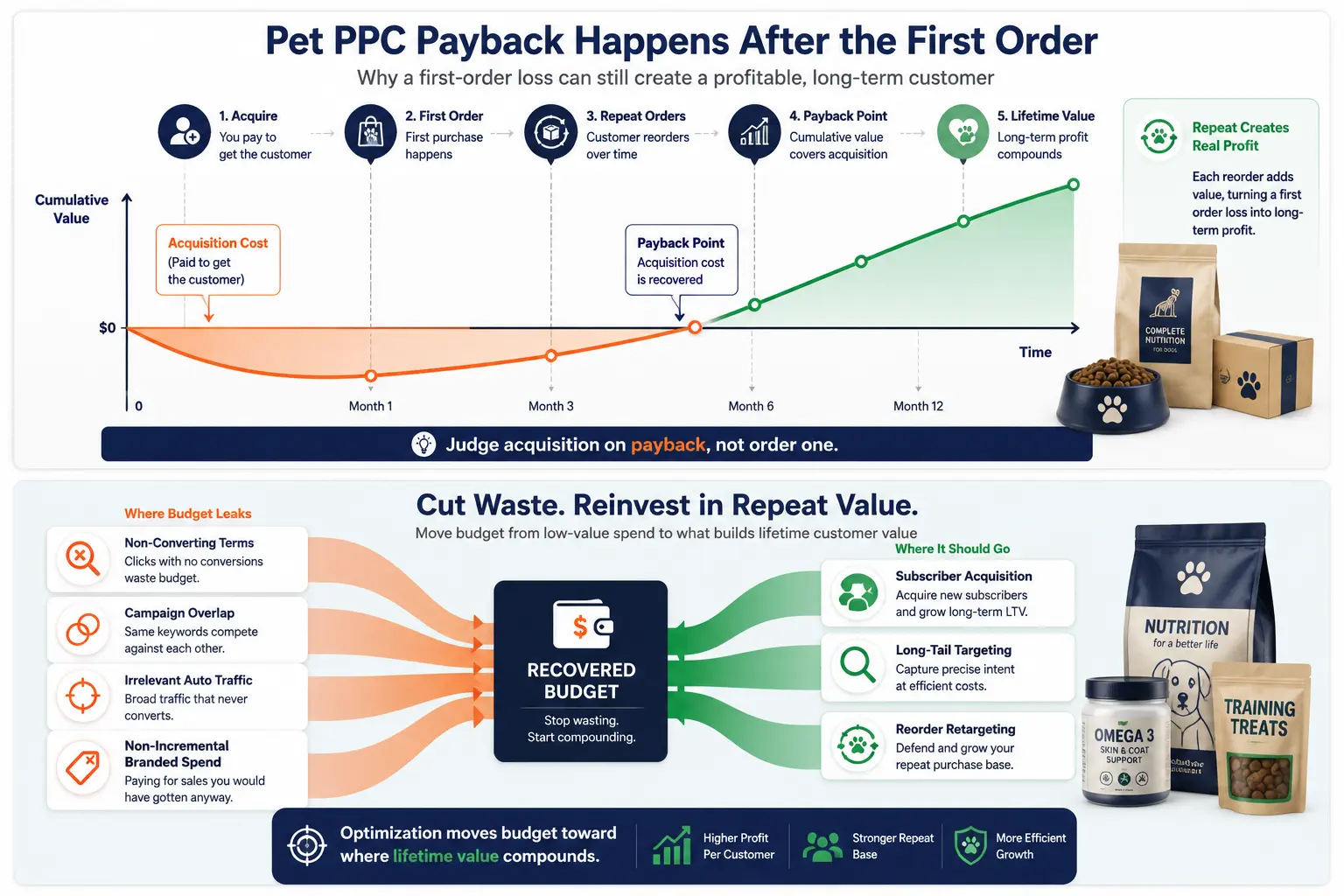
Start with non-converting search terms, campaign overlap, and non-incremental branded spend, because that is where a repeat-heavy pet account leaks most. Waste is the fastest lever you have.
The fastest wins are in waste, not clever bidding. On Sponsored Products, a large pet account accumulates non-converting terms, overlapping keywords, and auto campaigns buying irrelevant traffic that a tighter structure would stop.
A structured pass surfaces these fast, which is exactly what a focused Amazon PPC audit is built to do before any bids are touched.
Branded overspend hides here as well. Because loyal owners search your name, a large share of branded clicks may be reorders you would win for free, so branded campaigns deserve scrutiny before you celebrate their low ACoS.
Fixing waste first also makes the lifetime-value work cleaner. Once the obvious leaks are closed, you can judge the remaining spend on repeat value instead of noise.
Trim branded bids that pay for reorders you would win organically, and test incrementality before assuming every branded click is earned. Branded spend is the quietest leak in pet.
Loyal pet owners search your brand by name and reorder on their own, so aggressive branded bidding can quietly pay for organic sales, a dynamic covered in our guide on how pet brand PPC and organic search rank work together.
Defense still matters where competitors bid on your name. Sponsored Brands holds the top of your branded results, but the optimization is to defend where you are genuinely under attack, not to blanket every branded search.
Test before you trust the number. Pausing branded ads on a segment and watching whether sales move to organic tells you what that spend actually added, which is the only honest way to optimize it.
Run the test deliberately, not by feel. Hold branded ads back on a defined segment for a set window, compare total sales against a period with ads on, and let the difference decide the budget. A guess about incrementality is worse than the small cost of measuring it.
Harvest converting species, breed, and life-stage terms from broad and auto campaigns, then promote them to their own exact-match campaigns. Pet has an unusually rich long tail.
Dog versus cat, puppy versus senior, breed size, and dietary needs all create specific searches that convert well because intent is precise, and they cost less than broad head terms. That is where efficient targeting lives.
The loop is steady harvesting. Mine converting terms, promote winners to exact match with their own bids, and cut the losers, an approach that echoes Amazon's own Sponsored Products best practices.
Species-level detail matters enough to plan for specifically, which is why we treat dog brands on their own in our guide to building a dog brand PPC strategy at $200K a month.
Negatives do the other half of the work. A dog-food campaign that surfaces cat searches, or a puppy term that draws senior-dog buyers, spends without converting, so a steady negative-keyword habit is one of the most reliable ways to tighten a pet account.
Use retargeting to reach past buyers as they approach reorder, because re-engaging an existing pet owner is cheaper than acquiring a new one. Retention is an optimization lever, not an afterthought.
Sponsored Display keeps your products in front of past buyers as their supply runs low, recovering reorders a single search ad never sees. In a consumable category, that timing is worth real money.
Timing is what makes retargeting efficient. A pet owner runs out of food or litter on a predictable cycle, so reaching them just before that reorder date converts far better than a generic impression, and it protects the subscription from a competitor's switch offer.
Because the category is contested, market context sharpens every cut. A structured Amazon PPC competitor analysis shows why your share is moving, so optimization targets real pressure rather than guesswork.
Run waste and bid checks weekly, structure and harvesting monthly, and incrementality and lifetime-value reviews quarterly, so optimization never drifts. Cadence turns a cleanup into a discipline.
Optimization decays without rhythm. A pet account changes weekly as competitors shift and new terms appear, so a fixed cadence keeps efficiency from sliding back.
Weekly is for fast levers like negatives and bid nudges. Monthly is for structure and search-term harvesting, and quarterly is for the bigger questions: incrementality tests, lifetime-value re-basing, and whether branded spend still earns its place.
Write down what you change and why. A short log of each optimization and its result over the following weeks turns the cadence into a learning loop, so the account gets smarter instead of repeating the same adjustments every quarter.
Rank moves by impact against effort, and start by re-basing your targets on lifetime value before touching anything else. The metric change unlocks every other decision.
Negatives and obvious waste are the quickest wins, so they come next, followed by branded-spend testing, which usually frees meaningful budget in pet. Long-tail harvesting and retargeting build on that cleaner base.
Save structural rebuilds and deep incrementality work for last, because they are higher-effort and only pay off once the account is measuring the right number. Sequencing this way keeps you from optimizing hard toward the wrong goal.
The common mistakes are optimizing to first-order ACoS, over-bidding branded terms, ignoring retention, and cutting spend that acquires
subscribers. Each one optimizes a number instead of the business.
The first is treating a single-order ACoS as the goal in a repeat-purchase category, which cuts the spend that builds lifetime value. The second is blanket branded bidding that pays for reorders you would win anyway.
The third is ignoring retention, when retargeting past buyers is often the cheapest sales in the account. The fourth is slashing spend to flatter a ratio, which shrinks the subscriber base that makes pet profitable in the first place.
A fifth mistake is optimizing every campaign to the same target. A branded campaign, a discovery campaign, and a subscription-hero campaign each play a different role, so holding them all to one ACoS punishes the ones doing the most valuable work.
As a specialist Amazon PPC agency, Amplivus optimizes pet accounts to lifetime value and subscription, not a vanity ACoS, so every efficiency decision protects the repeat customers that make pet profitable.
Day to day, that means disciplined Amazon PPC management that cuts waste while defending the subscribers your spend worked hard to earn.
If you want that turned into a plan, a short Amazon strategy session maps the highest-value optimization moves for your account and your year, with no lock-in and no pressure.

Get a focused PPC review that uncovers wasted spend, weak lifetime-value bidding, branded cannibalization, and missed repeat-purchase growth.
Trim weak terms, branded overspend, and retention gaps without cutting the campaigns that build repeat pet revenue.