How Kitchen Brands Scale Past $100K/mo With Amazon PPC
Read more
.png)
Plan Amazon PPC for kitchen brands by spend tier: launch buys rank at a looser ACoS, then growth to enterprise tighten TACoS and add video, DSP, and AMC.
Summarize in ChatGPT
Kitchen is a crowded, price-sensitive aisle where a wasted click costs more than the same mistake costs a light-goods seller, because fees are high and the buyer compares carefully.
Most advice ignores that and hands a founder spending $3,000 a month the same tips it hands a brand spending $80,000.
Those two brands should be doing almost opposite things: one is buying its first rankings and cannot chase efficiency yet, while the other is defending shelf space, running Amazon Demand-Side Platform (DSP) campaigns, and reading Amazon Marketing Cloud (AMC) reports.
A single Advertising Cost of Sale (ACoS) target for both is close to useless.
This guide plans Amazon pay-per-click (PPC) advertising for kitchen and home brands by spend tier, so the moves match the money. You get benchmark ranges, budget splits, and a launch-to-scale sequence you can act on today.
If your goal is specifically crossing six figures a month, pair it with our guide on how kitchen brands scale past $100K a month.
Budget advice only means something once you know your own math. Two numbers frame every tier below: what you can afford to pay for a sale, and how much of your revenue should go to ads at your stage.
ACoS is ad spend divided by ad sales. Your break-even ACoS is your profit margin before advertising, and in kitchen it is often tighter than sellers expect, because the US small kitchen appliances market is weighted toward bulky products that carry oversize
Fulfillment by Amazon fees. If an air fryer sells for $80 and you keep $24 after cost of goods, the oversize FBA fee, referral fee, and freight, your margin is 30 percent, and that 30 percent is your break-even ACoS.
A gadget at a higher point margin can absorb a bigger cost per click than a heavy appliance at the same price, which is why break-even has to be calculated per product, not per account.
Anyone quoting a single ACoS number without asking your margin and your fee tier is guessing.
The fee side of this deserves more attention than most sellers give it. Amazon's 2026 fee schedule adds surcharges that land hardest on heavy and bulky items, and those are exactly the products that fill the kitchen aisle.
A stand mixer or a large air fryer can lose several dollars per unit to size-based fulfillment costs that a light gadget never sees, which means the same $1.20 click that is profitable on a $30 utensil can be a loss on a $120 appliance selling at the same margin percentage.
Run the arithmetic once per SKU before you set a bid, then revisit it whenever a fee change or a freight increase moves your landed cost.
A bid that was healthy last quarter can quietly go underwater without a single change to your campaign.
TACoS, Total Advertising Cost of Sale, is the companion metric. It measures ad spend against total revenue, so it exposes whether paid growth is pulling organic up with it.
When TACoS holds steady while total sales climb, your ads are building rank. When TACoS rises and sales stay flat, something in the targeting or the listing is off, and no bid change will fix it.
The mechanism behind that paid-to-organic lift is covered in our guide on how cooking brand PPC powers organic rank.
New kitchen brands often spend 20 to 40 percent of revenue on ads while they buy traction. Scaling brands settle into 15 to 25 percent. Mature brands with strong organic rank and repeat consumable buyers run leaner, often 8 to 15 percent, because rank and Subscribe & Save carry sales that no longer need paid support.
Kitchen leans to the higher end early, because the category is crowded and demonstration-driven, and shoppers rarely buy an unknown appliance on the first click.
The sharper question is not how much, but where the money goes first. Early on the goal is signal, not efficiency, so pushing for a low ACoS before you have conversion data switches off the very campaigns that would have taught you what works.
The right move at $3,000 a month is often the wrong move at $80,000. So instead of one plan, here are four, sorted by monthly Amazon Ads spend. Find your tier, read it closely, then skim the one above to see what comes next.
At this stage you have one or two hero products and no room for waste, so resist running every ad type. Put the majority of your budget into Sponsored Products, because kitchen is still search-driven at the point of purchase and Sponsored Products is where purchase-ready clicks live.
Run one Auto campaign to surface converting search terms and one manual Exact campaign to control the terms you already know matter. Mine the Auto campaign's search-term report every week, move winners into Exact, and add the junk as negatives so you stop paying for it.
Expect a higher ACoS here, running 45 to 60 percent for the first two to three months while you buy rank and reviews on a new ASIN, and plan for it.
Seed early reviews through Amazon Vine, because in a demonstration-driven category a listing with few reviews converts poorly no matter how good the ad is, and enroll in Brand Registry so you can run video later.
You have proof now: certain keywords convert, a few products carry the account, and you can afford to widen the funnel.
This is where Sponsored Brands and Sponsored Brands Video start to matter more in kitchen than in almost any other category, because gadgets and appliances sell on demonstration and video shows the blend, the fold, or the finished dish before the click, which lifts click-through rate and lowers wasted spend.
A disciplined Sponsored Brands management approach keeps that video budget productive. Start defending your brand name here too, since a competitor may bid on it, and a low-cost branded campaign keeps that traffic yours.
Your ACoS target tightens to roughly 30 to 40 percent as ranking work pays off. A typical split at this tier: about 60 to 70 percent to Sponsored Products, 20 to 25 percent to Sponsored Brands, and a small controlled slice to Sponsored Display for retargeting the long consideration window a higher-ticket kitchen buy carries.
Now you are a category contender, and the job shifts from capturing demand to owning share of voice. Sponsored Display grows from a test into a real line item, retargeting the shoppers who viewed an appliance and left to compare.
You start adjusting bids by placement, paying up for top-of-search where conversion is strongest and trimming where it is not, and dayparting enters the plan.
This is also where AMC becomes useful, letting you see how Sponsored Products, Sponsored Brands, and Sponsored Display work together across a shopper's path rather than in separate silos.
Blended ACoS at this tier usually lands around 25 to 35 percent, with mature hero products running lower and new launches still allowed to run hot.
This is also the tier where a viral product can distort your averages, which our guide on bidding for viral kitchen products addresses in full.
Market leaders stop asking only how to capture searches and start asking how to create demand. Amazon DSP is the tool for that, running programmatic display and video on and off Amazon, retargeting shoppers who left without buying and reaching look-alike audiences that match your best customers.
Self-serve Sponsored TV extends that reach into streaming. AMC Audiences turn your own data into targetable segments, so you can reach a household that bought an appliance before its likely accessory window, or exclude recent purchasers from acquisition campaigns.
At this tier the metric that matters most is new-to-brand sales, because growth comes from new households, and blended ACoS often runs 20 to 30 percent read alongside customer lifetime value rather than on its own.
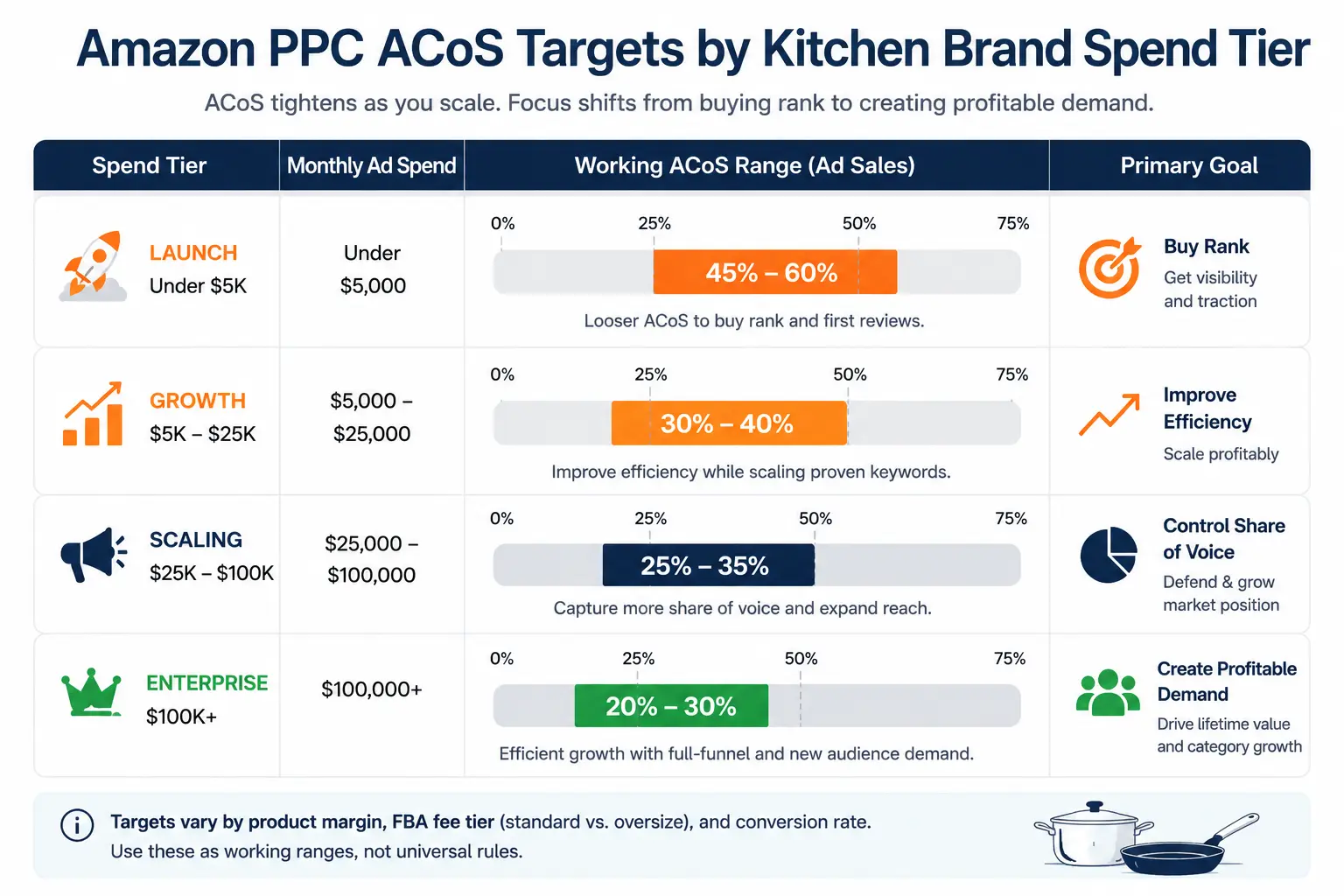
Numbers give you something to aim at. Treat both tables as starting points you adjust against your own margin and fee tier, not fixed rules.
There is no single public benchmark for every kitchen subcategory, so treat these as directional and pull each target down if your oversize fees leave a thinner margin than the range assumes.
A heavy appliance and a light gadget at the same price will not share the same healthy ACoS, because their break-even is different.
The tiers set your budget and targets. What separates a strong kitchen account from an average one is the detail: which subcategory you sell, the peaks you plan for, and the mistakes you sidestep.
Amazon treats kitchen as one bucket, but the subcategories do not behave alike.
Appliances and high-ticket items (air fryers, stand mixers, ice makers) carry high average order values but thin point margins after oversize fees, and the buyer takes days to decide, so retargeting and video earn their place.
Gadgets and mid-ticket tools (blenders, choppers, utensils) are the workhorse with balanced margins and enough volume to build rank, so this is where the bulk of your scaling budget belongs.
Consumable accessories (filters, replacement blades, liners) run on repeat purchase, and Subscribe & Save makes lifetime value high enough to justify a looser acquisition ACoS. Fund each group to its own ceiling rather than at one target.

Most categories have a single Q4 peak. Kitchen has two. The fourth quarter drives heavy gifting demand as small appliances and gadgets are among the most-given household gifts, and cost per click climbs across the board.
Then January brings a second surge, as cooking, meal prep, and healthy-eating resolutions concentrate demand into the new year.
Build reviews and rank in the quiet months, then raise budgets and loosen targets ahead of both peaks and tighten on the way down.
Gift sets and bundles deserve their own fourth-quarter campaigns, because holiday shoppers search "gift" intent your everyday keywords miss, and sync ad budgets to your restock cycles, because outrunning inventory triggers out-of-stock penalties that undo weeks of rank building.
A guide like this gets you a sound plan. What it cannot do is look inside your account and tell you which campaign is leaking or which appliance is being scaled past its margin.
If your ACoS has crept up, your sales have flattened, or you are about to scale spend into a peak, a structured review of your search-term reports, campaign structure, and placement data usually finds money faster than another round of guesswork.
The pattern shows up again and again: a founder is convinced the problem is bid strategy when the real leak is a handful of broad-match terms bleeding spend on searches that were never going to convert, or an oversize SKU priced for volume that quietly loses money on every advertised sale.
That is the kind of thing a fresh set of eyes catches quickly, and it is far cheaper to catch before you pour a bigger budget on top of a structure that is already leaking.
As a specialist Amazon PPC agency, Amplivus works with kitchen and home brands at every tier described above, from a founder buying first rankings to a market leader running DSP.
A free Amazon PPC audit reviews your account before you scale and flags the leaks worth fixing first, and a short Amazon strategy session maps the move to your next tier.

Meet with an Amazon PPC expert to create a profitable growth plan, improve efficiency, and confidently scale your kitchen brand.
Get a free Amazon PPC audit to uncover profit leaks, improve ACoS, and build the right strategy for your kitchen brand's spend tier.