Amazon PPC for Kitchen Brands: 2026 Strategy by Spend Tier
Read more
.png)
At $200K a month, cooking brands grow Amazon PPC by pairing demonstration creative with long-tail targeting, disciplined structure, and brand defense.
Summarize in ChatGPT
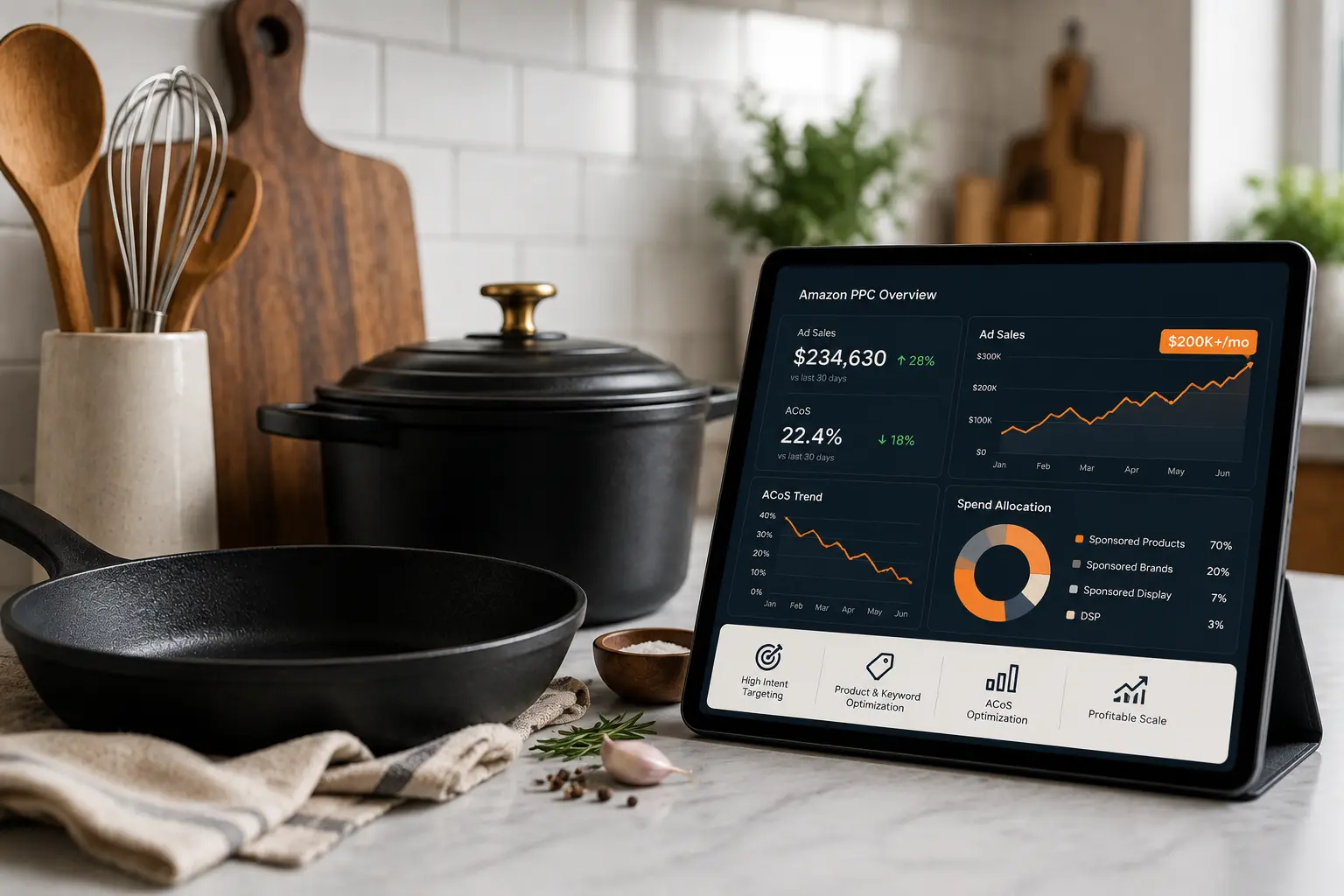
At $200K a month, a cooking brand has usually maxed out what its hero product can do on Amazon. The next stage of growth is not louder bidding on the same crowded head terms; it is winning the long tail, showing the product in action, and expanding across the catalog. Pushing harder on frying pan alone just raises your cost.
This guide is a practical growth playbook for cooking brands past $200K a month: how to structure the account, why demonstration creative matters so much, how to win recipe and use-case searches, and how to handle gifting seasonality. It assumes you have a working account and need to scale it efficiently, not launch it.
At $200K, growth shifts from defending a hero SKU to building category coverage across products, terms, and formats, judged on profit rather than a single ACoS. The job gets broader.
The move at this tier is breadth. A brand that rode one strong pan or knife to $200K now needs coverage across its range and its category's searches, a progression mapped in our guide to Amazon PPC for kitchen brands by spend tier.
Head terms alone stop scaling here. The broad, obvious keywords are the most contested and expensive in cooking, so leaning on them for growth raises cost faster than sales. The efficient growth sits in the terms and formats most brands ignore.
The goal also changes from efficiency to profitable expansion. At $200K you are buying new demand and new customers, so the metric is profit and total advertising cost of sale, not a low ACoS that rewards standing still.
Category coverage becomes the real target. At this size you are competing for a share of the whole cooking category's demand, not just your hero product's keyword, so the win is showing up across the materials, uses, and price points a shopper might search. Coverage is what turns one product into a brand.
The account also gets more complex to run. More products, more campaign types, and a real seasonal calendar mean more moving parts than a single-SKU account, which is usually the point where brands move from casual management to a dedicated operator.
Because cooking products sell on performance you can show, video and rich creative convert far better than a static image or a text ad. Seeing beats reading in this category.
A shopper choosing cookware wants to see the sear, the nonstick release, or the even heat, and a knife buyer wants to see the cut. Sponsored Brands video placements carry that demonstration where a static thumbnail cannot.
Video is the format that moves cooking consideration most, which is why we treat it as a growth channel in our guide to Sponsored Brands Video for kitchen gadget launches.
If you would rather not build that capability in-house, Sponsored Brands management is one way to get demonstration-led creative running as you scale.
Creative and proof reinforce each other. Video shows the product working, while strong reviews and lifestyle imagery confirm it, and cooking shoppers weigh both before buying something they will use daily for years. Brands that pair demonstration with social proof convert the same traffic at a lower cost.
Not every product needs video, though. Reserve the format for hero and higher-margin SKUs where a demonstration changes the decision, since production has a cost, and a $12 utensil rarely justifies what a $150 pan does. Match the creative investment to the product's value.
Separate head terms, long-tail terms, branded, and competitor traffic into their own campaigns so each can be bid and measured on its own. Structure is where efficient growth starts.
When broad, long-tail, and branded searches share campaigns, you cannot bid them differently, and on Sponsored Products that tangle quietly wastes budget as you scale. Every averaged number hides a decision you should be making.
Isolate the expensive head terms so you can control them deliberately. A term like chef knife deserves its own campaign and a conscious bid decision, not an average buried inside a broad campaign.
Give hero and growth products different roles. Your proven SKUs fund the account, while newer products get watched, deliberate spend to build rank and reviews, and the structure should make that separation obvious.
Negatives are as important as bids at this stage. A broad cooking term surfaces countless loosely related searches, so a steady negative-keyword habit keeps a scaling account from spending into traffic that never converts. Discipline here protects the budget you want to put toward growth.
Keep a discovery lane running alongside the tight campaigns. Auto and broad campaigns are how you find the next converting term, so a $200K account should always have a controlled budget mining for new keywords, not just harvesting the ones it already knows.
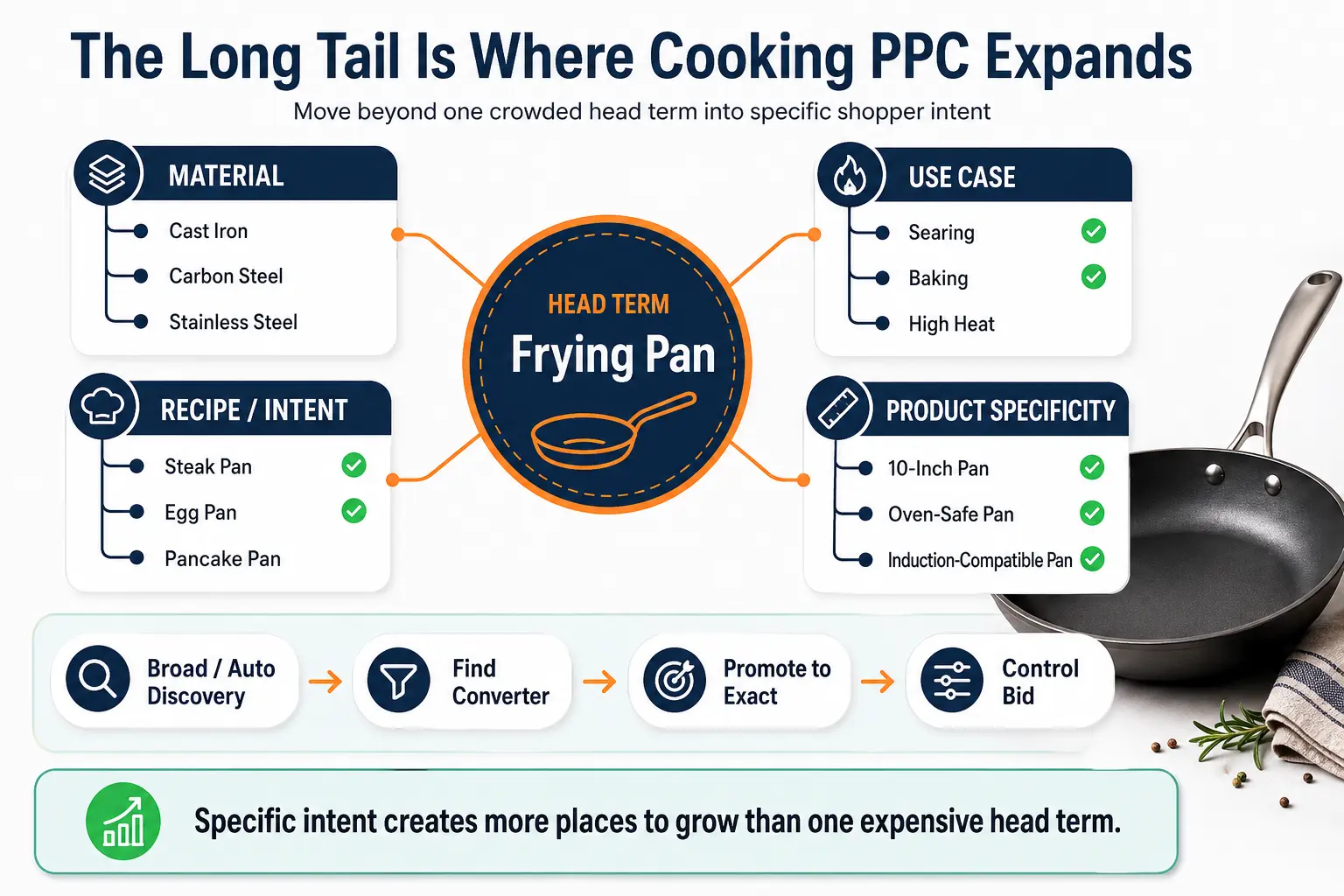
Harvest converting recipe, material, and use-case terms from broad and auto campaigns, then promote them to their own exact-match campaigns. The long tail is where cooking growth is most efficient.
Cooking has a rich long tail: material terms like cast iron or carbon steel, use-case terms like searing or baking, and specific recipe-adjacent searches. Brand Analytics and Search Query Performance show which of these you already win and which are worth chasing.
The loop is steady harvesting. Mine converting terms from broad and auto campaigns, promote the winners to exact match with their own bids, and cut the losers, an approach that echoes Amazon's own Sponsored Products best practices.
Long-tail cooking searches convert well because the intent is specific, and they cost far less than the head terms every competitor is bidding up. That combination is what lets you scale sales without wrecking ACoS.
Finding the long tail is a reporting habit. Work the search-term report and Search Query Performance regularly, looking for specific, converting phrases hiding inside broad campaigns, then give the winners their own home. The terms are already there; the work is noticing them.
Match types do the sorting. Broad campaigns discover new phrases, exact campaigns convert the proven ones at a controlled bid, and keeping the two separated is what lets a cooking account scale the long tail without losing control of cost.
Plan budget and inventory around Q4 and registry demand, because gifting swings cooking sales far more than an even monthly spend assumes. Cooking is a gifting category first.
Demand concentrates around the holidays and wedding-registry season, so pulling budget forward before those peaks and defending rank through them is core to the scaling sequence in our guide to scaling Amazon PPC for kitchen brands.
Sets and bundles matter more in this window. Cookware sets and knife sets are natural gifts, so featuring them and raising their share of voice before Q4 captures higher-value orders when shoppers are buying gifts rather than single replacements.
The quiet months matter as much as the peaks. After the holidays, cooking demand falls, so an efficient brand pulls budget back and protects margin instead of spending into a slower market, then rebuilds ahead of the next gifting window.
Coordinate ads with inventory before every peak. Nothing wastes a gifting surge like driving paid traffic to a product that goes out of stock mid-December, so a $200K cooking brand plans stock and spend together rather than in separate conversations.
Protect your branded searches and use retargeting to cross-sell across the range, because expanding a catalog is cheaper when you keep the customers you already earned. Defense and cross-sell compound each other.
Once your brand is worth searching for, competitors will bid on your name. Enrolling in Brand Registry unlocks the brand and defensive formats that keep rivals from buying attention on your own terms.
Cross-selling is where a cooking catalog compounds. Sponsored Display retargets shoppers who viewed one product with complementary items, turning a single pan sale into a set, a lid, or a matching utensil.
Your Brand Store is a cross-sell surface too. Sending branded and video traffic to a well-built store lets a shopper who came for one pan discover the set, the bakeware, and the tools, which lifts order value without extra acquisition cost.
Measure cross-sell on order value, not just ACoS. A retargeting campaign that looks expensive on a single click can be a bargain when it turns a one-item order into a set, so judge it on the basket it builds rather than the cost of the impression.
Profitable paid sales on a term lift its organic rank, so PPC and organic compound instead of competing when they are managed together. The two are one system, not two budgets.
Paid and organic feed each other in cooking. The mechanics of that flywheel, and how to avoid paying for rank you already own, are laid out in our guide on how cooking brand PPC powers organic rank.
The practical rule is to push paid hardest where it earns lasting rank, then ease off as organic takes over. Managed well, a term you win with ads today costs less to hold tomorrow.
There is a trap to avoid here. Bidding aggressively on your own brand terms can look efficient while paying for organic sales you would win for free, so a cooking brand should watch branded spend closely rather than assume every branded click is incremental.
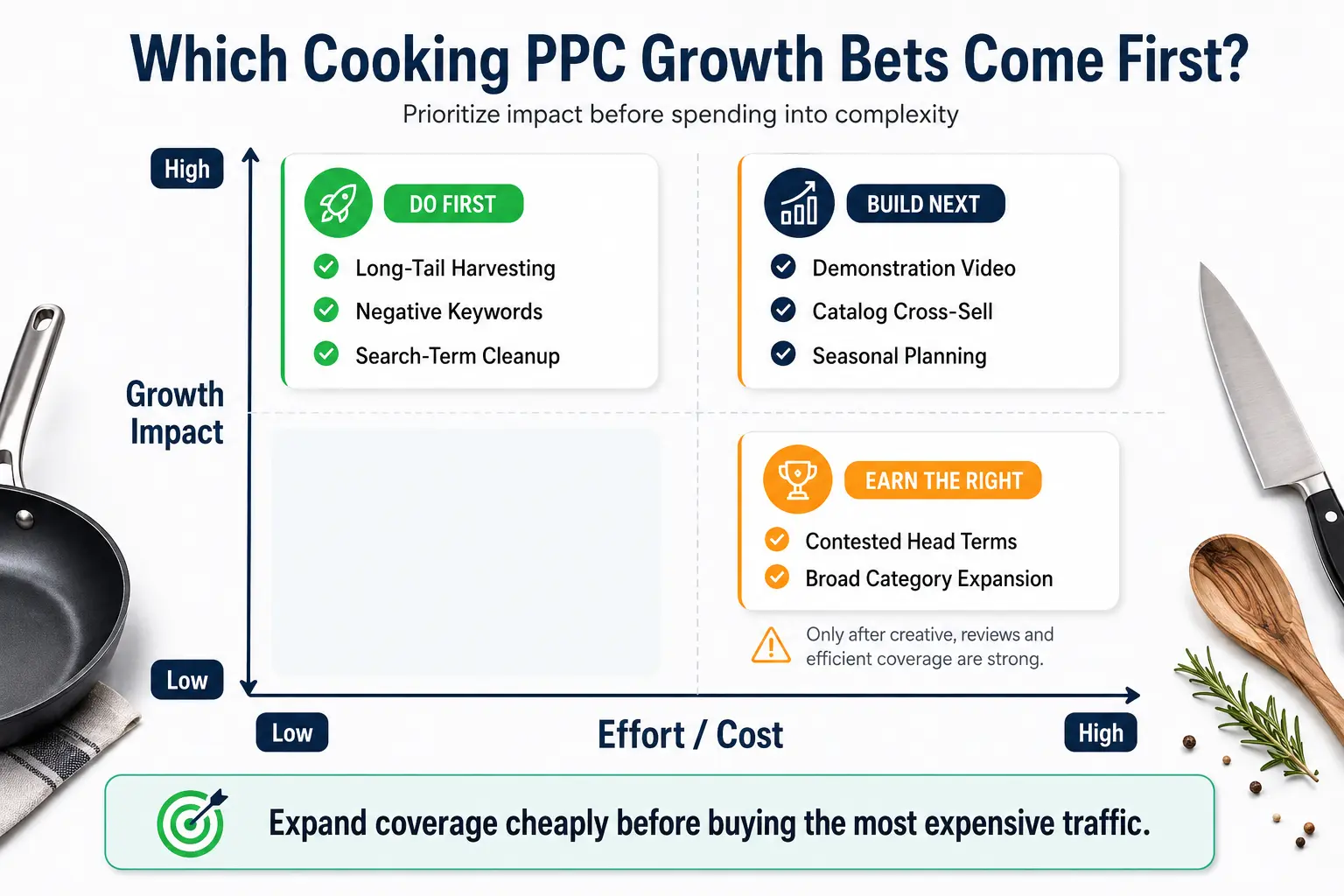
Rank growth moves by impact against effort, and start with the ones that expand coverage cheaply before the expensive, contested plays. Not every bet is worth making first.
Long-tail harvesting and negative keywords are usually the highest-return, lowest-effort moves, so they come first. Demonstration video and catalog expansion are higher-effort bets that pay off once the efficient base is in place.
Save the contested head terms for last, and only with strong creative and reviews behind them. Fighting for broad, expensive keywords before your long tail and creative are working is how brands burn budget without moving the business.
The common mistakes are overspending on head terms, neglecting video, ignoring seasonality, and judging growth on a low ACoS. Each one caps growth at exactly the wrong moment.
The first is pouring budget into broad head terms because they feel important, when the efficient growth is in the long tail. The second is running static ads in a category that sells on demonstration.
The third is spending evenly across a year that is anything but even, missing the gifting peaks that drive cooking. The fourth is treating a low ACoS as success, which rewards shrinking the catalog instead of expanding it.
A fifth mistake is scaling before the structure is clean. Adding spend on top of a tangled account just grows the waste, so the efficient path is to tidy the foundation first, then pour budget into a system that can actually use it.
As a specialist Amazon PPC agency, Amplivus grows cooking brands past $200K by pairing demonstration creative with long-tail targeting and clean structure, all managed to profit rather than a vanity ACoS.
Day to day, that means disciplined Amazon PPC management built around the cooking calendar and catalog, not a generic playbook applied the same way to every brand.
If you want to see where your spend is leaking before you scale, a free Amazon PPC audit maps the gaps first, and a short Amazon strategy session turns it into a growth plan for the year ahead.


Build a stronger cooking PPC engine with better long-tail targeting, demonstration creative, seasonal planning, and smarter brand defense.
Book a strategy call to review your structure, seasonality, creative, and the highest-value growth moves for your brand.