How Kitchen Brands Scale Past $100K/mo With Amazon PPC
Read more
.png)
The best Amazon PPC keywords for kitchen appliance brands are feature, spec, and use-case terms, not the brutal head terms every rival is bidding up.
Summarize in ChatGPT
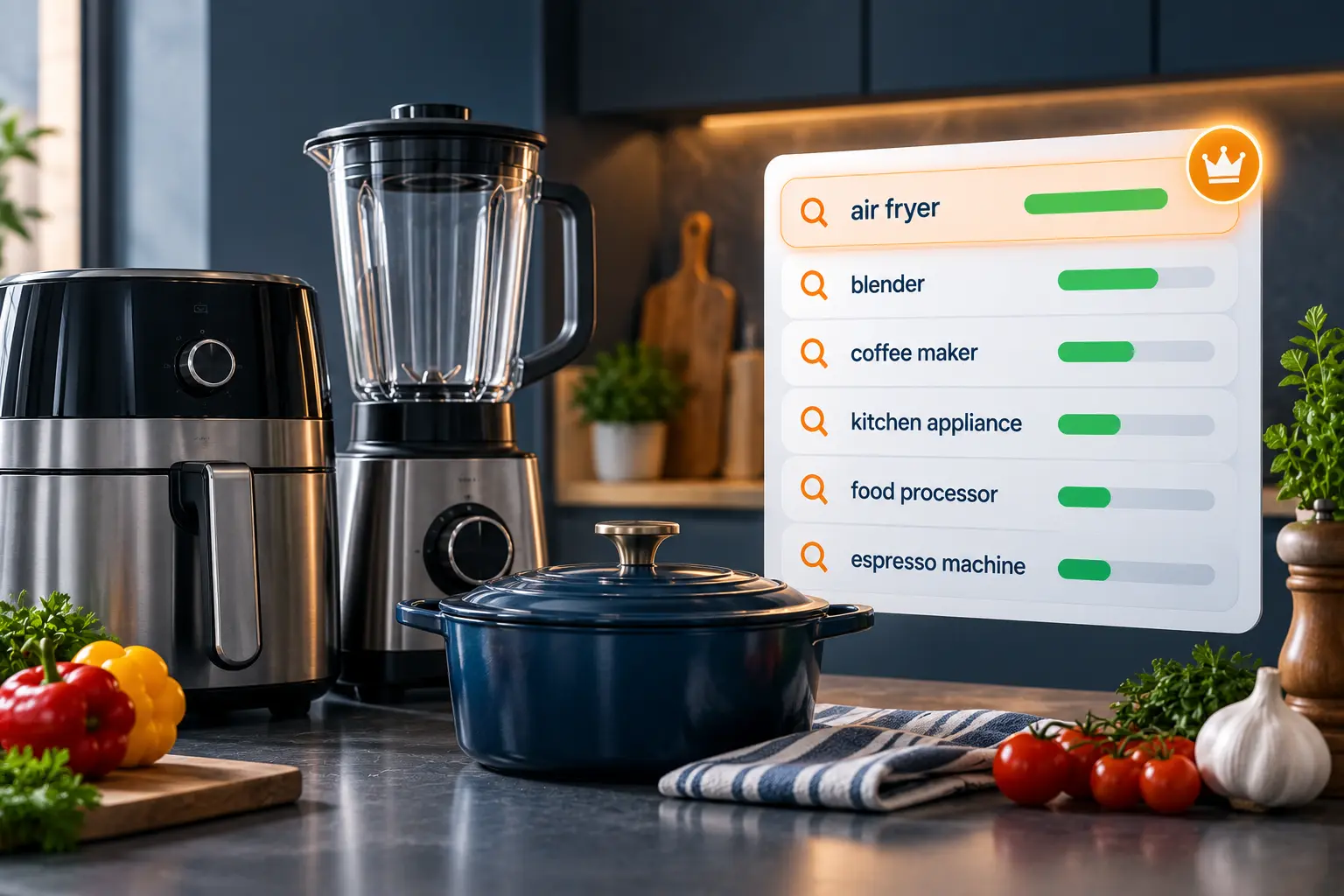
The best Amazon PPC keywords for a kitchen appliance brand are rarely the obvious head terms. Words like air fryer, blender, and coffee maker are among the most expensive and contested searches on Amazon, and pouring budget into them at full price is how appliance brands burn money.
The efficient keywords sit one level down, in the features, specs, and use cases shoppers actually search.
This guide is a keyword strategy for kitchen appliance brands on Amazon in 2026: the keyword categories that matter, why feature and spec terms beat the head term, how to win comparison searches, and how to find your own best keywords.
It is a framework for building your keyword set, not a generic word dump.
Own the feature, spec, and use-case terms shoppers narrow to, and let your own data pick the specifics, rather than paying full price for the mega head term. The framework matters more than any single word.
Kitchen appliances are a large, competitive category, so the right keyword approach depends on your product and price, a progression mapped in our guide to Amazon PPC for kitchen brands by spend tier.
The category is worth competing for carefully. The global small kitchen appliances market was valued at USD 39.6 billion in 2025 and is projected to grow to USD 70 billion by 2033, so demand is large and rising, but so is the competition for the obvious terms.
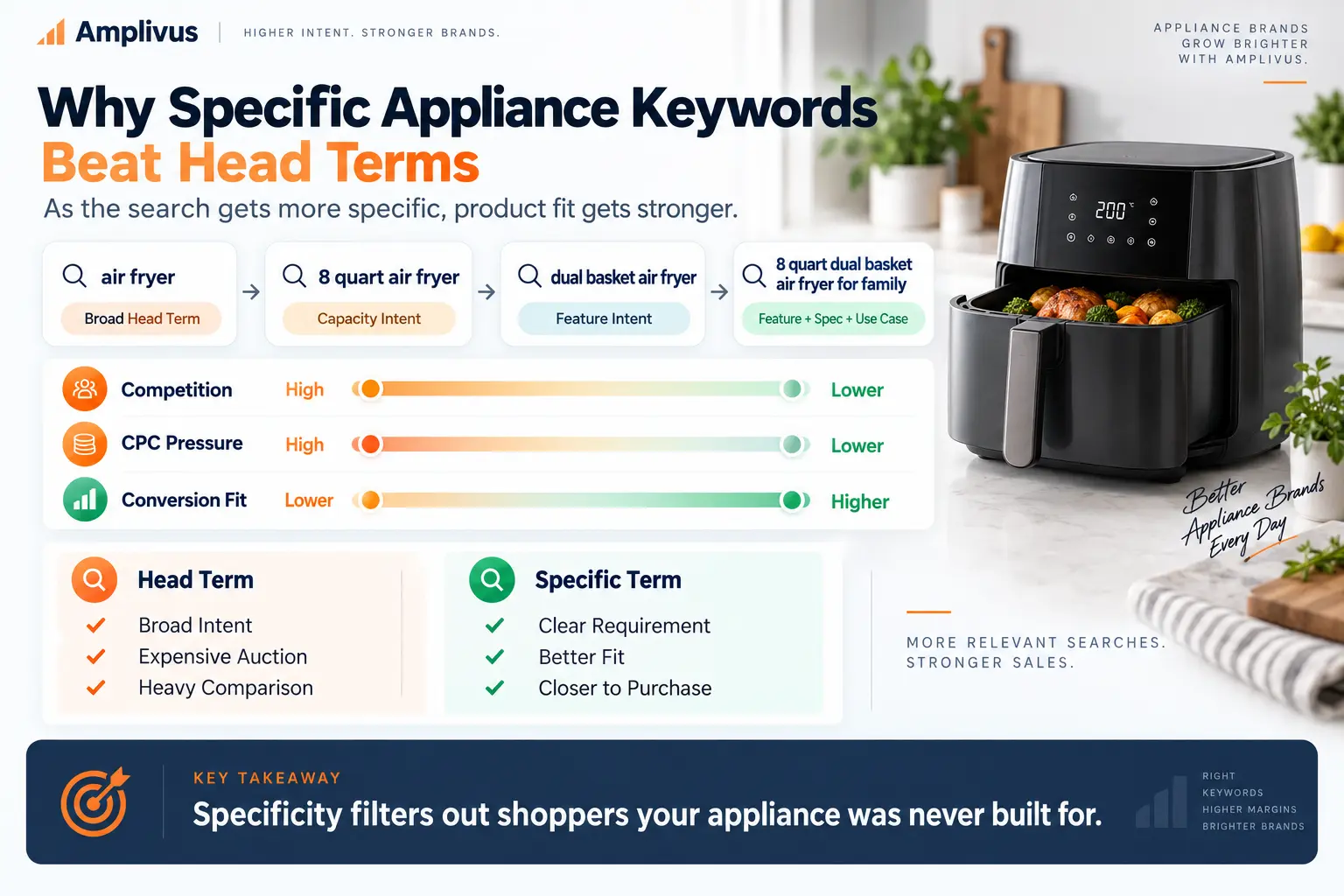
The mistake is treating the head term as the goal. A search like air fryer is broad, brutally expensive, and full of comparison shoppers, so an appliance brand usually wins by owning the specific terms that describe exactly what it sells.
Start from the product, not the category. A compact single-serve maker and a large family model win different searches, so the same keyword list rarely fits two appliances. What your product does best decides which terms you can honestly own.
The main categories are product-type, feature and spec, use-case, comparison, and branded or competitor terms, each with a different intent and cost. Sort your list this way first.
Feature and spec terms are usually the most efficient. A shopper searching 8 quart dual basket air fryer has already decided what they want, so the intent is precise and the click costs less than the bare head term.
Use-case terms carry the same advantage. Phrases like blender for smoothies or coffee maker for one cup are specific, less contested, and convert well, because the shopper has told you exactly how they plan to use the appliance.
Comparison terms are their own game. Searches like best air fryer carry strong intent but are won by reviews and rank more than by bids, so treat them as a goal to earn into rather than a term to simply outbid.
The richest terms stack attributes. A phrase that combines a feature and a use case, such as large capacity air fryer for a family, is specific, less contested, and often the cheapest efficient conversion in the account.
Point each keyword at the spec or feature your appliance leads on, because a kitchen appliance competes on specifics, not the category in general. Honesty here lifts conversion.
Lead with what your product does best. If your air fryer is unusually large, own capacity terms like family size and 8 quart. If it is quiet, own quiet and low-noise terms. If it is programmable or app-connected, feature terms about presets and control fit best.
Alignment is the point. A shopper who lands on a term your appliance genuinely satisfies converts far better than one drawn in by a broad claim the product cannot back, so match keywords to real strengths rather than chasing every term.
Because head terms like air fryer carry the highest click costs and the least specific intent, while feature and spec terms cost less and convert better. The long tail is where efficiency lives.
The economics favor the long tail. Head terms in appliances are among the most expensive clicks on Amazon, a reality reflected in our Amazon PPC cost benchmarks for kitchen gadgets, so paying full price for them rarely pays back for a single brand.
Specific terms also convert better. A shopper who types a capacity, a feature, or a use case is closer to buying than one typing the bare category word, so the same budget produces more sales on the long tail.
A rough example shows the gap. The click on a bare head term can cost several times what a specific feature term costs, while converting at a lower rate, so a dollar spent on the long tail often buys several times the sales of a dollar on the head term.
That does not mean ignoring the head term entirely. It means treating it as a costly, brand-building placement to hold selectively, while the efficient volume comes from the specific terms underneath it.
Win them with strong reviews, rank, and creative, because best and comparison searches are decided by trust as much as by bids. Appliances are compared before they are bought.
Appliances are heavily comparison-shopped, so best air fryer and similar searches reward the products that look most credible. Sponsored Brands puts your brand and best products at the top of those results, where the comparison actually happens.
Paid presence on these terms also compounds. Winning them profitably lifts organic rank, the flywheel we cover in our guide on how kitchen brand PPC powers organic rank, so the effort pays off twice over time.
Reviews are the quiet lever. No bid wins a comparison search if the listing has a thin or middling review profile, so the keyword strategy and the review strategy have to move together.
The comparison also happens on the page, not just the search. Clear images, a strong title, and a comparison-friendly A-plus layout do as much to win a best search as the bid that got the shopper there, so creative and keyword strategy work together.
Handle certification and performance claims carefully, because you cannot use Energy Star unless certified, and spec and safety claims must be accurate. What you cannot prove, you should not target.
Certification claims are the clearest line. Under the EPA program, Energy Star certification requires independent testing, and only certified products may use the label, so an efficiency claim you cannot back invites both audits and lost trust.
Safety and spec claims need the same honesty. Electrical safety marks, wattage, and capacity are all checkable, so a term or listing that overstates them risks returns, bad reviews, and policy problems that no bid can fix.Electrical certification deserves special care.
A safety mark like UL or ETL listing is either true or it is not, so claiming it on an uncertified product is both a policy risk and a safety liability, and shoppers of powered appliances often check for it.
The safer, more effective path is to compete on the specs you can prove. Accurate capacity, real features, and verified performance are both compliant and exactly what the appliance shopper is comparing.
Find them in your own data: read Brand Analytics and harvest converting terms from broad and auto campaigns, rather than copying a list. The best keywords are already in your account.
Your best keyword source is your own account. Brand Analytics and Search Query Performance show the exact searches shoppers use to reach products like yours, and which ones you already win.
Read those searches by intent and conversion, not just volume, applying the metric-by-metric discipline from our guide to Search Query Performance metrics to decide which appliance terms to fund.
Then let discovery do the work. Broad and auto campaigns surface terms you would never guess, and Amazon's own Sponsored Products best practices point to harvesting the winners into exact match while cutting the rest.
Make the search-term report a weekly habit. Appliance demand shifts with trends and seasons, so mining the report often keeps you catching new converting terms, from a viral feature to a new use case, before competitors bid them up.
Timing matters as much as terms. Appliance demand spikes around the holidays, Prime Day, and gifting seasons, so watching when your best terms surge helps you weight budget toward the moments shoppers are actually buying.
Group keywords into intent tiers, give the high-value ones their own campaigns, and separate branded, category, and competitor terms. Structure is where a list becomes a strategy.
On Sponsored Products, isolate your best feature and use-case terms into their own campaigns so you can bid them deliberately instead of burying them in a broad average.
Control follows separation.
Match types do the sorting. Broad campaigns discover new phrases, exact campaigns convert the proven ones at a controlled bid, and keeping them separate is how you scale the good terms without losing control of cost.
Negatives protect the budget. Appliance searches pull in accessories, parts, and unrelated products, so steady negatives keep spend on shoppers buying the appliance itself, not a replacement filter or a spare basket.
For your highest-value terms, tight ad groups pay off. Giving a proven keyword its own small, themed group lets you set a precise bid and budget for it, which is where a large appliance account recovers the control a broad campaign loses.
Defend your branded terms and selectively conquest competitor terms, because both matter in a category shoppers compare heavily. Neither should be left to chance.
Once shoppers search your brand, competitors will bid on it, so branded defense protects your cheapest, highest-intent conversions. Leaving your own name undefended hands ready-to-buy shoppers to a rival at the moment of decision.
Conquesting is the mirror image. Appearing on a rival's terms where your appliance wins on price, features, or reviews can pay off, and a structured Amazon PPC competitor analysis shows which competitor keywords are worth the spend and which are not.
The common mistakes are overpaying for head terms, ignoring feature long-tail, overclaiming certifications, and skipping branded defense. Each one wastes budget on the wrong searches.
The first is pouring budget into head terms like air fryer at full price, when the efficient volume sits in feature and use-case terms. The second is ignoring the specific long tail, where intent and margin are both stronger.
The third is leaning on certifications or specs you cannot back, from Energy Star to inflated capacity claims, which invites returns and policy trouble. The fourth is leaving branded terms undefended, which quietly funds competitors bidding on your own name.
A fifth mistake is setting the keywords once and forgetting them. Appliance search shifts with trends and seasons, so a list left untouched for a quarter is already behind the terms shoppers are actually using.
As a specialist Amazon PPC agency, Amplivus builds appliance keyword strategy from your own data, your specs, and your buyer, not a borrowed list, so every term you fund is one your product can win and keep.
Day to day, that means disciplined Amazon PPC management that harvests new keywords, structures them by intent, and defends the terms that matter to your brand.
If you want to see which keywords are already working and which are leaking budget, a free Amazon PPC audit maps it, and a short Amazon strategy session turns it into a plan for the year.


Build an appliance keyword strategy around product strengths, buyer intent, seasonal demand, and the search terms your catalog can actually win.
See which feature, use-case, and comparison terms can drive more efficient kitchen appliance sales from your Amazon PPC.