
Amazon PPC Management vs In-House Team for $500K+ Brands
Read more
.png)
Amazon PPC optimization services are the ongoing bid, keyword, and budget work a senior strategist runs to cut wasted spend and grow profitable sales.
Summarize in ChatGPT

Optimization services are recurring account work, not a one-time setup, and the value lives in the weekly decisions a senior strategist makes with your data.
Amazon PPC optimization services are the ongoing management of your Sponsored Products, Sponsored Brands, and Sponsored Display campaigns, aimed at lowering wasted spend and increasing profitable sales.
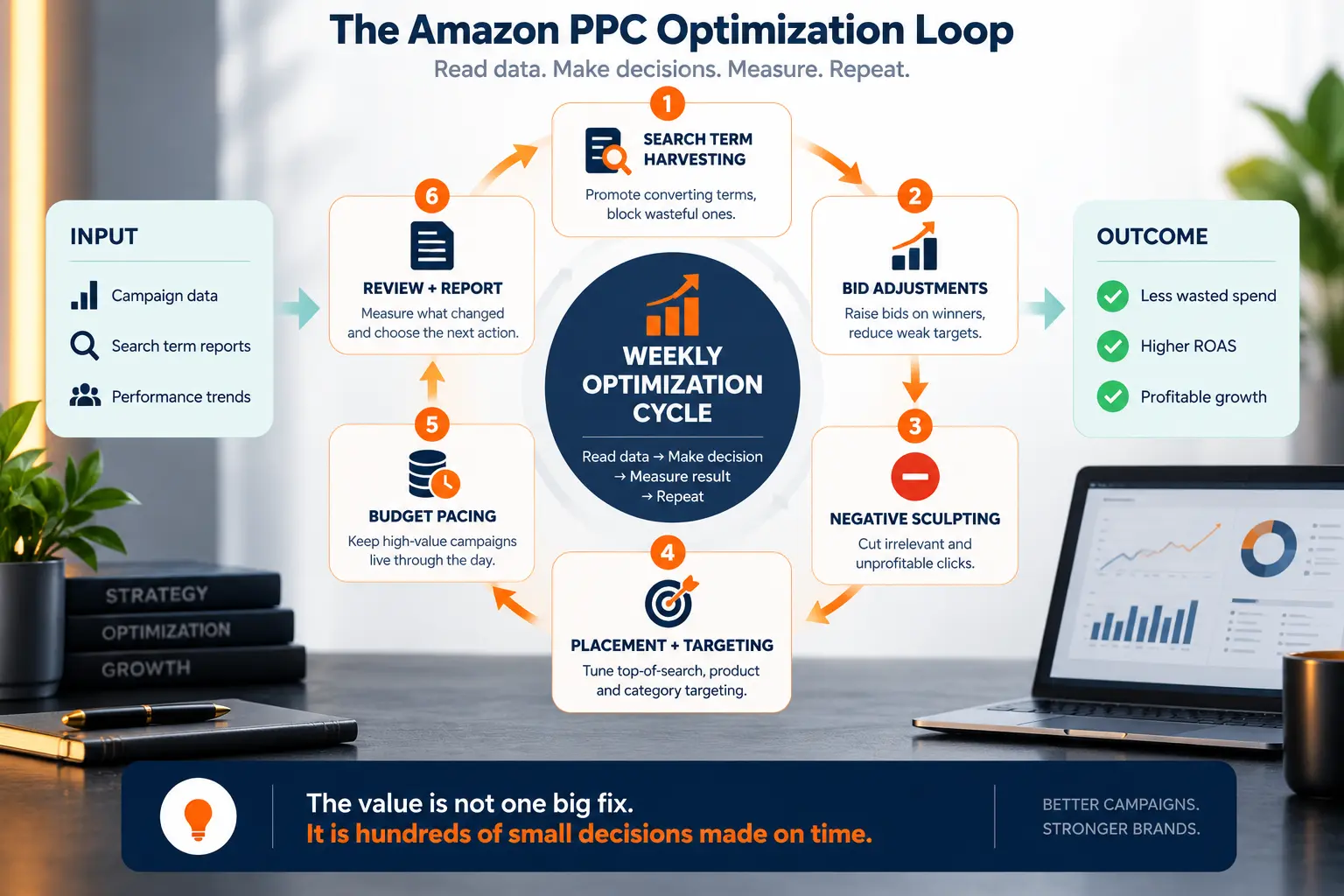
The word that matters is ongoing. A launch or a rebuild is a project with an end, while optimization is a repeating cycle of reading data, making decisions, and measuring the result.
The stakes keep rising, because Amazon's advertising business grew 23% to $21.3 billion in the fourth quarter of 2025 alone, so the spend moving through these campaigns, and the waste hiding in them, is larger than ever.
Most brands do not lose money on Amazon ads because they picked the wrong campaign type. They lose it in the gaps between decisions: the search term that kept spending for three weeks after it stopped converting, the bid that never came down, the budget that ran out by noon.
Optimization services exist to close those gaps on a schedule.
This is different from the initial architecture work of setting up an account. If you are still learning what Amazon PPC is and how it works, optimization is the layer that comes after the structure is sound. It assumes campaigns already exist and asks a narrower question every week: where is a dollar being wasted, and where could another dollar earn more?
The honest version of this service is unglamorous and specific. It is a set of recurring tasks run against real account data, not a strategy deck.
The table below shows the work behind the label, and how often each piece happens on a healthy account.
Amazon's own best-practice guidance for Sponsored Products mirrors this rhythm. It advises finding the shopping terms that earned clicks in the search term report, raising bids on the winners as exact match, adding negatives to protect budget, and reviewing performance at least twice a week in the early going.
A senior strategist runs that loop with judgment layered on top, not as a checklist.
The cadence is what makes it work. A weekly rhythm means a wasteful search term is caught within days instead of bleeding for a month, and a bid that has drifted from its target gets corrected before it distorts a whole campaign.
The gap between a good account and a wasteful one is rarely a single large mistake. It is a hundred small decisions made late, and cadence is how a service makes them on time.
None of this is a one-time fix. The account that was efficient last month drifts as competitors change bids, new search terms appear, and seasonality shifts demand.
The service is the discipline of catching that drift before it costs you, which is the same discipline behind scaling an account past six figures a month.
Every deliverable above pulls on a specific Amazon lever, and knowing the lever is how you tell a real service from a vague one.
Bidding is the first. Amazon's dynamic bidding, in its up-and-down setting, raises or lowers your bid by up to 100% in real time based on how likely a click is to convert. A strategist chooses that setting deliberately, because handing the platform a 100% upward swing on the wrong campaign is how budgets disappear.
The choice between down-only, up-and-down, and fixed bids is an active decision, revisited as the campaign matures.
Keywords are the second. The search term report is the raw material, and the work is a constant sort: which real customer searches deserve their own keyword, which deserve a negative, and which proven terms should migrate from broad to exact match for tighter control.
This harvesting loop, run weekly, is what keeps an account finding new profitable demand instead of stagnating.
Timing is the third, and it is where senior services separate themselves. Amazon Marketing Stream delivers campaign metrics hourly in near real time, which makes intraday decisions possible: raising bids in the hours that convert and easing off in the hours that waste.
Amazon reports that partner-managed advertisers using Marketing Stream for sponsored ads saw an average 5% increase in return on ad spend over the following six months, a gain that comes from acting on data most accounts never look at.
Targeting adds a fourth lever that pure keyword work misses. Beyond keywords, a strategist places product and category targets on Sponsored Products and Sponsored Display, bidding on the specific competitor listings and complementary products where your buyer is already looking.
Sponsored Brands and Sponsored Display each behave differently from Sponsored Products, so a real service tunes them separately instead of copying one playbook across all three ad types.
Budget and structure hold it together. Pacing keeps your best campaigns from going dark by noon, and clean campaign structure, one category and one price band per campaign, is what makes every other decision legible.
When the structure is messy, the data lies, and no amount of bidding cleverness fixes it. The strongest accounts pair these mechanics with the strategy patterns that seven-figure brands rely on.
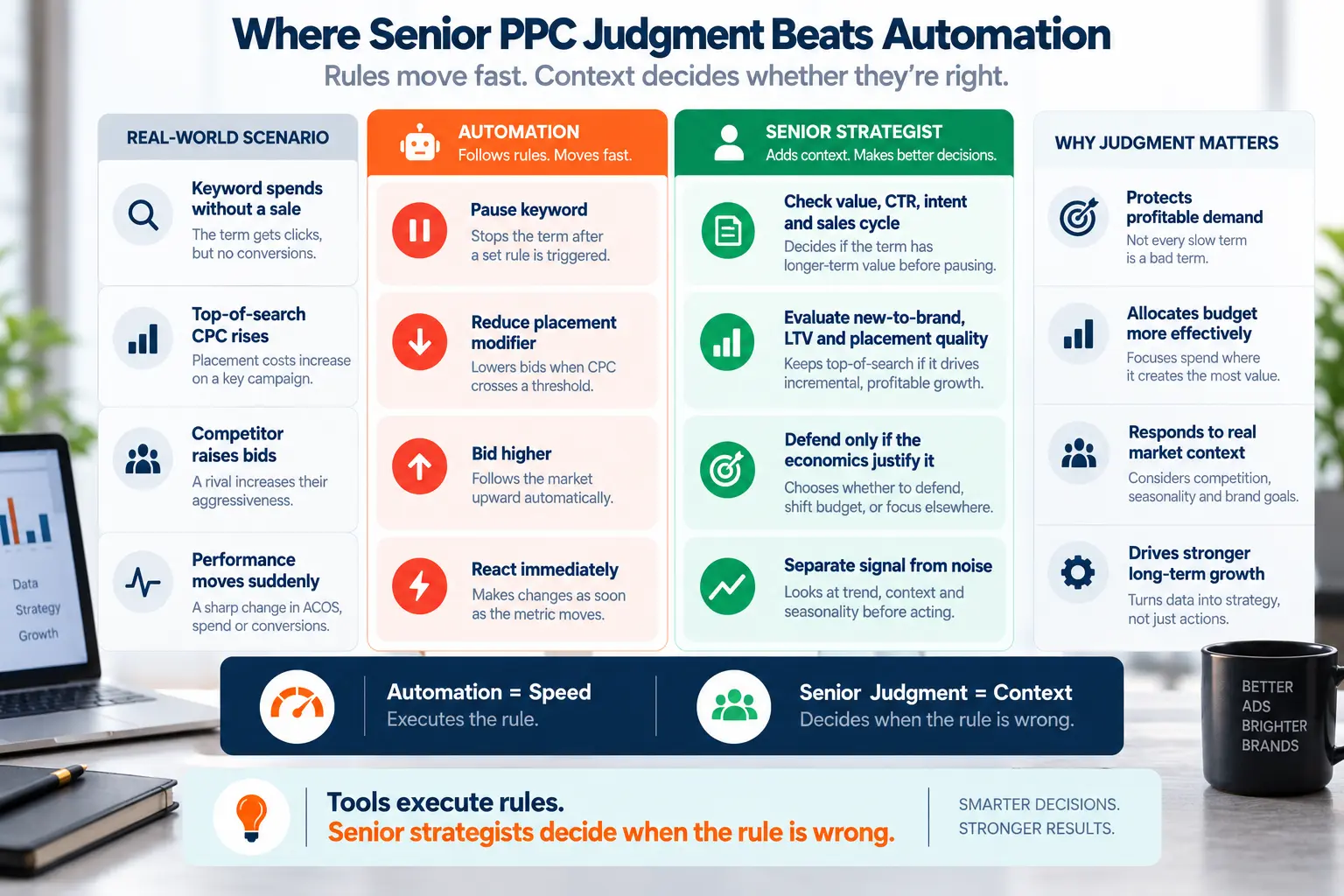
This is the part that justifies a senior rate, and it is the answer to what these strategists "actually" deliver. Automated tools and rules are good at doing the obvious thing quickly.
They are poor at knowing when the obvious thing is wrong.
A rule will pause a keyword after it spends without a sale. A senior strategist knows that a high-value keyword with a two-week sales cycle and a strong click-through rate may deserve two more weeks, not a pause, because the conversion is coming.
That single judgment call, made correctly across dozens of keywords, is the difference between an account that compounds and one that keeps cutting its own best terms.
Reading placement data is another example. A tool sees a high cost per click at top of search and trims the modifier. A strategist checks whether that placement is driving the new-to-brand orders that feed reorders and lifetime value, and may protect it precisely because it looks expensive on the surface.
The metric that looks bad in isolation can be the one earning the most once you follow the sale through to repeat purchases.
Competitor bid wars are a third place judgment earns its rate. When a rival suddenly bids up a shared keyword, a rule follows them up and both accounts overpay for the same clicks.
A senior strategist decides whether that term is worth defending at the new price or whether the smarter move is to redirect the budget to a term the competitor is ignoring.
Knowing which fights to skip protects more margin than winning every impression ever could.
Judgment also means knowing what to ignore. Amazon accounts generate a flood of numbers, and much of the daily movement is noise.
A senior strategist knows which swings are signal worth acting on and which are variance worth leaving alone, so the account is not whipsawed by overreaction.
This restraint is invisible in a report, and it is often the most valuable thing the service delivers.
A credible optimization service has a shape you can see. There is a named owner who knows your account, a defined cadence of work, and a report that explains decisions in plain language rather than dumping a dashboard on you. If you cannot tell what changed last month and why, you are paying for access to software, not for optimization.
Communication is part of the deliverable, not a courtesy. You should be able to reach the person who touches your account, ask why a decision was made, and get an answer in plain terms.
Services that route you through a ticket queue or a rotating cast of junior analysts tend to lose the context that makes optimization work, because the value compounds only when one owner remembers what was tried last quarter and why it did or did not work.
Reporting is a deliverable, not an afterthought. A good monthly review ties spend to profit, flags what improved and what regressed, and states the next month's plan.
It should connect the ad numbers to the business, using account data like the profit signals inside Amazon Brand Analytics rather than reporting clicks in a vacuum.
Cost transparency belongs in the structure too. You should know what you pay, what it covers, and how it scales as spend grows, which is why an honest provider publishes clear PPC management pricing instead of hiding it behind a sales call.
Pair that transparency with a plain-language view of what Amazon PPC costs at the platform level, and you can judge whether the service pays for itself rather than taking the fee on faith.
The math is simple: if optimization removes more wasted spend than the service charges, it earns its keep.
Optimization services fit brands that already have real sales volume and a catalog worth defending. If you are spending enough that a few points of wasted percentage is real money, and your team does not have a dedicated Amazon specialist watching the account weekly, a managed service usually pays for itself.
It is a poor fit in a few honest cases. If your product has thin margins that no amount of bidding can rescue, fix the unit economics before paying for optimization.
If you have almost no reviews or a weak listing, your conversion problem is upstream of ads, and optimization will only spend faster into a page that does not convert.
And if you enjoy the work and have the time to run the weekly loop yourself, you may not need to outsource it at all.
The clearest signal that you are ready is waste you can see but cannot chase down. When you know money is leaking but you do not have the hours to find it, that is exactly the gap a dedicated PPC management service is built to close.
A one-time PPC audit is the low-commitment way to confirm the leak is real before you commit to ongoing work, and it doubles as a way to judge whether a provider's thinking actually matches your brand.
The honest answer is a range, not a promise, and any provider who guarantees a specific number is selling you something. Optimization moves the levers it controls: it lowers wasted spend, sharpens targeting, and shifts budget toward what converts.
How much that improves your bottom line depends on factors the strategist does not control, including your margin, your reviews, your inventory, and your pricing against competitors.
What you can reasonably expect is steadier efficiency and fewer surprises. Wasted search terms get caught faster, budgets stop running dry, and profitable placements get the room to grow.
The gains from acting on real-time data, like the average return-on-ad-spend improvement Amazon reports for Marketing Stream users, are real but incremental, and they compound over months rather than arriving overnight.
Time horizon matters as much as the numbers. The first month is often about cleanup, cutting obvious waste and fixing structure, so the early win is usually efficiency rather than growth.
Real compounding shows up over the following quarter, as harvested keywords mature and budget settles onto what converts. Judge a service on the trend across ninety days, not on any single week, because weekly variance will always be louder than the underlying signal.
Set expectations by the input, not just the output. A good service should show you cleaner decisions every week and a report you can act on, and understanding where competitors are winning through a competitor analysis keeps those expectations grounded in your actual market rather than a generic benchmark.
Amazon PPC optimization services are ongoing, specific, and judgment-driven. The deliverables are concrete, the levers are Amazon's own, and the value is the senior decision-making that tools cannot replicate.
The best way to know whether the service is worth it for your brand is to look at your own account and count the waste.
If you want that assessment done for you, book an Amazon strategy session and a strategist will count the waste in your account with you.
You can also explore the full library of category playbooks at Amplivus to see what disciplined optimization looks like in your specific niche.


Build a pet supplement keyword strategy around buyer intent, claim-safe copy, proven ingredients, and search terms your products can truly win.
See which benefit, ingredient, and long-tail terms deserve more budget and which costly searches should be blocked.