Amazon PPC Strategies for 7-Figure Brands in 2026
Read more
.png)
For most $500K+ brands, managed Amazon PPC delivers senior expertise and full-funnel tools faster than building an in-house team from scratch.
Summarize in ChatGPT

At $500K a month, the question is rarely whether to invest in Amazon PPC. It is whether to hire and build a team internally or hand the account to a managed service. The two paths cost differently, scale differently, and fail differently, and choosing wrong is expensive at this size.
This guide compares managed Amazon PPC against an in-house team for a $500K+ brand: what each really includes, how the costs actually stack up, where each wins, and who should choose which. The goal is a confident decision, whether or not that decision is to work with us.
A managed service runs the whole account, from structure and bids to full-funnel formats and measurement, using a team of specialists rather than one person. It is a capability, not a task.
Managed Amazon PPC is more than someone adjusting bids. A good Amazon PPC management engagement owns structure, bidding, creative direction, measurement, and reporting, run by people who do only this work.
The day-to-day still runs on the core formats. A managed team optimizes Sponsored Products structure and bids, then layers brand, video, and display formats on top as the account needs them.
At $500K, the work is closer to portfolio management than campaign tweaking, which is the level our guide to Amazon PPC strategy for 7-figure brands describes.
You also get redundancy by default. A managed team has more than one person who knows your account, so a holiday, a sick day, or a resignation does not stall your spend the way it can with a single hire.
Reporting is part of the package, not an afterthought. A good managed engagement explains what changed and why in plain language, so you keep visibility without having to run the analysis yourself every week.
An in-house team means hiring, training, and tooling one or more specialists who work only on your account, under your direct control. It buys focus and ownership.
Building in-house means recruiting a skilled Amazon PPC manager, buying the tools they need, and giving them time to learn your catalog. Done well, you get a dedicated expert who lives inside your brand.
It also means keeping that person current as the platform changes, which is constant. The pace of change for established brands is covered in our guide on what changed in Amazon Ads for established brands.
The catch is depth. One hire is one perspective, one skill set, and one point of failure, which is manageable at a smaller scale but riskier as spend and complexity grow.
Hiring is the first hurdle. Skilled Amazon PPC managers are in demand and hard to assess, so a bad hire can cost months, and even a good one arrives without knowing your catalog. Recruiting well is a project in itself before any optimization happens.
Tooling is the second hurdle. A serious in-house operation needs analytics, bid automation, and reporting software, and those subscriptions add real recurring cost on top of the salary you already committed to.
Managed services win on depth, tools, and speed to expertise, while in-house wins on control, focus, and brand knowledge. Neither is universally right.
Read the table as a set of trade-offs, not a scoreboard. The right answer depends on which columns matter most to your brand, your margins, and your team.
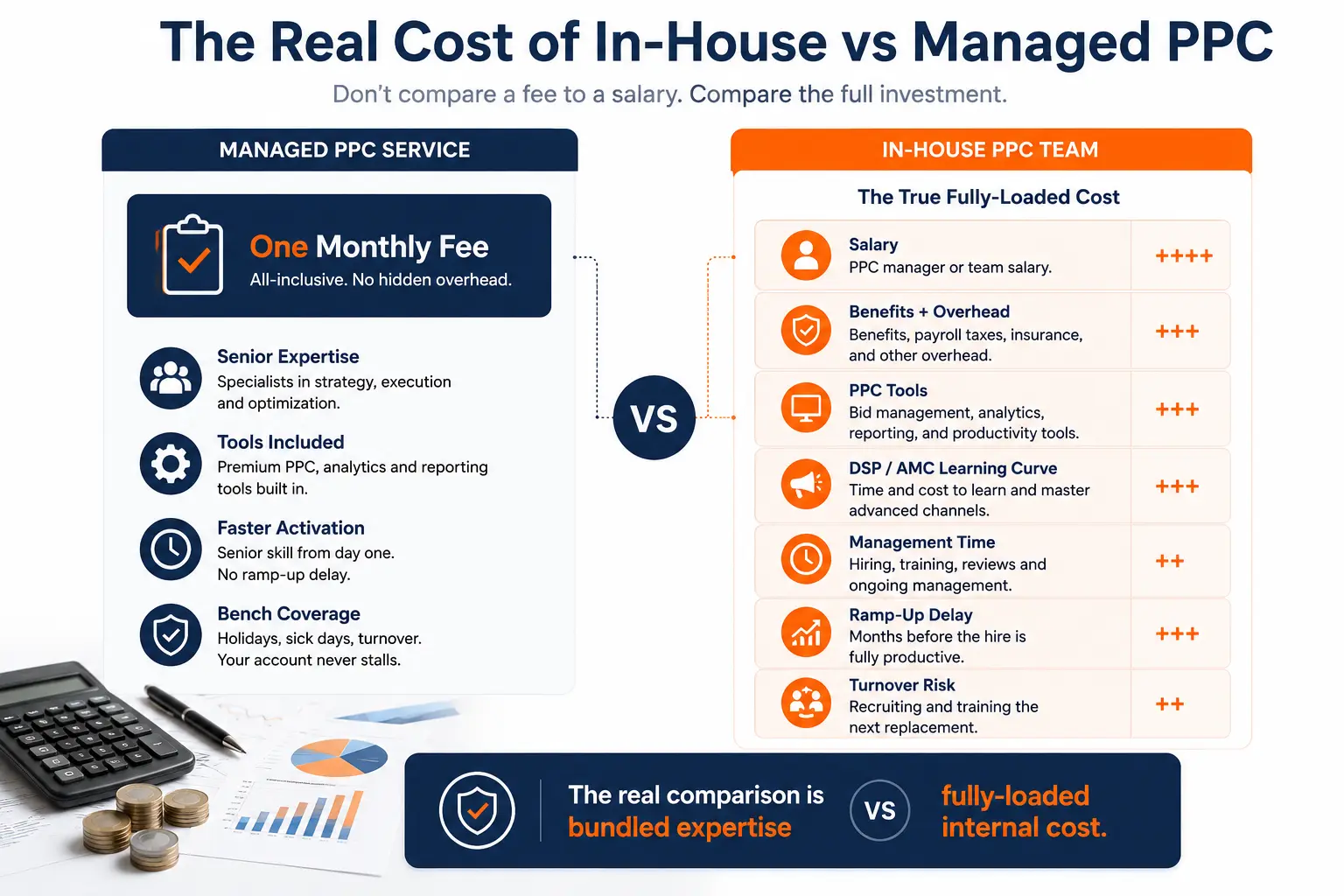
Compare a management fee against the fully-loaded cost of in-house, which is salary plus benefits, tools, management time, and ramp, not salary alone. The gap is smaller than it first looks.
The common mistake is comparing an agency fee to a single salary. The real in-house cost includes benefits and overhead, the software the team needs, the management time to lead them, and the months before a new hire is fully productive.
Add the tools alone and the gap narrows fast, since serious accounts need analytics and automation a managed fee usually covers. The wider economics of what PPC costs are laid out in our Amazon PPC cost breakdown by spend tier.
Ramp is the hidden cost. A new in-house hire can take months to reach the output a senior managed team delivers in week one, and at $500K a slow start is measured in real lost profit.
A rough example makes it concrete. Between a competitive salary, benefits and overhead, a stack of tools, and the management time to lead the hire, the fully-loaded cost of a capable in-house operation often lands well above the sticker price of the salary alone.
Compared like that, a management fee looks very different.
Opportunity cost belongs in the sum too. Every week a new hire spends ramping is a week the account underperforms what a senior team would deliver, and at $500K that lost efficiency is real money that rarely shows up in a budget line.
Managed services win where depth, advanced tooling, and objectivity matter, which is exactly where a $500K account gets complex. The edges compound at scale.
The clearest edge is full-funnel capability. Running Amazon DSP well takes specialist experience most single hires do not have, and it is often bundled into a managed engagement rather than learned on your budget.
Measurement is the second edge. Amazon Marketing Cloud and incrementality testing need real expertise to use, and a managed team brings that on day one instead of building it over quarters.
Advanced tooling widens the gap. Hourly optimization through Amazon Marketing Stream and similar systems is standard for a specialist team and a heavy lift for one internal hire to master alone.
Objectivity matters too. An outside team judges spend on incrementality without internal politics, and pairs it with a market read like a structured Amazon PPC competitor analysis an internal hire rarely has time to run.
Speed is the last edge. A managed team brings senior skill from week one, which is why brands in a hurry lean on it, as our guide to scaling Amazon PPC past $100K a month shows.
Staying current is its own advantage. Amazon changes formats, fees, and tools constantly, and a specialist team absorbs those changes across many accounts, where a single hire has to learn each one alone and on your time.
In-house wins on control, dedicated focus, and native brand knowledge, which can outweigh depth for the right brand. These are real advantages, not consolation prizes.
An internal hire lives inside your brand. They know the product roadmap, the margins, the seasonal quirks, and the internal context an outside team learns only over time, and that closeness can sharpen decisions.
Control is real value. With in-house, you set priorities directly, move fast on internal changes, and keep every decision under your own roof, which some brands weigh heavily.
Focus is the third advantage. A dedicated hire works only on your account, where an agency splits attention across clients, so for a single complex brand a strong internal lead can go deep.
Internal coordination can be faster, too. When PPC sits next to the brand, listing, and inventory teams, a change in one can move quickly into the ads, without the back-and-forth an outside relationship sometimes adds.
At the very top of the spend range, the math can also shift. A brand spending several million a month may find a full in-house team cost-effective in a way a $500K brand does not, so the right answer changes as you grow.
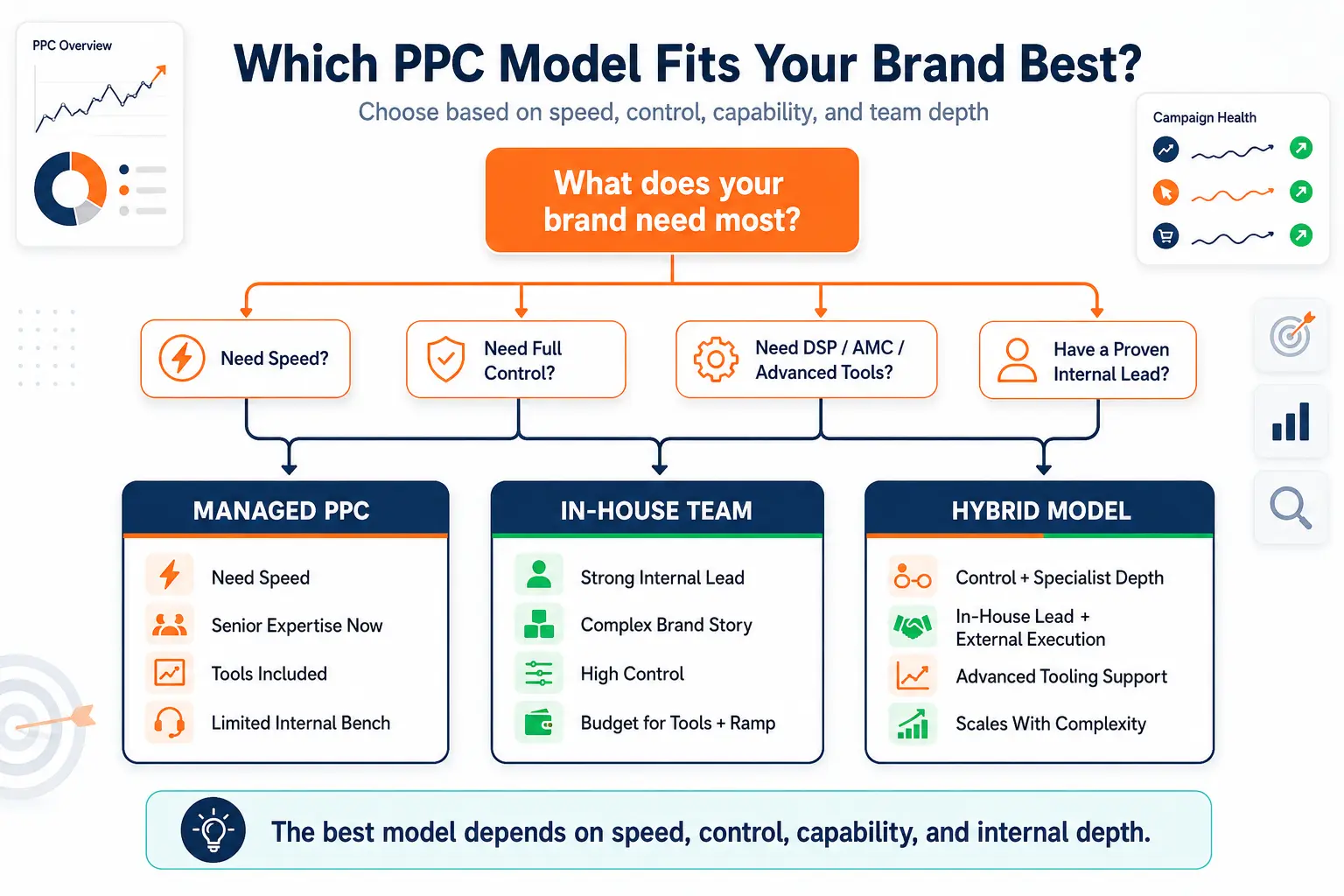
Build in-house if you have a complex brand story, a strong existing lead, and the budget to tool them; outsource if you need senior depth and speed without the overhead. Match the model to your reality.
In-house fits brands with an unusually complex catalog or story, a proven internal lead already managing to profit, and the resources to buy tools and cover turnover. If that describes you, building internally can pay off.
Managed fits brands that need senior expertise now, want full-funnel tools without buying them, and would rather not carry hiring and turnover risk. Most $500K brands scaling quickly sit here.
Be honest about your bandwidth and your bench. A single stretched hire on a growing account usually underperforms a focused managed team, and the gap shows up as wasted spend long before anyone names it.
Growth rate matters as much as size. A brand scaling fast usually cannot wait months to hire and ramp, so it leans managed to move now, while a stable brand with time to build can take the in-house path more comfortably.
Yes. Many $500K brands pair an in-house lead for control and brand knowledge with a managed team for depth, tools, and objectivity. It is often the strongest option of the three.
The hybrid keeps the best of both. Your in-house lead owns priorities and brand context while the managed team brings advanced execution, and both work from the same Brand Analytics and Search Query Performance data.
It works when roles are clear. The internal lead sets direction and the managed team executes to a shared standard, guided by Amazon's own Sponsored Products best practices, so nothing falls between them.
Structure the hybrid before you start it. Decide who owns strategy, who executes, who reports, and who has the final call, so the arrangement runs on clear roles rather than goodwill. Ambiguity is what makes hybrids fail.
Ask what the decision is really about: speed, cost, control, or capability. Naming your priority makes the choice far clearer than comparing features in the abstract.
Ask whether you can hire and retain senior talent, and how long ramp would take against your growth plans. If the market is tight or the clock is short, managed usually wins on speed alone.
Ask what tools and full-funnel capability you actually need. If DSP, AMC, and incrementality testing are on the table, weigh how long an internal hire would take to reach that level against a team that already has it.
The common mistakes are comparing a fee to a bare salary, underestimating ramp, and treating the choice as permanent. Each one skews the decision.
The first is the salary-versus-fee trap, which ignores tools, overhead, and management time and makes in-house look cheaper than it is.
The second is forgetting that a new hire is not productive on day one, so the real comparison is senior output now against junior output for months.
The third is assuming the decision is forever. Brands routinely start managed to move fast, then bring pieces in-house as they grow, or add an agency to an in-house team when complexity rises. The model can change as you do.
As a specialist Amazon PPC agency, Amplivus gives $500K brands a senior team, full-funnel tooling, and objective, incrementality-first management without the cost and risk of building it all in-house.
We also work alongside in-house leads where that fits, bringing depth and tools to a team that keeps control, so the choice is not always all or nothing.
The right first step is proof, not a contract. A free Amazon PPC audit shows where your account is leaking, and a short Amazon strategy session maps the highest-value moves, in-house or managed.

Get a focused PPC review that shows whether managed, in-house, or hybrid support gives your $500K+ brand the best mix of cost and capability.
Compare cost, control, expertise, and speed to see whether managed PPC, in-house, or a hybrid model fits your brand.