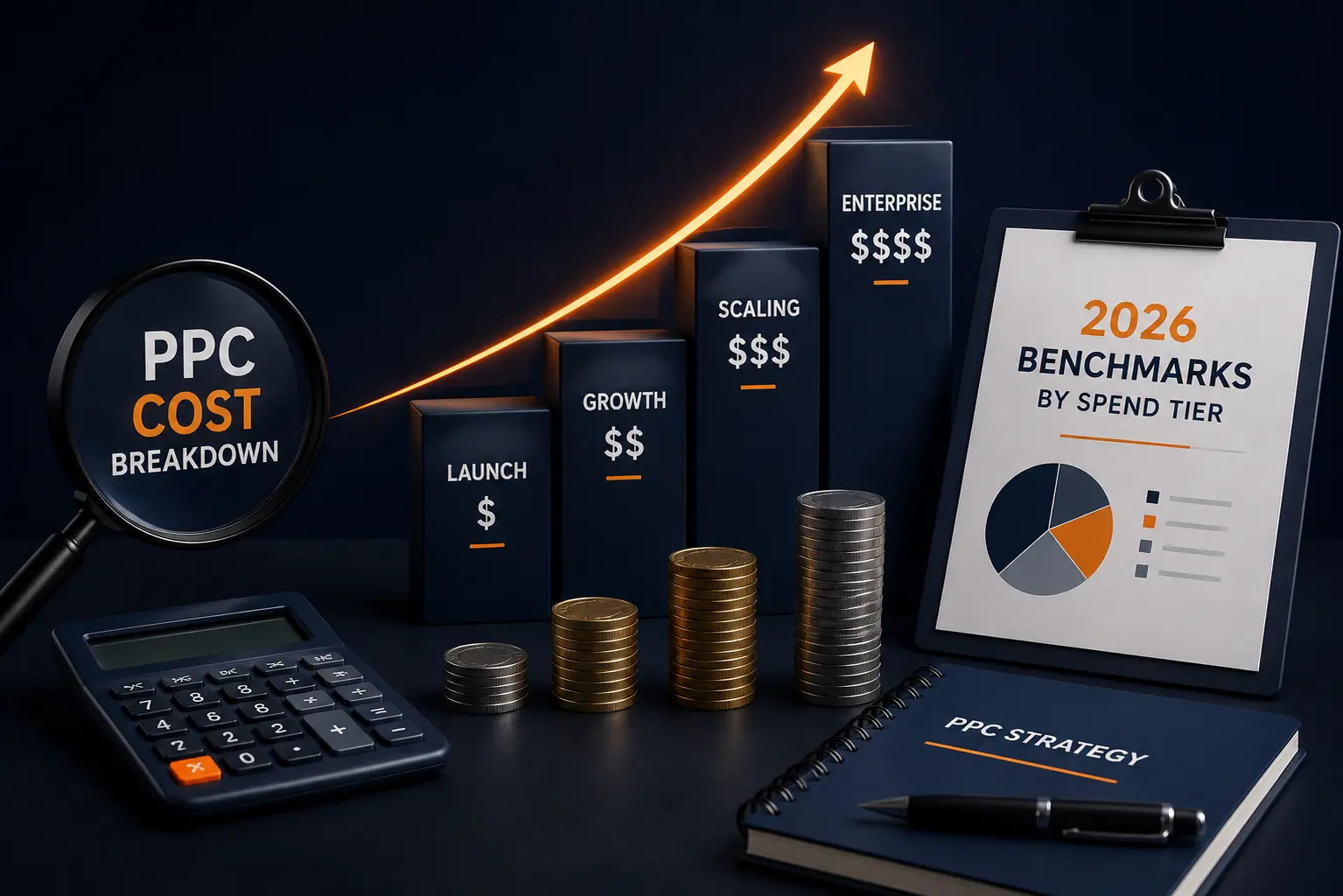
Amazon PPC Cost Breakdown: 2026 Benchmarks by Spend Tier
Read more
.png)
The best Amazon PPC agency for a 7-figure brand manages profit and incrementality, runs DSP and AMC, reports transparently, and aligns fees with your growth.
Summarize in ChatGPT

Choosing an Amazon PPC agency at 7 figures is a different decision than it was at $20,000 a month. The stakes are higher, the account is more complex, and the wrong choice costs real money every week. Yet most "best agency" lists rank vendors by logo, not by what actually matters to a brand your size.
This guide takes a different approach. Instead of a ranking, it gives you the criteria a 7-figure brand should use to evaluate any agency, the red flags to walk away from, the questions to ask before you sign, and what the engagement should cost. The goal is a confident decision, whether or not that decision is to hire us.
At this scale, the best agency is the one that manages your account for profit and growth, not for a metric that looks good in a screenshot. That single shift separates a genuine partner from a vendor.
A smaller brand can run on a simple ACoS target. A 7-figure brand cannot, because that target hides two things at once: waste on branded terms you would win for free, and profitable acquisition that looks expensive on the surface.
The strategy behind that shift is covered in our guide on Amazon PPC strategy for 7-figure brands.
The best agency reads the whole picture. It manages total advertising cost against revenue, watches incrementality, and treats your catalog as a portfolio with different roles, not one blanket target.
Scale is also why the choice matters more now. Amazon advertising has grown into a business worth more than $68 billion a year and rising over 20 percent, which means more competition, higher click costs, and more ways to waste a large budget. At your size, a mediocre agency does not just underperform; it quietly loses real money every month.
Best is also relative to your stage. A brand crossing $1 million a year needs different help than one pushing toward $10 million, and the right agency adjusts its playbook to where you actually are rather than selling the same package to everyone.
The rest of this guide turns that principle into a checklist you can hold any agency against, including us.
Judge any agency against these criteria, not against its client logos. The table sums up what strong and weak answers look like on each.
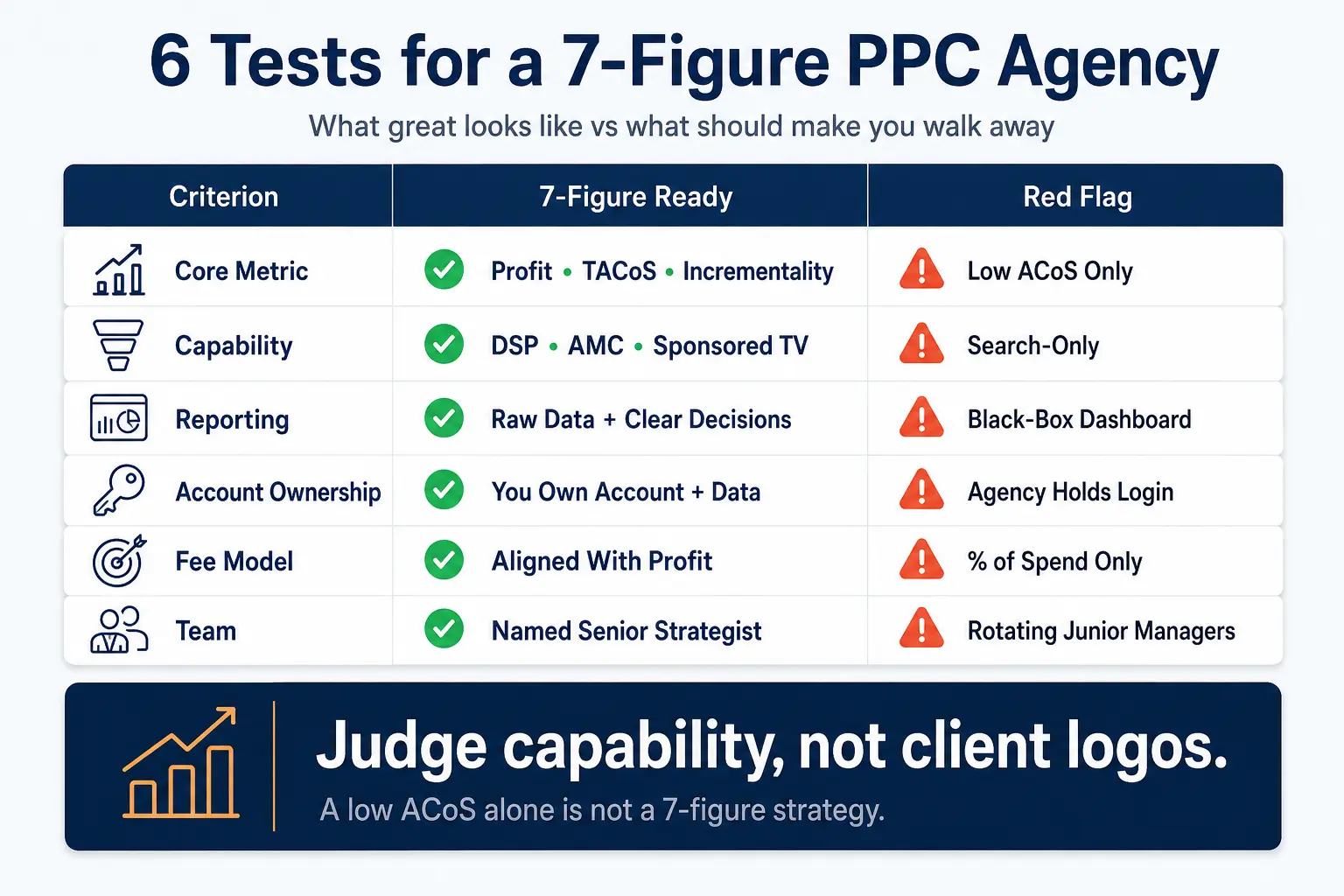
Ask how the agency defines success. If the answer is a low ACoS and nothing else, that is a warning. A low ACoS is easy to fake by cutting the spend that grows the business.
The right answer talks about profit, total advertising cost of sale, and whether spend is incremental. An agency that tests incrementality, holding out audiences to see what sales do without the ad, is operating at the level your account needs.
Push one level further and ask what they would stop spending on. A real operator can name the spend they would cut on day one, because protecting profit means saying no to budget that only looks productive. An agency that only talks about adding spend has told you how it makes money.
At 7 figures, growth comes from creating demand, not just capturing it. That requires Amazon DSP for programmatic display and video, and Amazon Marketing Cloud for building audiences from your own data.
An agency that only runs Sponsored Products is built for a smaller brand. Ask directly whether they run DSP and read AMC, and ask to see how they use them, because saying yes is not the same as doing it well.
Full-funnel does not mean spending everywhere at once. It means the agency knows which surface does which job, and can judge upper-funnel spend on new-to-brand and lifetime value rather than a search ACoS. If they cannot explain that distinction, they will cut the very spend that grows you.
If you want a plain-language refresher on how the ad types fit together before you interview anyone, our guide on Amazon Sponsored Ads explained covers the foundation.
The best agency reads your category, not just your account. It knows who is bidding against you, where their listings beat yours, and which competitor moves are pulling your click costs up.
That outside read is where a structured Amazon PPC competitor analysis earns its place. An agency that cannot tell you why a rival is winning a keyword is guessing, and at your spend, guessing is expensive.
You should own your advertising account and your data. The best agencies operate inside your account, show you the raw numbers from Brand Analytics and Search Query Performance, and explain decisions in plain language.
A black-box dashboard that only shows a flattering headline is a red flag. If you cannot see what was changed and why, you cannot judge whether it worked, and you are locked in by opacity rather than results.
Ownership matters as much as visibility. Your advertising account, your Brand Registry enrollment, and your historical data should stay yours, so that if the relationship ends, nothing walks out the door with the agency. Any agency that resists this is protecting itself, not you.
Insist on a handover plan before you ever need one. The moment to confirm you can walk away with your data intact is at signing, not at the exit. Agencies that document this upfront tend to be the ones that never make you use it.
Ask who actually runs your account. A named strategist you can reach beats a rotating cast of junior managers every time, especially on a complex catalog.
Fee model matters too. A pure percentage of ad spend can quietly reward spending more, so look for a model that ties the agency's success to your profit and outcomes. Our own Amazon PPC management pricing lays out how that alignment can work.
Some signals should end the conversation. Each one tends to predict a poor engagement at scale.
Ask questions that reveal how an agency thinks, not just what it sells. The answers separate operators from order-takers.
Ask how they would find waste in your account in the first month. A strong answer names specifics: branded overspend, non-incremental spend, a catalog on one blanket target. Ask how they measure incrementality, and listen for a real method rather than a buzzword.
Ask who runs the account day to day and how often you will speak. Ask what happens if performance dips, and whether you can leave without penalty. An agency confident in its work does not need to trap you.
Ask them to explain one thing they would change about your listings or structure, based on a quick look. The quality of that single answer tells you more than any case study.
Ask what they would not change, too. A senior operator respects the parts of your account that already work and can explain why. If everything you built is wrong in their telling, they are selling a rebuild, not reading your business.
Watch how they talk about your existing account too. A partner is curious and specific about what you have built; an order-taker is dismissive and promises to rip it all out. Wholesale teardowns on day one usually destroy rank you paid months to earn.
Finally, ask for a client you can actually speak to at your scale. Logos on a homepage are cheap. A real reference who runs a seven-figure account will tell you in five minutes what a sales call never will.
A strong agency does not rebuild your account overnight; it audits, protects your winners, and phases changes. The first weeks should be about understanding before action.
In month one, expect a genuine audit: where spend is non-incremental, which products sit on the wrong target, where the catalog structure hides waste. You should see findings, not just a new dashboard.
By month two and three, expect deliberate changes with reasons attached, and the beginnings of full-funnel work if DSP and AMC are in scope. The pace should feel controlled, because the goal is compounding, not a risky reset. The scaling logic underneath that sequencing is covered in our guide on how to scale Amazon PPC past $100K a month.
Ask what the reporting rhythm will be during this window. You should expect a clear cadence, a named person, and findings written in plain language, not a dashboard you have to interpret alone.
The first 90 days set the tone for the whole relationship, so treat slow or vague communication now as a preview of later.
Pricing for a serious agency usually follows one of three models, and each has trade-offs worth understanding before you sign.
A percentage of ad spend is common but can misalign incentives, since it rewards larger budgets. A flat monthly retainer is predictable and neutral on spend. A performance or hybrid model ties part of the fee to results, which aligns incentives but needs clear, fair metrics.
The right number depends on your spend, catalog complexity, and whether DSP is in scope. What matters more than the model is that the fee rewards your profit, not just your ad budget.
The wider economics of what PPC actually costs are laid out in our guide on the Amazon PPC cost breakdown by spend tier. Whatever the model, insist the fee is tied to a plan you can see and a profit outcome you can measure, not simply a budget the agency controls.
One more test on price: ask what happens to the fee as you grow. A model that scales cleanly with your success is fair; one that quietly takes a bigger cut as your budget rises, without adding work, is not. The best agencies can explain exactly what you get for each extra dollar you pay them.
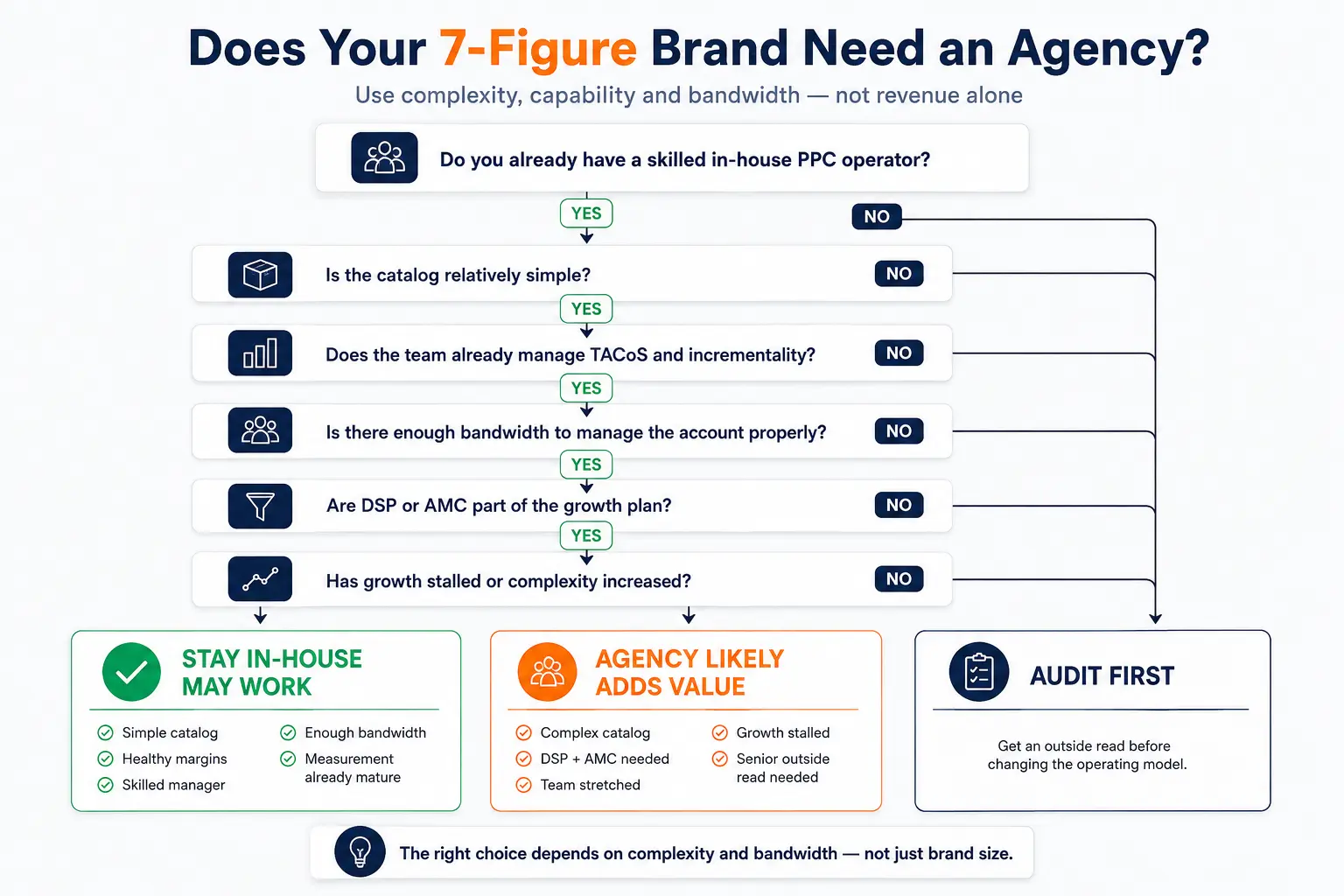
The honest answer is that not every 7-figure brand needs one. If your catalog is simple, your margins are healthy, and you have a skilled in-house manager who already reads TACoS and tests incrementality, an agency may add cost without adding much.
An agency earns its fee when the account is complex, when DSP and AMC are on the table, when your team is stretched, or when growth has stalled and a fresh, senior read would find money faster than another internal cycle. If none of that describes you, staying in-house is a valid choice, and a good agency will tell you so.
Be honest about your own bandwidth as well. In-house only wins if that skilled manager has the hours to run a growing account, not just the knowledge.
A capable person stretched across ten jobs will quietly underperform a focused team, and the gap shows up in wasted spend long before anyone names it.
That said, most brands at this scale are leaving money on the table somewhere, and the fastest way to know is an outside review rather than a guess.
As a specialist Amazon PPC agency, Amplivus is built for exactly the criteria above. We manage to profit and incrementality, run the full funnel including DSP and AMC, keep you in your own account with transparent reporting, and staff seven-figure brands with senior strategists rather than a rotating desk.
We also believe the right first step is proof, not a contract. That is why we start with a free Amazon PPC audit that shows where your account is leaking before you decide anything, backed by ongoing Amazon PPC management if the fit is right.
If you want to talk it through, a short Amazon strategy session maps the highest-value moves for your account and your year. No lock-in, no pressure, just a clear read on what is possible.

Stop settling for vanity ACoS and black-box reporting. Get a clear plan for profit, incrementality, full-funnel growth, and better agency fit.
Book a strategy call to review your account, growth goals, agency fit, and the highest-value PPC moves for your brand.