Finding Hidden Profit in Your Brand Analytics Dashboard
Read more
.png)
Home gym brands pass $250K/mo on Amazon by setting profit-first TACoS targets, segmenting campaigns by margin, and using Sponsored Brands video to win new-to-brand buyers.
Most home gym brands do not stall because demand dried up. They stall because the ad account that carried them to $200K a month was never built to carry them past it. The structure worked at one size. At the next size it starts to leak.
You feel it before you can name it. Spend goes up, sales barely move, and ACoS (Advertising Cost of Sale, the share of ad-driven revenue you pay back in ad spend) creeps in the wrong direction.
Adding budget feels like pushing on a rope. The instinct is to spend more or spend less. The real fix is usually to rebuild how the account is put together.
This is a practitioner's walk-through of Amazon PPC for home gym brands, and it builds on our general framework for how fitness brands scale past $100K a month on Amazon PPC, applied to the bigger catalog and thinner margins of a home gym line.
Here is the pattern we see again and again in fitness accounts. A brand grows fast by chasing a low ACoS.
That discipline works early. It also plants the seeds of the ceiling. When you optimize only for ACoS, you pause or starve the keywords that cost the most.
Trouble is, those expensive category terms were often the ones feeding your organic rank. Cut them, and organic sales soften a quarter later. Your ACoS on paper looks clean. Your total business is quietly shrinking.
This is the trap that hides inside "good" numbers.
Run this quick diagnostic before touching a bid. Pull your TACoS (Total Advertising Cost of Sale, ad spend as a share of total revenue, both paid and organic) for the last 90 days.
If TACoS is falling while total revenue is flat or dropping, you are over-optimizing and choking growth. Check how much of your ad revenue comes from branded search. If most of it is people already typing your name, your ads are harvesting demand, not creating it.
Look at your New-to-Brand (NTB) share, the percentage of orders from shoppers buying your brand for the first time. If it is thin, you have no acquisition engine, only a retention one.
A brand can look efficient and still be stuck, because efficiency and growth are not the same goal. The move past the ceiling starts with deciding, on purpose, how much efficiency you are willing to trade for volume.
Before structure, before bids, set the number that governs everything: your TACoS target.
This is the guardrail that lets you grow on purpose instead of by accident. Amazon's own ad business shows how much competition you are buying into.
Amazon's advertising revenue passed 68 billion dollars in 2025, up about 22 percent year over year, which ranks it as the third-largest digital ad platform behind Google and Meta.
More advertisers means higher costs, with average Amazon cost per click running roughly 1.00 to 1.25 dollars in 2026, up sharply from a few years earlier. You cannot out-spend that math. You have to out-structure it.
A common working TACoS target when scaling fitness ASINs is 12 to 18 percent. That is not a rule handed down from Amazon.
It is a range that lets most home gym brands buy growth while keeping the business healthy.
Here are tighter ranges we target by sub-category. Treat them as starting points, not guarantees, and adjust to your true margin.
The reason this matters: a target set at the account level hides the truth. A launch SKU that needs to run at 20 percent TACoS gets punished by the same rule that lets a mature hero product coast at 9 percent.
Set the floor per product, not per account, and the whole thing loosens up.
At $50K a month you can run a loose account and get away with it. At $250K you cannot.
The single biggest lever most home gym brands ignore is segmentation by margin and intent. Stop running one "gym gear" campaign. Split your catalog so each group can carry its own bid logic.
Hero ASINs get their own campaigns. Your two or three best sellers earn the largest budget share and the most attention, so protect them.
Branded defense runs separately: a small, tightly controlled campaign on your own name keeps competitors from buying your customers on the cheap.
Non-branded category terms are your growth account, and this is where new buyers live. It costs more and converts lower, and that is the point. Harvesting flows one direction: let automatic and broad campaigns discover search terms, then graduate the converters into exact-match campaigns where you control the bid.
That harvesting loop runs on your Search Query Performance report, which shows which discovered terms actually convert.
A quick note on conversion, because it changes the whole equation. A listing that converts at 12 percent pulls three times the sales from the same clicks as one at 4 percent.
Before you pour budget into a product, make sure the product detail page earns the click: main image, title, bullets, and A+ content all pull weight. Ads amplify a listing. They do not save a weak one.
Sponsored Products will always be the workhorse.
For a brand under a million dollars in revenue, a heavy tilt toward Sponsored Products, often around 95 percent of budget with the rest in Sponsored Brands, is a sensible starting split. But the products that break a plateau are usually the ones that bring in strangers, and that is a different job.
This is where Sponsored Brands Video (SBV, a short video ad that runs in search results) does its quiet work.
In 2026 account data, Sponsored Brands campaigns carry a far higher New-to-Brand rate than Sponsored Products, often 35 to 55 percent and climbing above 50 percent on category keywords.
Sponsored Products on branded terms, by contrast, runs closer to 5 to 15 percent NTB.
Read that again: the video ad on a category term is where new customers actually come from. For a home gym brand, that video does not need a studio.
A 15-second clip showing a rack being used, a dumbbell adjusting, a bench folding flat, answers the one question a first-time buyer has: will this work in my space.
That clarity is what converts a stranger, which is why a disciplined Sponsored Brands management approach treats video as an acquisition line, not an afterthought.
Sponsored Display then keeps the demand you created.
Retarget shoppers who viewed the product and did not buy. In fitness, the consideration window is long.
A treadmill is not an impulse buy, so the shopper who clicked in January may convert in February once the paycheck lands.
The paid-to-organic mechanism underneath all of this is the same one we break down in our Amazon PPC halo effect playbook: ad velocity feeds rank, and rank feeds free sales.
The most common scaling mistake is doubling budget overnight and watching ACoS spike. Amazon's system needs stability to optimize.
Yank the budget and you reset its learning. Move in steps. Raise budget on proven campaigns by 10 to 20 percent at a time, hold for a week to ten days, read the result, then step again.
Keep the 80/20 discipline: roughly 80 percent of budget on hero products and proven terms, 20 percent reserved for testing new keywords and ad types.
Here is representative math, illustrative and simplified, to show how the tiers work. This is a model, not a client account. Say a brand sits at 200,000 dollars a month. TACoS is a tight 9 percent.
ACoS on ad-driven sales runs near 28 percent. On paper it looks efficient. It has also stopped growing. The diagnosis: it is over-optimized.
The account starves category terms to protect ACoS, so no new buyers enter, and organic rank has quietly stopped climbing.
The moves, over one quarter: lift the TACoS ceiling on three hero ASINs from 9 percent to 14 percent, funding category keywords the account had been avoiding. Launch Sponsored Brands Video on the top category terms to pull New-to-Brand orders.
Add a top-of-search placement bid adjustment on the hero campaigns, where high-intent shoppers cluster. Harvest the converting search terms into exact-match and drop the wasted ones.
The mechanism: paid sales rise first. Rank follows, because ad-driven velocity feeds organic position.
Organic sales grow into the space the ads opened. Total revenue moves toward the 250,000 to 300,000 range, and because organic is carrying more of it, blended TACoS often settles back down even though you spent more.
The point is not the exact figures. It is the sequence: raise the ceiling deliberately, fund acquisition, let rank catch up, then let efficiency return on its own.
Amazon DSP (Demand-Side Platform, Amazon's programmatic system for buying display and video ads on and off Amazon) gets pitched too early to brands that are not ready.
For most home gym brands, DSP earns its place once Sponsored ads are well-structured and you have enough traffic to build meaningful audiences.
The real value shows up when you pair DSP with Amazon Marketing Cloud (AMC, a privacy-safe clean room that combines your Amazon ad signals with your own data).
AMC lets you build an audience from a real behavior, for example everyone who viewed a hero rack in the last 60 days but did not buy, then activate that audience across DSP and Sponsored ads.
AMC works over a lookback window of about a year or more, so you can reach lapsed buyers well after their first purchase, which suits a category where people buy in stages: bench first, rack next, plates after.
If you are under a quarter million a month and Sponsored ads are still messy, fix those first. DSP amplifies a good foundation. It cannot substitute for one.
Nothing shapes a home fitness year like the new-year surge. January can account for a quarter to a third of annual home fitness equipment sales, running two to three times a normal month.
Resolutions turn into carts. By mid-February the spike fades, and by March the category is back to baseline. That single fact rewrites your ad calendar.
Three moves matter.
Bid up before the crowd. Costs climb as competitors flood in during the first week of January, so brands that raise bids in late December ride lower CPCs into the surge instead of fighting the peak.
Tie ad pacing to inventory. The surge is worthless if you stock out, and to sell in January inventory generally needs to be in Amazon's warehouses by mid-December, which means purchase orders going out in October.
Never let ads outrun stock, because a sold-out hero ASIN loses rank that takes months to rebuild. Defend margin in peak. January is a high-price month, not a discount month.
Prime Day and Black Friday are where the deep cuts belong, so hold your price in January and let demand do the work.
Our walking pad Q4 planning guide walks through this corridor pacing in detail for a lighter fitness product.
If you take one habit from this piece, take this: judge the account on TACoS and total revenue, not on ACoS alone.
ACoS tells you how efficient a single ad dollar was. TACoS tells you whether advertising is building the whole business.
Watch these together on a rolling 14-day basis so seasonality does not fool you: total revenue, TACoS, New-to-Brand share, and organic rank on your top ten terms.
When paid spend rises and organic rank climbs with it, you are buying growth. When paid rises and organic sits flat, you are renting sales.
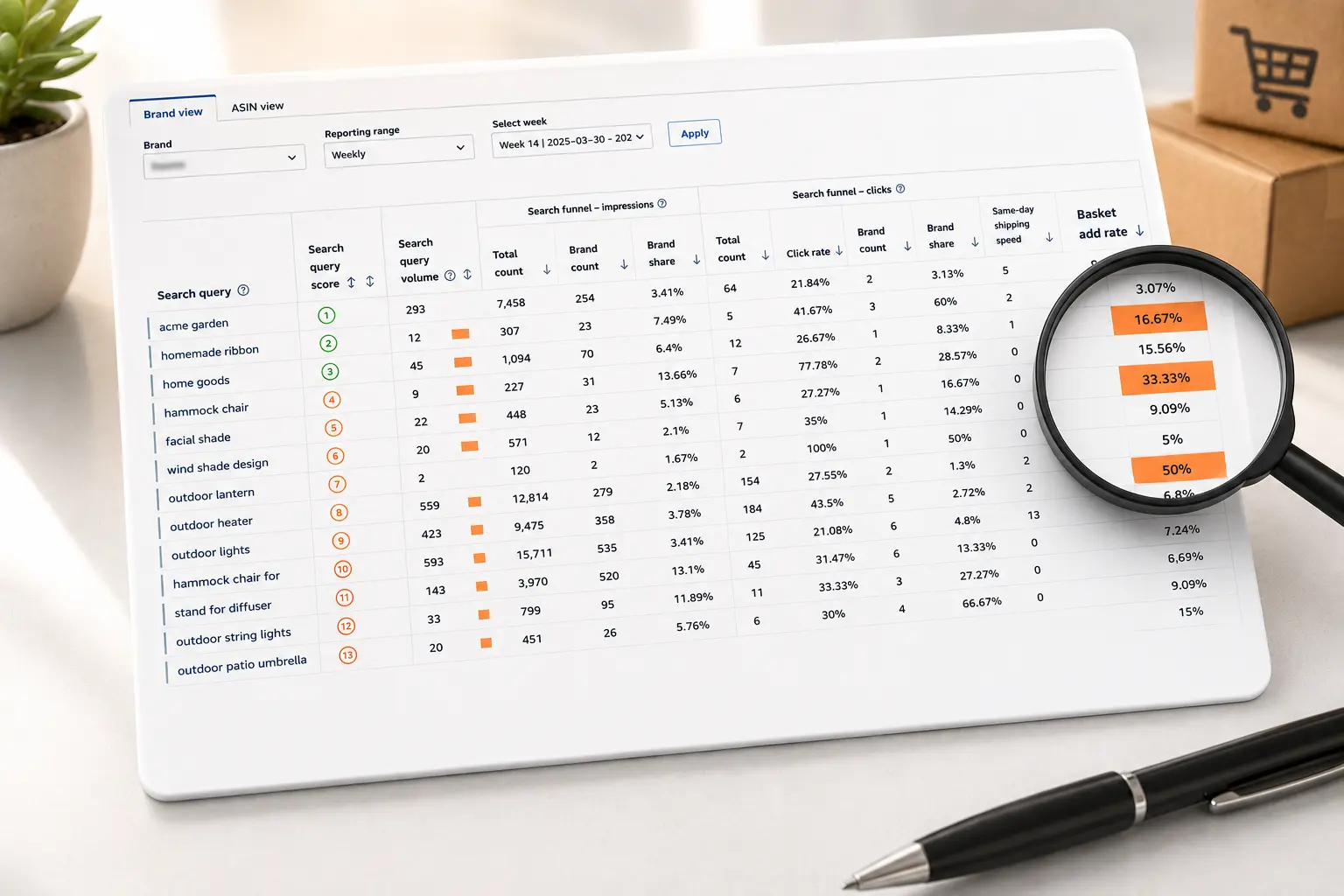
Amazon's Search Query Performance report and Brand Analytics give you the raw view of where your share is really moving.
A short list of the errors we most often clean up in fitness accounts:
Plenty of founders run their own ads well into six figures a month. The question is not whether you can.
It is whether the hours you spend inside the ad console are the highest use of your time as the business gets more complex.
The honest signals that it is time to bring in help: you are managing more than a handful of hero ASINs, seasonality keeps catching you off guard, DSP and AMC are on the table, or you simply cannot tell anymore whether your ads are building the brand or just harvesting it.
Some brands keep it in-house and hire a specialist. Others hand day-to-day management to a team that lives in these accounts daily. Both can work.
Growth past the ceiling is rarely about a secret tactic. Done well, Amazon PPC for home gym brands is mostly structure, a profit floor you set on purpose, and the patience to let rank catch up to spend.
As a specialist Amazon PPC agency, we would rather show you your own numbers read this way first: a focused Amazon PPC audit shows where your ceiling actually sits and the first three moves to lift it, ongoing Amazon PPC management runs the plan day to day, and a short Amazon strategy session maps the next tier before you commit budget.

Speak with an Amazon PPC expert to improve campaign structure, increase new-to-brand sales, and scale your home gym brand profitably.
Get a detailed Amazon PPC audit to uncover growth blockers, improve TACoS, and scale your home gym brand with confidence.