
How Amazon Brands Scale Past $100K/mo With PPC
Read more
.png)
To scale Amazon PPC past $100K/mo, fitness brands fix account structure, scale only proven winners 15-20% weekly, steer by TACoS, then add Sponsored Display and DSP once listings convert.

If you sell protein, supplements, or fitness gear on Amazon, you have probably felt the wall. The brand climbed to six figures on the launch playbook. Then you pushed budget to grow, and ACoS crept up while profit stayed flat. More spend, same money in the bank.
That wall is real, and it has almost nothing to do with your bids. Learning how to scale Amazon PPC past $100K a month is a structural problem, a margin problem, and a category problem.
Fitness and supplements have their own economics, and the generic guides ignore all three. This is the framework we use at Amplivus, written for a founder who already runs ads and wants the next move, not another definition of ACoS.
It builds on the general mechanics in our guide on how to scale Amazon PPC past $100K a month, applied to the fitness and supplement economics that change the math.
Here is the mechanism no one explains. Your account has a finite set of keywords and products that convert well. Early on, your budget is smaller than that proven demand, so every extra dollar finds a good home. ACoS stays low.
It feels easy.
Push spend past that proven pool and two things happen at once. Your bids start reaching into weaker searches that convert less often, which lifts your average cost per click (CPC) and drops your conversion rate.
At the same time, you spread the same budget across more targets, so each one gets fewer conversions and the campaigns learn slower. Auction pressure up, data per target down.
That is the ceiling.
Amazon's 2026 systems changed the texture of this problem. COSMO, the intent model behind product discovery, and Rufus, the shopping assistant that Amazon moved toward Alexa for Shopping during 2026, both push the platform toward matching shopper intent rather than exact keywords.
Targeting is broader and fuzzier than it was two years ago. That rewards clean account structure and punishes accounts that scale by turning bids up and hoping. So the answer is not a bigger number in the bid field.
It is a structure that keeps proven demand and new demand in separate lanes, which is what the rest of this guide builds.
Most sellers steer by ACoS, the ad spend on a sale divided by the revenue from that sale. It is useful, but for a fitness brand it hides the real picture, because your customer rarely buys once.
Switch your eyes to TACoS, total ad spend divided by total revenue, ads and organic together. TACoS tells you whether advertising is buying durable growth or just renting sales.
When TACoS holds flat or drifts down while total revenue rises, scaling is healthy. When TACoS climbs and sales sit still, you are pouring money into a leak.
Commonly reported 2026 category benchmarks put the median managed account near 15 percent TACoS, and supplements a little higher, around 12 to 18 percent, since cost per click in those categories often runs above $5. Treat those as reference ranges, not fixed targets.
Now add the piece competitors leave out. Supplements and fitness run on repeat purchase. A pre-workout buyer might reorder every month. A protein customer on Subscribe and Save can deliver four to eight purchases a year from one acquisition.
That lifetime value (LTV) means a first order that looks break-even on ACoS is often strongly profitable once the reorders land.
This is the mental shift: you are not buying a sale, you are buying a customer. A brand that knows its repeat rate can spend to the reorder and out-bid a competitor who only sees the first order.
That single insight funds most of the scaling that follows, and it is the same repeat-purchase logic behind our supplement brand PPC strategy.
Quick gut check: if you cannot state your 90-day repeat rate and your Subscribe and Save share, get those two numbers before you touch a bid. They set your real acquisition budget.

Here is the framework, built on Amazon's core ad products. Three rungs, each with a TACoS band and a job to do. You climb one rung at a time, and you do not skip.
These bands are Amplivus reference estimates drawn from 2026 category benchmarks. Treat them as starting points, not guarantees. Your numbers move with margin and repeat rate.
Before scaling anything, the account has to be honest. Break-even ACoS equals your profit margin before ad cost, so a 40 percent-margin protein has a 40 percent break-even.
Know it per product. Harvest converting search terms out of auto campaigns into exact-match, add negatives so broad campaigns stop feeding junk, and get every hero ASIN ranking on its main keyword. A messy base does not scale, it multiplies the mess.
This is where most $100K attempts are won or lost. Sponsored Products is still the workhorse at this rung, so do not raise budgets across the board.
Find the campaigns that already profit on a daily basis and lift their budgets 15 to 20 percent a week, then watch for 10 to 14 days before the next move.
Add a top-of-search placement multiplier where your data shows that spot converting well, since top-of-search often converts at a higher rate than product-page slots, so you buy the best real estate without lifting every bid.
Bring in Sponsored Brands and Sponsored Brands Video (SBV) now, because at this stage brand search starts to matter and video earns cheap, high-intent clicks. Isolate each new winner in its own campaign so its budget cannot be pulled toward an unproven target, and give every scaled campaign a full 10-to-14-day read before you judge it, since a two-day dip after a budget lift is usually the algorithm relearning, not a failure.
Past $100K, Sponsored Products alone starts to cap out. You have harvested the obvious demand. Now you grow by reaching shoppers earlier, with Sponsored Display retargeting first, then Amazon DSP for audiences beyond the search page.
This is also where you defend hard: bid on your own brand terms so competitors cannot buy your customers cheaply, and protect your Subscribe and Save base.
The ladder works because each rung funds the next. Reorders from Rung 1 customers pay for the aggression in Rung 2.
The brand demand you build in Rung 2 lowers your blended TACoS in Rung 3, which frees budget for the funnel.
That is the compounding a static budget rule can never capture. Working the ladder across a full catalog is where most in-house teams run short on time, so a structured Amazon PPC audit that maps each product group to its rung before you spend a dollar more is usually the fastest first step.
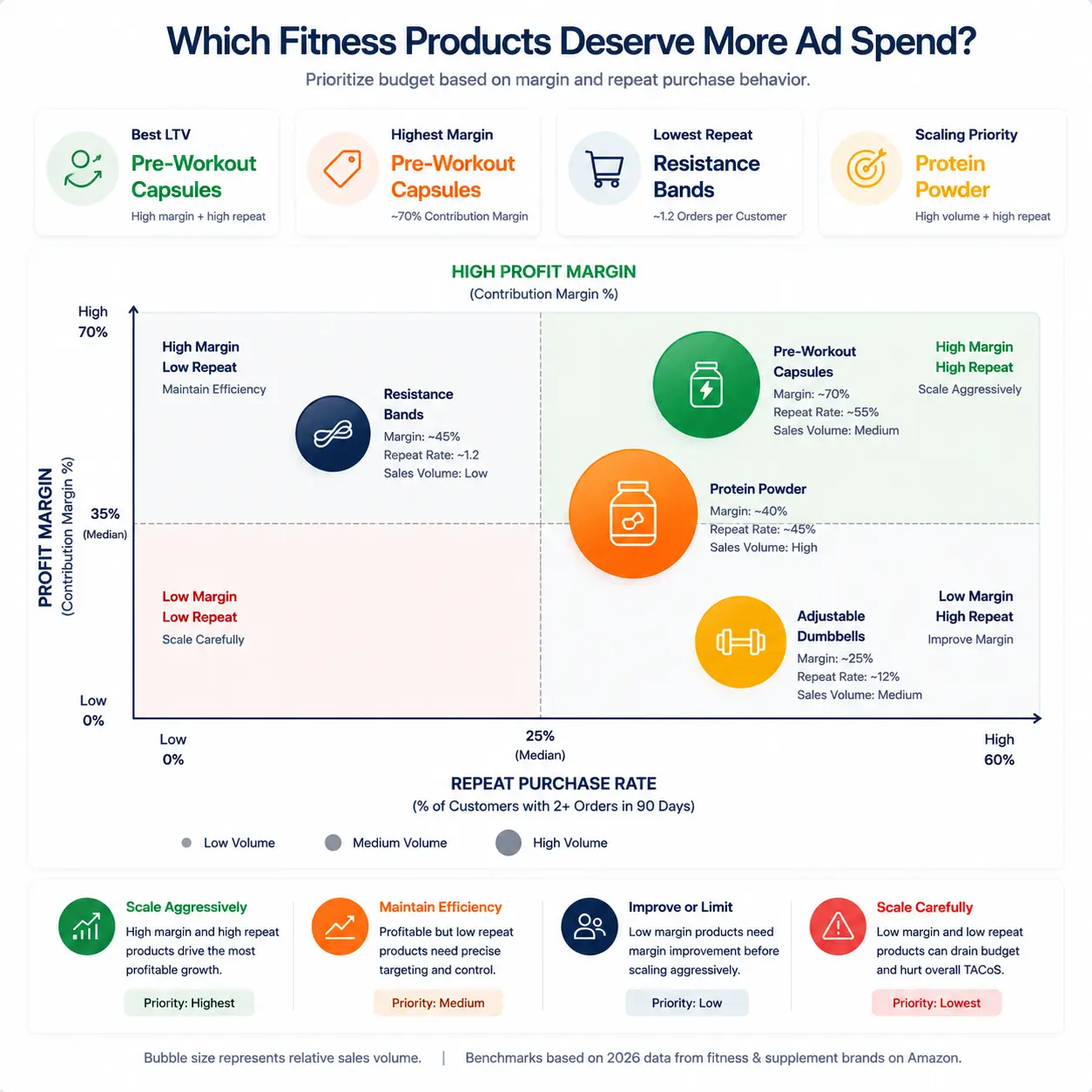
A fitness catalog is never one thing. Picture a representative sports-nutrition brand at about $85K a month in ad-driven revenue. Its capsules run 70 percent margin. Its whey protein runs 25 percent after cost of goods sold (COGS) and shipping weight.
Its resistance bands run 45 percent. Scale all three at the same TACoS and you overspend on protein while starving the capsules that could take far more budget profitably. So group the catalog before you push:
Now take a representative fitness-equipment brand instead, selling adjustable dumbbells and benches. There is no monthly reorder, margins are thin after freight, and demand spikes hard in January.
That brand cannot run the supplement playbook. It scales on tight efficiency, heavy product targeting against competitor listings, and Sponsored Display for the long consideration window buyers take on a $300 purchase. Same marketplace, different ladder.
The same repeat-versus-one-time split drives our wellness brand scaling guide, which is worth reading if your catalog leans heavily toward subscriptions.
The most expensive scaling mistake is reaching for Amazon DSP as a rescue when Sponsored Products is bleeding. DSP is a reward for a clean account, not a fix for a broken one.
Use this readiness test. You are ready for the funnel layer when three things are true: Sponsored Products runs at or below your target ACoS, your main listings convert at a healthy rate with strong reviews, and you have consistent budget you are not pulling back mid-month.
Miss any of those and DSP will simply spend faster.
When you are ready, add in order. Sponsored Display comes first, for retargeting shoppers who viewed your listing and did not buy, which is cheap, warm demand.
Then Amazon DSP, which reaches audiences off the search page and is where you grow new-to-brand (NTB) sales, the customers buying your brand for the first time in twelve months.
Amazon classifies a purchase as new-to-brand by looking back twelve months, so a rising NTB share is real evidence you are expanding the customer base rather than reselling to the same people.
Amazon Marketing Cloud (AMC), now available in a self-serve tier with AMC Audiences, is the measurement layer underneath all of this.
It shows how Sponsored Products, DSP, and organic work together, so you can see the true path a fitness customer takes from a pre-workout impression to a protein reorder. You do not need AMC at $50K. You want it by $250K.
This is the section your competitors skip, and it matters most for your category. As you scale Sponsored Brands and video, you multiply how many people see your claims. That raises your compliance exposure.
Supplement and fitness marketing sits under real rules. The FDA governs how dietary supplements can be labeled and described, which limits structure-function claims and forbids disease claims.
The FTC requires that health and performance claims be truthful and substantiated. A Sponsored Brands headline that promises to "cure" or "burn fat guaranteed" is not just risky creative, it can draw enforcement and get your ads or listing pulled at the worst possible moment.
The practical rule while scaling: keep claims in your ad copy and video scripts as tight as the claims on your label, and let benefits show through customer language and demonstration rather than promises.
Build a pre-cleared claims list before you scale spend, so a new video does not sit in review during a demand spike, and route any borderline wording past that list before it goes live. Compliant creative is not a brake on growth. It is what keeps the growth from being reversed.
Scaling is a habit, not an event. A simple weekly loop keeps a bigger account from drifting:
Rule-Based Bidding inside the Amazon Ads Console can automate parts of this against a target ACoS or ROAS, and a Maximize New-to-Brand strategy can steer Sponsored Brands toward fresh customers.
Automation helps once the structure is right. It cannot save a structure that is wrong.
Be honest about where you are.
A few signs the account has outgrown part-time management: you are past $100K a month and still bidding by feel, your catalog has crossed a dozen ASINs with variants multiplying, you know DSP is next but have no time to learn it, or TACoS has been climbing for two months and you cannot say why.
None of that means you failed. It means the account crossed the size where structure and hours beat instinct. That is the point where done-for-you Amazon PPC management tends to pay for itself, and where a fresh audit usually finds budget hiding in plain sight.
As a specialist Amazon PPC agency, we would rather show you the gaps first: a short Amazon strategy session lets you compare what management costs against the spend you are likely wasting today, and make the call with numbers instead of a hunch.

Talk with an Amazon PPC expert to uncover scaling opportunities, reduce wasted spend, and build a roadmap for profitable long-term growth.
See where your fitness brand can scale profitably with a detailed Amazon PPC audit focused on TACoS, structure, and wasted spend.