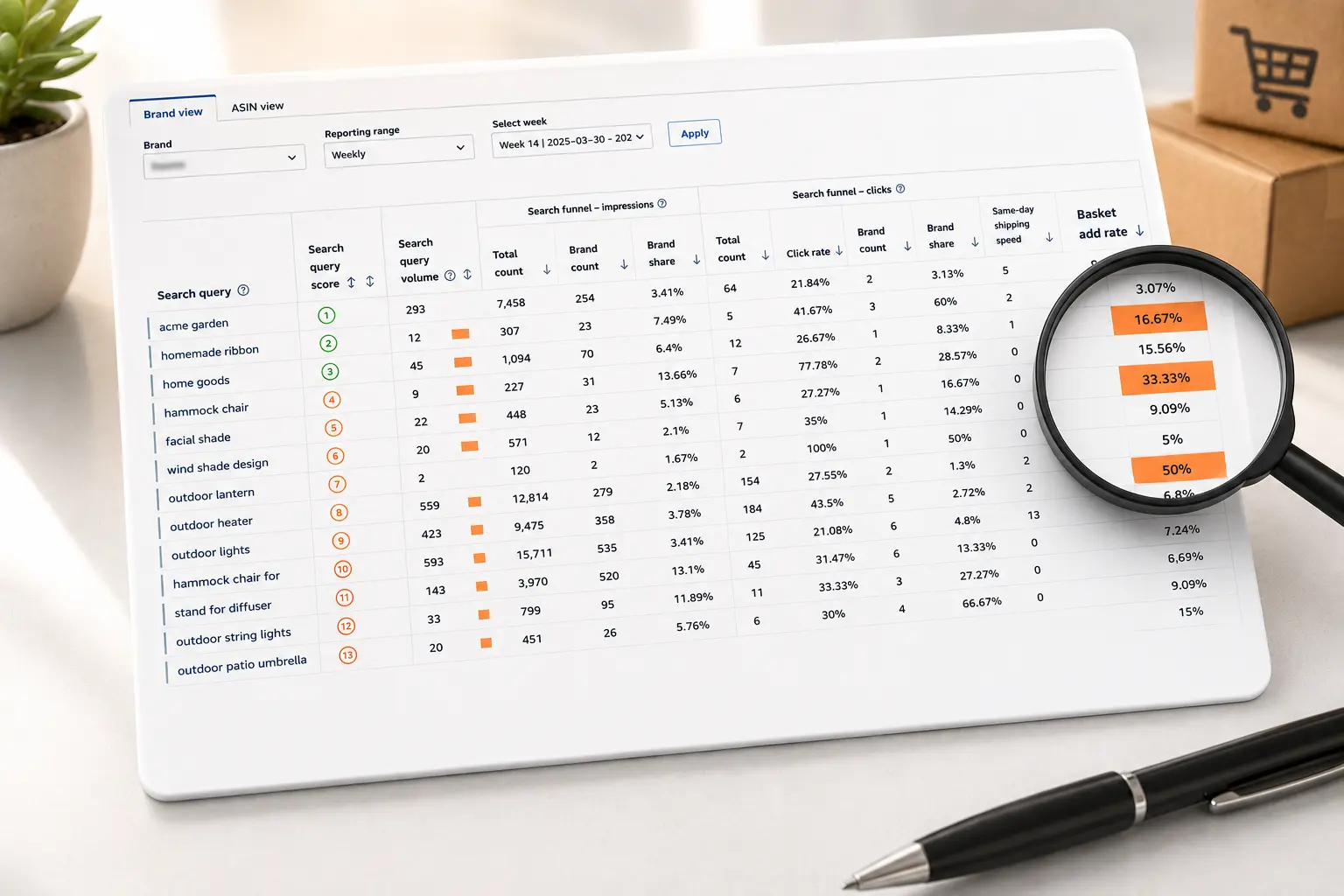
How To Actually Read Your Amazon SQP Report Without Drowning
Read more
.png)
An SQP-driven bid system reads Search Query Performance share signals, then raises, cuts, or holds Sponsored Products bids by a fixed set of rules.
Summarize in ChatGPT

Most sellers can read a Search Query Performance report by now. Far fewer have turned it into a system that actually changes bids on a schedule. That gap is where money leaks, because the data sits in a spreadsheet while bids stay on autopilot.
This guide is about the action layer. Not how to read SQP, but how to build a repeatable rules engine that converts specific signals into specific bid moves, with guardrails so it does not overreact. It is written for brands already spending enough that gut-feel bidding has stopped scaling.
It is a fixed set of rules that maps Search Query Performance signals to bid actions, so decisions stay consistent instead of reactive. The system does the thinking once, then applies the same logic every cycle.
The key thing to understand first is what SQP measures. It reports your share of a whole search query's funnel: your slice of its impressions, clicks, cart adds, and purchases, against the entire market for that term. It is not your ad campaign data.
That distinction is what makes a system necessary. SQP tells you where a query is winnable and where you are already saturated. Your campaign reports tell you what you paid to get there.
A bid system connects the two, using market share to set direction and your own numbers to size the move. The foundations are covered in our guide on how to read the Amazon SQP report.
SQP lives in Brand Analytics and requires Brand Registry, so this system assumes you have brand-registered access to query-level share data. Search Query Performance in Brand Analytics is where every signal in this article comes from.
Manual bidding fails at scale for a simple reason. A large catalog throws off more share signals each week than any person can weigh by feel, so decisions drift toward whatever term was noticed last.
A system judges every query by the same rules, which is how it finds money a manual pass walks past.
It helps to separate share from rank. Rank tells you where you appear on a given search. Share tells you how much of the whole query's demand you capture across every position and seller. Bids move rank, but share is how you judge whether that movement is worth paying for.
Four signal patterns carry almost all the bid decisions: impression share against purchase share, click share, the cart-add drop-off, and median price trends. Learn these four and you can rule on most of your queries.
When your purchase share on a query is high but your impression share is low, you are converting demand you rarely get to see. That is the clearest reason in the system to bid up.
Read it plainly. Shoppers who reach you on this term buy from you more often than the market average, yet you win only a small slice of its impressions.
Raising the keyword bid and lifting the top-of-search placement puts you in front of more of that demand. This is the highest-confidence move you can make, because both halves of the signal point the same way.
A quick example makes it concrete. Say a query shows you holding 4 percent of impressions but 11 percent of purchases. Shoppers find you rarely, yet buy from you at nearly triple your exposure.
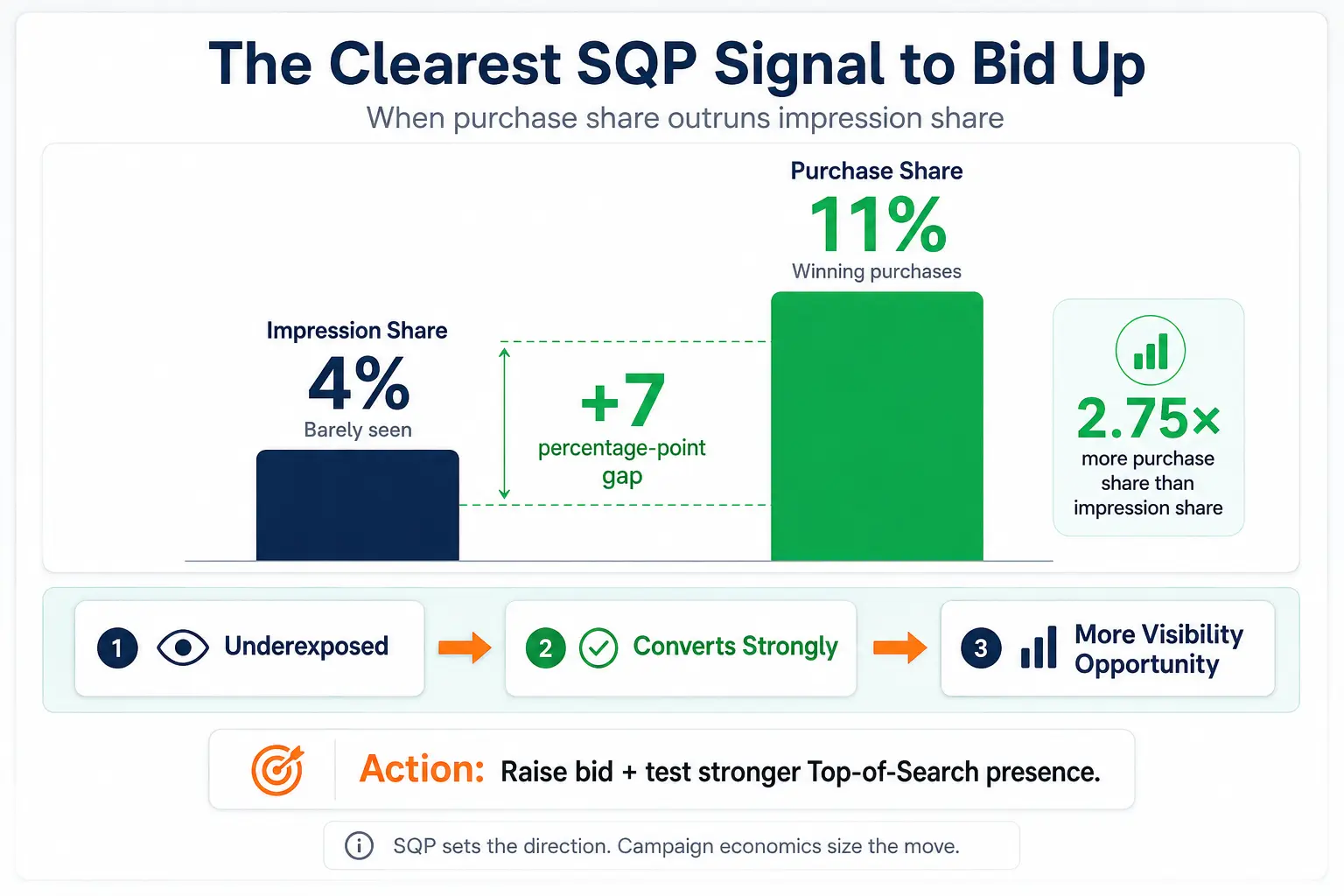
That is a term to bid into, because the demand is proven and you are simply absent from most of the auction.
High impression share with low click share is not a bid problem, and treating it as one wastes money. You are being seen, but shoppers are choosing someone else at the click.
The cause is almost always the main image, title, price, or rating. Bidding up buys more impressions that still will not earn clicks, and bidding down hides a fixable weakness.
The right action is to hold the bid and fix the listing first, then revisit the term. Our breakdown of Search Query Performance metrics shows how to isolate which stage is actually failing.
When cart-add share is healthy but purchase share falls off sharply, the offer is losing shoppers at the last step. Spending more to push traffic into that leak only makes the leak more expensive.
This drop-off usually points to price, reviews, availability, or a competitor winning the buy box. Until that is addressed, the system holds or trims bids on the query rather than feeding it.
We cover the diagnosis in detail in the guide on the SQP cart-add to purchase drop-off.
SQP reports a median price at click, cart add, and purchase for each query, and that median moving against you is a quiet bid signal. If the winning price is dropping while yours holds, your conversion share tends to follow it down.
Pair that with a rising cost per click and the query is getting more expensive to win at the exact moment it gets harder to convert. The system responds by lowering bids or narrowing to tighter match types, not by chasing the term down. Reading those movements is the focus of our guide on click price trends in your SQP report.
Write each signal as an if-then rule with a defined action, so the same input always produces the same bid move. The table below is the core of the engine.
The branded row matters most at scale. If your purchase share on your own brand terms is already high, aggressive bids there often pay for sales you would capture for free. A system flags that automatically instead of leaving it to memory.
Keep the rules few and firm. Five clear rules applied every week beat twenty vague ones applied when someone remembers. The point of a system is to remove the daily judgment call, not to capture every rare edge case.
One habit separates a system that improves from one that drifts. Log every rule change with the signal that triggered it and the result a cycle later. Over a few months that log shows which rules earn their keep and which need retuning, so you are not guessing whether the system works.
Amazon gives you three levers on Sponsored Products: the base keyword bid, a dynamic bidding strategy, and placement adjustments of up to 900 percent. A good rule names which lever it pulls, not just the direction.
The base bid sets your starting point. On top of it, Amazon's dynamic bidding strategies decide how that bid flexes in the auction. Down only lowers bids when a click looks unlikely to convert. Up and down raises them by up to 100 percent when conversion looks likely and lowers them when it does not. Fixed uses your exact bid every time.
Placement adjustments are the sharper tool for the raise signal. You can add up to 900 percent to top-of-search, rest-of-search, or product-page placements, which lets you push hard on the placement that converts without inflating every bid.
When SQP says a query converts well but is under-exposed, a top-of-search adjustment is often cleaner than a blanket bid hike.
Match the lever to the signal. A high-confidence raise pairs up-and-down bidding with a top-of-search adjustment. A pull-back leans on down-only or a lower base bid. Amazon's own Sponsored Products best practices back this data-first approach: raise on proven converters, cut on weak ones.
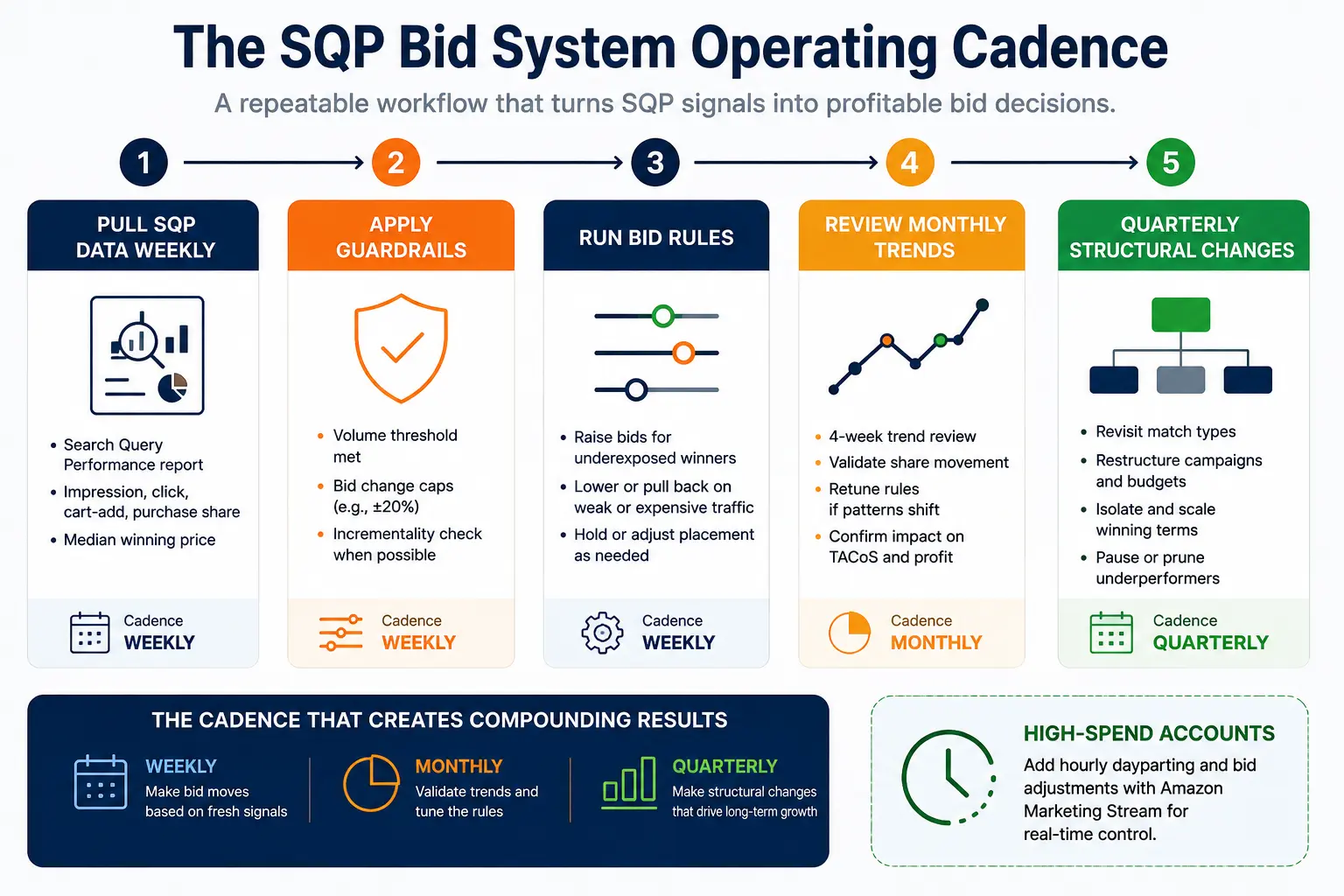
Run bid rules weekly on aggregated SQP, review trends monthly, and reserve structural changes for quarterly, with hourly data used only where it earns its place. Cadence is what turns a report into a habit.
SQP aggregates on a weekly, monthly, and quarterly basis, and a single week is noisy.
Weekly is the right rhythm for routine bid moves on high-volume terms, because you get fresh signal without chasing daily static.
Resist the urge to touch bids daily. Daily edits chase random variation and rob your rules of a clean weekly read, because you can no longer tell whether a change or the market moved the number. Patience is a feature of the system, not a limitation of it.
Monthly is where trends become trustworthy. A query that drifts the same direction for four straight weeks is telling you something a single week cannot. Quarterly is for structure: match types, campaign splits, and which terms deserve their own campaign at all.
For high-spend accounts, hourly data adds a real edge on timing. Amazon Marketing Stream delivers hourly performance that supports dayparting, so you can shift bids around the hours a query actually converts. Use it where volume justifies the added complexity, not everywhere at once.
Volume thresholds, change caps, and an incrementality check stop the system from chasing noise or bidding up demand you already own. Guardrails are what separate a system from a nervous habit.
Set a minimum query volume before any rule fires. A term with a handful of weekly purchases will swing wildly on share, and acting on that noise does more harm than holding. Most disciplined teams set a floor and simply ignore anything beneath it.
Cap how far a single adjustment can move a bid in one cycle. A rule that changes a bid by only a set percentage per week keeps one strange data point from wrecking a budget. Steady, bounded moves compound better than large corrections you later reverse.
Finally, check incrementality on your raise signals. High purchase share on a branded term can tempt a bid hike for sales you would win organically anyway.
Holding that spend out to see what happens is how you separate real growth from paid-for demand. That test is central to how we run Amazon PPC management for larger accounts.
Write the rules down where the whole team can see them. A system that lives only in one person's head is not a system, it is a dependency. Documented rules survive turnover, onboarding, and the week the usual operator is out.
Pull the latest SQP, sort queries by volume, run each rule from the top, and apply only the moves that clear your guardrails. The sequence is deliberately dull, and that is the point.
Start by pulling the current week's Search Query Performance and sorting queries by volume, so the terms that move the account sit at the top. Low-volume noise stays out of the way where it belongs.
Work down the list and check each query against the rule table. Most terms will not trigger anything, and that is fine. The few that do get the matching bid or placement move, sized against your own conversion data and capped by your per-cycle limit.
Close the loop by recording what you changed and why. Next week you compare, keep what worked, and adjust what did not. That review step is the difference between a living system and a spreadsheet nobody trusts.
A bid system is only as good as the account structure and market read underneath it. As a specialist Amazon PPC agency, Amplivus builds SQP-driven rules on top of clean campaign architecture, so signals map to the right keywords and placements rather than a tangled account.
Because SQP is share data, market context matters as much as your own numbers. A structured Amazon PPC competitor analysis shows why your share is moving on a query, so the rules respond to real pressure rather than guesswork.
If you want to see where your current bids are fighting the data, a free Amazon PPC audit maps the biggest gaps first. From there, a short Amazon strategy session turns those findings into the first rules worth running.


Stop adjusting bids by feel. Build a clear SQP-driven system that raises, cuts, or holds bids based on market share and real performance.
Find where your bids fight SQP signals, waste spend, or miss profitable queries, then turn the data into a repeatable bidding system.