Why Wellness Brands Struggle With Amazon PPC Past $100K/mo
Read more
.png)
The best Amazon PPC expert for a wellness brand masters FDA and FTC claim limits, manages to lifetime value, and keeps your account fully transparent.
Summarize in ChatGPT

Hiring a wellness PPC expert is a compliance decision as much as a media one, so vet for claim fluency, lifetime-value thinking, and full account transparency.
Hiring an Amazon PPC expert for a wellness brand is not the same as hiring one for a generic catalog. Wellness carries claim rules that other categories never touch, sells on subscription and repeat purchase, and competes in a crowded, ingredient-driven search space. An expert who has only run ordinary consumer goods will miss all three, and in wellness the wrong miss can cost you the listing itself.
This is a practical checklist for evaluating a senior Amazon PPC strategist for a wellness brand: the competencies that actually matter, the red flags to walk away from, the questions to ask, and what it should cost. The goal is a confident hire, whether or not that hire is us.
Wellness combines strict claim rules, subscription-driven lifetime value, and a crowded ingredient-led search space, so the expert you hire needs category-specific judgment, not general PPC skill. The category shapes the whole job, starting with what you are even allowed to say.
Compliance is the loudest difference. A supplement can make a structure/function claim like "supports immune health," but the moment copy says it treats or prevents a disease, the FDA treats it as a drug claim. That single line separates a compliant listing from a suppressed one, and an expert has to know exactly where it sits.
The economics are different too. Wellness buyers reorder, so the value of a customer is measured across months of Subscribe and Save, not a single order. A senior strategist prices bids against that lifetime value, while a generalist chasing a low first-order ACoS will underbid the very terms that build a subscriber base.
The search space is dense and ingredient-led. Shoppers hunt by ingredient and benefit, competitors crowd every head term, and branded defense matters, so keyword judgment carries more weight here than in a thin category. A strong keyword strategy for a supplement brand is inseparable from the FDA-compliant approach that governs supplement advertising.
The cost of a bad fit is concentrated in risk. A misstep in a flat category wastes budget, but a claim misstep in wellness can pull the listing down entirely, erasing rank and reviews you spent years earning. That asymmetry is why category experience matters so much here.
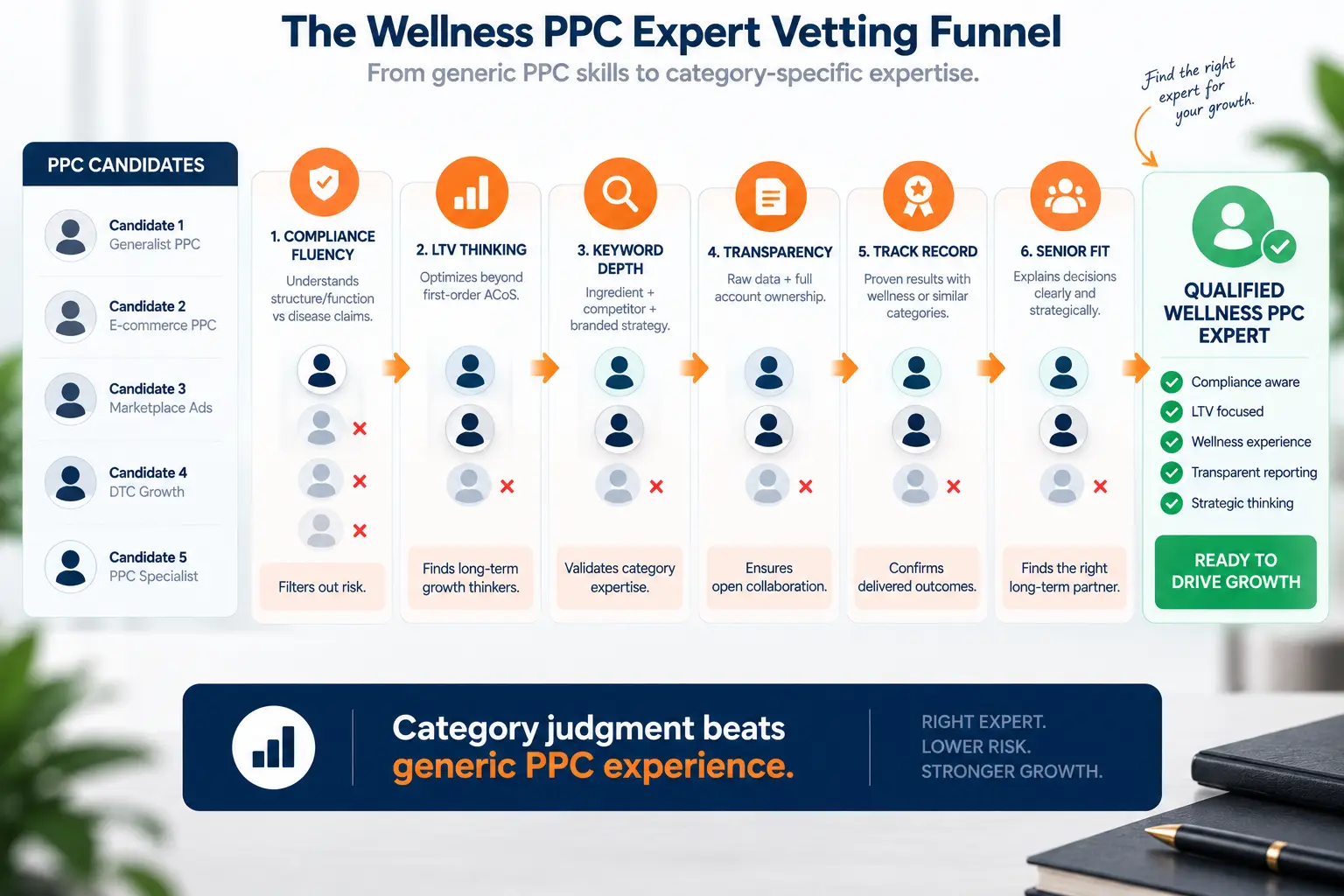
Judge any wellness PPC expert against five competencies: claim compliance, profit and lifetime-value command, claim-safe keyword fluency, ingredient and competitor strategy, and transparent reporting. The table sums up strong versus weak on each.
Ask how they keep ad copy compliant before you ask anything about bids. A senior wellness strategist can explain the line between a structure/function claim and a disease claim, and why the DSHEA disclaimer belongs on the label, not in the ad headline.
They should also know that the platform enforces this. Amazon moderates ad creative, and its Sponsored Brands and display moderation rules require every claim in an ad to match the detail page and be substantiated. An expert who treats ad copy as a place to say more than the listing does is a liability.
Substantiation is the third leg. The Federal Trade Commission expects health claims to be backed by solid scientific evidence, so a real expert steers you toward benefits you can support, not ones borrowed from a competitor's label. In wellness, knowing what not to say is a senior skill.
Ask how they define success. A senior strategist talks about profit and lifetime value, because wellness customers reorder and the real return on a first sale shows up over months of repeat purchase and Subscribe and Save.
A generalist optimizing to a low first-order ACoS will quietly starve your growth. They cut the acquisition terms that look expensive on day one but pay back across a subscriber's lifetime, and the account looks efficient while the subscriber base stops growing.
The right expert models the reorder. They know an acquisition cost that looks high against a single unit can be excellent against a year of refills, and they bid accordingly, a mindset that underpins any serious plan to scale a wellness brand on Amazon.
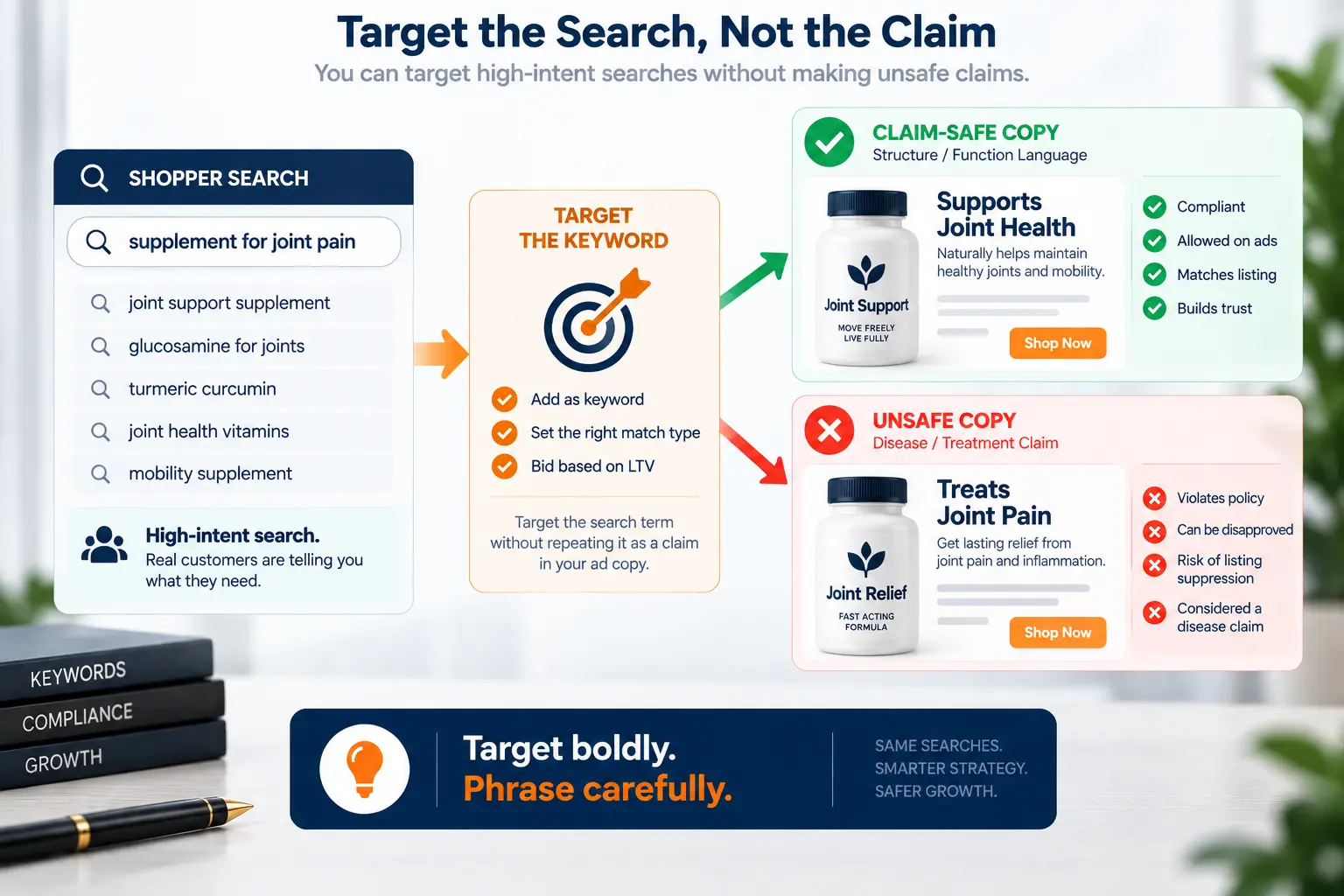
Targeting a keyword is not the same as making a claim, and a senior strategist knows the difference cold. You can bid on a search like "supplement for joint pain" because that is where the buyer is, but the title and headline must stay in structure and function language, never promising to treat the condition.
An expert who confuses the two fails in one of two ways. Either they avoid valuable restricted keywords entirely and leave demand on the table, or they match the keyword with an unsafe claim in copy and invite a policy strike. The skill is holding both truths at once: target boldly, phrase carefully.
A quick test reveals the skill. Ask a candidate whether they would bid on a condition keyword and what the ad copy would then say. A senior answer targets the term and keeps the headline on supporting normal function, never on curing or treating the condition itself.
Wellness shoppers search by ingredient and benefit, so keyword depth beats head-term bidding. A senior strategist builds around ingredient terms, competitor conquesting, and branded defense, using Amazon keyword targeting match types to control each one at its true value.
Branded defense deserves its own attention in a category this crowded. Competitors bid on your brand name, and an expert decides where to defend and where the spend is just taxing sales you would win anyway, the kind of nuance covered in a real supplement PPC strategy.
You should own your account and see the raw numbers. A senior strategist shows you Brand Analytics and Search Query Performance data and explains decisions in plain language, never a black-box dashboard.
Ownership belongs in the checklist too. Your advertising account, your historical data, and your Brand Registry enrollment should stay yours, so that if the relationship ends, nothing walks out the door. Anyone who resists that is protecting themselves, not you.
Some signals should end the conversation early. Each one tends to predict a poor engagement on a compliance-sensitive wellness account.
Most of these share a root cause: a generalist applying a flat playbook to a category that punishes it. If a candidate cannot speak fluently about claim rules and lifetime value in the first conversation, the rest of the checklist rarely saves the hire.
Ask questions that reveal how the expert thinks, not just what they sell. The answers separate a senior operator from an order-taker.
Ask them to explain the difference between a structure/function claim and a disease claim, and to give an example of ad copy they would reject. A fluent, specific answer is the single fastest way to tell a wellness specialist from a generalist.
Ask how they would find waste in your account in the first month. A strong answer names specifics, and their approach should echo Amazon's own Sponsored Products best practices: raise bids on proven converters, cut the weak ones, and structure for control.
Ask how they measure lifetime value and factor subscriptions into bids, who runs the account day to day, and whether you can leave without penalty. Then ask for a reference at your scale, because a real wellness brand that trusts them will tell you in five minutes what a sales call never will.
Ask for specific, verifiable results on brands like yours, not logos or vague claims of growth. Category proof matters more than a long client list.
A strong candidate can describe a wellness account they improved: what was broken, what they changed, and what happened, in concrete terms. Vague answers about driving growth usually mean the specifics do not exist.
Ask specifically about compliance-sensitive and subscription-driven accounts, because a strategist who has only run ordinary goods has never faced the two hardest parts of wellness. Experience in your exact conditions is worth more than a longer resume in easier ones, and a spend-tier view like our wellness PPC spend benchmarks helps you judge whether their numbers are realistic.
Pricing usually follows one of three models, and each has trade-offs worth understanding before you sign. None of them is automatically the right fit.
A percentage of ad spend is common but can reward spending more, which fits a lifetime-value category poorly. A flat monthly retainer is predictable and neutral on spend, and a performance or hybrid fee ties part of the payment to results.
What matters more than the model is that the fee rewards your profit and your subscriber growth, not just your ad budget. Several factors move the number: your ad spend, catalog complexity, how much compliance review is involved, and whether creative is included. Ask exactly what is covered, what counts as extra, and how the fee changes as you grow.
Not every wellness brand needs an outside expert, and a good one will tell you so. The honest answer depends on your catalog, your margins, and your team.
If your catalog is simple, your margins are healthy, and your in-house lead already runs claim-safe and manages to profit, hiring out may add cost without adding much. There is no shame in staying in-house when in-house is working.
An expert or agency earns the fee when compliance risk is real, when subscription economics are on the table, or when growth has stalled in a crowded category. A single senior hire gives you depth in one person, while an agency gives you a bench and a second set of eyes on every claim.
If none of that describes you, staying in-house is valid, and seasonal pushes like a Q4 sleep and wellness plan may be the only time you reach for outside help.
Expect a compliance and waste audit before action, then phased changes, not an overnight rebuild of an account you spent years building. Good experts move deliberately.
In the first weeks, expect a real audit: where spend is wasted, which listings carry claim risk, and which products sit on the wrong targets. You should see findings, not just a new dashboard.
By month two and three, expect deliberate changes with reasons attached, claim-safe copy where the old copy was risky, and a keyword plan built around ingredients and subscriptions.
A wholesale teardown on day one usually destroys rank and reviews you paid months to earn, which is the opposite of what a senior hire should do.
As a specialist Amazon PPC agency, Amplivus staffs wellness brands with senior strategists who keep copy claim-safe, manage to lifetime value, and keep you in your own account with transparent reporting.
Day to day, that means disciplined Amazon PPC management built around the compliance and subscription realities of wellness, not a generic playbook applied the same way to every category.
The right first step is proof, not a contract. A free Amazon PPC audit shows where your account is leaking and where your claims carry risk.
From there, a short Amazon strategy session turns those findings into a claim-safe plan for the year ahead.

Hire a strategist who understands claim rules, subscriber lifetime value, and the keyword depth needed to scale a wellness brand safely.
See who can manage claim risk, subscriptions, and ingredient-led PPC before you trust them with your wellness brand.