.webp)
Amazon PPC for Wellness Brands: 2026 Strategy by Spend Tier
Read more
.png)
At $500K, health brands optimize Amazon Ads by cutting waste, tightening structure and bids, and measuring for incremental profit, not a lower ACoS.
Summarize in ChatGPT

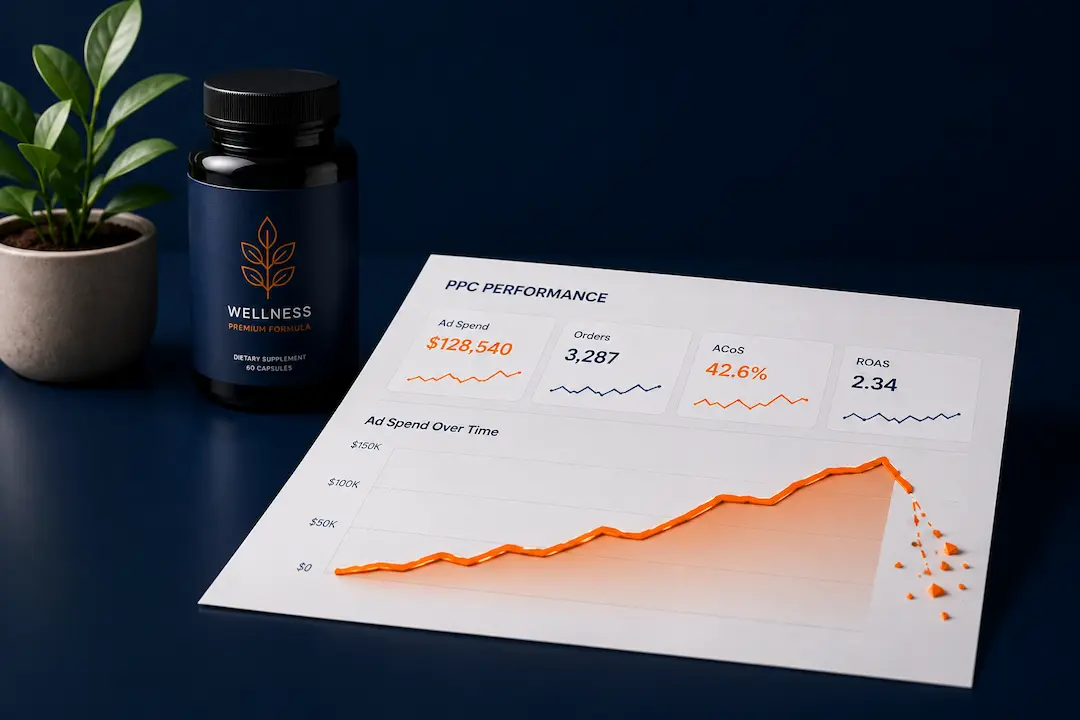
A $500K health account rarely fails for lack of budget. It fails because that budget is spread across waste, overlap, and untested campaigns that a smaller account could ignore but a large one cannot. Optimization at this scale is about finding and fixing that drift, over and over.
This guide is a practical optimization playbook for health and supplement brands already spending at scale. Not how to launch or how to grow, but how to make an existing large account more efficient and more profitable, with the compliance limits of the category built in. It assumes full-funnel spend is already running and needs sharpening.
Optimization means systematically raising the profit your existing spend produces, through waste removal, structure, bidding, targeting, and measurement, run as a repeating loop. It is a habit, not a project.
Optimization is often confused with scaling, but the two pull in different directions. Scaling adds spend to grow revenue, while optimization sharpens the spend you already have so more of it converts. A $500K account usually needs both, but they are different jobs with different metrics.
Where your brand sits also shapes the work. The right optimization for a half-million-dollar account differs from a smaller one, a distinction we map in our guide to Amazon PPC for wellness brands by spend tier.
At this size, small percentage gains are large absolute numbers. Trimming a few points of wasted ACoS on a $500K spend frees real budget, which is why continuous optimization pays for itself many times over.
It also never truly finishes. Competitors change bids, new search terms appear, and Amazon shifts placements, so an account optimized in January drifts by March. Treating optimization as a standing process, not a project with an end date, is the mindset the rest of this guide assumes.
Start with non-converting search terms, campaign overlap, and unmanaged auto campaigns, because that is where a saturated health account leaks the most. Waste is the fastest lever you have.
The biggest early wins are almost always in waste, not in clever bidding. A large health account accumulates search terms that spend without converting, keywords competing against themselves across campaigns, and auto campaigns quietly buying irrelevant traffic.
A structured pass through the account surfaces these fast, which is exactly what a focused Amazon PPC audit is built to do before any bids are touched.
Fixing waste first also makes every later step cleaner. Once the obvious leaks are closed, bid and placement changes act on real signal instead of noise, so the rest of the optimization compounds.
Branded overspend is the quietest leak of all. Bidding aggressively on your own name can look efficient while paying for sales you would win organically, so branded terms deserve their own scrutiny before you celebrate a low ACoS there.
Rank optimizations by impact against effort, and start with the high-impact, low-effort fixes that a large account almost always leaves on the table. Not every lever is worth pulling first.
Negative keywords and obvious waste are usually the highest-impact, lowest-effort moves, so they come first. Structure fixes are high-impact but higher-effort, which makes them the next block of work rather than a same-day change.
Placement and bid tuning sit lower in the order, because they only pay off once the account underneath them is clean. Running them first, on a messy account, optimizes noise. Sequencing the work this way separates a quick efficiency gain from months of churn.
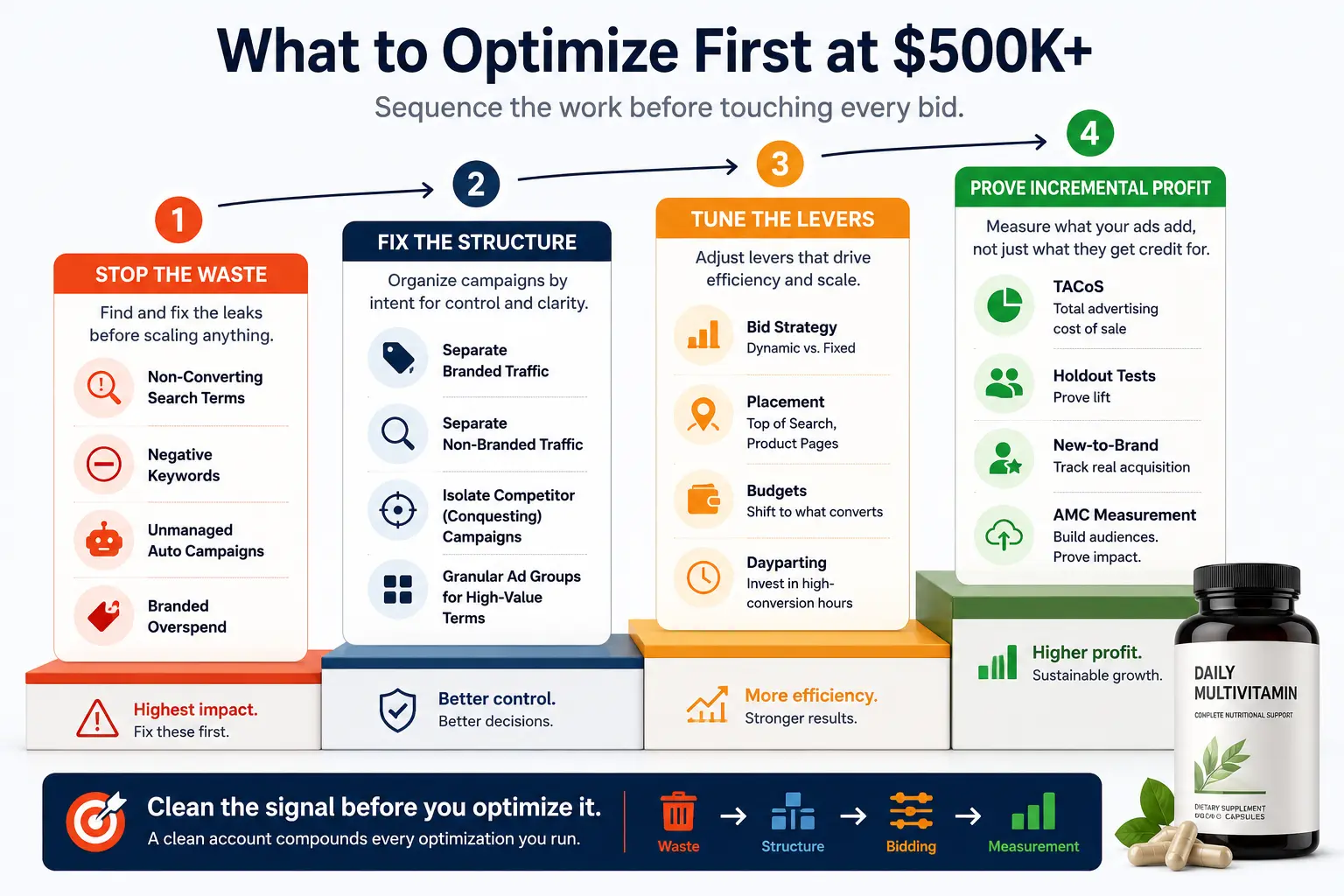
Separate branded, non-branded, and competitor traffic into their own campaigns so each can be measured and bid on its own terms. Structure is where control lives.
When branded, generic, and competitor searches share campaigns, you cannot bid them differently or judge them fairly, and a large health catalog makes that tangle expensive. Every averaged number hides a decision you should be making.
Clean architecture isolates each intent so budget follows performance, a principle covered in our guide to Amazon PPC strategy for supplement brands.
Competitor targeting deserves its own structure too. Isolating conquesting into dedicated campaigns, informed by a proper Amazon PPC competitor analysis, keeps that spend measurable instead of buried inside generic campaigns.
Tighter structure is also what makes bidding meaningful. You cannot optimize a bid on a keyword that is averaged together with ten others, so structure is the foundation every later lever rests on.
Granular ad groups give you that control. Splitting high-value terms into their own tightly themed groups lets you set a bid and a budget per term rather than per bundle, which is where a large account recovers the precision it lost as it grew.
Match a bidding strategy and placement adjustments to each campaign's role, then use hourly data to weight spend toward the hours that convert. The lever should fit the job.
Amazon gives you three bidding strategies, and the right one depends on the campaign's role. Amazon's dynamic bidding options let you lower bids when a click looks unlikely to convert, raise and lower them on proven terms, or hold a fixed bid where you want control.
Placement adjustments are the sharper tool. You can add up to 900 percent to top-of-search, rest-of-search, or product-page placements, so you push hard only where a term actually converts rather than inflating every bid at once.
Timing is the next layer. Amazon Marketing Stream delivers hourly performance that supports dayparting, so a large health account can weight spend toward the hours a product genuinely sells instead of paying full rate around the clock.
The overall rule stays simple. Amazon's own Sponsored Products best practices point to raising bids on proven converters and cutting the weak ones, which is where disciplined bidding earns its keep.
Budgets deserve the same discipline as bids. A campaign capped too low throttles a proven winner, while an uncapped weak campaign bleeds all day, so reviewing where budget is constrained is often as valuable as any single bid change.
Optimize through search-term harvesting, negative keywords, and match-type discipline, because compliance blocks the stronger claims other categories test. You sharpen the mechanics instead of the message.
Health advertising cannot lean on the claims that usually sharpen targeting. The FTC requires strong scientific evidence before a health claim, so the optimization has to happen in the account rather than the copy.
Search-term harvesting is the core loop. Mine converting terms from broad and auto campaigns, promote them to exact match with their own bids, and let the losers fall away. In a saturated category, this steady harvest is where efficiency accumulates.
Mining the reports rewards patience. Reviewing search terms by converting versus spending, then acting on the pattern rather than a single week, keeps you from cutting a term that simply had a slow seven days. In a high-cost category, that patience protects real winners.
Negative keywords matter more here than almost anywhere, because a compliant listing draws loosely related searches that spend without converting. The compliance-first foundation for all of this is laid out in our guide to FDA-compliant Amazon PPC for supplement brands.
Match-type discipline ties it together. Broad campaigns discover, exact campaigns convert, and keeping the two separated is how you optimize targeting without touching a single claim.
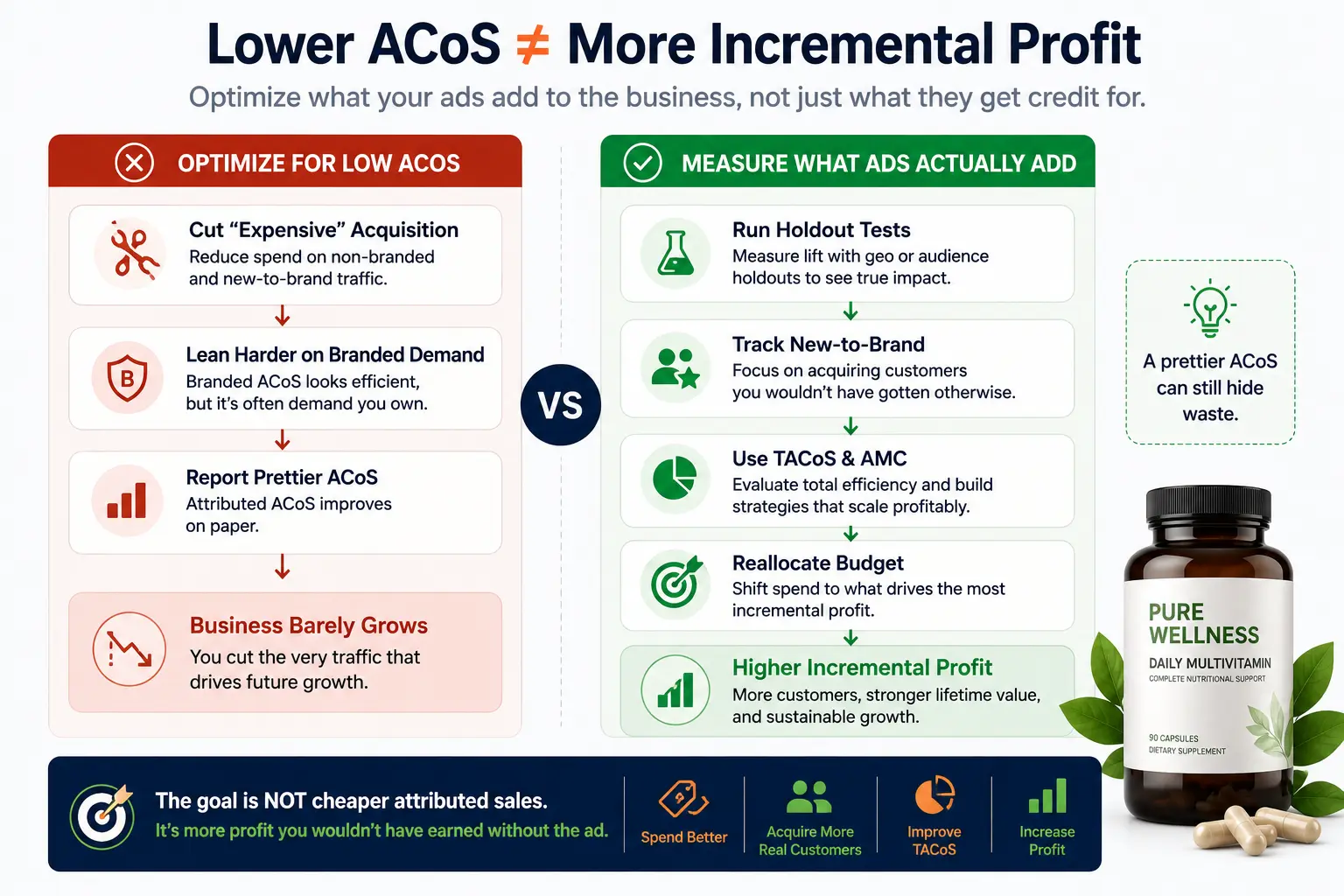
Judge every change on incremental profit and TACoS, using holdout tests and new-to-brand data rather than a lower ACoS alone. The number you optimize is the number you get.
A lower ACoS is easy to manufacture and often meaningless. Cut spend on your brand terms and ACoS improves while sales you would have won organically simply move to organic, so the account looks better and the business does not.
The fix is to measure lift. Holdout tests reveal what spend actually added, new-to-brand metrics separate acquisition from repeat, and Amazon Marketing Cloud connects those signals across the account.
A branded holdout makes this concrete. Pause brand-defense ads for a controlled window and watch whether those sales move to organic or disappear. If they hold, the spend was low-incremental and can be trimmed; if they drop, the defense was earning its place.
Ground the whole effort in your own data. Brand Analytics and Search Query Performance show your share of each query and where optimization is winning or losing the market, which matters more than any single efficiency number.
TACoS is the honest headline metric here. Because it measures total ad spend against total revenue, it exposes whether optimization is buying real growth or just shuffling organic sales into paid, which a campaign-level ACoS can hide entirely.
Retention is the quiet profit lever. Because health is a repeat-purchase category, re-engaging existing buyers is often cheaper than sharpening acquisition, a theme we develop in our guide to scaling Amazon PPC for wellness brands.
Run waste and bid checks weekly, structure and targeting reviews monthly, and deeper measurement quarterly, so optimization never drifts. Cadence is what turns a cleanup into a discipline.
Optimization decays without rhythm. A large health account changes every week as competitors shift and new terms appear, so a fixed cadence is what keeps efficiency from sliding back.
Weekly is for the fast levers: negative keywords, obvious waste, and bid nudges on high-volume terms. Monthly is for structure and search-term harvesting, where a few weeks of data make the pattern trustworthy.
Quarterly is for the bigger questions: incrementality tests, budget reallocation across the funnel, and whether the account structure still fits the catalog. Skipping the quarterly review is how accounts quietly optimize toward the wrong goal.
Write down what you change and why. A short log of each optimization and its result turns the cadence into a learning loop, so the account gets smarter over time instead of repeating the same adjustments every quarter.
The common mistakes are cutting spend to chase ACoS, optimizing before fixing structure, ignoring incrementality, and forgetting retention. Each one optimizes a number instead of the business.
The first is treating a lower ACoS as the goal, which rewards shrinking the account. The second is tuning bids on top of a messy structure, so the numbers never mean what they should.
The third is scaling changes without measuring lift, so waste hides behind a bigger revenue line. The fourth is optimizing acquisition while ignoring the repeat buyers who make health profitable in the first place.
A fifth, subtler mistake is changing everything at once. Adjust too many variables in a single week and you cannot tell which move helped, so disciplined brands change fewer things and read the result before the next round.
Fixing these is less about new tactics than about choosing the right thing to measure. Once the goal is incremental profit rather than a flattering ratio, most of the mistakes correct themselves.
As a specialist Amazon PPC agency, Amplivus optimizes large health accounts for incremental profit, working the waste, structure, bidding, and measurement levers as one continuous system rather than a one-off cleanup.
Day to day, that means disciplined Amazon PPC management that keeps the account tight as the category shifts, with compliance built into every change rather than bolted on afterward.
If you want that turned into a plan, a short Amazon strategy session maps the highest-value optimization moves for your account and your year, with no lock-in and no pressure.

Stop letting waste, overlap, and weak targeting drain your account. Build a clear optimization plan focused on incremental profit and TACoS.
Book a strategy call to identify the highest-impact optimization moves across bids, targeting, structure, and spend.