
Amazon PPC Strategy for Hair Growth Oil Brands: Sponsored Brands Video Plays
Read more
.png)
The best Amazon PPC keywords for hair growth brands are ingredient, benefit, and product-type terms, not drug-claim phrases a non-drug product cannot own.
Summarize in ChatGPT

The best Amazon PPC keywords for a hair growth brand are not a list you can copy from a tool. They are the specific terms your shoppers use, grouped by intent, filtered for what your product can legally and credibly deliver.
A biotin gummy and a scalp serum compete for different searches, and both have to stay on the right side of the claims that turn a cosmetic into a drug.
This guide is a keyword strategy for hair growth brands on Amazon in 2026: the categories of keywords that matter, the terms to handle carefully for compliance, how to find your own best keywords in the data, and how to structure them. It is a framework for building your keyword set, not a generic word dump.
Think in intent categories, not a flat list, and let your own search data decide which specific terms to fund. The framework matters more than any single word.
Hair growth is a crowded, high-consideration corner of beauty, so the right keyword approach depends on your product and price point, a progression mapped in our guide to Amazon PPC for beauty brands.
The mistake most brands make is chasing a published keyword list. Those lists ignore your product, your margin, and your compliance position, so they send budget at terms that never convert for you.
A better model is intent. Group keywords by what the shopper is actually trying to do, then fund the groups your product genuinely satisfies. That framing survives algorithm changes and tool fads.
Start from the product, not the category. An oil, a serum, a supplement, and a shampoo satisfy different searches, so the same keyword list rarely fits two of them. What you sell decides which intents you can honestly win.
Margin gates the list as well. A premium serum can afford contested head terms that a low-margin gummy cannot, so your price point quietly decides how aggressive your keyword targeting should be.
Competition shapes the plan too. Hair growth is one of the most contested beauty niches, so a smaller brand usually wins by owning specific, lower-competition terms first, then expanding toward the broad head terms as reviews and rank build.
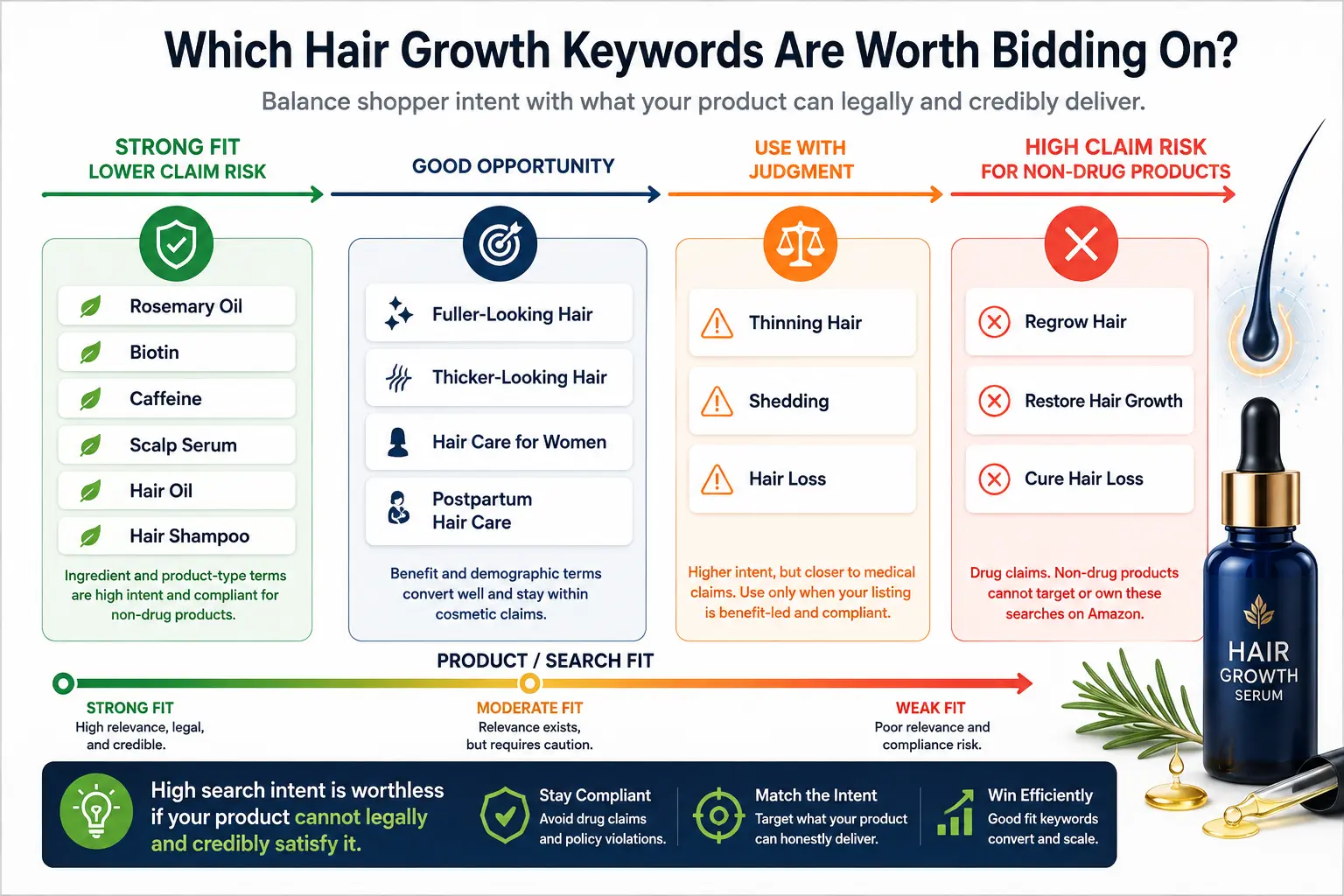
The main categories are ingredient, product-type, benefit, demographic, problem, and branded or competitor terms, each with a different intent and value. Sort your list this way first.
Ingredient and product-type terms are usually the safest and most efficient. A shopper searching biotin gummies or rosemary oil for hair has clear intent, and a non-drug product can match it without a compliance problem.
Demographic terms are underrated. Phrases like hair growth for women or postpartum hair loss are more specific, less contested, and often convert better than broad head terms, because the shopper has told you exactly who they are.
Problem terms need the most judgment. Searches like thinning hair or shedding carry high intent, but they sit closest to the claims a non-drug product cannot make, so target them only when your benefit-led listing can honestly speak to that shopper.
The richest terms are combinations. A phrase that stacks an ingredient, a benefit, and an audience, such as rosemary oil for thinning hair in women, is specific, less contested, and often the cheapest efficient conversion in the account.
Match each product to the searches it can honestly satisfy, because an oil, a serum, a supplement, and a shampoo compete for different intents. One keyword list rarely fits them all.
An oil or serum leans on ingredient and application terms, from rosemary oil to scalp treatment, where the shopper wants a topical product they apply directly. The keyword set follows how the product is used.
A supplement leans on ingredient and benefit terms like biotin or fuller hair, while staying clear of drug claims, since it works from the inside and cannot promise regrowth.
A shampoo competes on routine and ingredient terms, where the shopper is replacing a daily product rather than adding a new one.
Handle drug-claim terms like regrow, restore, or cure with care, because a non-drug product cannot legally own them and rarely converts on them. Compliance and efficiency point the same way here.
The line matters. The FDA treats a claim to restore hair growth as a drug claim, which means an oil, serum, or supplement that promises regrowth is legally a drug, not a cosmetic.
Bidding on a term is not the same as claiming it, but the two are linked. You can appear on a search like regrow hair, yet if your listing cannot credibly and legally match that intent, the click converts poorly and can invite policy trouble.
Performance claims also need proof. The FTC requires competent and reliable evidence before you claim a result, so a benefit-led keyword strategy backed by honest listing copy is both safer and more effective than chasing drug-style terms.
Safe phrasing is a skill worth building. Describing what a product supports, or how hair looks and feels, keeps you in cosmetic territory, while promising to treat, cure, or regrow crosses into drug claims. The same discipline shapes both your listing and your keyword choices.
Amazon's own policies add a layer. Beyond FDA and FTC rules, Amazon restricts certain health and drug claims in listings and ads, so a compliant keyword strategy also keeps your account clear of the policy flags that can suspend a listing.
The practical rule is to target cosmetic and ingredient terms you can stand behind, and let the true drugs, like minoxidil products, own the regrowth searches. Fighting for terms your product cannot legally satisfy wastes both budget and goodwill.
Find them in your own data: mine converting terms from broad and auto campaigns and read Brand Analytics, rather than copying a list. The best keywords are already in your account.
Your best keyword source is your own account. Brand Analytics and Search Query Performance show the exact searches shoppers use to find products like yours, and which ones you already win.
Read those searches by intent and conversion, not just volume. The metric-by-metric discipline in our guide to Search Query Performance metrics applies directly to choosing which hair-growth terms to fund.
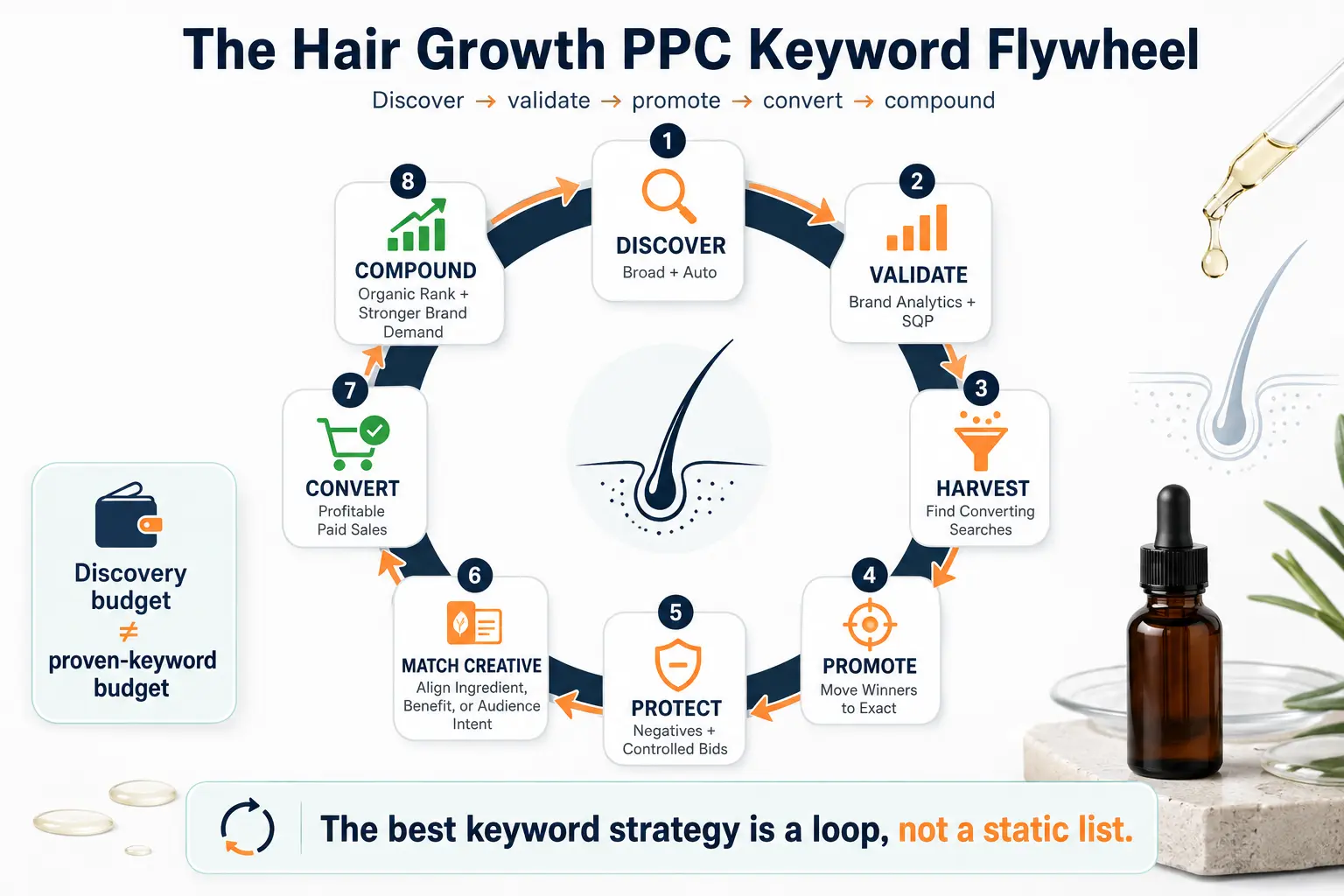
Then let discovery do the work. Broad and auto campaigns surface terms you would never guess, and Amazon's own Sponsored Products best practices point to harvesting the winners into exact match while cutting the rest.
Make the search-term report a habit, not a one-off. New converting phrases appear constantly in a category this active, so a brand that mines the report every week keeps finding cheap, high-intent terms competitors have not noticed yet.
Watch for trending ingredients, too. Hair-growth demand moves with viral ingredients and routines, so a term that was quiet last quarter can spike, and catching that early is one of the cheapest ways to grow before the auction heats up.
Group keywords into intent tiers, give the high-value ones their own campaigns, and separate branded, generic, and competitor terms. Structure is where a list becomes a strategy.
On Sponsored Products, isolate your best converting terms into their own campaigns so you can bid them deliberately instead of burying them in a broad average. Control follows separation.
Match types do the sorting. Broad campaigns discover new phrases, exact campaigns convert the proven ones at a controlled bid, and keeping them separate is how you scale the good terms without losing control of cost.
Negatives protect the whole thing. Hair growth searches pull in unrelated terms, from wigs to unrelated conditions, so a steady negative-keyword habit keeps budget on the searches your product actually serves.
For your highest-value terms, tight ad groups pay off. Giving a proven keyword its own small, themed group lets you set a precise bid and budget for it, which is where a large hair-growth account recovers the control a broad campaign loses.
Budget should follow intent, not habit. Your proven, high-intent terms deserve the headroom to scale, while discovery terms run on a smaller, controlled budget, so the account funds what converts and still keeps finding new winners.
Defend your branded terms and selectively conquest competitor terms, because both are efficient once your brand is worth searching for. Neither should be left to chance.
Once shoppers search your name, competitors will bid on it, so branded defense protects your cheapest conversions. Sponsored Brands holds the top of your branded results and keeps rivals from taking loyal buyers at the moment of purchase.
Conquesting is the mirror image. Appearing on a rival's terms where your product genuinely wins can pay off, and a structured Amazon PPC competitor analysis shows which competitor keywords are worth the spend and which are not.
Measure branded spend honestly. Because loyal buyers search your name and would often find you anyway, test whether branded ads add sales or simply shift them from organic, and defend hardest where the test shows you are genuinely under attack.
The right keyword only converts with matching creative, and winning it in paid lifts your organic rank on the same term. Keywords do not work in isolation.
Keywords and creative work together. A shopper who clicks a hair-growth term wants to see the product and its results, which is why demonstration formats matter, as our guide to Sponsored Brands Video for hair growth oil shows.
Winning a keyword in paid also compounds. Profitable paid sales on a term lift its organic rank, the flywheel we cover in our guide on the beauty PPC halo effect, so the right keywords pay off twice over time.
Match the creative to the keyword's intent. A shopper on an ingredient term wants to see that ingredient and its result, while a demographic searcher wants to see someone like them, so aligning the ad to the search lifts conversion on the same keyword.
The common mistakes are copying generic lists, chasing drug-claim terms, ignoring demographic long-tail, and skipping branded defense. Each one wastes budget on the wrong searches.
The first is trusting a published keyword list over your own data, which funds terms that never convert for your specific product. The second is chasing regrow and restore terms a non-drug product cannot legally own.
The third is ignoring the demographic long tail, where the most efficient conversions often hide. The fourth is leaving branded terms undefended, which hands warm, ready-to-buy shoppers to a competitor's ad.
A fifth mistake is setting keywords and forgetting them. The best terms drift as demand and competition shift, so a keyword list left untouched for a quarter is already out of date in a category that moves this fast.
As a specialist Amazon PPC agency, Amplivus builds hair-growth keyword strategy from your own data and your compliance position, not a borrowed list, so every term you fund is one your product can win and keep.
Day to day, that means disciplined Amazon PPC management that harvests new keywords, structures them by intent, and defends the terms that matter to your brand.
If you want to see which keywords are already working and which are leaking budget, a free Amazon PPC audit maps it, and a short Amazon strategy session turns it into a plan for the year.


Get a focused PPC review that uncovers wasted terms, missed long-tail keywords, weak branded defense, and compliance risks holding growth back.
See which terms deserve more budget, which need negatives, and where branded defense can protect high-intent sales.