Amazon PPC Strategy for Hair Growth Oil Brands: Sponsored Brands Video Plays
Read more
.png)
Plan Amazon PPC for beauty by spend tier. Launch under $5k prioritizes ranking despite higher ACoS; growth through enterprise tightens ACoS and adds Sponsored Brands, DSP, and AMC.
Beauty is one of the most expensive aisles on Amazon to advertise in. Average cost per click (CPC) in the category sits around $2.00 to $2.50 in 2026, and the most contested skincare and cosmetics search terms push well past that.
So a plan that wastes clicks costs a beauty brand more than the same mistake would cost a phone-case seller.
Most advice ignores that. It hands a founder spending $3,000 a month the same tips it hands a brand spending $120,000. Those two brands should be doing almost opposite things.
One is buying its first rankings and cannot afford to chase efficiency yet. The other is defending shelf space, running Amazon Demand-Side Platform (DSP) campaigns, and reading Amazon Marketing Cloud (AMC) reports.
A single Advertising Cost of Sale (ACoS) target for both is close to useless.
This guide fixes that. It plans Amazon pay-per-click (PPC) advertising for beauty by spend tier, so the moves match the money. You get benchmark ranges, budget splits, and a launch sequence you can act on today.
Budget advice only means something once you know your own math. Two numbers set the frame for every tier below: what you can afford to pay for a sale, and how much of your revenue should go to ads at your stage.
Get these right and the rest of this guide is a matter of degree.
Before any tier talk, you need the number that makes every target meaningful. ACoS is ad spend divided by ad sales. Your break-even ACoS is simply your profit margin before advertising.
If a serum sells for $30 and you keep $12 after the cost of goods, Amazon fees, and shipping, your margin is 40 percent. That 40 percent is your break-even ACoS.
Spend more than that to make a sale and the ad loses money on that order.
This matters because a "good" ACoS is not a fixed figure. It is your break-even, adjusted for the job the product is doing.
A launch product can run above break-even on purpose to buy rank and reviews. A mature hero product should run well under it.
Anyone who quotes you a single ACoS number without asking your margin is guessing.
TACoS, or Total Advertising Cost of Sale, is the companion metric. It measures ad spend against total revenue, not just ad-driven sales.
When TACoS holds steady while total sales climb, your ads are pulling organic rank along with them.
When TACoS rises and sales stay flat, something in the targeting or the listing is off, and no bid change will fix it.
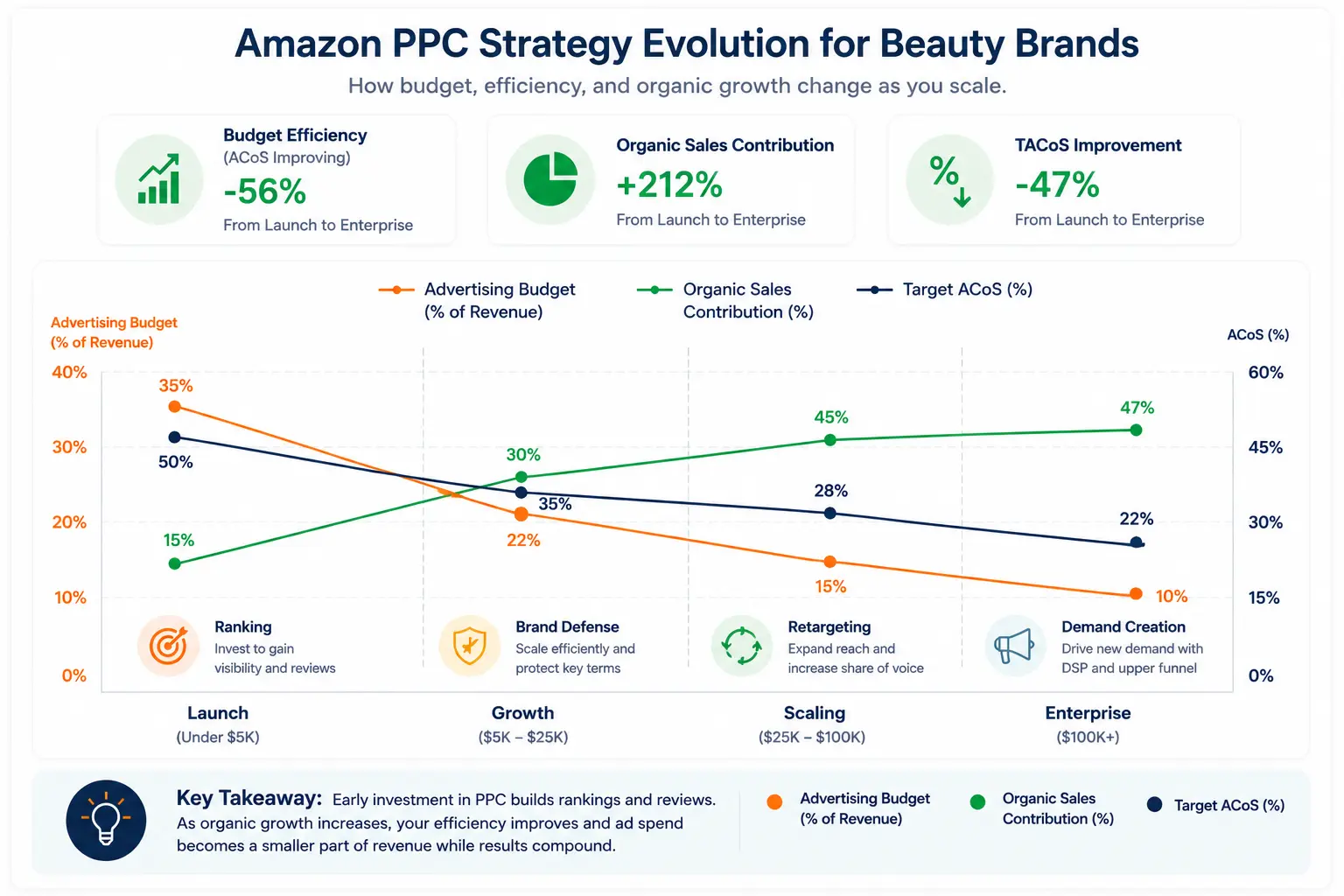
A useful rule ties budget to revenue and stage. New beauty brands often spend 20 to 40 percent of revenue on ads while they buy traction. Scaling brands settle into 15 to 25 percent.
Mature brands with strong organic rank and repeat buyers run leaner, often 8 to 15 percent, because Subscribe and Save and brand loyalty carry sales that no longer need paid support.
Beauty leans to the higher end of these bands early on, for one reason: the category is crowded and trust-driven. Shoppers compare textures, finishes, and ingredient claims, and they rarely buy an unknown serum on the first click.
Paid visibility funds the reviews and rank that eventually make organic sales cheaper.
The sharper question is not how much, but where the money goes first. Early on, the goal is signal, not efficiency. You are paying to learn which keywords convert and which creative earns clicks.
Push for a low ACoS before you have that data and you will often switch off the very campaigns that would have taught you what works.
The right move at $3,000 a month is often the wrong move at $80,000. So instead of one plan, here are four, sorted by what you spend on Amazon Ads each month.
Find your tier, read it closely, then skim the one above to see what comes next.
Find your row, then read the tier that matches. If you sit between two, start with the lower tier and graduate as your data supports it.
At this stage you have one or two hero products and no room for waste.
Resist the urge to run every ad type. Put the majority of your budget into Sponsored Products, because beauty is still search-driven at the point of purchase, and Sponsored Products is where purchase-ready clicks live.
These ads also tend to convert 2 to 5 times better than Sponsored Brands and cost 20 to 30 percent less per click, which is exactly what a thin budget needs.
Run one Auto campaign to let Amazon surface converting search terms, and one manual Exact campaign to control the terms you already know matter.
Mine the Auto campaign's search term report every week, move winners into Exact, and add the junk as negative keywords so you stop paying for it.
This loop, called keyword harvesting, is the single highest-value habit at this tier.
Expect a higher ACoS here, and plan for it. Running at 45 to 60 percent for the first two to three months is normal when you are buying rank and reviews on a new Amazon Standard Identification Number (ASIN).
Enroll the product in Amazon Vine to gather early reviews, because in beauty a listing with fewer than 15 reviews converts poorly no matter how good the ad is.
Launch checklist for a new beauty ASIN:
You have proof now. Certain keywords convert, a few products carry the account, and you can afford to widen the funnel. This is where Sponsored Brands starts to matter more in beauty than in almost any other category.
Variants, shades, and routines are hard to explain in a text ad, and Sponsored Brands video shows application and finish before the click, which lifts CTR and lowers wasted spend. A short clip of a cream being applied does more work than any headline.
Start defending your brand name here. When shoppers search your brand, a competitor may be bidding on it, and a low-cost branded Sponsored Products campaign keeps that traffic yours.
Branded terms are cheap and convert high, so this is rarely the place to save money.
Your ACoS target tightens to roughly 30 to 40 percent as ranking work pays off and organic sales grow. Watch TACoS as your north star now. If it holds flat while revenue climbs, keep scaling.
Lean on Search Query Performance and Amazon Brand Analytics to see which queries you win and which you only rent through ads.
A typical split at this tier: about 60 to 70 percent of budget to Sponsored Products, 20 to 25 percent to Sponsored Brands, and a small, controlled slice to Sponsored Display for retargeting shoppers who viewed but did not buy.
Now you are a category contender, and the job shifts from capturing demand to owning share of voice.
Sponsored Display grows from a test into a real line item, retargeting shoppers across product pages and pulling back the ones who drifted to a competitor.
You start adjusting bids by placement, paying up for top-of-search where beauty conversion is strongest and trimming where it is not.
Dayparting enters the plan. If your data shows conversions cluster in the evening, concentrate budget there instead of spreading it flat across a day.
At this spend, small percentage gains are real dollars, so these refinements earn their keep.
This is also where AMC becomes useful. Amazon Marketing Cloud lets you see how Sponsored Products, Sponsored Brands, and Sponsored Display work together across a shopper's path, not in separate silos.
It answers questions a single campaign report cannot, like which first touch leads to a new-to-brand purchase two weeks later.
Blended ACoS at this tier usually lands around 25 to 35 percent, with mature hero products running lower and new launches still allowed to run hot.
Market leaders stop asking only "how do I capture searches" and start asking "how do I create demand." Amazon DSP is the tool for that.
It runs programmatic display and video on and off Amazon, retargeting beauty shoppers who left without buying and reaching look-alike audiences who match your best customers.
DSP is where you find buyers before they type a search.
Sponsored TV extends that reach into streaming, putting a beauty brand in front of relevant viewers through a self-serve tier that no longer requires an enormous minimum.
AMC Audiences turns your own data into targetable segments, so you can retarget past purchasers before a repurchase window or reach people who bought a complementary product.
At this tier the metric that matters most is new-to-brand sales, because growth comes from new customers, not just repeat buyers you would have kept anyway. Blended ACoS often runs 20 to 30 percent, but the leadership team reads it alongside customer lifetime value and total market share, not on its own.
Numbers give you something to aim at. The two tables below show where beauty budgets tend to sit and what an efficient account looks like at each stage. Treat them as starting points you adjust against your own margin, not as fixed rules.
Percentages are directional. Treat them as starting points, then let your own conversion data move the sliders.
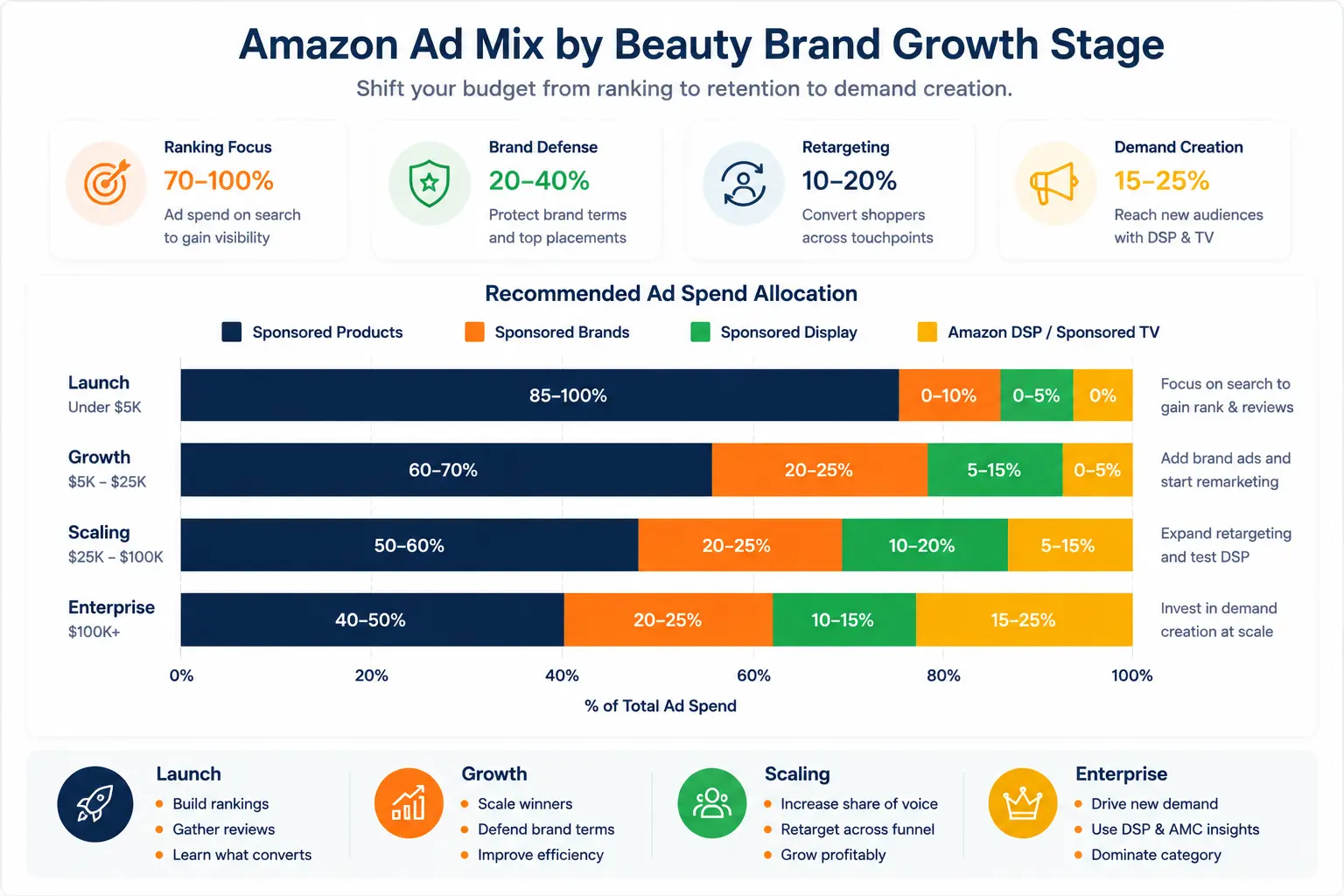
These ranges assume a healthy break-even margin in the 35 to 50 percent zone common to beauty. If your margin is thinner, pull every target down to match.
The tiers set your budget and your targets. What separates a strong beauty account from an average one is the detail: which subcategory you sell, the mistakes you sidestep, and how you handle the calendar.
This is where the everyday work lives.
Amazon's beauty advertising solutions treat the category as one bucket, but the subcategories do not behave alike.
Skincare is claim-heavy and repeat-friendly. Shoppers research ingredients, so long-tail functional keywords ("vitamin C serum for dark spots") convert better than broad ones, and Subscribe and Save makes lifetime value high enough to justify a patient ACoS.
Cosmetics is shade-driven and visual. Variants multiply fast, and when shades compete against each other they inflate CPC. Sponsored Brands video earns its place here because color and finish are hard to judge from a static image.
Haircare sits between the two, with routine-based bundles (shampoo plus conditioner plus mask) that reward Sponsored Brands product collections and cross-selling.
Fragrance is the outlier. It is hard to sample online, so trust signals, reviews, and brand recognition carry more weight than any keyword.
Paid works best here to defend brand terms and support a strong Brand Store rather than to chase cold traffic.
The most common one is chasing a low ACoS during a launch, which switches off campaigns before they have taught you anything. The second is letting variants fight each other in the same campaign, so you pay inflated CPCs to compete with yourself.
The third is judging a weak campaign by its bid when the real problem is creative: in beauty, a low CTR is almost always an image or positioning issue, not a bidding one.
The fourth is ignoring branded search until a competitor is already siphoning it. The fifth is scaling spend on a listing with too few reviews, which pours paid traffic into a page that cannot convert it.
Beauty spikes hard around Prime Day and the winter holidays, and CPCs climb with demand.
The brands that win are the ones that build review counts and rank in the quiet weeks before, then raise budgets and defend branded terms during the event. Gift sets and bundles deserve their own campaigns in the fourth quarter, because holiday shoppers search "gift" intent that your everyday keywords miss.
A guide like this gets you a sound plan. What it cannot do is look inside your account and tell you which of your campaigns is leaking.
If your ACoS has crept up, your sales have gone flat, or you are about to scale spend on a launch, a structured review of your search term reports, campaign structure, and placement data usually finds money faster than another round of guesswork.
That is the point where many beauty brands bring in help. If you want a professional read on where your spend is going, Amplivus offers a free Amazon PPC audit that reviews your search term reports, campaign structure, and placement data before you scale.

Discover the best PPC strategy for your spend level with expert guidance that lowers wasted ad spend and supports profitable long-term growth.
Get a 24-hour Amazon PPC Audit to find wasted spend, improve ACoS, and build the right strategy for your current budget tier.

.png)
.png)


.png)
.png)