.png)
Key Takeaways
- The routine is the growth engine. A skincare customer builds a regimen, so expanding a single-product buyer into a full routine is the cheapest growth you have.
- Segment by concern, not just product. Anti-aging, acne, sensitive, and brightening buyers are almost different markets and deserve their own strategy.
- Replenishment is lifetime value. Skincare is consumable, so a first sale is the start of a reorder stream that should set your bids, not first-order ACoS.
- Claims are the constant risk. The line between a cosmetic and a drug is set by your marketing language, so ad copy has to stay on the cosmetic side.
- Demand creation joins the mix. At this scale DSP and AMC time replenishment, drive the routine cross-sell, and reach new customers before they search.
Crossing $200,000 a month with a skincare brand changes the problem you are solving. Below that level the work is capturing demand efficiently: finding keywords, buying rank, tightening cost.
Above it, the machine already runs, and growth comes from a different place, from turning a single-product buyer into a routine, timing the reorder, and reaching new customers before they search.
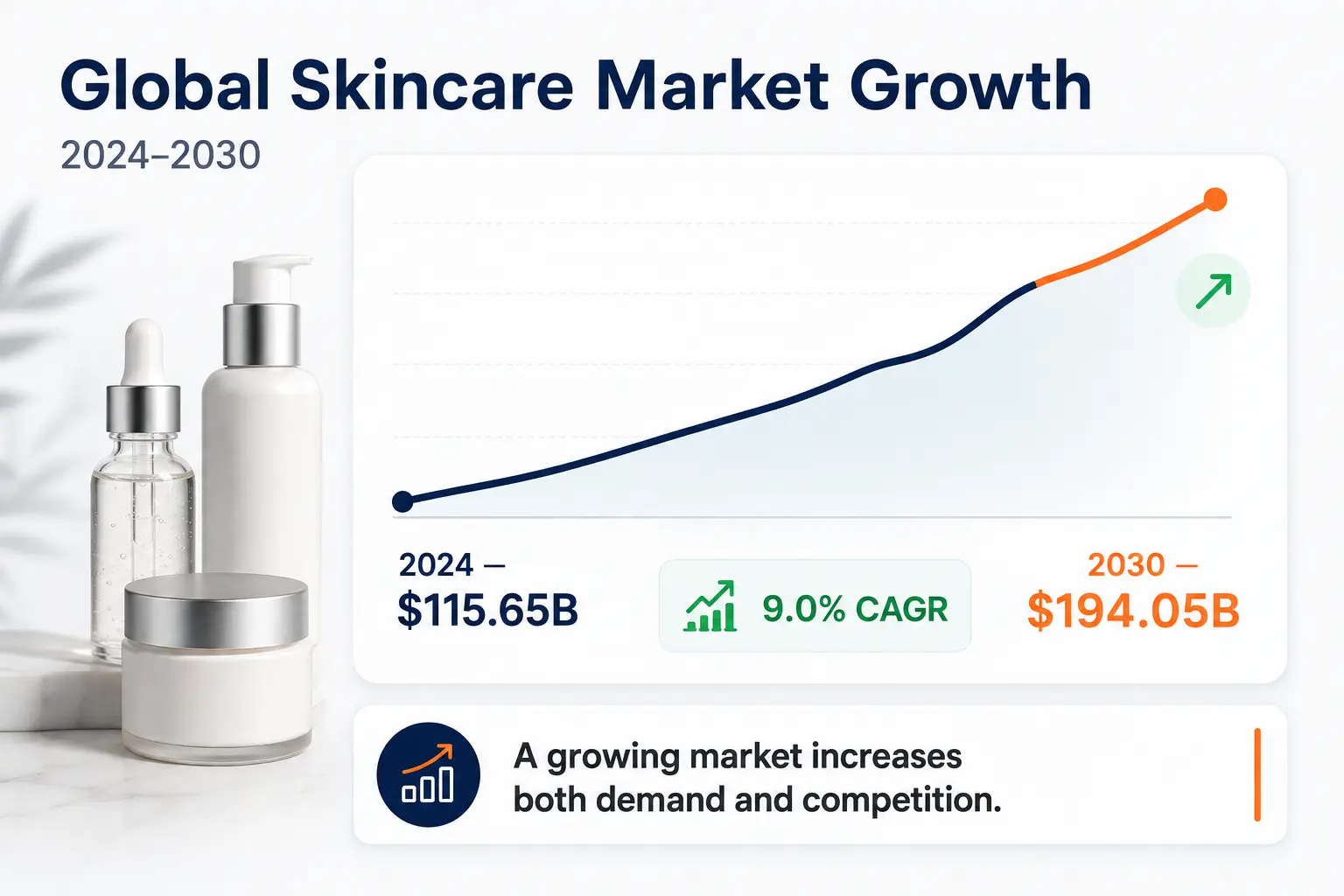
The global skin care market reached about $156 billion in 2025 and is projected near $203 billion by 2033, with premium and clinically framed products growing fastest, and at this scale you compete with sophisticated brands for a customer who buys not one product but a regimen.
The brands that keep growing change what they optimize for, not just how hard they bid.
This guide is a practical playbook for skincare brands already at $200,000 a month and up. It covers the routine cross-sell that drives growth, segmenting by skin concern, replenishment lifetime value, the claims discipline the category demands, and how Amazon Demand-Side Platform (DSP) and Amazon Marketing Cloud (AMC) earn their place.
It builds on the creative sequencing in our guide on full-funnel Amazon Ads for skincare brands and applies the advanced moves from our guide on PPC strategy for 7-figure brands to skincare specifically.
The Routine Is Your Growth Engine
The defining feature of skincare at scale is that customers do not buy a product, they build a regimen, and that changes where growth comes from.
Cross-sell the full routine
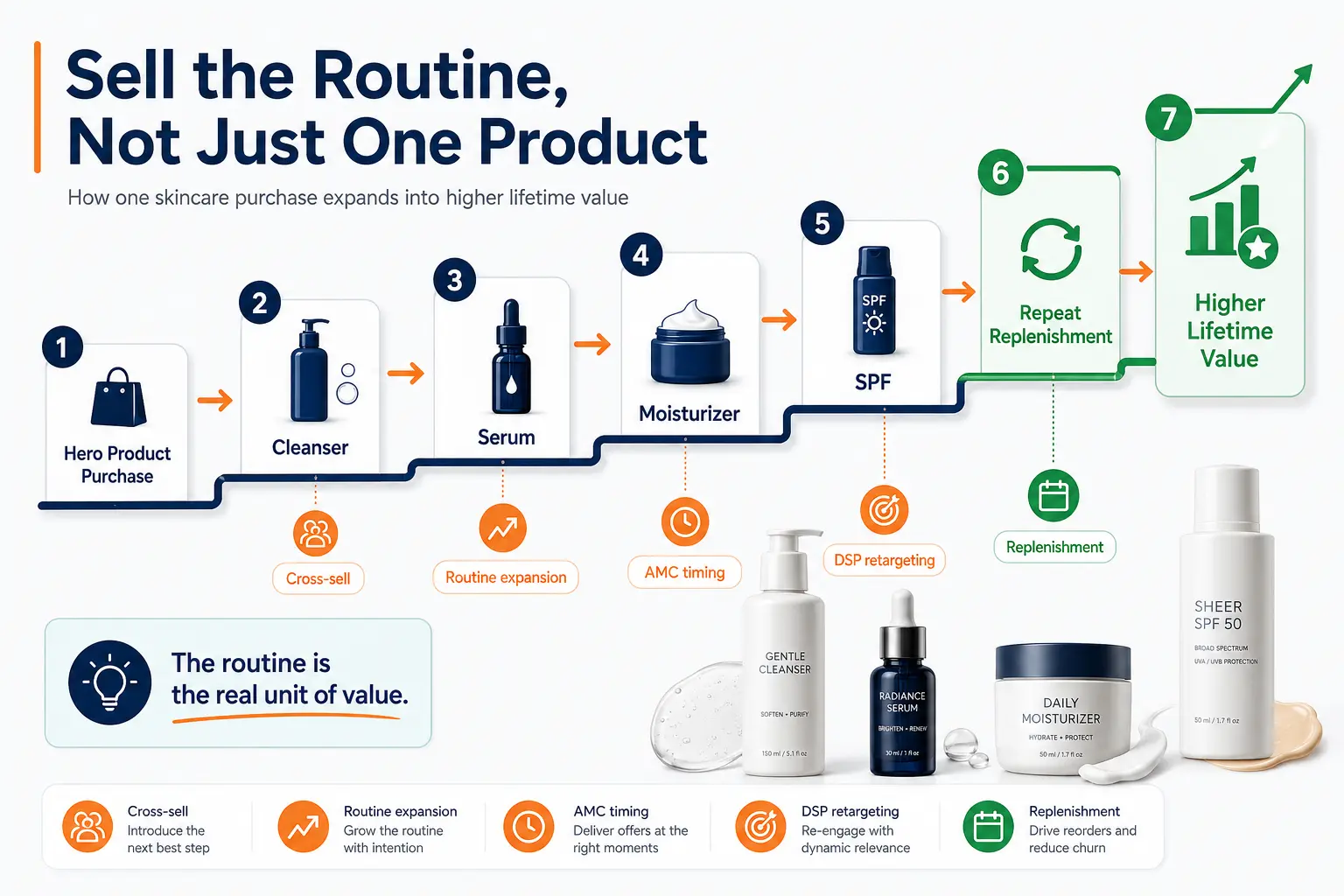
A customer who buys your serum is a candidate for your cleanser, your moisturizer, and your SPF, because skincare is used in a routine and a satisfied buyer wants the rest of it from a brand they trust.
Expanding a single-product buyer into a multi-step routine is the cheapest growth you have at $200,000 a month, because you have already paid to acquire them and each added product raises their value without a new acquisition cost.
Build campaigns and audiences that move a first-product buyer toward the next step, and treat the routine, not the product, as the unit you are selling. A brand that sells one serum and stops leaves most of a customer's value on the shelf.
The economics of this are worth being explicit about.
If your average acquisition wins a single-product buyer, and a routine buyer is worth three or four times as much across their relationship, then the highest-return work in the whole account is often not winning more first sales but converting more existing buyers into full-routine customers.
That conversion costs a fraction of a cold acquisition, because you already have the customer's trust and their address in your audiences.
The brands that plateau at this scale usually do so because they keep pouring budget into the top of the funnel while neglecting the far cheaper growth sitting in their own customer base, one product deep and ready for the next step.
Sequence the regimen
The routine has an order, and your cross-sell should follow it.
A cleanser buyer is early in building a regimen; a serum buyer is investing in a specific concern; an SPF buyer is completing the routine. Map which products lead to which, then use your data to anticipate the next step rather than waiting for a fresh search.
Push Sponsored Products to acquire on the entry products, then rely on lifecycle marketing to capture the rest of the routine at a far lower cost than acquiring each step cold from a new shopper.
Segment by Skin Concern
Skincare is not one market, and at scale a blended strategy across concerns wastes spend on all of them.
Concern is the real segment
Anti-aging, acne, hyperpigmentation, and sensitive-skin buyers search differently, respond to different messages, and value different proof.
A blended target across them forces very different customers into one plan, and the fix is to segment your catalog and campaigns by concern, funding each to its own economics and speaking to its specific worry.
At $200,000 a month you have the data to see which concerns drive your volume and which convert best, so build the portfolio around them. A message written for the anti-aging buyer lands flat on the acne buyer, and the reverse is just as true, so the precision genuinely pays at this scale.
The scaling discipline that gets a beauty brand to and past this point is covered in our guide on scaling beauty brands past $100K a month, and it compounds once you organize the account by concern.
Ride ingredient trends without overfitting
Skincare runs on ingredient cycles, retinol, vitamin C, niacinamide, peptides, and a trending ingredient can spike demand fast.
Capture that demand while it lasts, but do not rebuild your whole account around a trend that will cool, and above all keep the claims compliant when an ingredient is hot and the temptation to overpromise is highest.
Convert a trend spike into durable rank and reviews rather than a cost structure that assumes it lasts, the same discipline that governs any volatile demand.
Ingredient trends also cut the other way, as an entry point rather than just a spike.
A shopper who arrives searching a trending ingredient can be introduced to your whole routine, so treat the trend keyword as a doorway into the concern portfolio rather than a standalone sale.
The brand that captures a vitamin C trend buyer and then guides them into a full brightening routine turns a fleeting moment of demand into a lasting customer, which is worth far more than the single trend-driven purchase that most competitors will settle for.
Replenishment Is Lifetime Value
If the routine is the engine, replenishment is the fuel, and it should drive your bids more than first-order ACoS.
Bid to the reorder, not the first sale
Skincare is consumable; a serum runs out, a moisturizer is repurchased, and Subscribe & Save turns a first sale into a recurring one.
That means a first order that breaks even on Advertising Cost of Sale (ACoS) can be a strong decision when the customer reorders for months and adds the rest of the routine, so bid to lifetime value on products with strong replenishment and subscription attach.
Judge those campaigns on the relationship, not the first sale, or you will switch off the spend that builds your most valuable customers.
Track subscription attach rate by product, because that is what tells you which acquisition compounds into recurring revenue.
Read TACoS across the relationship
Total Advertising Cost of Sale, ad spend against total revenue including organic and repeat, shows whether acquisition is turning into retention.
When TACoS holds or falls while total sales climb, your paid spend is winning customers who reorder and build routines organically.
Read the whole picture across months rather than a single campaign's ACoS, because in a replenishment category the first sale is the least important part of the customer's value.
The paid-to-organic flywheel behind that lift is the same mechanism explored in our guide on the halo effect for beauty brands, where paid velocity pulls organic rank up with it.
Keep Claims on the Cosmetic Side
Skincare sits on a regulatory line that your marketing language, not your formula, decides, and at scale a slip is expensive.
Marketing language sets the classification
The FDA distinguishes a cosmetic from a drug by intended use, judged through the claims you make.
An anti-aging moisturizer marketed for appearance is a cosmetic; the same product marketed to treat wrinkles or restore skin structure becomes a drug, which it is not approved to be.
That line runs through every headline, image, and product name in your PPC, so a claim to reduce the appearance of fine lines is safer ground than a claim to treat them.
At $200,000 a month you run many ads across many products, so write from a compliant vocabulary rather than letting each campaign reinvent the language, because consistency is what keeps a large account on the cosmetic side.
Compliance protects the brand and converts
Overreaching does not just risk listing suppression; it undermines the credibility a skincare buyer is paying for, because the modern shopper is skeptical of a product that promises too much.
Compliant, specific, honest claims read as more believable than sweeping ones, so the discipline that keeps you safe also converts better.
Standardize how claims, before-and-after imagery, and reviews are used across the catalog, so one product's aggressive language does not put the brand at risk, and knowing where competitors are pushing claims they cannot defend is the kind of read a structured Amazon PPC competitor analysis can surface.
DSP and AMC Earn Their Place
Below this scale, Sponsored Products and Sponsored Brands do most of the work. At $200,000 a month, with a customer base and a routine to manage, programmatic tools pay off.
Time replenishment and the routine
Amazon DSP runs programmatic display and video on and off Amazon, and in skincare its best use is timing.
Amazon Marketing Cloud audiences let you build segments from your own purchase data, so you can reach a serum buyer just before the bottle runs out, offer the moisturizer to the cleanser buyer at the right moment, or exclude recent purchasers from acquisition.
That timing turns the routine and the reorder cycle from a hope into a system, putting the right product in front of the customer when their need arises.
The replenishment window is the single most valuable moment to reach a skincare customer, because a satisfied buyer whose product is running low is close to a certain reorder, and reaching them then is far cheaper than reacquiring them cold if they drift.
A nearer-term version of the same job runs through a Sponsored Display campaign, which keeps you in front of recent viewers and past buyers without the reach of full programmatic.
Together they close the gap between one purchase and the next, which in a consumable category is where a large share of your revenue is won or lost.
Reach new customers before they search
The other job at this scale is demand creation. New skincare customers form constantly as concerns change with age and season, and upper-funnel display and video reach them before they search a specific product.
Judge this spend on new-to-brand sales and lifetime value, not a search ACoS, because it works earlier in the decision, and a high new-to-brand rate means you are growing the base rather than recycling it.
The same claim discipline applies to every one of these surfaces, with no exception for being further up the funnel.
Mistakes That Stall Skincare Brands at Scale
- Selling one product instead of the routine, leaving most of a customer's value unclaimed.
- Blending targets across skin concerns, so anti-aging and acne buyers get one message that fits neither.
- Judging acquisition on first-order ACoS, which ignores replenishment and routine value.
- Making drug claims in ad copy, images, or product names, which risks suppression and the trust a buyer pays for.
- Rebuilding the account around an ingredient trend that will cool, instead of banking durable rank from it.
- Assuming upper-funnel DSP creative is exempt from the cosmetic-claim rules that govern search ads.
Where an Outside Read Pays Off
At $200,000 a month the gains hide in places a busy team rarely has time to dig: acquisition judged on one product instead of a routine, a concern portfolio managed as one blended target, claim exposure across hundreds of ads, or AMC data sitting unused while customers lapse between reorders.
An outside review that reads lifetime value, the routine, claim risk, and the full funnel together tends to find both waste to cut and growth to fund.
That is a specialist's job, and at this scale the return on getting it right dwarfs the cost of the review.
As a specialist Amazon PPC agency, Amplivus works with scaled skincare brands on exactly these questions, reading growth and compliance together rather than one at the expense of the other.
A free Amazon PPC audit reviews your account for the leaks and the claim exposure at your scale, and a short Amazon strategy session maps the highest-value moves for the year.
Authoritative Resources
- Grand View Research, skin care products market, category size and growth data.
- FDA, is it a cosmetic, a drug, or both?, how claims set classification.
- Amazon Ads, Sponsored Products, core ad format and structure.
- Amazon Ads, Amazon DSP, programmatic display and video for timing and demand.
- Amazon Ads, Amazon Marketing Cloud, first-party audiences and cross-channel measurement.
- Amazon Brand Registry, official enrollment site, required for Sponsored Brands, Display, and AMC.
Frequently Asked Questions?

YOY
Spend
Turn Skincare Ads Into Growth
Build a stronger skincare growth engine with better cross-sells, smarter replenishment, compliant ads, and a clear Amazon PPC roadmap.
.png)
.png)



.png)