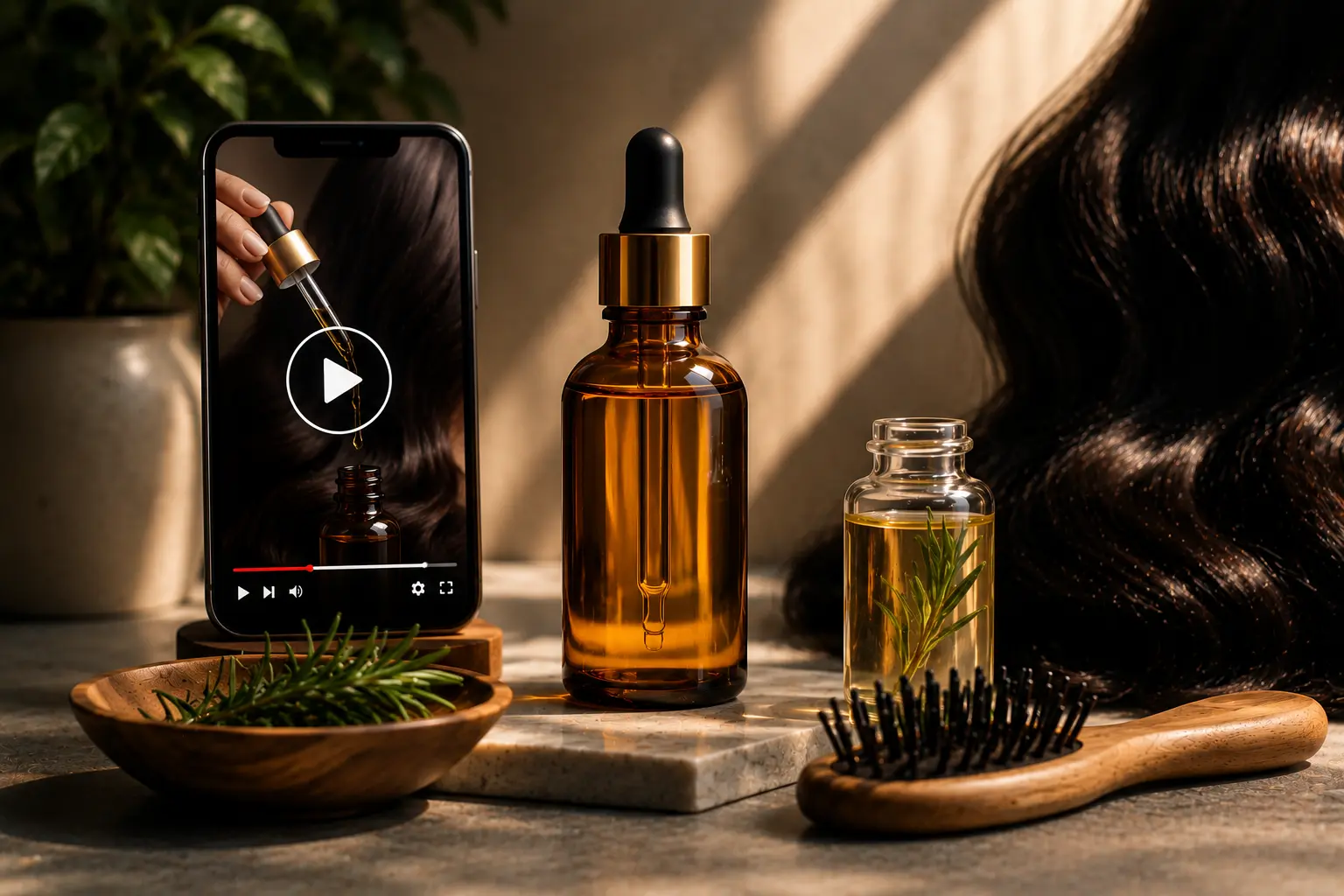
Amazon PPC Strategy for Hair Growth Oil Brands: Sponsored Brands Video Plays
Read more
.png)
Full-funnel Amazon ads pair DSP retargeting with Sponsored Products conversion. Skincare brands should add DSP once SP is stable, typically past $1.5M-$2M in annual Amazon revenue.
Summarize in ChatGPT
.webp)
Sponsored Products has a ceiling, and most skincare brands hit it faster than they expect. You raise bids, you add keywords, you refine negative targeting, and for a while, sales climb.
Then they flatten.
Your Advertising Cost of Sale (ACoS, the percentage of sales spent on ads) starts creeping up even though nothing about your campaigns changed. That's not a targeting problem. It's a structural one.
Sponsored Products only reaches shoppers who are already searching for something like your product. It captures demand. It cannot create it. If your skincare brand's Amazon revenue has plateaued in the last two or three quarters, the ceiling you're hitting isn't a bidding issue, it's the ceiling of demand capture alone.
This is where Amazon DSP (Amazon's demand-side platform, used to buy display, video, and audio ads programmatically both on and off Amazon) enters the picture, and where most explanations of "full-funnel advertising" fall short.
They tell you DSP builds awareness and SP converts, which is true but incomplete. What actually matters for a skincare brand is the sequence, the budget, and the data connection between the two, not just the concept.
The stakes for getting this right are only rising.
Beauty and personal care ecommerce growth is outpacing overall beauty sales, and as more skincare brands pile into Sponsored Products alone, the ceiling described above arrives faster than it did even a year or two ago.
Full-funnel Amazon advertising means running ads that match each stage of a shopper's decision, instead of only fighting for shoppers who already searched your product name.
Amazon Ads' own guide to demand-side platforms frames this as reaching shoppers before they search, not just when they search, which is the distinction most explainer content glosses over.
At the top, DSP display and video ads reach people who haven't searched for skincare yet but match your ideal customer profile, based on browsing history, past purchase categories, or lookalike modeling built from your existing buyers.
In the middle, DSP retargeting reaches shoppers who viewed your product detail page or added to cart but didn't buy.
At the bottom, Sponsored Products captures the shopper who is actively searching "vitamin C serum" or "retinol cream for sensitive skin" with a card already half out of their pocket.
The mistake most brands make is skipping straight to the bottom because it's measurable and comfortable. You can see the ACoS. You can see the click.
DSP's upper-funnel impact is harder to attribute directly, which is exactly why most brands avoid it until a competitor with a fuller strategy starts winning the placements they used to own.
Sponsored Products alone stalls because it depends entirely on existing search volume for your category. Once you've captured most of the shoppers actively typing your keywords, there's nowhere left to grow inside that channel except by raising bids and accepting a worse ACoS.
Skincare is a repeat-purchase category. A shopper who buys a moisturizer today is a realistic buyer again in 30 to 60 days. Sponsored Products has no mechanism to reach that same shopper again unless they search for you by name.
DSP does, through retargeting segments built around past product-page visitors and past purchasers.
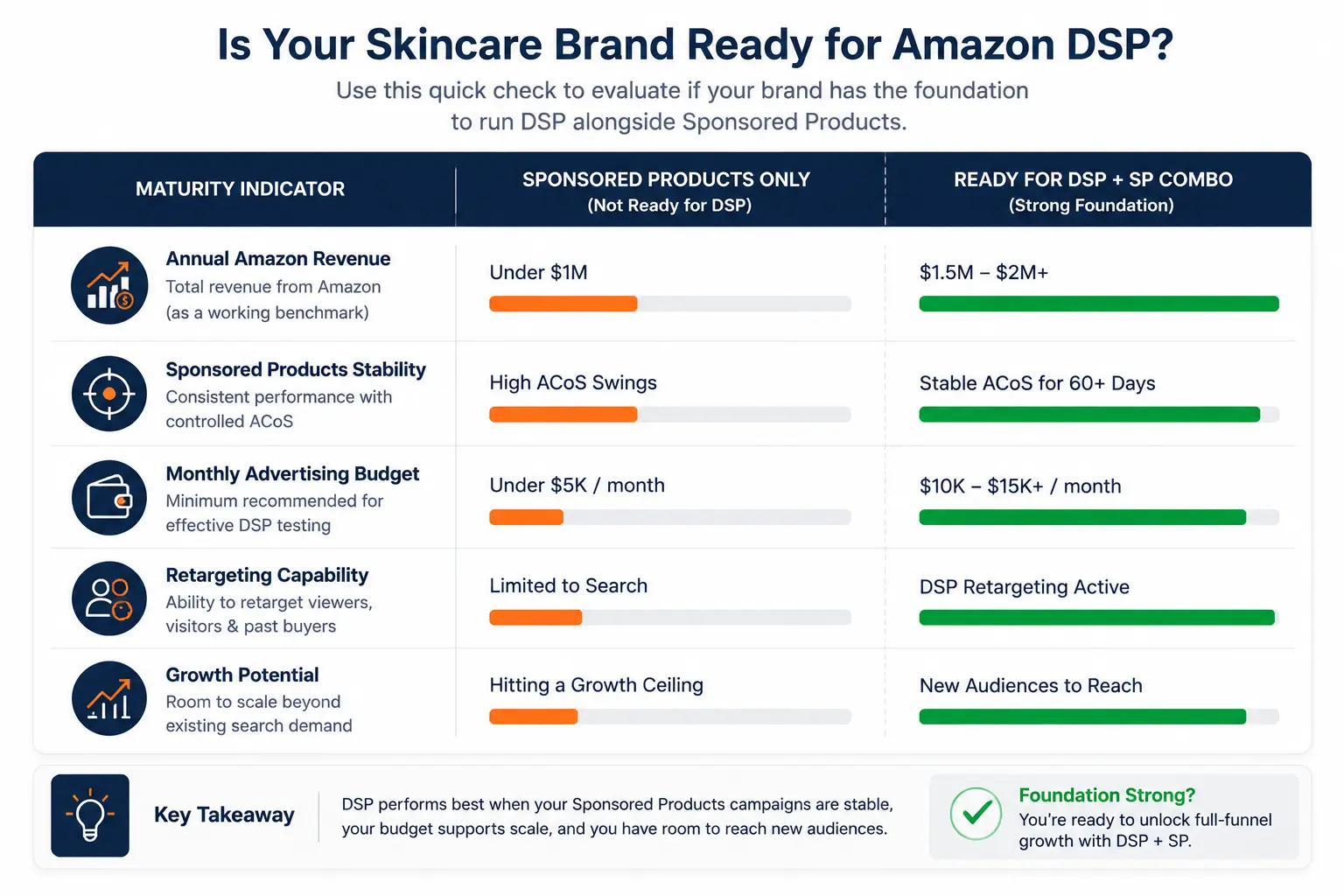
Here's the part that rarely gets said plainly: if your brand is under roughly $1M a year in Amazon revenue, or if your Sponsored Products account still has ACoS swings you can't explain, DSP is premature.
That $1M figure isn't an Amazon-published rule, it's the threshold we use when advising accounts, based on the point where SP campaigns typically have enough conversion history to be genuinely stable rather than lucky.
Fix conversion rate and campaign stability on SP first. DSP amplifies whatever foundation you already have. If that foundation is shaky, DSP amplifies the shakiness, not the growth.
Most articles quote Amazon's managed-service minimum of roughly $50,000, which is real but only applies if Amazon's own team manages your DSP account directly.
That's an enterprise number, and it scares off exactly the brands who could benefit most from a smaller test.
Self-service DSP, run either directly through the Amazon Ads Console or through an agency holding a DSP seat, has no official minimum. In practice, budgets under $5,000 a month don't generate enough signal for the algorithm to optimize, so most experienced operators recommend starting closer to $10,000-$15,000 a month to get a fair read on performance.
That's a realistic entry point for a skincare brand doing $2M or more a year in Amazon sales, assuming Sponsored Products is already stable.
Here's our recommended starting point, not an Amazon-published standard: a 70-80% Sponsored Products (and Sponsored Brands, for search-visibility support) to 20-30% DSP split for a brand in that range.
We land on that ratio from managing accounts at this stage, not from a published Amazon benchmark, so treat it as a starting hypothesis to test against your own AMC data, not a fixed rule.
As DSP proves incremental reach, that ratio shifts, sometimes to 60/40, but rarely beyond that for a mid-market skincare brand. Enterprise brands with seven-figure monthly ad budgets can justify a heavier DSP weighting because their prospecting audiences are large enough to sustain it.
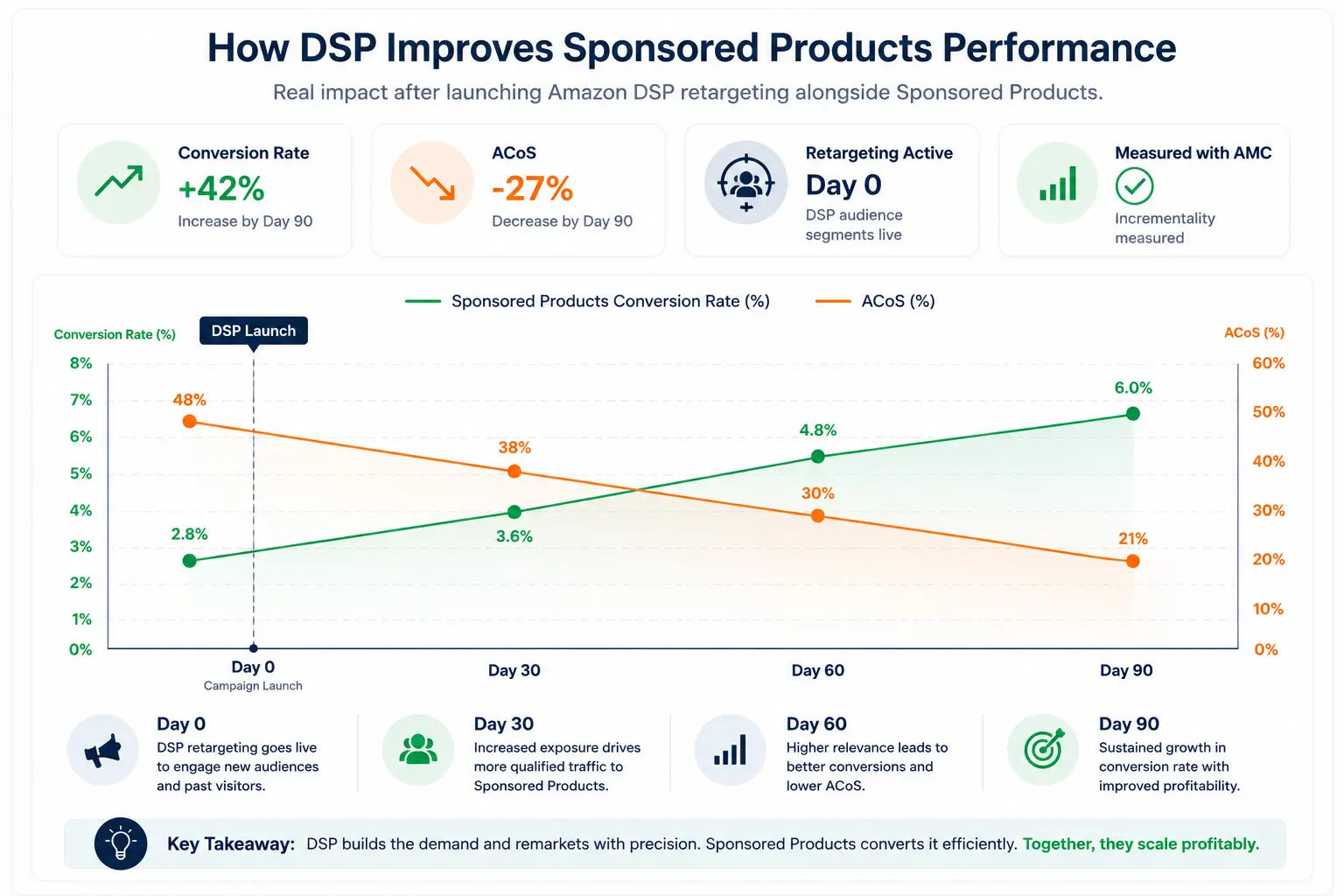
The mechanical answer: DSP builds and retargets audiences, Sponsored Products captures the resulting search demand, and Amazon Marketing Cloud (AMC, Amazon's clean-room analytics environment) is what lets you see whether the two are actually connected instead of assuming it.
Without AMC, you're running two separate campaigns and hoping they interact. With AMC, you can query whether a shopper exposed to your DSP display ad later converted through a Sponsored Products search, and how much faster that shopper converted compared to someone with no DSP exposure.
Amazon's own documentation on Amazon Marketing Cloud describes this cross-channel measurement as the core reason AMC exists, precisely because DSP and Sponsored Products live in different reporting systems by default.
In practice, this looks like building a "product page viewers, no purchase in 14 days" audience in DSP, retargeting them with a Sponsored Brands Video or standard display creative, and then checking in AMC whether that segment's Sponsored Products conversion rate outperforms your account average.
If it does, you've proven incrementality. If it doesn't, you've saved yourself from scaling a channel that isn't actually adding anything.
The audience setup matters more than the creative for a skincare brand's DSP retargeting, and this is the step most guides skip past. A generic "everyone who visited my product page" audience mixes together shoppers who were seconds from buying with shoppers who bounced immediately, and treats them identically.
A tighter setup separates cart abandoners (highest intent, shortest retargeting window, 3-7 days) from product-page viewers who never added to cart (lower intent, longer window, up to 30 days) from past purchasers eligible for a repeat-purchase reminder (a completely different message, since they don't need convincing, they need a timely nudge).
Skincare's repeat-purchase cadence makes that third segment unusually valuable compared to a category like electronics or home goods, where DSP guides typically default their examples to.
The most expensive mistake is sequencing. Brands turn on DSP before Sponsored Products is stable, see no immediate lift, and conclude DSP "doesn't work" for their category. DSP's job is to feed demand into a search funnel that already converts well.
If SP conversion rate is inconsistent, DSP traffic lands on a leaky funnel.
The second mistake is under-funding the test.
A $2,000-a-month DSP budget split across broad prospecting and retargeting audiences rarely generates enough impressions for Amazon's algorithm to learn, so brands judge the channel on a sample too small to mean anything.
The third mistake, specific to skincare, is ignoring repeat-purchase timing. A 14-day cart-abandonment retargeting window makes sense for a one-time-purchase category.
For a moisturizer or cleanser someone reorders every 30-45 days, a retargeting audience built around past purchasers (not just abandoners) captures a much larger and more predictable pool of shoppers.
The fourth mistake is treating New-to-Brand (NTB, a metric tracking first-time buyers of your brand) as a vanity number instead of a growth signal.
Amazon's expanded AMC lookback window, extended to five years of purchase history, now lets brands measure how NTB customers behave over a much longer horizon, including whether they become repeat buyers across a skincare line's full catalog, not just the first product they tried.
Once the basics are working, a few tactics separate brands getting real incrementality from those just spending more, and creative is one of the most overlooked ones.
Rule-Based Bidding, Amazon's automated bid strategy tied to a target ACoS or target ROAS, works well for Sponsored Products once you have enough conversion history for the algorithm to calibrate against.
Layer this on top of a stable DSP retargeting flow rather than turning both on simultaneously; you want a clean baseline to measure DSP's incremental lift against.
For brands with multiple SKUs across a skincare line (cleanser, serum, moisturizer, SPF), AMC audience building lets you retarget a customer who bought your cleanser with DSP ads for your serum, using actual purchase history rather than generic category interest.
That's a meaningfully more precise signal than a lookalike audience built from category browsing alone.
Creative needs to change between the two channels, and brands frequently reuse the same product shot across both without realizing why performance drops.
Sponsored Products creative competes in a search results grid, where a shopper is already comparing options and scanning quickly. A clean product image with clear labeling wins there.
DSP display and video ads show up in entirely different contexts, on other websites, in apps, in Amazon's own browsing environment, where the shopper isn't actively comparing anything.
That creative needs to stop someone mid-scroll, which usually means texture, application, or a before-and-after moment rather than a static packaging shot.
This is where Sponsored Brands Video and Store Spotlight formats earn their place in a skincare full-funnel strategy specifically. A short video showing how a serum absorbs, or how a moisturizer looks on skin, answers the exact question a static image can't: what does this actually feel and look like once it's on.
For a category shoppers can't touch or smell before buying, that gap matters more than in most other Amazon categories.
Most brands try to launch DSP and expect a verdict within a few weeks. That's not enough time for Amazon's algorithm to learn, and it's not enough time for AMC to accumulate a data set worth querying. A more honest timeline looks like this.
Confirm Sponsored Products is genuinely stable. Pull 90 days of ACoS and conversion rate history. If either swings more than 10-15 points month over month without an obvious cause (a stockout, a price change, a seasonal spike), fix that before adding DSP spend on top of it.
Set up DSP with two audience types only, to keep the test clean. A retargeting audience built from product detail page viewers with no purchase in the last 14-30 days, and a prospecting audience built from lookalike modeling off your existing purchasers. Resist the urge to launch five audience types at once; you won't be able to tell which one is doing the work.
Let the campaigns run without major changes. This is the learning phase, and it's the phase where most brands panic and pull the plug. A CPM-based (cost-per-thousand-impressions) channel doesn't show the same immediate feedback loop as a CPC (cost-per-click) channel like Sponsored Products, and that's expected, not a warning sign.
Pull an AMC query comparing Sponsored Products conversion rate for shoppers with DSP exposure against your account average. This is the moment you find out whether the channel is adding real, incremental reach or simply serving impressions to people who would have converted anyway.
The single most overlooked step in full-funnel Amazon advertising is proving the funnel actually functions as one, rather than assuming two channels running simultaneously are automatically connected.
This is the practical version of the AMC query mentioned in the rollout above: build an AMC audience of shoppers exposed to your DSP ads in a given month, then compare their Sponsored Products conversion rate and average order value against shoppers with zero DSP exposure in the same period.
If the DSP-exposed group converts meaningfully better, you have evidence of incrementality worth scaling. If the two groups look nearly identical, your DSP spend may be reaching people who were going to buy anyway, and that budget is better redirected toward prospecting audiences you haven't reached yet, or back into Sponsored Products entirely.
If your Amazon account is under $1M a year, if ACoS still swings more than 10-15 points month to month without a clear cause, or if you don't yet have a repeat-purchase SKU to anchor retargeting around, hold off on DSP.
Put that budget into tightening Sponsored Products campaign structure, cleaning up negative keywords, and building Brand Analytics and Search Query Performance (SQP) data history first.
DSP rewards brands with a stable foundation. It does not build that foundation for you.
The honest version of "full-funnel advertising" isn't "spend more everywhere." It's sequencing your Amazon Ads investment to match where your brand actually is, then expanding once the data proves the next channel is adding real, measurable incremental reach rather than duplicating spend you were already capturing.

Know exactly when to add Amazon DSP and how to build a full-funnel PPC strategy that increases reach, lowers waste, and drives growth.
Find out if your brand is ready for Amazon DSP with a 24-hour PPC Audit that uncovers growth gaps and wasted ad spend.

.png)
.png)


.png)
.png)