Hire an Amazon PPC Expert for Fitness Brands
Read more
.png)
At $500K a month, fitness Amazon Ads are managed to profit through seasonality and heavy fees, with full-funnel reach and incrementality measurement.
Summarize in ChatGPT

At $500K a month the job shifts from scaling to defending and compounding, so a senior strategist manages profit, seasonality, and incrementality rather than a flat ACoS.
The global fitness equipment market is large and still growing, valued at USD 19.7 billion in 2025 and forecast to reach USD 27.4 billion by 2033. At $500K a month you are competing at the top of that market, where the easy growth is gone and every point of wasted spend is real money.
This is a playbook for how a senior strategist actually manages a fitness brand at that scale: the levers that matter, how success is measured, the mistakes that cost the most, and the operating cadence that keeps it all disciplined. It assumes the account already works, and asks a harder question: how do you defend and compound it?
At $500K a month the goal shifts from growth to durability, so the strategist manages a portfolio to profit rather than pushing a few hero products up the rankings. The climb that got you here is a different job from the one that keeps you here.
The scaling playbook is behind you. The tactics that scale a fitness brand toward six figures a month are about finding demand and winning rank, while the $500K job is about defending that rank, protecting margin, and compounding what already works.
The stakes also change shape. At smaller spend a wasteful month is a rounding error, but at $500K a few points of inefficiency is tens of thousands of dollars, so the discipline that once felt optional becomes the whole game, a foundation our guide to Amazon PPC for fitness equipment brands lays out.
The account is also more complex. A large fitness catalog spans price points, sizes, and seasons, so the strategist is orchestrating many moving parts at once rather than optimizing a handful of campaigns. That complexity is why seniority, not just effort, is what the tier demands.
The team around the account changes too. At $500K there is usually inventory to coordinate, a brand to protect, and a finance side that cares about margin, so the strategist is as much an operator communicating trade-offs as a bidder adjusting campaigns. The job is broader than the console.
Manage a fitness account at this scale against five levers: seasonality orchestration, fee-aware profit targets, full-funnel reach, incrementality measurement, and portfolio discipline. The table sums up what each looks like when it is done well.
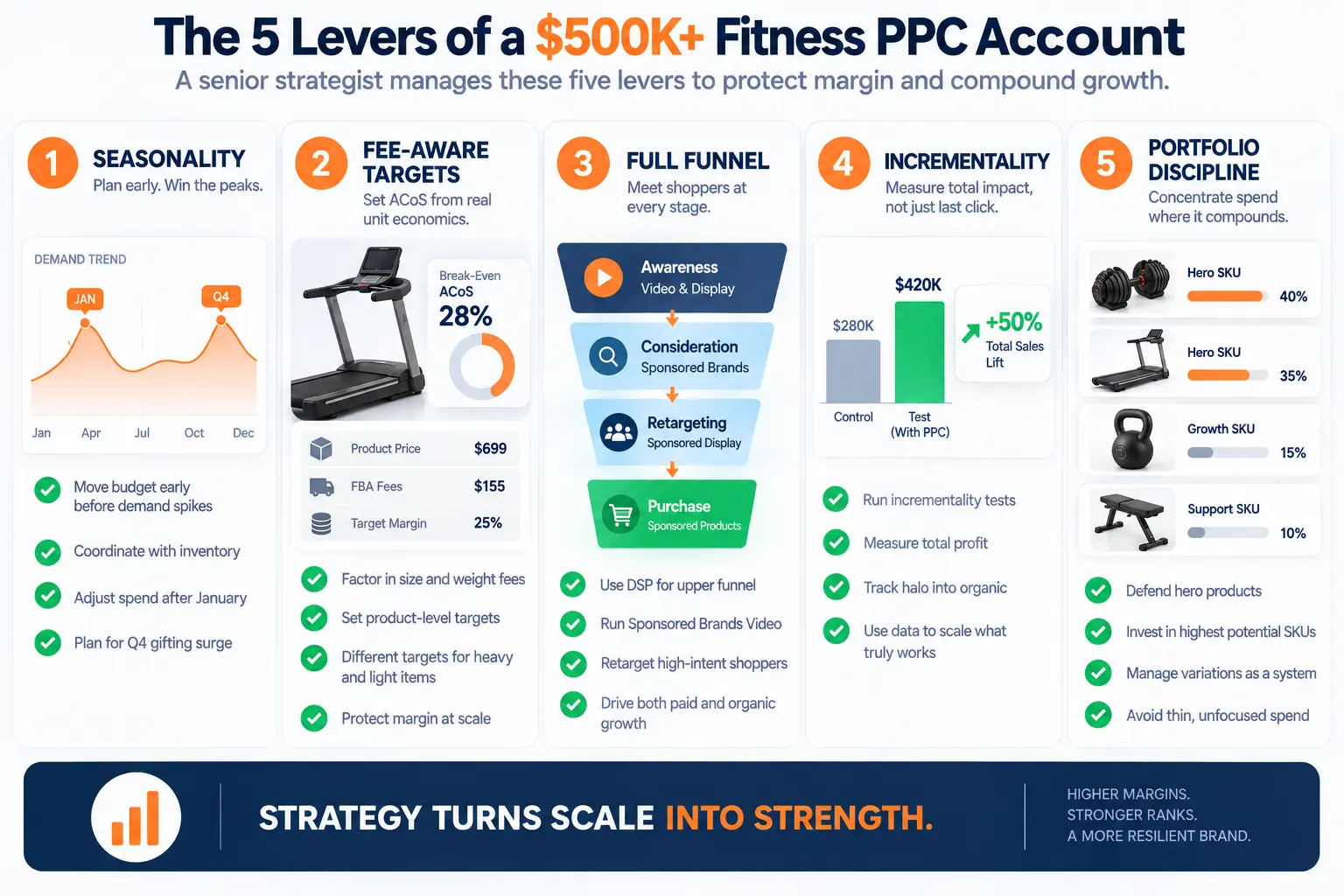
Fitness demand swings harder than almost any category, so a senior strategist runs the calendar as deliberately as the keywords. Budget and inventory move weeks ahead of the January resolution surge and the Q4 gifting peak, so you are not paying peak click prices from a cold start.
The trough matters as much as the peak. After January, demand and conversion fall, so the strategist pulls spend back and protects margin instead of buying into a slower market, the two-sided discipline our walking pad seasonal strategy is built around.
At scale the orchestration is portfolio-wide. Different products peak at different times, so the senior sequences budget across the catalog through the year rather than treating the whole account as one seasonal curve.
Defensive bidding matters more at this size. During a peak, competitors bid up the same terms, so a senior decides which rankings are worth defending at a higher cost and which to concede, rather than reflexively matching every rival. Winning the peak is about choosing the right fights, not all of them.
Heavy and oversize equipment carries higher fulfillment costs, and that changes what good spend even looks like. Amazon FBA fees are tiered by size and weight, so heavier products cost more per unit, which raises break-even ACoS and shrinks the room for error.
A senior sets targets from your unit economics, not a benchmark. A treadmill with steep fulfillment fees may only tolerate a low break-even ACoS, so a strategist chasing a generic figure borrowed from a lighter category loses money on every sale while the dashboard still looks fine, a trap our fitness PPC cost benchmarks help you avoid.
The modeling has to be per product, not per account. A senior builds break-even ACoS from each item's price, margin, and fulfillment tier, so a heavy machine and a light accessory carry different targets in the same catalog. One blended number across a fee-varied portfolio hides exactly where the money is leaking.
Expensive fitness products have a long deliberation window, so a single search click rarely closes the sale. A senior runs a full funnel, using Amazon DSP for awareness and retargeting across display, video, and streaming to stay in front of a shopper deciding on a $600 machine.
Demonstration carries the middle of the funnel. Sponsored Brands Video for fitness brands shows build quality and motion in a way a static thumbnail cannot, which is what moves a high-consideration purchase toward a decision.
The upper funnel has to be judged on the right metric. Awareness and retargeting for expensive equipment are measured on new-to-brand acquisition and later-stage lift, not a same-day ACoS, because the purchase often lands days after the first impression.
Retargeting closes the gap the first click leaves open. Sponsored Display keeps your equipment in front of shoppers through a deliberation window that can run days or weeks, so the consideration a video started does not fade before the purchase. On big-ticket fitness, the follow-up impression often matters more than the first one.
At $500K the question is no longer what a campaign spent, but what it actually caused. A senior strategist thinks in incrementality, testing whether spend on a term is generating sales that would not have happened anyway, and uses Amazon Marketing Cloud for cross-channel and custom measurement to see the whole path rather than the last click.
Timing precision is part of the same discipline. Amazon Marketing Stream delivers hourly performance data, which lets a senior daypart budget toward the hours that convert and ease off the hours that waste, a move most accounts never make.
Holdout thinking makes the tests real. A senior withholds spend from a segment or a term for a defined window and watches what happens to sales, which turns incrementality from a slogan into a number. If organic sales hold when the ads pause, that spend was defending a position you already owned.
At scale the account is a portfolio, so a senior concentrates spend where it compounds and defends the hero SKUs that carry the rank and the reviews. Spreading budget evenly across every product is how large accounts quietly go inefficient.
Inventory discipline rides on top of the bids. A hero product that sells out during a January surge wastes the demand a campaign paid to build, so a senior watches stock on the key SKUs as closely as the targets, and eases spend before a listing goes dark rather than after.
De-prioritizing the losers is half the discipline. Not every SKU deserves ad support, and a senior is willing to pull spend from products that will never earn it, freeing budget for the heroes that compound. Large accounts drift inefficient precisely because no one is willing to stop funding the weak performers.
Success at this scale is measured in profit and incrementality, not a low ACoS. A flat ACoS target ignores fees, seasonality, and the halo into organic, so a senior manages the numbers that actually reflect the business.
Total advertising cost of sales tied to profit is the anchor. The strategist watches what the whole account spends against total sales and margin, so a low ACoS on a fee-heavy product that is quietly losing money gets caught instead of celebrated.
The halo into organic belongs in the picture too. Well-run fitness ads lift organic rank and total sales, so a senior credits that effect rather than judging every campaign on its own last click. Ignoring the halo makes profitable awareness spend look wasteful and invites a cut that quietly lowers total sales.
Incrementality is the maturity marker. Measuring what spend truly caused, rather than what it took credit for on a last-click basis, is what separates a $500K operator from someone still optimizing to the number that is easiest to report.
The first mistake is running the growth playbook forever. The tactics that scaled the brand toward six figures keep chasing new demand when the job has become defending rank and protecting margin, and the account overspends into diminishing returns.
The second is a flat ACoS target across a fee-varied catalog. A single number ignores that a heavy treadmill and a light accessory have completely different break-even points, so the strategist loses money on the heavy goods while the average looks healthy.
The third is treating seasonality as a surprise. At $500K, reacting to January instead of planning for it weeks ahead means paying peak click prices from a cold start and missing the surge you most needed to win.
The fourth is judging the full funnel on last-click ACoS. DSP and video that fill the top of the funnel look expensive on a same-day basis and get cut, which starves the very awareness that feeds the search demand later.
The fifth is letting a junior desk run a senior account. A $500K fitness catalog is too complex and too seasonal for a rotating team optimizing to easy metrics, and the gap between what a senior would do and what a junior actually does shows up as slow, expensive drift across the year.
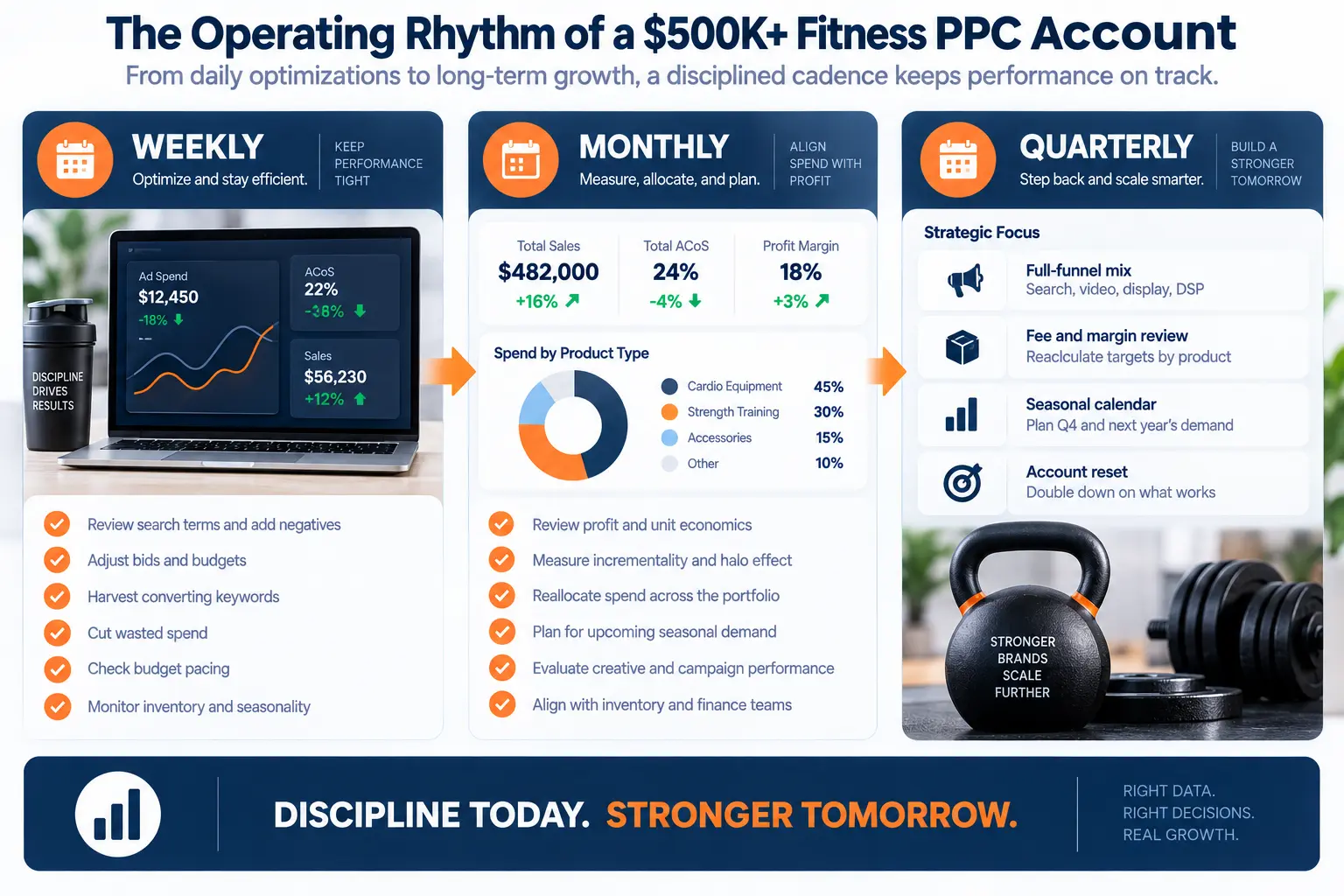
A $500K account runs on a fixed rhythm, not ad hoc firefighting. Weekly, the senior reviews search terms and bids, harvests converting terms, cuts waste, and checks pacing against the seasonal plan, the disciplined loop behind Amazon's own Sponsored Products best practices.
Monthly, the view widens to profit, incrementality, and the season ahead. The strategist ties spend to margin, reads what the advanced measurement is saying, and adjusts the portfolio plan before the next peak rather than during it.
Quarterly, the account gets a strategic reset. The senior revisits the full-funnel mix, the fee math as fulfillment costs change, and the seasonal calendar for the coming quarter, so the plan stays ahead of the market instead of chasing it.
Ownership keeps the rhythm honest. One named senior strategist should hold the account across all three cadences, because the weekly moves only compound when the same person remembers what the monthly and quarterly reviews decided. A rotating junior desk breaks that thread, and the plan slowly loses the plot.
Bring in senior help when the complexity of a $500K fitness account outgrows the time your team can give it. A large seasonal catalog with heavy-fee economics and a full funnel is a lot for one in-house generalist to run well.
As a specialist Amazon PPC agency, Amplivus manages fitness brands at this scale with senior strategists who orchestrate seasonality, set fee-aware targets, and measure incrementality, all from inside your own account.
The right first step is proof, not a contract. A free Amazon PPC audit shows where a $500K account is leaking and how much of the spend is not actually incremental.
A short Amazon strategy session then turns those findings into a seasonal plan for the year ahead, mapped to your fee math and your peaks.
From there, disciplined Amazon PPC management keeps the plan running around the fitness calendar, not a generic playbook applied the same way to every category.

Get a senior-led PPC plan built around profit, seasonality, fee-aware targets, full-funnel reach, and incrementality at $500K+ scale.
See where fee math, seasonality, weak incrementality, or poor portfolio focus is leaking profit from your fitness account.