.webp)
Walking Pad Amazon PPC: Why Q4 Demand Doubles (and How to Pre-Plan Spend)
Read more
.png)
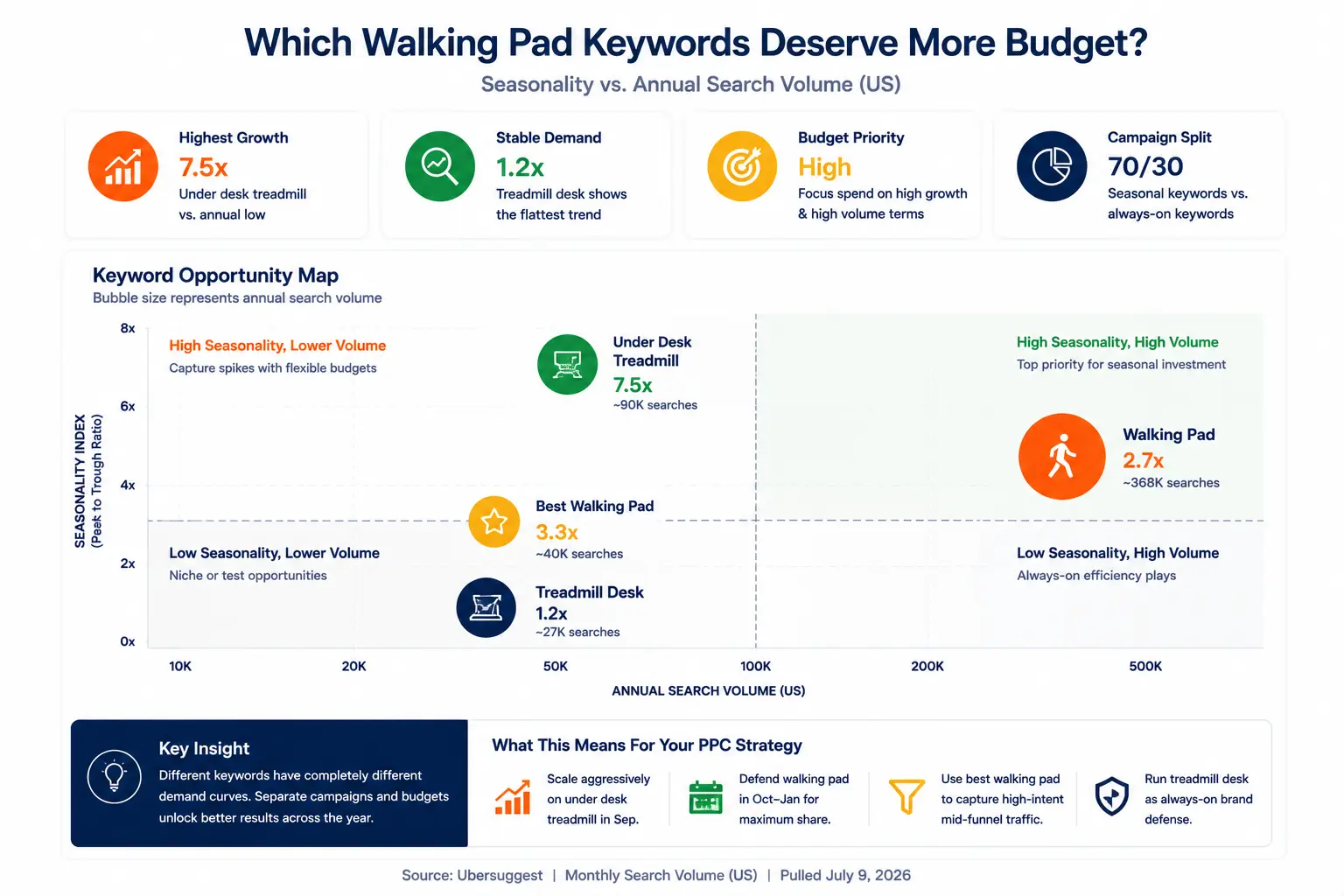
Walking pad search peaks in December and January. Under desk treadmill peaks again in September, when walking pad sits at its annual floor. Budget the two terms on separate curves.
Something strange happens to walking pad accounts every September, and most sellers read it as noise.
Your head term goes quiet: impressions on "walking pad" thin out and the instinct is to pull budget and wait for the New Year. Meanwhile your under-desk keywords start moving. Clicks arrive. Sales do not, at least not straight away.
Here is what the data says.
Between August and September 2025, United States search volume for "walking pad" fell from 165,000 to 135,000, its lowest month. Over the same weeks, "under desk treadmill" climbed from 60,500 to 90,500.
Two names for the same object. One falls, one climbs, inside the same thirty days. That is not noise. It is a second buying season, and it is not on anyone's calendar.
This piece is the year-round companion to our walking pad Q4 planning guide, which covers the gifting-and-resolution corridor; here the focus is the full-year keyword seasonality that decides how you pace the other ten months.

Most walking pad advertisers build their year around one curve. They watch the head term, see it swell in December, and plan accordingly. That instinct is right for eleven months and wrong for one.
Thirteen months of United States search volume for the four names shoppers use for this product gives four curves, and two of them disagree.
Read the bottom two rows. "Under desk treadmill" is one of the most seasonal terms in consumer goods, moving roughly sevenfold between May and January. "Treadmill desk" is almost flat across a full year.
Same product, roughly the same shopper, wildly different demand shapes. If those two keywords share a campaign, a bid strategy, and a daily budget, then for most of the year you are either overpaying on one or starving the other.
(These figures originate as Google Keyword Planner ranges, so treat the shape as reliable and the absolute numbers as approximate; see the note at the end.)
Each term is indexed to its own annual peak, so you can compare shape rather than size.
Look down the September column. Three of the four terms sit at or within a point of their annual floor; the fourth is at 67 and climbing.
Now look at October: everything drops back. Those two columns are the strategy.
If your account has never been mapped against this curve, a structured Amazon PPC audit will show which months you have been overspending.
Walking pad search peaks in January because the product solves a problem people only name once a year.
It lets someone move while they work, addressing sedentary behaviour without asking for gym time, and New Year resolutions compress that intent into about four weeks, which is why United States volume for "walking pad" runs 368,000 in January against 135,000 in September.
The mechanism underneath is older than the product. In 2002, Dr. James A. Levine of the Mayo Clinic defined Non-Exercise Activity Thermogenesis (NEAT) as the energy expended for everything we do that is not sleeping, eating, or sports-like exercise, and trivial movement across a day accounts for most of a person's non-resting energy use.
A walking pad is a NEAT device. The public-health case reinforces the January timing: the US Physical Activity Guidelines for Americans compress their first adult guideline to four words, move more and sit less.
Why does this matter to someone setting bids? It tells you when your customer becomes conscious of the problem: on January 2, and again in early September when the desk comes back.
Here is the transition, in volume bands, because that is what the underlying data measures.
In August the two terms sit five bands apart. By September they are two bands apart. A three-band convergence inside a single month is far too large to be rounding.
The natural reading is a return-to-desk pool: summer ends, the desk comes back, and people look for a way to move while they work.
That story fits, but it is a hypothesis, not a finding, since back-to-school shopping and Amazon's October deals event overlap the same weeks.
The pattern is solid; the cause is not settled.
What to do about it: keep auto and broad campaigns funded through September, but tell them where to look.
Desk-adjacent language ("under desk," "office," "quiet," "compact," "small apartment") is where the demand sits that month, so harvest it then and build the exact-match structures you will lean on twelve weeks later.
One caveat, and it is why sellers give up on September: those clicks may convert worse than January clicks, because you are meeting a shopper earlier in their consideration.
Judge the window on New-to-Brand (NTB) orders and Total Advertising Cost of Sale (TACoS) rather than last-click Advertising Cost of Sale (ACoS), or you will switch off the campaign that seeded your Q4.
October is the one month where all three of the category's meaningful keywords sit near the bottom together: "walking pad" at index 45, "best walking pad" at 37, "under desk treadmill" back to 37.
Be careful, because this is where most seasonality advice quietly cheats. Low search demand is not the same thing as a cheap Amazon auction, which Amazon does not publish density on, and competitors may hold October bids steady while demand sits at its floor.
What October reliably gives you is not a discount. It is a quiet month in which the queries you discover are the same queries that will be expensive in January.
A practical October sequence: fund your auto campaigns properly, since they are your listening device, and read the four automatic-targeting buckets (close match, loose match, substitutes, complements) separately.
Pull the search term report weekly, graduate converters into exact match immediately, and pull the placement report to check whether top-of-search converts differently for desk queries than for resolution queries, which sets your Q4 placement adjustment.
Your October ACoS will look ugly, because you are paying for exploration and booking little revenue against it.
If your reporting punishes a bad month rather than a bad quarter, October gets cut, and you spend every November discovering keywords you could have found earlier.
Increase budget twice. Ramp desk-adjacent campaigns in the last week of August, so they carry rank into the September under-desk window.
Then ramp the full account in the third week of December rather than on January 2, so early impressions build the rank you cash in during the resolution rush. Between those ramps, hold, but do not go dark.
Both dates are our judgment from the demand curve, and the same twice-a-year ramp logic runs through our guide to scaling fitness brands past $100K a month.
"Walking pad black friday" averages 390 searches a month across the year, and quoting that annual average is how most guides get this wrong.
In November 2025 the term returned 4,400 searches; in December it fell to 720; for the rest of the year it sits between 10 and 30.
Roughly three quarters of its trailing-twelve-month volume lands inside a single month. Event demand here arrives in four weeks, then it is gone.
That concentration is a reasonable prompt to have your Black Friday campaign structured and indexed by mid-October. It is not evidence that Prime Day is a poor event for walking pads.
The opposite is more likely, because Prime Day is a Deals-page event, exactly the kind of demand that never appears in an event-name keyword.
Build the Black Friday campaign by the second week of October, keep Prime Day funded, and settle the question the only way it can be settled: compare your own ad-attributed revenue across both events, year over year.
Sponsored Products will carry your volume. The argument for Sponsored Brands Video is a reasoning one rather than a benchmark one, so test it rather than take it.
A walking pad is a physical object a shopper is trying to place in a room they are standing in, and four questions decide the sale that a static white-background image answers none of.
Footprint: show the product beside a person and beside a desk, because the shopper is measuring the gap under their own desk. Motor noise: "quiet walking pad for office" pulls 260 searches a month, so put a decibel figure on screen.
Weight rating: they will not type "will it hold me" into a search bar, so show the rating decal.
Storage: the fold-flat motion in one continuous shot beats any bullet point.Our Sponsored Brands Video launch guide for fitness brands breaks down that muted-first creative in detail.
Sponsored Display retargeting is worth funding when the consideration cycle is long, and for a several-hundred-dollar object that has to fit a specific room it usually is, which is why a disciplined Sponsored Display setup earns its place.
Someone views the detail page in September, measures their desk, and buys weeks later; if your only measurement is last-click ACoS, that sale looks like it came from nowhere.
Walking pad campaigns bleed through four doors, and broad match opens all of them. Read every item against your own catalogue first, because a negative keyword that protects one seller destroys another.
Door one is the runner: most walking pads cap out near 4 mph, so "running treadmill" wants a machine you probably do not sell, though incline is a trap, since a growing number of walking pads now ship with incline.
Door two is the commercial buyer ("commercial gym treadmill"), the wrong buyer and price point.
Door three is the bargain hunter ("refurbished walking pad"), which you negative-exact unless you run a certified refurbished line.
Door four, and almost nobody has this one, is the safety searcher: "walking pad recall," "walking pad fire," and any competitor brand under a safety action.
That fourth door was theoretical until April 2026.
On April 16, 2026, the U.S. Consumer Product Safety Commission issued a safety warning urging consumers to stop using Sperax walking pads and treadmills immediately.
Per the CPSC release, the agency cited reports of uncontrollable speed and abrupt stops, dozens of falls or injuries, and hundreds of reports of overheating and thermal incidents, and noted that the importer declined to agree to an acceptable recall.
The CPSC also notes the company objects to the release, as the agency is required to state. The products were sold on Amazon, among other platforms.
What it means for your account. Do not target a brand under an active safety warning: if you run brand or product targeting against those ASINs, you are spending money to appear next to a listing regulators have told shoppers to throw away.
Add safety language to your negative list, since "walking pad recall," "walking pad fire hazard," and the affected brand name carry informational intent and no purchase intent, and they climb every time a news cycle turns.
Watch for category-level drag on conversion rate, because a safety story rarely stays inside one brand. And audit your own listing before someone else does: weight rating, motor rating, and certification marks are part of your risk posture now.
None of this appears in the PPC guides that do not read the safety register. If you sell physical products, you should.
Cautiously, and with a plan for losing it. WalkingPad is a registered trademark, but many shoppers use the word to mean any under-desk walking treadmill, so some share of the people typing it are not looking for that brand at all.
Amazon can restrict trademarked brand terms in advertising, and rights holders can enforce, so if brand terms are material to your plan, have the position checked by counsel rather than by a blog.
The safer arbitrage sits down the tail, where long branded model strings attract far fewer bidders than ambiguous head terms.
The index column is data. The posture and action columns are our judgment applied to that data, so treat them as a starting hypothesis, not a rule.
If this table just rearranged your year, most brands find their campaign structure cannot execute it.
As a specialist Amazon PPC agency, we pressure-test the structure before Q4 through ongoing Amazon PPC management, and we will tell you honestly if it does not need changing.
You have six weeks and three things, in order. First, separate the curves: split "walking pad" and "under desk treadmill" language into different campaigns with different budgets and bid strategies.
Dynamic bids down-only is the conservative setting on desk-adjacent discovery, while Rule-Based Bidding against a target ACoS is where the head term earns its keep.
Second, get hourly data before you need it: Amazon Marketing Stream, available through the Amazon Ads Console, delivers hourly campaign metrics for serious dayparting, and desk-intent searches likely cluster in the working day while resolution searches cluster at night, so confirm that against your own data first.
Third, write the negative list now against your own catalogue, then map bids to inventory cover, because the fastest way to waste peak spend is to win an auction for a product that stocks out mid-January.
The pattern here is a snapshot, not a law, and demand bands move as the tools that measure them revise their figures.
What holds is the discipline underneath: find the month where your terms disagree, look closely at why, and check it against your own account before you move a budget.
If you would rather have that read done for you, a short Amazon strategy session maps your account against this curve before the next season starts.

Talk with an Amazon PPC strategist to align budgets, keywords, and campaign timing with seasonal demand before competitors react.
Get an Amazon PPC audit to uncover seasonal keyword opportunities, reduce wasted spend, and prepare campaigns before peak demand.