
Amazon Advertising Guide for $500K+ Baby Brands
Read more
.png)
The best Amazon PPC manager for a baby brand keeps safety claims compliant, earns parent trust, and manages to lifetime value across life stages.
Summarize in ChatGPT

Hiring a baby PPC manager is a trust and compliance decision, so vet for safety-claim fluency, review-led creative, life-stage economics, and parent search skill.
Hiring an Amazon PPC manager for a baby brand is not the same as hiring one for a generic catalog. Baby is a safety-regulated, deeply emotional category where parents research obsessively and trust decides the sale. A manager who has only run ordinary consumer goods will misread all of it, and a careless safety claim can put the listing, and the brand, at real risk.
The global baby products market was valued at USD 355.9 billion in 2025 and is forecast to reach USD 579.5 billion by 2033, so the competition for a parent's attention is intense. This is a practical checklist for evaluating a senior Amazon PPC manager for a baby brand: the competencies that matter, the red flags to walk away from, the questions to ask, and what it should cost.
Baby combines strict safety rules, a trust-led buying decision, fast life-stage turnover, and a distinct way parents search, so the manager you hire needs category-specific judgment, not general PPC skill. The category shapes the whole job, starting with safety.
Compliance is the loudest difference. Children's products carry real regulatory weight, and advertising claims about safety have to be truthful and backed by the testing behind them. A manager who writes a careless safety claim into copy exposes the brand in a way that no other category quite matches, a risk foundational to any plan for Amazon PPC for baby brands.
Trust is the second difference, and it drives conversion. Parents read reviews, compare materials, and look for certifications before they buy, so the job is as much about supporting trust signals as it is about bidding. An aggressive bid on a listing parents do not trust just spends faster.
The catalog turns over with the child. Sizes and stages move from newborn to toddler, and consumables reorder on a schedule, so a manager plans for progression and repeat purchase rather than a one-time conversion. That life-stage thinking is foreign to a generalist used to static catalogs.
Judge any baby PPC manager against five competencies: safety and compliance command, trust-led creative, life-stage and subscription economics, parent search fluency, and transparent reporting. The table sums up strong versus weak on each.
Ask how they keep ad copy compliant before you ask anything about bids. A children's product sold in the United States generally needs third-party testing and a Children's Product Certificate, and a senior manager understands that the claims in an ad have to be supported by that testing, not invented for the campaign.
Substantiation is the practical rule. Terms parents look for, like non-toxic, BPA-free, or pediatrician recommended, are claims that need proof, and the FTC expects health and safety claims to be backed by solid evidence. A senior manager steers you toward benefits you can support, not ones borrowed from a competitor's label.
The platform enforces this too. Amazon moderates ad creative, and its Sponsored Brands and display moderation rules require every claim in an ad to match the detail page and be substantiated. A manager who treats ad copy as a place to say more than the listing supports is a liability in a category watched this closely.
Parents buy on trust, so a senior manager builds the whole approach around it. Reviews, ratings, certifications, and clear material claims are what convert a cautious parent, so the manager concentrates spend on listings that already earn that trust and flags the ones that do not.
Creative carries the trust signals a text ad cannot. Lifestyle imagery, certification badges where allowed, and video that shows the product in a real setting answer the safety questions a parent brings to the page. On a baby product, better creative often moves conversion more than a bid change ever will.
A low-trust listing is a spending trap. When reviews are thin or the images do not answer safety questions, more traffic just pours budget into a page that cannot close, so a senior manager fixes the trust problem before scaling the ads rather than after.
Babies grow, so a senior manager plans for progression rather than a single sale. A newborn product gives way to a toddler one, and a manager who understands that maps campaigns to the stages a parent moves through, a dynamic our guide to Amazon PPC for baby and toddler brands covers in depth.
Consumables change the economics entirely. Diapers, wipes, and formula reorder on a schedule, often through Subscribe and Save, so the value of winning a customer is measured across months, not a first order. A manager optimizing to a low first-order ACoS will starve the acquisition that builds a subscriber base.
Gifting adds a second buyer. Registries and baby showers mean people who are not the parent are buying too, and a senior manager knows that seasonality and gifting demand deserve their own plan rather than being treated like everyday purchases.
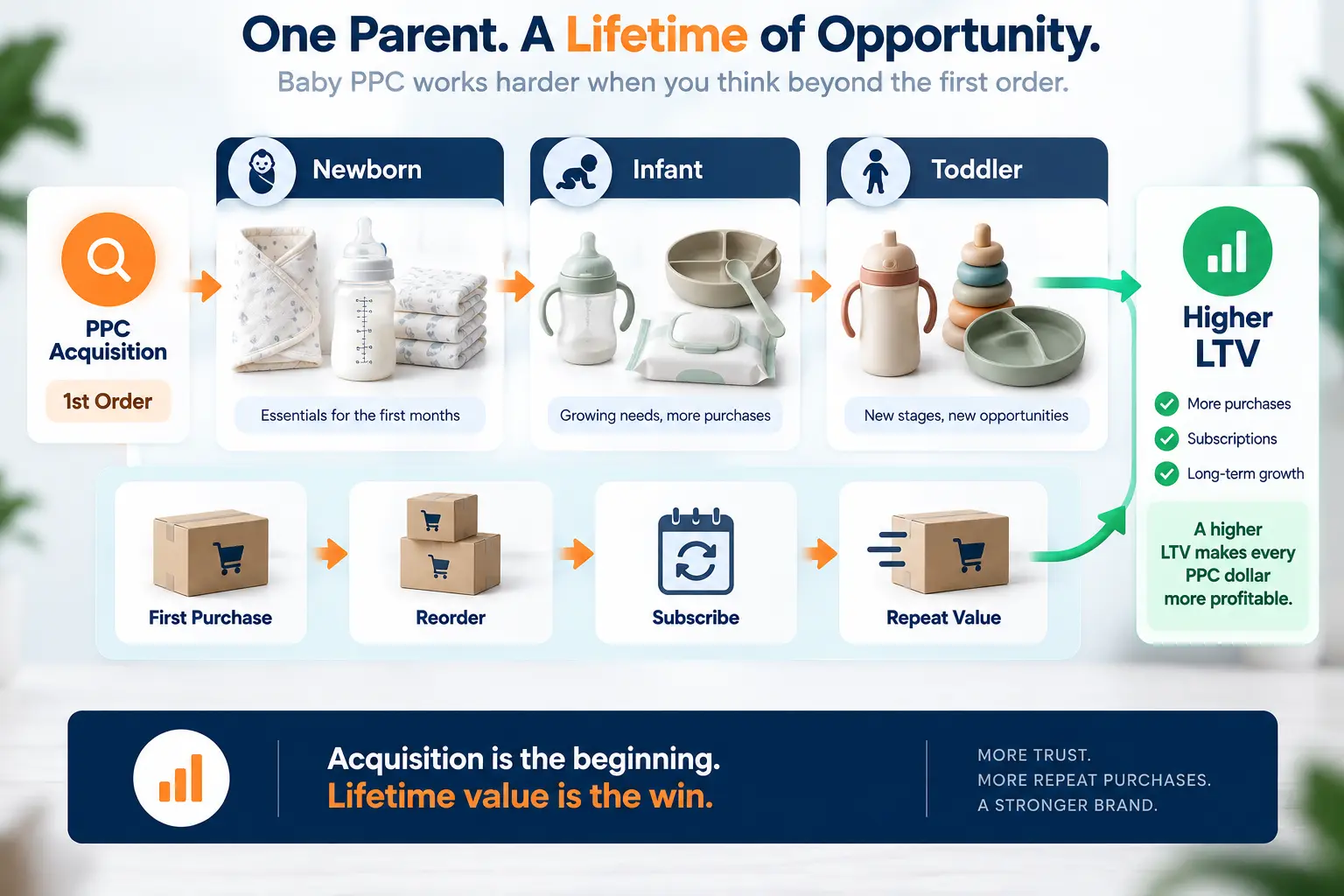
Parents search in their own language, so keyword judgment matters more than raw bidding. They search by stage, by concern, and by safety attribute, and a manager who understands that pattern targets the terms that convert, the exact behavior our guide to how parents search in the SQP report breaks down.
The long tail is where trust and intent meet. A search like organic cotton newborn swaddle carries a parent who knows exactly what they want, and it converts far better than a broad head term while costing less. A senior manager builds around those specific, high-intent phrases instead of fighting for the crowded generic ones.
You should own your account and see the raw numbers. A senior manager shows you Brand Analytics and Search Query Performance data and explains decisions in plain language, never a black-box dashboard.
Ownership belongs in the checklist too. Your advertising account, your historical data, and your Brand Registry enrollment should stay yours, so that if the relationship ends, nothing walks out the door. Anyone who resists that is protecting themselves, not you.
Some signals should end the conversation early. Each one tends to predict a poor engagement on a safety-sensitive, trust-driven baby account.
Most of these share a root cause: a generalist applying a flat, aggressive playbook to a category built on safety and trust. If a candidate cannot speak fluently about claims and parent behavior in the first conversation, the rest of the checklist rarely saves the hire.
Ask questions that reveal how the manager thinks, not just what they sell. The answers separate a senior operator from an order-taker.
Ask what substantiation a claim like BPA-free or pediatrician recommended needs before it can go in an ad. A fluent, specific answer is the fastest way to tell a baby specialist from a generalist who will get you in trouble.
Ask how they would find waste in your account in the first month. A strong answer names specifics, and their approach should echo Amazon's own Sponsored Products best practices: raise bids on proven converters, cut the weak ones, and structure for control.
Ask how they measure lifetime value across life stages, how they would handle gifting seasonality, who runs the account day to day, and whether you can leave without penalty. Then ask for a reference at your scale, because a real baby brand that trusts them will tell you in five minutes what a sales call never will.
Ask for specific, verifiable results on brands like yours, not logos or vague claims of growth. Category proof matters more than a long client list.
A strong candidate can describe a baby account they improved: what was broken, what they changed, and what happened, in concrete terms. Vague answers about driving growth usually mean the specifics do not exist.
Ask specifically about compliance-sensitive and subscription-driven accounts, because a manager who has only run ordinary goods has never faced the two hardest parts of baby, and a spend view like our Amazon PPC for baby brands at 200K a month helps you judge whether their numbers are realistic.
Pricing usually follows one of three models, and each has trade-offs worth understanding before you sign. None of them is automatically the right fit.
A percentage of ad spend is common but can reward spending more, which fits a lifetime-value category poorly. A flat monthly retainer is predictable and neutral on spend, and a performance or hybrid fee ties part of the payment to results.
What matters more than the model is that the fee rewards your profit and your subscriber growth, not just your ad budget. Several factors move the number: your ad spend, catalog width, how much compliance review the copy needs, and whether creative is included. Ask exactly what is covered, what counts as extra, and how the fee changes as you grow.
Not every baby brand needs an outside manager, and a good one will tell you so. The honest answer depends on your catalog, your margins, and your team.
If your catalog is simple, your margins are healthy, and your in-house lead already runs claim-safe and measures lifetime value, hiring out may add cost without adding much. There is no shame in staying in-house when in-house is working.
An expert or agency earns the fee when compliance risk is real, when subscription economics are on the table, or when growth has stalled in a crowded category. A single senior hire gives you depth in one person, while an agency gives you a bench and a second check on every claim, the kind of support a brand advertising toward 500K a month usually needs. If none of that describes you, staying in-house is valid.
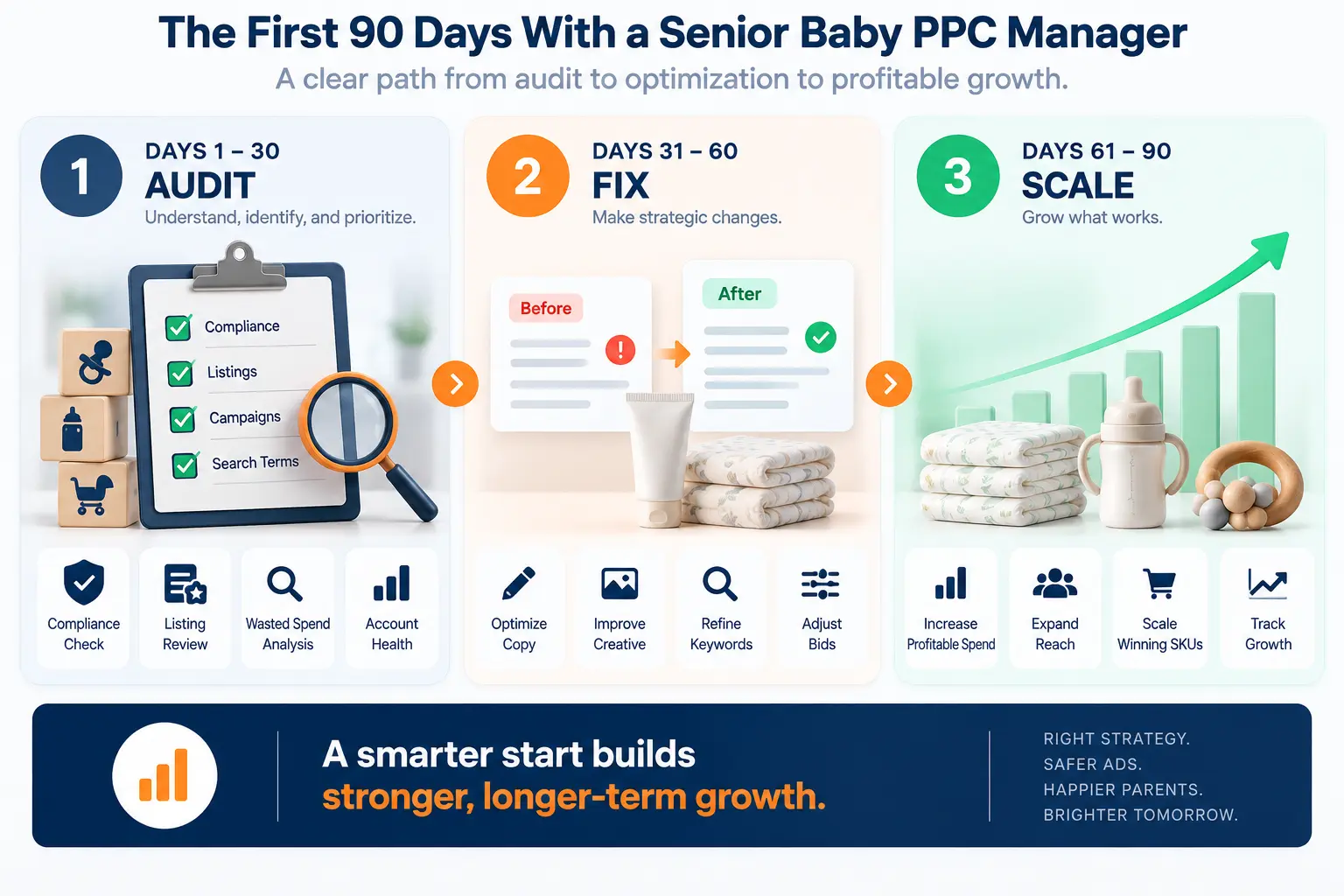
Expect a compliance and trust audit before action, then phased changes, not an overnight rebuild of an account you spent years building. Good managers move deliberately.
In the first weeks, expect a real audit: where spend is wasted, which listings carry claim risk, and which ones lack the reviews and creative to convert. You should see findings, not just a new dashboard.
By month two and three, expect deliberate changes with reasons attached, claim-safe copy where the old copy was risky, and a keyword plan built around how parents actually search. A wholesale teardown on day one usually destroys rank and reviews you paid months to earn, which is the opposite of what a senior hire should do.
As a specialist Amazon PPC agency, Amplivus staffs baby brands with senior managers who keep copy claim-safe, build around parent trust, and manage to lifetime value, all from inside your own account.
Day to day, that means disciplined Amazon PPC management built around the safety and subscription realities of baby, not a generic playbook applied the same way to every category.
The right first step is proof, not a contract. A free Amazon PPC audit shows where your account is leaking and where claims carry risk.
From there, a short Amazon strategy session turns those findings into a compliant, trust-led plan for the year ahead.