
Amazon PPC for Baby and Toddler Brands: 2026 Strategy by Spend Tier
Read more
.png)
At $500K+/mo, baby brands shift from growth to leadership: manage profit and incrementality, defend the category, build the brand, and protect trust at scale.

A baby brand doing $500,000 a month is not a bigger version of one doing $100,000; it is a different kind of business, and the difference is what you are optimizing for.
Getting to this scale was about building a growth engine: capturing demand, moving customers up the age ladder, and turning first sales into subscriptions.
Staying here, and growing from here, is about something else, defending a leadership position that competitors are now actively attacking, managing for profit rather than raw efficiency, and protecting a brand that is now worth protecting.
The global baby products market reached roughly $356 billion in 2025 and is projected near $580 billion by 2033, which means the prize is large and the competition for it is sophisticated. The brands that keep leading change the questions they ask.
This guide picks up where the growth playbook leaves off. It assumes you already run the age-ladder and subscription engine covered in our guide on Amazon PPC for baby brands at $200K+ a month, and it focuses on the leadership problems that come next: profit and incrementality, defending your category position, building the brand at scale, and protecting trust.
It applies the advanced measurement moves from our guide on PPC strategy for 7-figure brands to the specific position of a category-leading baby brand.
The biggest shift at this scale is what you optimize toward, and it is a change in mindset before it is a change in tactics.
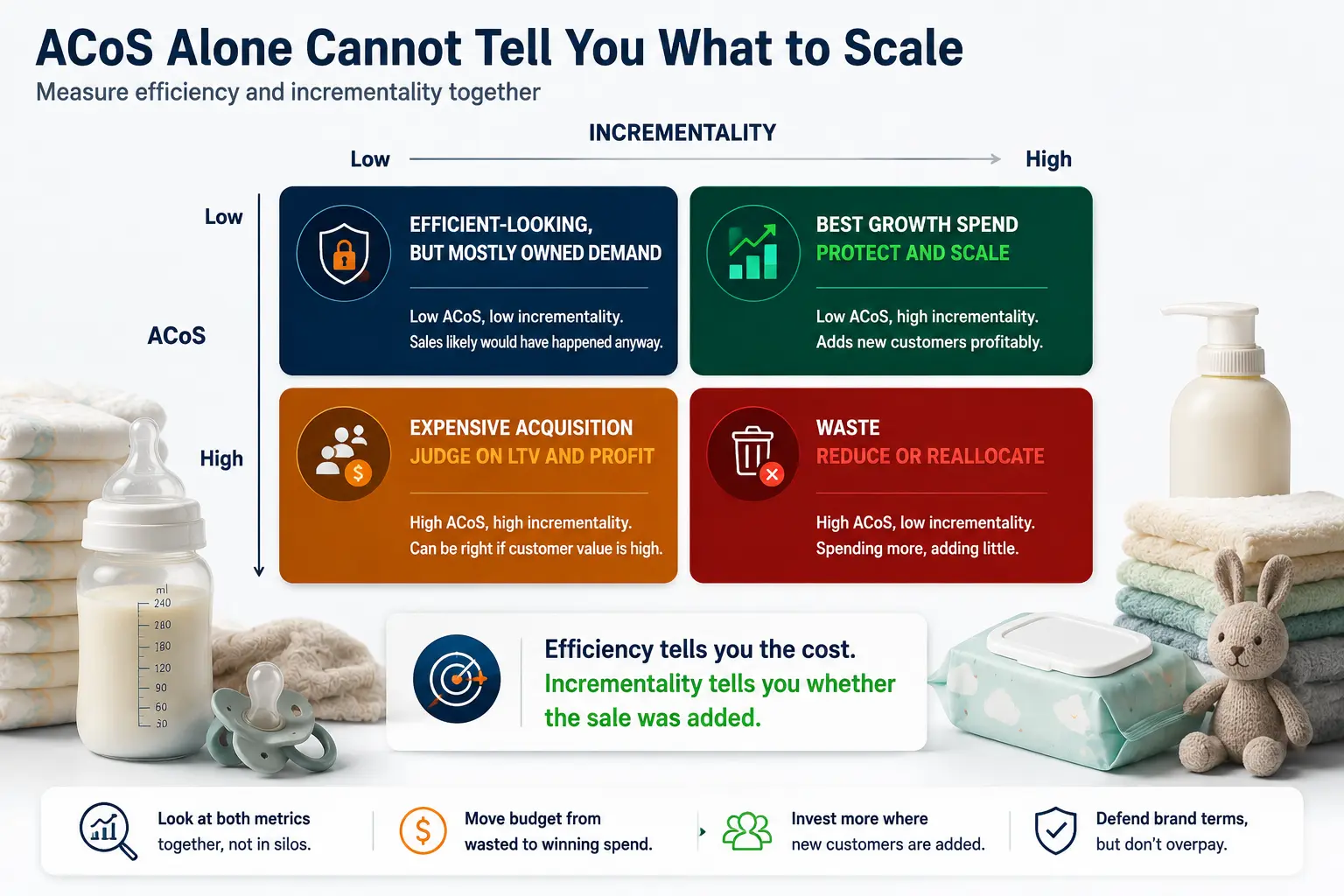
Advertising Cost of Sale is a fine control metric for a single campaign, but as the only lens it misleads a leading brand in two directions. It hides waste, because a campaign hitting its ACoS target may be spending heavily on branded and already-ranked terms it would win for free.
And it hides opportunity, because a campaign that looks expensive may be the one bringing in new households that reorder and move up the age ladder for years.
At this scale you manage total advertising cost against total revenue, and beneath that, total profit, because a lower ACoS achieved by cutting incremental spend can shrink the business even as the ratio improves.
The question is no longer whether a campaign is efficient, but whether the last dollar of spend adds profit you would not otherwise have earned.
Incrementality is the discipline of separating sales your ads caused from sales that would have happened anyway. A parent searching your brand name was often going to buy regardless, so that spend is largely non-incremental; a parent reached by a DSP ad who had never heard of you is fully incremental.
Leading baby brands test this directly, holding out audiences or regions to see what sales do without the ad, then reallocating budget from non-incremental spend toward the campaigns that genuinely add households.
It is harder than reading an ACoS column, and it is exactly the work that separates a brand compounding at the top of its category from one plateauing on vanity efficiency.
The first real incrementality test a leader runs is usually uncomfortable, because it tends to reveal that a chunk of the most efficient-looking spend, the tight-ACoS branded campaigns everyone is proud of, was buying sales the brand already had.
That is not a reason to zero out branded defense, which still matters when rivals bid on your name, but it reframes that spend as insurance rather than growth.
The budget freed by seeing this clearly is what funds the demand creation that actually expands the household base, so incrementality does not just tell a leader what to cut; it tells them what the cutting is for.
At this scale you win on how deeply you read your own data, because the tools that reveal the real picture are underused by most sellers.
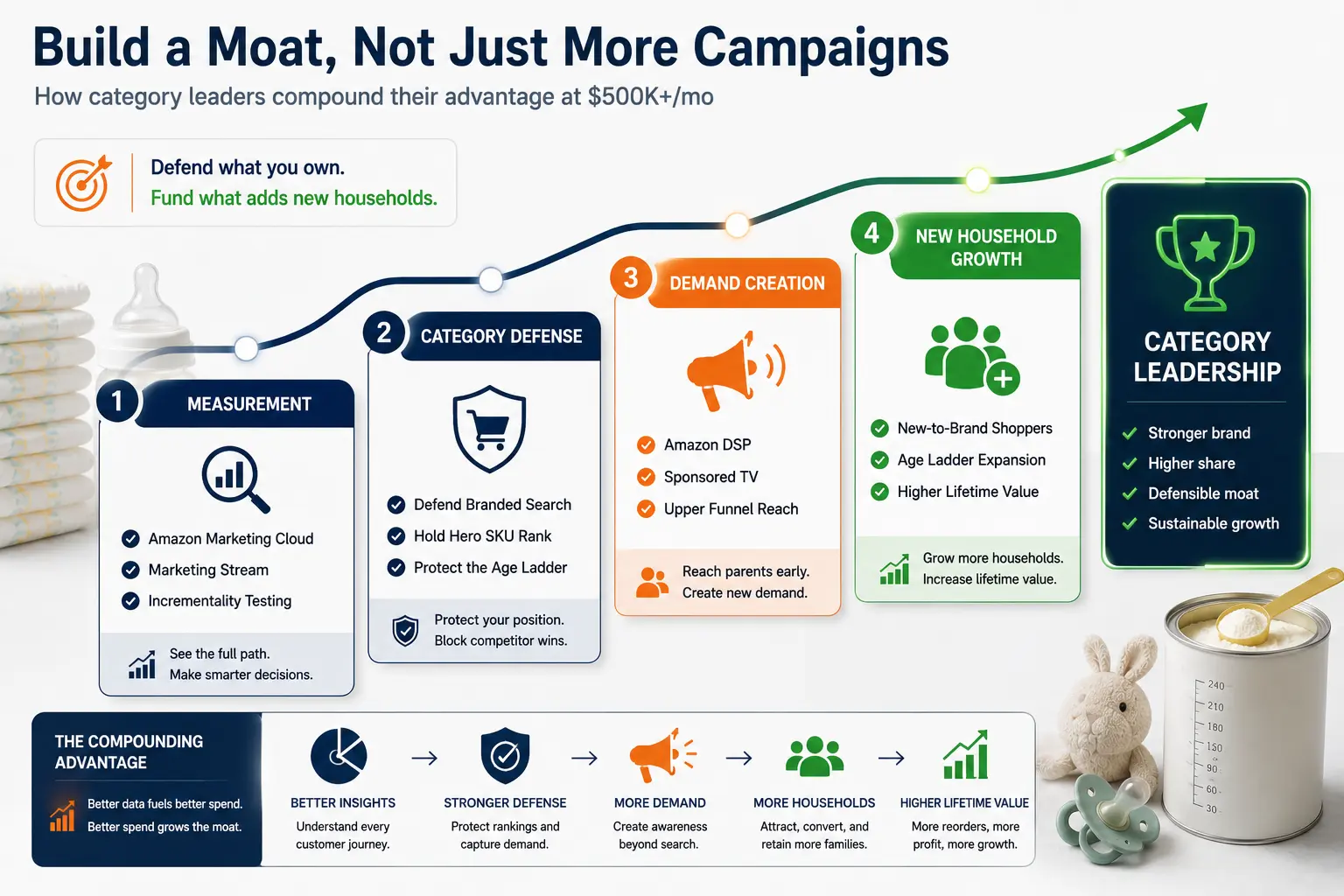
Amazon Marketing Cloud stitches together the full parent journey across Sponsored Products, Sponsored Brands, Sponsored Display, and DSP, so you can see the assists a single campaign's ACoS never credits, and it holds years of purchase signal to model audiences from.
Amazon Marketing Stream delivers campaign data at an hourly cadence, which turns decisions like dayparting and budget shifts from guesses into reads grounded in when parents actually convert.
Reading these together, rather than campaign by campaign, is what lets a leading brand see the whole board while competitors watch single squares.
The practical payoff is timing. AMC audiences let you reach a parent as they enter the market for the next age stage, reach a food buyer before the bag runs out, or exclude recent purchasers from acquisition so you stop paying for sales you already have.
For a brand sitting on years of purchase data, this is the difference between knowing something and acting on it, and it is where a large share of your remaining efficiency lives once search is saturated.
Running Sponsored Products as the base and layering this data-driven targeting on top is what a mature account looks like.
The tier framework that this leadership stage sits at the top of is laid out in our guide on Amazon PPC by spend tier for baby and toddler brands, which frames how the moves change as spend grows.
The habit that separates leaders here is reading the data as a system rather than a set of campaign reports. A brand that only looks at ACoS by campaign sees a flat surface; a brand that reads the full path in AMC sees which search terms feed which subscriptions, which upper-funnel spend actually produces new households, and which reorders happen without any ad at all.
That systemic view is what lets a leader cut the spend that only looks like it works and fund the spend that genuinely compounds, and it is available to any brand at this scale that commits to reading its own data properly.
At $500,000 a month you have a position others want, so defense stops being incidental and becomes a real line of the strategy.
Smaller competitors conquest a leader's products, bid on a leader's brand name, and undercut a leader's price, because taking a slice of your demand is easier than building their own.
Keep branded search held so a rival cannot intercept a parent looking specifically for you, watch for competitors conquesting your hero products, and hold the high-intent placements where decided buyers land.
The nuance is spending enough to protect the ground that matters without pouring budget into positions you already own outright.
Knowing which competitors are actually taking share, and where, is the kind of read a structured Amazon PPC competitor analysis is built to produce, so you defend deliberately rather than reactively.
A leader's advantage is the customer base and the rank it has accumulated, and defense means protecting both. Do not let a mature hero drift on rank because you stopped feeding it velocity, and do not leave the age-transition moments open for a rival to catch your customer at the switch.
The retention and lifecycle work that a steady Amazon PPC management practice maintains is what keeps a leadership position from quietly eroding while you chase new acquisition, which is the more common and more expensive mistake at this scale.
Once you own most of the demand already searching for you, growth has to come from creating demand and building the brand that captures it.
Amazon DSP runs programmatic display and video on and off Amazon, reaching new parents before they search, and self-serve Sponsored TV extends that into streaming.
New parents enter the category constantly, often during pregnancy and before they know which brands exist, so the leader that introduces itself early wins the whole journey of buying that follows.
Understanding exactly how those parents search and what language they use, covered in our guide on how parents search Amazon and what it means for PPC, is what makes upper-funnel creative land rather than talk past them.
Judge this spend on new-to-brand sales and lifetime value, not a search-style ACoS, because it works earlier in the decision and builds the brand equity that makes every later search cheaper to win.
Brand-building at this scale is also a defensive act, not only a growth one. The parent who already knows and trusts your brand from a display or streaming ad is far cheaper to convert when they finally search, and far harder for a competitor to intercept, because they are looking for you specifically rather than shopping the category blind.
A leader that invests in being known turns its brand into a moat that lowers the cost of every search sale and blunts the conquesting that smaller rivals rely on.
That compounding, where brand equity makes performance marketing cheaper over time, is one of the clearest advantages scale confers, and it is wasted if you judge the upper funnel on a metric built for the lower one.
The share of your sales going to households that have not bought you in the past year is the clearest read on whether you are growing the base or recycling it, and for a category on a fixed clock, where customers age out on a timer, filling the top of the funnel with new households is survival, not just growth.
Read new-to-brand alongside lifetime value, because a new parent acquired at a high first-order cost is a good trade when they buy up the age ladder for years. A leader that stops acquiring new households is a leader in slow decline, however healthy this quarter looks.
In no category does trust matter more than baby, and at $500,000 a month a lapse is not a paused campaign, it is a threat to the brand you built.
Many baby products are safety-regulated, and the CPSC's guidance on durable infant and toddler products sets mandatory standards your listings and ad claims must respect.
At this scale you have a brand reputation that a safety problem or an overreaching claim can damage far beyond a single suppressed listing, so treat claim discipline and safety compliance as a growth strategy rather than a compliance chore.
Surface your certifications and testing prominently, keep every claim accurate and substantiated, and standardize how claims and reviews are used across the catalog so one product's aggressive language never puts the whole brand at risk.
For a cautious parent, visible safety is the strongest conversion asset you have, so the discipline that protects you also sells.
At $500,000 a month the gains are no longer obvious, and they hide in places a busy team rarely has time to dig: non-incremental spend disguised as efficiency, a leadership position eroding at the edges, AMC data unused, or claim exposure across hundreds of ads.
An outside review that reads profit, incrementality, and brand defense rather than the ACoS column tends to find both waste to cut and growth to fund.
That is a specialist's job, and at this scale the return on getting it right dwarfs the cost of the review. As a specialist Amazon PPC agency, Amplivus works with category-leading baby brands on exactly these questions, reading the whole picture rather than the campaign surface.
A free Amazon PPC audit reviews your account for the leaks and the missed levers at your scale, and a short Amazon strategy session maps the highest-value moves for the year.

Turn your scale into a stronger moat with smarter incrementality, better brand defense, and a clear plan to grow profitably on Amazon.
Book a strategy call to review incrementality, brand defense, and the highest-value growth moves for your baby brand.


.png)
.png)


.png)
.png)