How Fitness Brands Scale Past $100K/mo on Amazon PPC
Read more
.png)
Premium under-desk treadmill brands win by not cutting price: compete on safety and warranty, fund the consideration window, and bid to lifetime value.
Summarize in ChatGPT
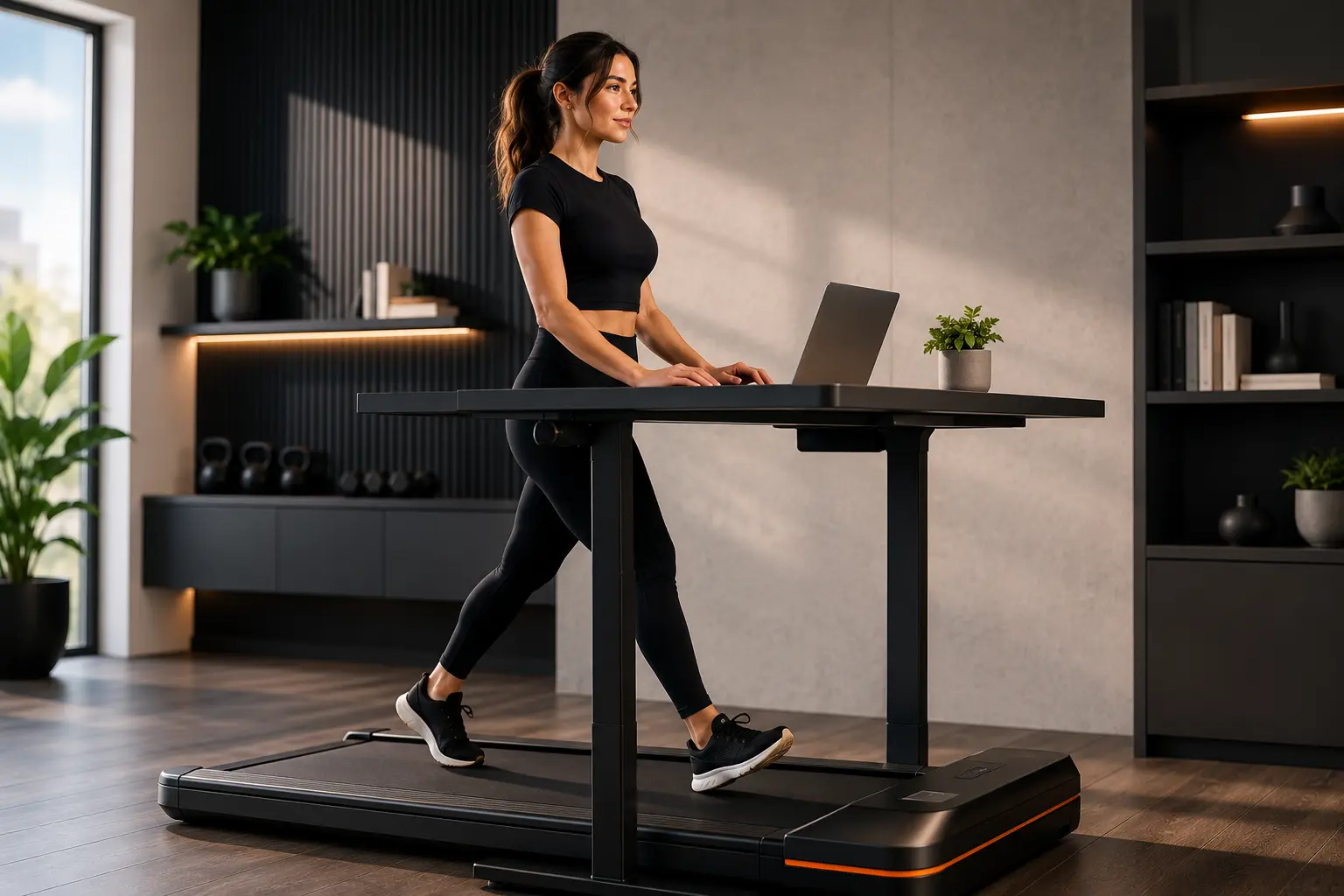
An under-desk treadmill is a hard product to advertise well on Amazon, because it breaks the reflex most sellers run on. When a cheaper machine undercuts you, the instinct is to lower your price and raise your bids, and for a premium device that instinct quietly destroys the business.
These are considered purchases at a real price point, often several hundred dollars, and the buyer does not click and buy on impulse; they research the motor, the weight capacity, the warranty, and the reviews, then come back days later.
It matters that these are motorized machines with real safety stakes: the CPSC's exercise equipment recall records show treadmills pulled from the market for fire and fall hazards, which is exactly why a cautious buyer will pay more for one they can trust.
Winning as the premium option means advertising in a way that protects your price instead of surrendering it.
This guide is a premium-pricing PPC playbook for under-desk treadmill and walking-pad brands.
It covers why price-cutting is the wrong move, how safety and warranty become your marketing, funding the long consideration window, and defending a premium position against cheaper clones.
It applies the same premium framework as our guide on premium pricing for LED face mask brands, adapted to the specific economics of a heavy, motorized device.
The first strategic decision is the one most sellers get wrong, so it comes first.
When a cheaper treadmill takes some of your clicks, cutting your price to match feels like defense. It is not.
Your premium price funds your reviews, your video, your retargeting, your warranty, and your support, and every dollar you cut removes ammunition from the parts of the plan that actually win a considered purchase.
Worse, a premium machine sold cheap reads as suspicious to the exact buyer you want, who associates a serious price with a serious motor and a real warranty.
The clone competes on being cheapest and will always win that race; your job is to compete on a different axis entirely, so the comparison stops being about price. Hold the price, and spend that healthy margin instead on making the real value obvious.
Under-desk treadmills are heavy and often oversize, so Fulfillment by Amazon fees take a large bite of every sale, and that changes the math.
Calculate your break-even Advertising Cost of Sale, your margin after cost, fees, and freight, honestly, because a machine that looks like it has a healthy margin can be thin once the oversize fulfillment fee is counted.
The upside is that a premium price still leaves real margin even after those fees, and that margin is a strategic asset: it lets you afford a higher cost per click than a budget seller and fund the longer path to conversion a considered purchase requires.
The mistake is leaving that room unused, but the discipline is to size it correctly against your true landed cost.
A quick example shows why this matters more here than in a light-goods category. Say your treadmill sells for $350 and leaves $140 in margin after cost, the oversize fulfillment fee, and freight.

A 30 percent ACoS, which would frighten a seller of a $25 accessory, still leaves you $35 of profit on that sale before you count the customer's future value, so you can outbid the clone whose entire margin is a few dollars.
Run Sponsored Products with that headroom in mind, bidding confidently on the high-intent terms a serious buyer uses, because your price is not a disadvantage in the auction; it is your biggest advantage.
The brands that lose are the ones that never do this arithmetic and bid as timidly as if they sold a commodity.
At a premium price on a motorized machine, the buyer's real question is not "is this cheap enough" but "can I trust this in my home," and your advertising has to answer it.
A serious under-desk treadmill buyer is weighing quiet worries: will the motor last, will it hold my weight, will it stop safely, is the warranty real.
Those are exactly the concerns a cheap clone cannot answer, so make them the center of your marketing rather than an afterthought.
Surface your weight capacity, your motor quality, your safety features, your warranty length, and your support, in the images, the video, and the copy, because for this buyer those specifics are the product.
The recall history in the category, visible in public CPSC records, means the cautious buyer is actively looking for a brand that takes safety seriously, and the premium brand that shows it wins the trust the discounter cannot.
Proof does the persuading a discount cannot. Surface your strongest review themes about durability and quietness, make the warranty and support visible and specific, and present your safety credentials honestly.
A shopper spending several hundred dollars on a machine they will use daily wants reassurance before they commit, so a strong warranty stated plainly can be the single most persuasive thing in your listing.
A premium ad pointing at a listing that hides the warranty and buries the specs wastes the click, because the mismatch quietly tells a careful buyer to keep on looking.
A+ Content earns its place here: use it to explain the motor, the safety system, and the warranty in plain terms, and to answer the questions a considered buyer is quietly asking.
Every unanswered question is a reason to leave and compare, and at this price point a careful shopper will take it, so a listing that reassures thoroughly converts far better than one that simply asserts quality and hopes.
A higher-ticket device is rarely bought on the first visit, so the account has to be built for a journey, not a click.
Most buyers meet an under-desk treadmill needing to understand it before they will pay for it: how quiet it is, how it fits under a desk, how it feels to walk and work.
That is a job for Sponsored Brands Video, showing the machine in real use at a desk, so the shopper can picture owning it.
Lead the upper funnel with education and demonstration rather than a hard price pitch, because a shopper who does not yet understand the product will not be moved by a discount, and video answers the questions a static image cannot.
The remote and hybrid work shift has widened this audience well beyond dedicated fitness buyers, which changes the education job. Many shoppers are not gym people; they are desk workers trying to move more during the day, and they need to understand how the machine fits their life before price even enters the picture.
That means your upper-funnel content should show the ordinary moment, someone walking slowly while taking a call, the treadmill sliding neatly under a standing desk, the quiet motor that will not disturb a meeting, rather than a fitness pitch that talks past them.
Meeting this newer, broader buyer where they are is part of the wider scaling approach in our guide on how to scale Amazon PPC past $100K a month.
Because the buyer leaves and returns, retargeting is not optional for a premium device; it is where a large share of sales close.
A Sponsored Display campaign keeps your machine in front of the shopper who viewed it and left to think, and at larger scale Amazon DSP extends that reach off Amazon across a consideration gap that can run days or weeks.
A shopper who spent time on your listing and left is worth far more than a cold click, so fund retargeting as a core line item and let it bring the high-intent buyer back when they are ready.
The second touch should answer the specific hesitation, price, warranty, or a safety concern, rather than repeat the first pitch.

Cheaper clones are a permanent feature of a growing category, so defense has to be deliberate rather than reactive.
When a clone undercuts you, the answer is to make the difference visible, not to erase it. Emphasize what the cheaper option lacks, the tested safety, the real warranty, the heavier-duty motor, the reviews, so the shopper understands what the price buys.
Bid to defend your branded search so a rival cannot intercept a shopper looking specifically for you, and hold the high-intent placements where serious buyers land.
Knowing which clones are actually taking clicks, and where, is the kind of read a structured Amazon PPC competitor analysis is built to produce, so you defend where it matters and ignore the noise.
Not every cheap clone is worth a defensive dollar; most are competing for a different, price-first buyer you were never going to win anyway, and spending to fight them just funds a race you do not want.
The clones worth defending against are the ones edging into your high-intent, quality-seeking terms, and the analysis is what tells the two apart.
A premium treadmill buyer can be worth more than one purchase: a walking mat, a standing desk, a warranty extension, or the next machine in your line.
Judging acquisition only on the first-click ACoS undervalues that relationship and pushes you to underbid on customers who would pay you back.
Read your targets against customer lifetime value, and you will find room to acquire a high-value buyer at a cost that looks aggressive on a single sale but is sound across the relationship.
The broader cost math behind that decision is laid out in our guide on the Amazon PPC cost breakdown by spend tier, and the advanced moves that a scaled premium brand layers on top are covered in our guide on PPC strategy for 7-figure brands.
Building that cross-sell catalog is worth the effort, because a treadmill is durable and does not reorder like a consumable, so the lifetime value has to come from somewhere.
An accessory line, a warranty upsell, and a follow-on product give every acquired customer somewhere to go beyond the single machine, which raises what you can afford to pay for them and smooths the revenue between big-ticket purchases.
A single-product treadmill brand caps its own lifetime value at one sale; the brand that surrounds the machine with a range keeps earning from the customer long after the treadmill ships.
A premium device account fails in quiet, specific ways: retargeting left underfunded, branded search undefended, bids set with a budget seller's caution when the margin could support more, or oversize fees quietly making a headline ACoS unprofitable.
None of these is obvious from a glance at the ad report, and each costs a high-ticket brand real money per sale.
That is a specific, findable set of problems, and for a high-ticket brand the return on fixing them is large, because each recovered sale carries real margin.
As a specialist Amazon PPC agency, Amplivus reviews premium and high-ticket accounts for exactly these leaks, reading margin, lifetime value, and the full consideration path rather than the campaign surface.
A free Amazon PPC audit shows where a premium position is being undersold, and a short Amazon strategy session maps the pricing and bidding moves worth making first.

Get a focused PPC review that uncovers fee-blind bids, weak brand defense, poor retargeting, and missed premium-positioning opportunities.
See which campaigns undersell your safety, warranty, and premium value while wasting budget on low-intent shoppers.
.webp)