How Beauty Brands Scale Past $100K/mo With Amazon PPC
Read more
.png)
Premium LED mask brands win by not cutting price: fund the long consideration window with video and retargeting, compete on trust, and bid to lifetime value.
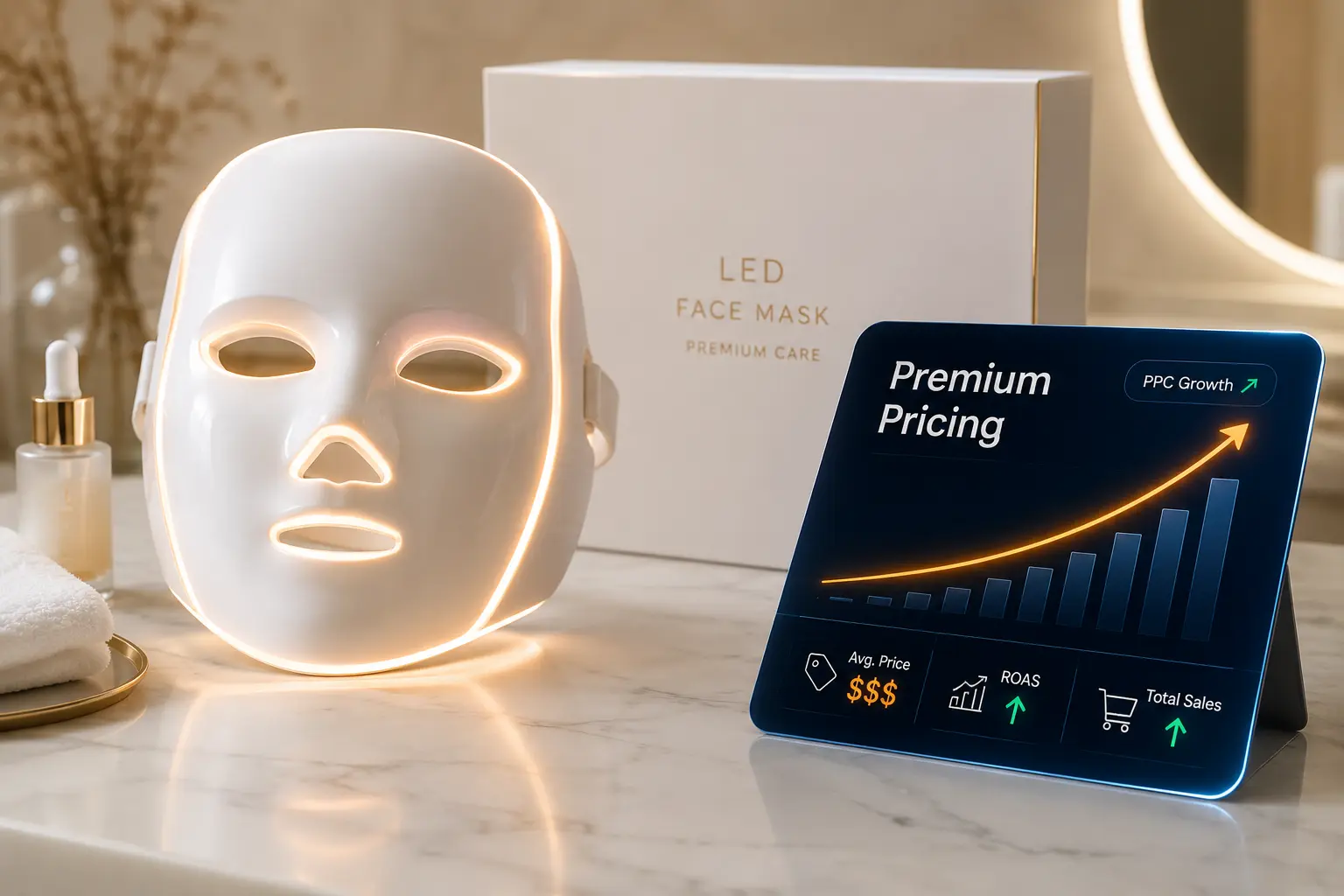
An LED face mask is one of the harder products to advertise well on Amazon, because it breaks the reflex most sellers run on.
The instinct when a competitor undercuts you is to lower your price and raise your bids, and for a premium device that instinct quietly destroys the business.
These are considered purchases at a real price point, often several hundred dollars, and the buyer does not click and buy on impulse; they research, compare, read reviews, and come back days later.
The LED light face mask market reached roughly $238 million in 2021 and is projected near $656 million by 2030, and that growth is drawing in cheap imitators fast.
Winning as the premium option means advertising in a way that protects your price instead of surrendering it.

This guide is a premium-pricing PPC playbook for LED face mask and light-therapy device brands.
It covers why price-cutting is the wrong move, how to fund the long consideration window, the trust and claims discipline the category demands, and how to defend a premium position against cheaper rivals.
It builds on the wider approach in our guide on Amazon PPC for beauty brands, applied to the specific economics of a high-ticket device.
The first strategic decision is the one most sellers get wrong, so it comes first.
When a cheaper mask appears and takes some of your clicks, cutting your price to match feels like defense. It is not.
Your premium price is what funds your reviews, your video, your retargeting, and your margin, and every dollar you cut removes ammunition from the parts of the plan that actually win a considered purchase.
Worse, a premium product sold cheap reads as suspicious to the exact buyer you want, who associates a serious price with a serious device. The knockoff competes on being cheapest and will always win that race; your job is to compete on a different axis entirely, so the comparison stops being about price.
Hold the price, and spend that healthy margin instead on making the value obvious.
A shopper who is genuinely choosing between a $60 mask and a $300 one has usually already decided which kind of buyer they are; the premium seller's job is not to convert the bargain hunter but to reassure the buyer who wants the better device that they are making the right choice.
Discounting muddies exactly that signal.
Premium devices usually carry a healthy per-unit margin, and that margin is a strategic asset.
Calculate your break-even Advertising Cost of Sale, your margin before ads, honestly, and you will often find you can afford a higher cost per click than a low-ticket seller, because one sale is worth far more.
That headroom is what lets you win the expensive, high-intent clicks and fund the longer path to conversion a considered purchase requires.
The mistake is leaving that room unused out of a low-ticket seller's fear of a high ACoS, when your economics are built to spend it.
A quick example makes the point. Suppose your mask sells for $300 and leaves $180 in margin after cost and fees. A 40 percent ACoS, which would terrify a seller of a $20 product, still leaves you $60 of profit on that sale before you even count the customer's future value.
The seller of the cheap knockoff cannot come close to matching your bid, because their whole margin is a few dollars.
Read correctly, your price is not a disadvantage in the auction; it is your single biggest advantage, because it lets you outbid the field for the buyer who is actually willing to pay for quality.
The brands that lose are the ones that never do this arithmetic and bid as timidly as if they sold a commodity.

A high-ticket device is rarely bought on the first visit, so the account has to be built for a journey, not a click.
Most buyers meet an LED mask needing to understand it before they will consider paying for it: how it works, how it is used, why it costs what it does.
That is a job for Sponsored Brands Video and rich content, showing the device in use, the routine, the finish, so the shopper can picture owning it.
Lead the upper funnel with education and demonstration rather than a hard price pitch, because a shopper who does not yet understand the product will not be moved by a discount.
The full-funnel sequencing this calls for is laid out in our guide on full-funnel Amazon Ads for skincare brands.
Because the buyer leaves and returns, retargeting is not optional for a premium device; it is where a large share of sales actually close.
A Sponsored Display campaign keeps your mask in front of the shopper who viewed it and left to think, and at larger scale Amazon DSP extends that reach off Amazon, so the consideration gap that can run days or weeks stays populated with your brand.
Fund retargeting as a core line item, not an afterthought, and let it do the patient work of bringing a high-intent shopper back when they are ready.
A shopper who spent time on your listing and left is worth far more than a cold click, and reaching them again is some of the most efficient spend in the whole account.
The message in a retargeting ad should also differ from the message that first drew the shopper in.
On the first touch you are explaining what the device is; on the second and third, the shopper already knows, and what they need now is a reason to commit, a strong review, a guarantee, a reminder of what sets you apart from the cheaper option they may also be weighing.
Repeating the introductory pitch wastes the touch. Answering the specific hesitation that made them leave, price justification, results, trust, is what converts a returning premium shopper.
A high-ticket buyer searches differently at each stage, and your keywords should meet them where they are.
Early on they use broad, educational terms as they learn the category; later they search specific features, comparisons, and eventually the buying terms that signal intent.
Run Sponsored Products across that spread, accepting a higher cost of sale on the educational terms that start the journey and tightening on the high-intent terms that finish it.
Mine your search-term reports to see which research queries actually lead to eventual purchases, and do not judge an upper-funnel keyword by the same yardstick as a bottom-funnel one, because in a long consideration cycle the term that introduces the buyer and the term that closes them are rarely the same.
At a premium price, the buyer's real question is not "is this cheap enough" but "can I trust this to be worth it," and your advertising has to answer that.
Reviews, visible quality, and clear evidence do the persuading a discount cannot. Surface your strongest review themes, make quality and materials visible in your images and video, and present your evidence honestly.
This is a regulated space: many LED masks are cleared devices rather than approved ones, and the FDA distinguishes cleared from approved medical devices in ways your marketing must respect.
Describe what your device is cleared for accurately, avoid implying approval you do not have, and keep benefit claims within what you can substantiate.
Overreaching on claims does not just risk suppression; it undermines the trust that a premium buyer is paying for. Getting this framing right is part of the brand-authority flywheel covered in our guide on the halo effect for beauty brands.
Advertising buys the click, but the listing has to justify the price once the shopper arrives.
A premium device needs premium presentation: clean images, a clear explanation of the technology, honest before-and-after framing where permitted, and a listing that looks as considered as the price implies.
A strong ad pointing at a cheap-looking listing wastes the click, because the mismatch between the ad's promise and the page's polish tells a premium buyer to keep looking. Spend as much care on the destination page as you do on the ad itself.
This is where A+ Content earns its place.
Use it to tell the brand's story, explain the technology in plain terms, and lay out the evidence and the care behind the device, so a shopper weighing a serious purchase feels informed rather than sold to.
The premium buyer is doing homework, and a listing that answers their questions thoroughly, how it works, how often to use it, what results to expect within the bounds of your claims, converts better than one that simply asserts quality.
Every unanswered question is a reason to leave and keep comparing, and at this price point they will.
Cheaper rivals are a permanent feature of a growing category, so defense has to be deliberate rather than reactive.
When a knockoff undercuts you, the answer is to make the difference visible, not to erase it.
Emphasize what the cheaper option lacks, the clearance, the build quality, the reviews, the results, so the shopper understands what the price buys.
Bid to defend your branded search so a rival cannot intercept a shopper looking specifically for you, and use your authority to hold the high-intent placements where serious buyers land and are ready to pay.
Knowing exactly which competitors are taking which clicks is the kind of read a structured Amazon PPC competitor analysis is built to produce, and it tells you where to defend and where to ignore the noise.
A premium device buyer is often worth more than one purchase: replacement parts, upgrades, and other products in your line.
Judging your acquisition spend only on the first-click ACoS undervalues that relationship and pushes you to underbid on customers who would pay you back many times over.
Read your targets against customer lifetime value, and you will find room to acquire a high-value buyer at a cost that looks aggressive on a single sale but is sound across the relationship, especially in a line where replacement parts and follow-on devices bring the same customer back.
This is the same scaling discipline in our guide on scaling beauty brands past $100K a month, applied to a high-ticket line.
A premium device account fails in quiet, specific ways: retargeting left underfunded, branded search undefended, acquisition judged on the wrong metric, or bids set with a low-ticket seller's caution when the margin could support far more.
None of these is obvious from a glance at ACoS, and each one costs a high-ticket brand real money per sale.
That is a specific, findable set of problems, and for a high-ticket brand the return on fixing them is large, because each recovered sale carries real margin.
As a specialist Amazon PPC agency, Amplivus reviews premium and high-ticket accounts for exactly these leaks, reading margin, lifetime value, and the full consideration path rather than the campaign surface.
A free Amazon PPC audit shows where a premium position is being undersold, and a short Amazon strategy session maps the pricing and bidding moves worth making first.

Get a focused PPC review that uncovers wasted spend, weak retargeting, and missed opportunities to defend your premium LED mask position.
See which campaigns undersell your value, waste margin, or lose high-intent shoppers before they are ready to buy today.