How Kitchen Brands Scale Past $100K/mo With Amazon PPC
Read more
.png)
At $200K+/mo, portable blender brands grow by managing viral spikes, creating demand with DSP, defending copycats, and bidding to accessory lifetime value
Summarize in ChatGPT
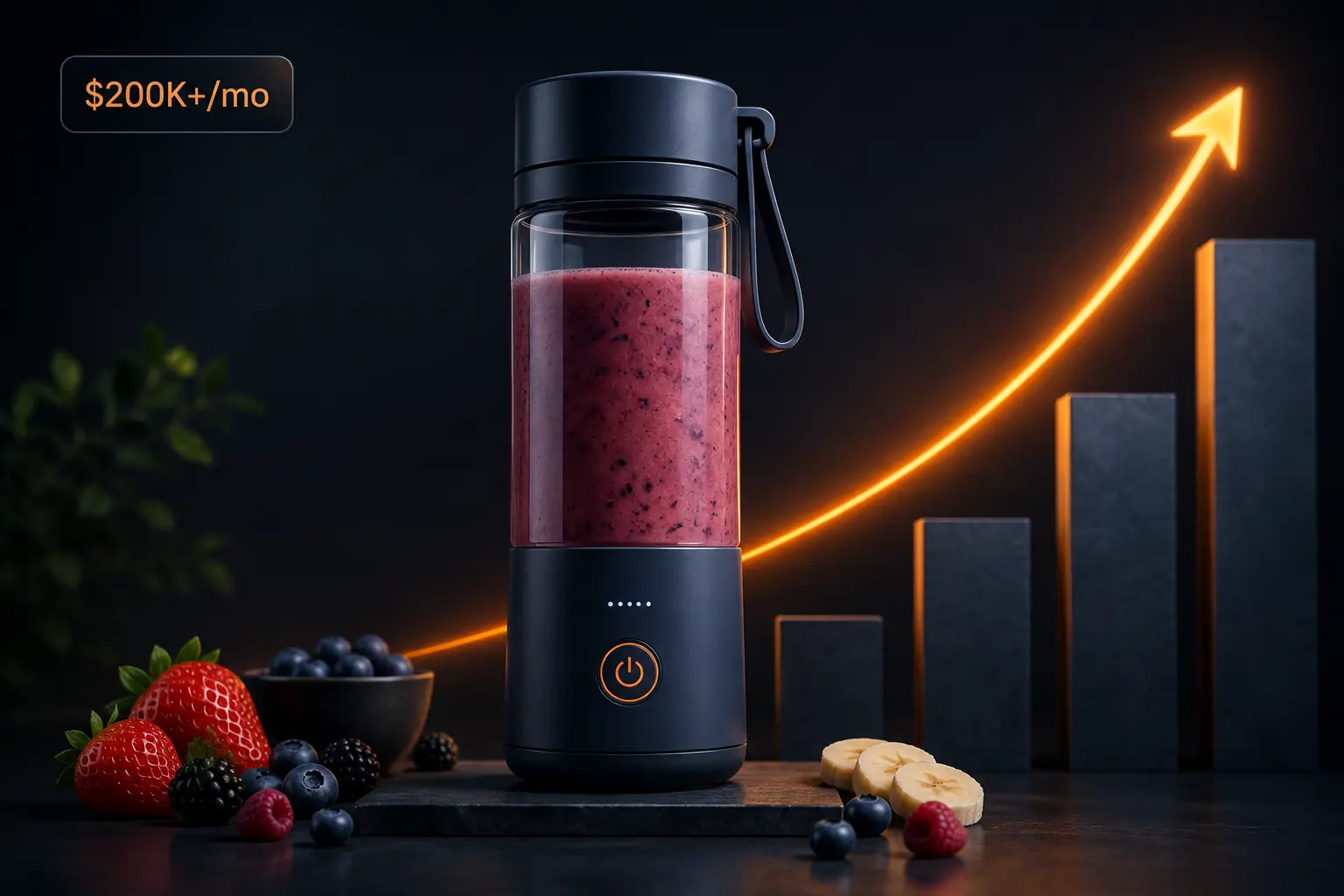
Crossing $200,000 a month with a portable blender is a different problem from getting there, and the thing that makes it hard is the same thing that got you here: virality.
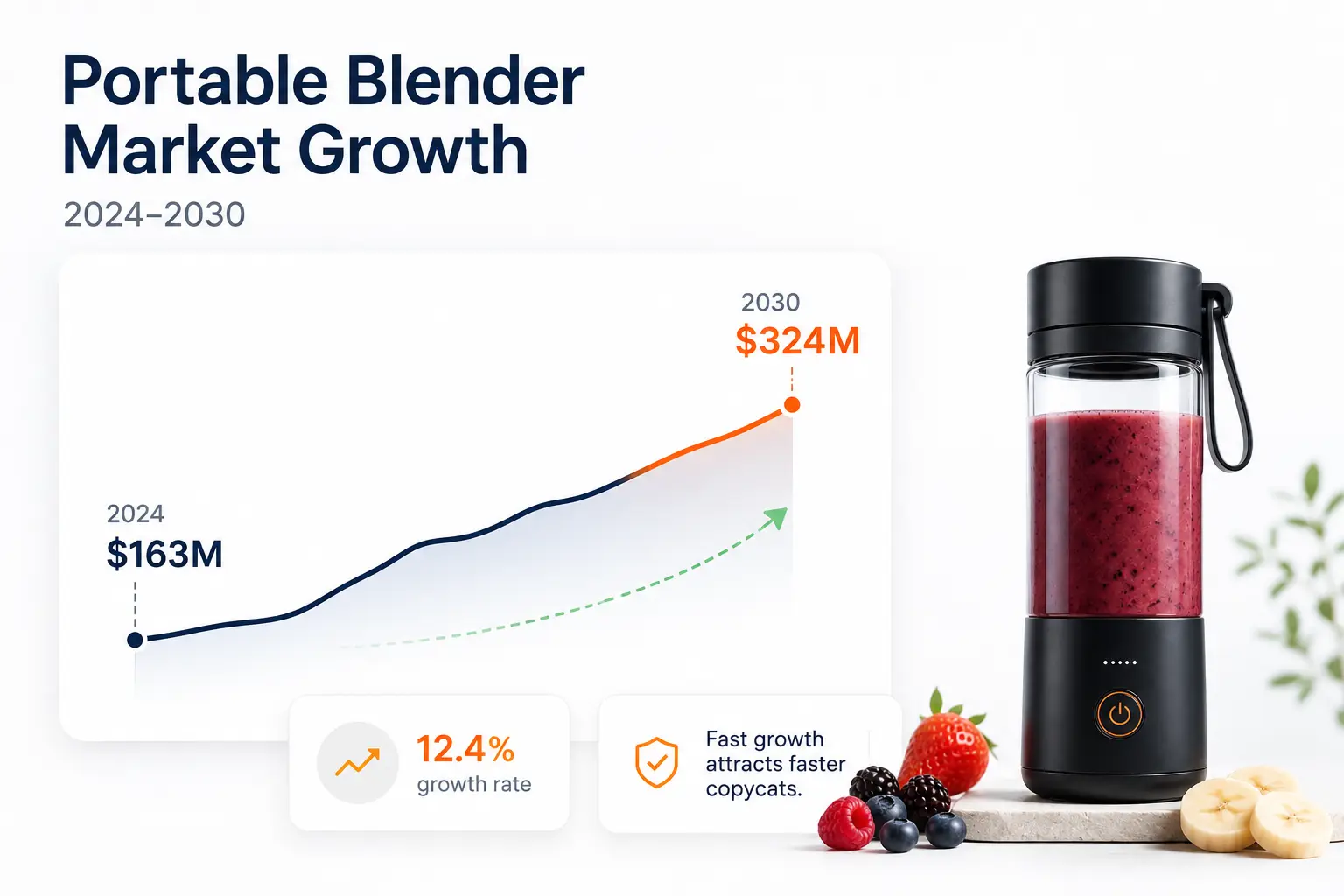
Portable blenders are impulse, demonstration-driven, socially spread products, and the portable blenders market is growing fast, from about $163 million in 2024 toward $324 million by 2030 at a 12.4 percent rate, with online sales and influencer-driven discovery leading that growth.
That demand is a gift and a trap.
At scale, the account has to turn unpredictable viral spikes into durable rank, keep growing when the trend cools, and defend a position that copycats are actively trying to take.
Below $200,000 a month you were riding demand; above it, you have to build a machine that outlasts any single wave.
This guide is a practical playbook for portable blender brands already at $200,000 a month and up.
It covers managing viral volatility, the gadget economics that should set your bids, creating demand through Amazon Demand-Side Platform (DSP) and video, and defending a viral position against copycats.
It builds on the auction mechanics in our guide on bidding for viral kitchen products, and applies the advanced moves in our guide on PPC strategy for 7-figure brands to the specific case of a portable blender.
The defining feature of this category at scale is that demand does not arrive smoothly, and how you handle the spikes decides whether they leave anything behind.
When a portable blender trends, demand can jump for days or weeks, and it is tempting to pour budget in and treat the surge as the new normal.
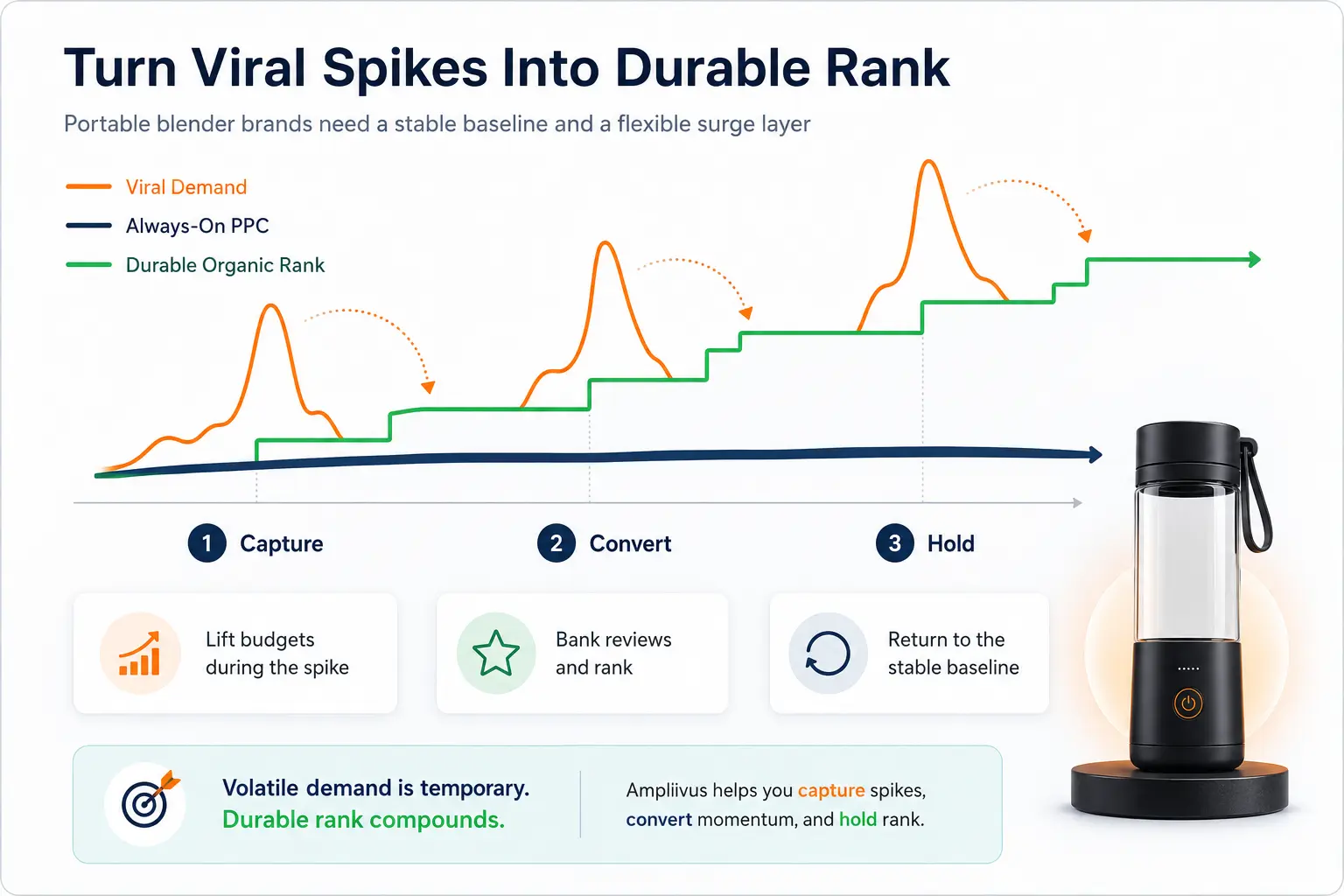
The discipline is to capture the spike while it lasts and convert it into something permanent, organic rank and reviews, rather than building a cost structure that assumes the wave never breaks.
During a surge, lift budgets to capture the volume and the cheap velocity it brings, but keep your break-even honest and do not let the excitement push bids past what the sale can bear.
When the wave cools, the rank and reviews you banked during it are what keep sales up, so the goal of a spike is not just the sales it brings but the durable position it can buy.
The mental model that helps is to treat a viral spike as a rank-buying opportunity rather than a revenue event.
The extra sales are welcome, but the real prize is the organic position and the review base you can accumulate while demand is cheap and abundant, because those are the assets that keep paying after the trend moves on.
A brand that spends a spike purely on grabbing every last sale, then watches its rank fade with the trend, has treated a durable opportunity as a disposable one.
The brand that uses the same surge to lock in top-of-category rank and a wall of fresh reviews comes out of the wave structurally stronger than it went in, and that compounding across successive trends is how a gadget brand builds a moat in a category that would otherwise reset every season.
Volatility cuts both ways, and an account tuned to a peak looks broken in a trough.
Avoid over-automating to short-term signals that a viral swing will distort, because a rule that reacts to a spike can overspend into a fade.
Keep a steady baseline of always-on campaigns underneath the reactive layer, so your core rank holds regardless of the trend cycle.
The steadiness matters more here than in a stable category, and maintaining it through the swings is exactly what a disciplined Amazon PPC management practice is built to provide.
Think of the account as two layers: a stable foundation that defends your core terms and rank in every season, and a flexible surge layer that flexes up and down with the trend.
Confusing the two, letting the reactive layer set your baseline, is how brands overspend into a fade and then panic-cut when the numbers turn, which only deepens the trough.
Lifetime value should drive your bids at this scale, but a blender earns it differently than a consumable does, and missing that changes the whole calculation.
A portable blender is durable; the customer does not reorder it next month the way they reorder wipes or supplements.
So the lifetime value is real but it comes from a different place: replacement bottles and blades, recipe and cleaning add-ons, color and size variants, and the next product in your line.
That means your acquisition math should count the accessory and repeat-line revenue a first-time blender buyer brings, not just the single blender sale.
A buyer acquired through a blender who then buys two accessories and a second-generation model is worth far more than the first order suggests, and bidding only on that first sale underprices the customer.
Build the catalog and the cross-sell so the blender is a doorway, then let your acquisition bids reflect the whole relationship.
This is also where a viral gadget brand should invest ahead of the curve. The single-product brand that rode one trend has nowhere to send its customers next, so its lifetime value stays stuck at one sale and its growth ends when the trend does.
The brand that builds an accessory range and a follow-on product line gives every acquired customer somewhere to go, which both raises lifetime value and smooths the volatility, because accessory and repeat-line sales keep flowing even when the flagship is between waves.
At $200,000 a month you have the volume to justify that expansion, and it is often the difference between a brand that spikes and fades and one that compounds across trends into something lasting.
Total Advertising Cost of Sale, ad spend against total revenue including organic, is the metric that shows whether paid spend is building durable position rather than just buying spikes.
When TACoS holds or falls while total sales climb across a trend cycle, your ads are converting volatile demand into lasting rank.
Push Sponsored Products to build that velocity, harvest the winning terms a viral surge surfaces into permanent exact-match campaigns, and read the whole picture across the full cycle rather than judging the account on a single hot week or a single quiet one.
At $200,000 a month you have usually captured most of the demand already searching for a portable blender, so the next growth has to come from creating it.
Amazon DSP runs programmatic display and video on and off Amazon, reaching buyers who are not yet searching for a blender, retargeting those who watched and left, and modeling look-alikes of your best customers
Sponsored TV, now self-serve, extends that into streaming, which suits a visual, demonstration-driven product that sells on being seen in use.
The reason these matter at this scale is that a mature blender brand has usually saturated search; further growth means reaching new buyers earlier, in the feed and on the screen, before they type a query.
The creative you run through those channels does most of the work, because a portable blender sells on being seen in motion, the blend, the pour, the finished drink.
The craft that makes that video convert is covered in our guide on Sponsored Brands Video for portable blender brands, and at this scale you should treat creative as a portfolio too: several variants tested against each other, refreshed as trends shift, rather than one hero clip run everywhere.
The brand that keeps its upper-funnel creative fresh holds attention that a stale ad quickly loses in a fast-moving category.
Once you own your existing demand, the metric that matters most is new-to-brand: the share of sales going to households that have not bought you in the past year.
A high new-to-brand rate means your spend is genuinely expanding the customer base rather than recycling it, which is exactly what a demand-creation strategy should produce for a category fed by constant new interest
Amazon Marketing Cloud lets you build audiences from your own purchase data and read the full path across your ad types, so you can see which upper-funnel spend actually brings new customers and exclude recent buyers from acquisition campaigns.
Judge DSP and Sponsored TV on new-to-brand and lifetime value, not a search-style ACoS, or you will cut the spend that fills the top of the funnel.
A viral product is a target, and at scale the copycats are relentless, so defense has to be deliberate.
When cheaper clones appear, and they will, the wrong move is to chase them down on price, which throws away the margin that funds your video, DSP, and reviews.
The right move is to make the difference visible: your reviews, your brand, your quality, your accessories ecosystem, so a shopper understands what the clone lacks.
Defend your branded search so a copycat cannot intercept a buyer looking specifically for you, and hold the high-intent placements with authority rather than discounts.
Knowing which copycats are actually taking clicks, and where, is the kind of read a structured Amazon PPC competitor analysis is built to produce, and it tells you which clones are worth defending against and which are noise not worth a dollar of your budget.
Portable blenders carry two demand peaks, not one: Q4 gifting, when a photogenic gadget is a popular present, and the January surge, when health and smoothie resolutions pull demand into the new year.
Pace budget to lift ahead of both and ease after, and above all sync spend to inventory, because a viral product that sells out at a peak hands its hard-won rank to a competitor at the worst possible moment.
At this scale, running out of stock during a surge is one of the most expensive mistakes you can make, since the rank you lose took months and real spend to build and recovers slowly once the wave has passed.
The wider tier logic that this enterprise stage sits at the top of is laid out in our guide on Amazon PPC for kitchen brands by spend tier, which frames how the moves change as spend grows.
At $200,000 a month the gains hide in places a busy team rarely has time to dig: bids tuned to a viral peak that leak in the trough, acquisition judged on the first sale while accessories go uncounted, or demand-creation spend cut because it looked expensive on the wrong metric.
An outside review that reads the trend cycle, lifetime value, and the full funnel rather than the ACoS column tends to find both waste to cut and growth to fund.
That is a specialist's job, and at this scale the return on getting it right dwarfs the cost of the review.
As a specialist Amazon PPC agency, Amplivus works with scaled gadget and kitchen brands on exactly these questions, reading the whole picture rather than the campaign surface.
A free Amazon PPC audit reviews your account for the leaks and missed levers at your scale, and a short Amazon strategy session maps the highest-value moves for the year.

Get a focused PPC review that uncovers trend-cycle waste, weak brand defense, missed accessory value, and underfunded demand creation.
Build durable rank, stronger lifetime value, and demand beyond search without overspending when viral momentum fades.
.png)
.png)


.png)
.png)