.webp)
Amazon PPC for Wellness Brands: 2026 Strategy by Spend Tier
Read more
.png)
Wellness brands pay above-average Amazon PPC costs in 2026 because a saturated, compliance-limited category raises CPC and slows conversion.
Summarize in ChatGPT

Wellness is one of the most expensive categories to advertise on Amazon, and most brands benchmark it against numbers that were never true for them.
A generic average ACoS hides the two forces that actually shape wellness cost: a crowded auction and a ceiling on what you are allowed to say.
This guide breaks down what Amazon PPC really costs a wellness or supplement brand in 2026, why those costs sit above the marketplace average, and how to benchmark against the only figure that matters, which is your own. It is written for brands past the launch phase that need a realistic cost model, not a vanity target.
Three forces push wellness costs up: category saturation raises click prices, claim restrictions flatten differentiation, and buyer skepticism slows conversion. Each one compounds the others.
Supplements and wellness are among the most saturated segments on Amazon, and saturation shows up directly in your cost per click. When dozens of near-identical products chase the same keyword, the auction price rises for everyone in it.
This is the first reason a generic benchmark misleads you. A CPC that is normal in a quiet category is a bargain in wellness, and a CPC that looks alarming may simply be the going rate for a contested term. Context decides whether a number is good or bad.
The pressure is not static, either. New entrants and overseas sellers pile into proven wellness keywords constantly, so a term that was affordable last quarter can climb without any change on your side. A useful benchmark moves with the auction rather than sitting fixed.
Wellness advertising sits under two regulators, and both limit the claims that usually drive clicks.
The FDA separates structure/function claims from disease claims: you can say a nutrient supports normal function, but only an approved drug can claim to treat or cure a disease.
On the advertising side, the FTC requires competent and reliable scientific evidence before you make a health claim, with randomized trials as the expected standard.
The cost effect is real. When every compliant listing sounds similar, click-through and conversion flatten, and flatter conversion means a higher ACoS to move the same volume.
The constraint reaches your creative, too. Every structure/function claim needs the FDA disclaimer, and Amazon reviews supplement copy and images against its own policies. That leaves less room to stand out in the exact spots, the title and the main image, that decide whether a click happens at all.
Wellness shoppers are cautious, and they lean on reviews, ratings, and brand trust more than buyers in low-consideration categories.
A thin review count or a middling rating suppresses conversion no matter how sharp your bid is.
That gate matters for cost because conversion rate sits underneath every efficiency metric. Two brands can pay the same CPC and land very different ACoS purely because one converts the traffic and the other does not.
This hits new products hardest. A launch with few reviews faces a cold start, where low trust drags conversion and a soft conversion rate inflates ACoS at the very moment a brand can least afford it. Cost and credibility move together in this category.
Benchmark your break-even ACoS, TACoS, CPC, conversion rate, and new-to-brand share, measured from your own data rather than a category average.
Those five tell you almost everything about your cost position.
The metrics that matter are the ones tied to your economics. Break-even ACoS, set by your contribution margin, marks the ceiling before a sale starts losing money. TACoS shows whether ad spend is buying real growth or just shifting organic sales into paid.
Your conversion rate and cost per click explain most of your ACoS between them, and new-to-brand metrics tell you whether spend is acquiring new customers or repeating existing ones.
Brand Analytics is where you pull the query-level and share data to ground each of these in reality.
New-to-brand share deserves special attention in wellness. Because repeat purchase carries the economics, knowing what portion of spend brings genuinely new customers tells you whether you are growing the base or just paying to reach people who would have reordered anyway.
To turn these into a target, start from margin and work backward. Your contribution margin sets break-even ACoS, your repeat rate tells you how far above it you can safely run, and your trend tells you whether this month beats the last. That is a benchmark you can actually act on.
None of this comes from a public benchmark, and that is the point. The method for building your own cost model from the ground up is covered in our guide on the Amazon PPC cost breakdown by spend tier.
Expect wellness CPCs and ACoS to run above the marketplace average, but treat any specific figure as a directional range, not a target. The honest answer is that no trustworthy public number exists.
The average wellness CPC and average supplement ACoS figures floating around are mostly pulled from individual tool datasets, not a representative sample, so they are directional at best.
Anchoring your budget to them is how brands set the wrong target and then miss it.
Cost also varies inside a single account. Product age, review depth, and how contested each keyword is all pull the number in different directions. An account-wide average can hide a handful of expensive terms that are quietly dragging the whole figure up.
Read the table as a diagnosis, not a scorecard. Each row tells you which lever moved your cost, so you can act on the cause instead of chasing a number someone else published for a different brand.
No. Wellness is not one market, and cost varies widely between vitamins, beauty supplements, functional foods, and sports nutrition.
Benchmarking the whole category as a single number blurs differences that decide whether your spend is efficient.
Everyday vitamins and minerals face heavy competition and thin margins, so click costs are high and break-even ACoS is tight. Differentiation is hardest here, which is exactly where the compliance limits bite most.
Beauty and collagen supplements often carry higher prices and stronger brand stories, which can support a higher ACoS because the margin per order is larger.
Sports nutrition sits in between, with loyal repeat buyers but fierce competition on hero terms.
Herbal and functional products can see lower volume but more defensible positioning, which sometimes means a lower effective cost once a brand owns its niche.
Benchmark your subcategory, not the wellness average, or the comparison will mislead you.
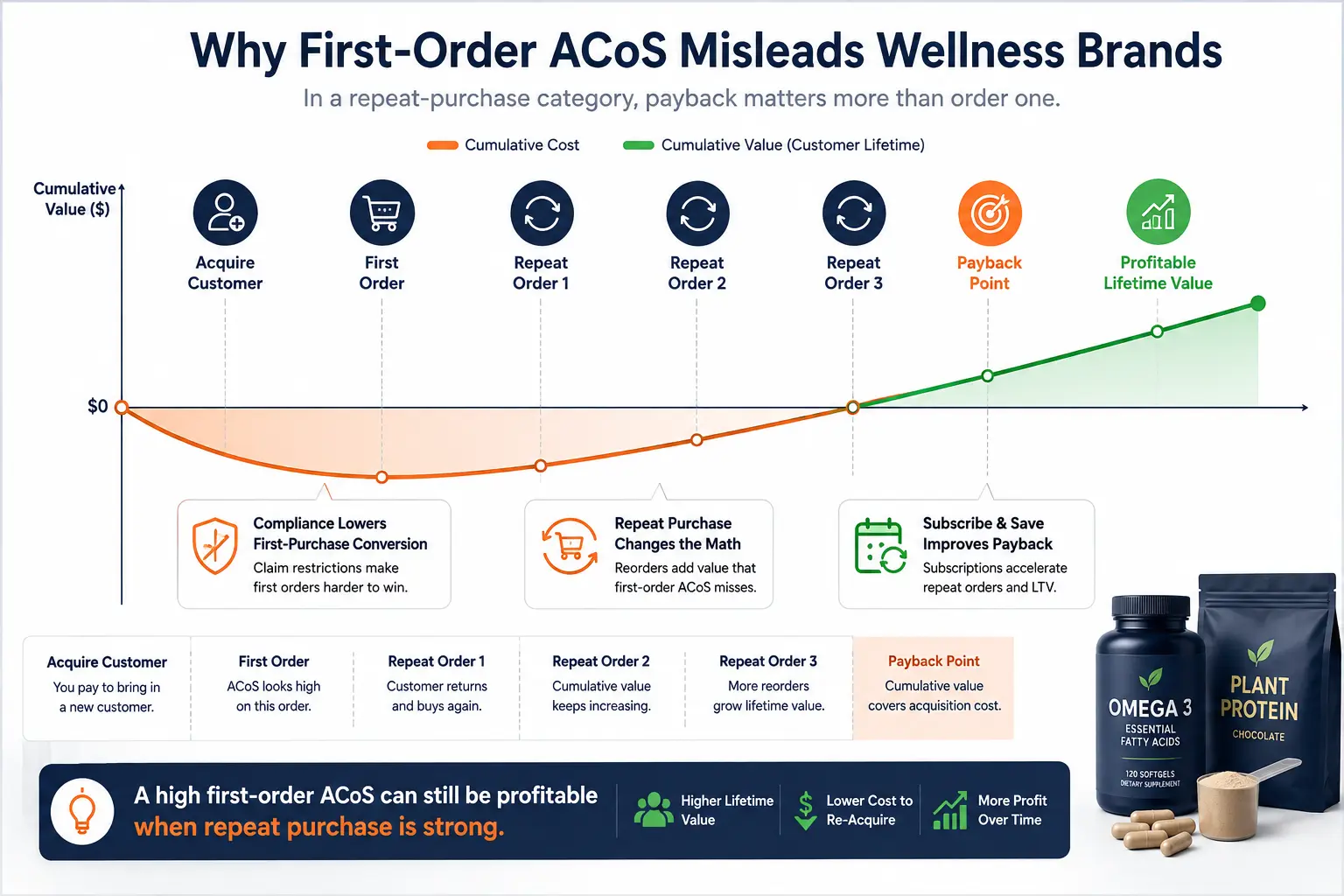
Compliance raises your break-even ACoS by suppressing first-purchase conversion, so repeat purchase and lifetime value are what keep wellness spend profitable.
This is the piece most benchmarks miss entirely.
Because you cannot lean on strong claims, first-time conversion tends to run lower than an unregulated category would, which means each new customer costs more to acquire.
On a single-order view, that acquisition cost can look unaffordable and scare a brand into cutting spend too early.
Repeat purchase changes the picture. Wellness is consumable and habitual, so a customer who sticks buys again and again, often through Subscribe and Save.
When you value that customer over a year rather than one order, a first-order ACoS that looked too high is frequently comfortable.
A simple example shows the effect. Say a product carries a 35 percent break-even ACoS while first-order acquisition runs at 45 percent, which reads as a loss.
If the average customer reorders twice more across the year, the blended ACoS over those orders can fall well under break-even, turning an apparent loss into a profitable customer.
That is why compliant brands should benchmark acquisition against lifetime value, not first-order revenue. The compliance-first approach that keeps this sustainable is laid out in our guide on FDA-compliant Amazon PPC for supplement brands.
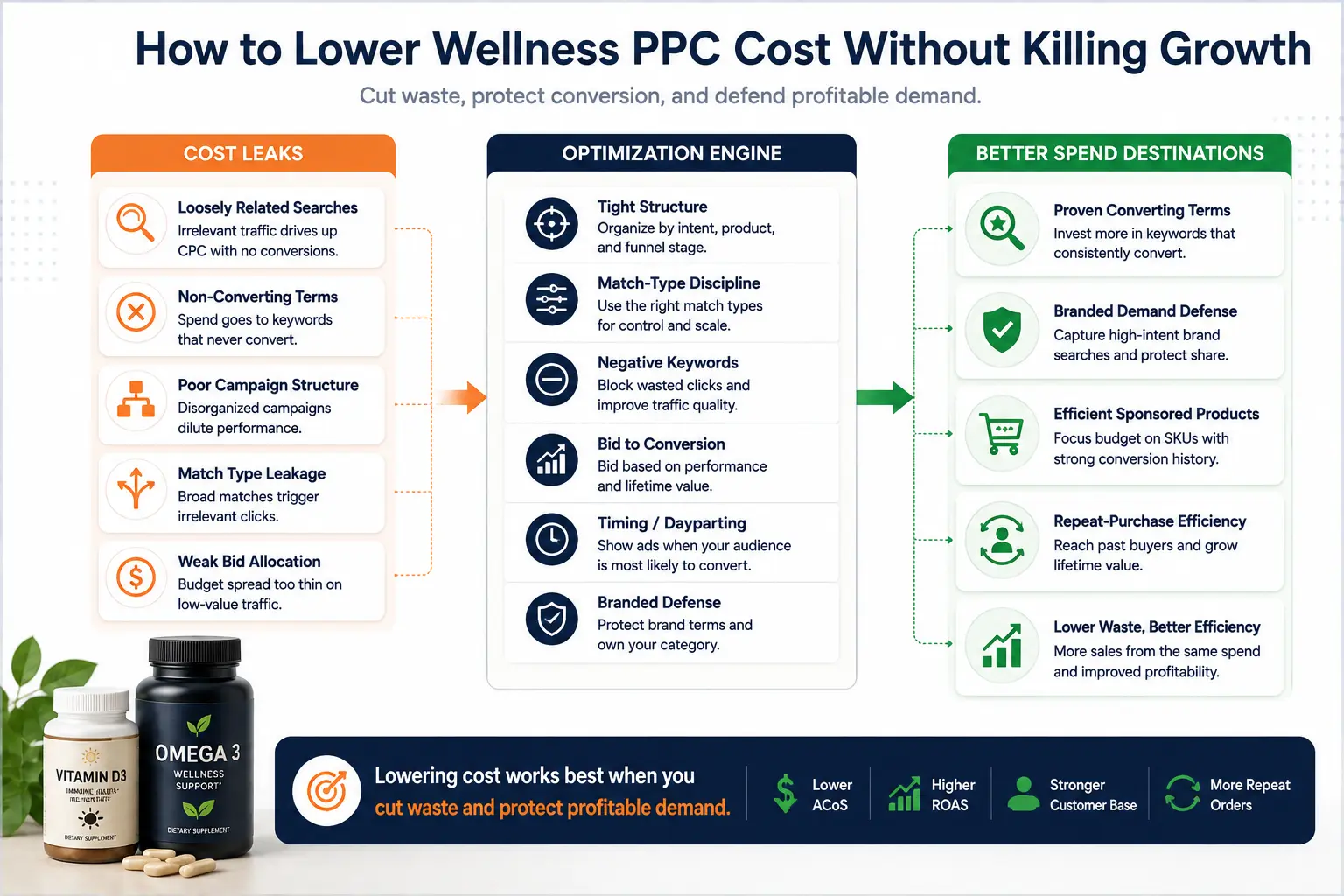
Lower wellness cost by tightening account structure, defending branded terms, and pruning non-converting spend, not by slashing bids across the board.
Cutting bids blindly usually cuts the profitable spend along with the waste.
The cheapest click is the one you never waste. Clean campaign structure, tight match types, and disciplined negatives cut the spend a saturated category quietly drains.
On Sponsored Products, that discipline usually moves ACoS more than any single bid change.
Negative keywords earn their keep here more than almost anywhere. A saturated category surfaces countless loosely related searches that spend budget without converting, and a steady negative-keyword habit is one of the most reliable ways to bring a bloated wellness ACoS back down.
Defending your brand terms matters more in wellness because acquisition is expensive, so protecting the customers you already earned is efficient spending. Sponsored Brands keeps competitors from buying attention on your own name at the exact moment a loyal buyer is ready to reorder.
Beyond structure, match your bids to what actually converts. Amazon's own Sponsored Products best practices point to raising on proven terms and cutting on weak ones, and our guide to scaling Amazon PPC for wellness brands shows how to apply that without choking growth.
Timing is another lever worth pulling. Hourly data can reveal the parts of the day a wellness term actually converts, so you can weight spend toward those windows instead of paying full rate around the clock. In a high-CPC category, even small timing gains add up across a month.
The strategy layer underneath all of this deserves its own read. Our Amazon PPC strategy for supplement brands covers how structure, compliance, and bidding fit together over a full year rather than a single cycle.
The common mistakes are trusting public averages, ignoring lifetime value, and judging cost without accounting for compliance drag. Each one leads a brand to the wrong decision about spend.
The first is treating a published average as a target. Those numbers rarely match your margin, your review depth, or your compliance position, so they set you chasing an ACoS that was never right for you.
The second is benchmarking on first-order revenue alone. In a repeat-purchase category, that understates what a customer is worth and makes healthy acquisition look wasteful, which pushes brands to underspend.
The third is forgetting the compliance drag when comparing yourself to other categories. Your conversion carries a handicap those categories do not, so the only fair benchmark is your own trend over time, not a cross-category screenshot.
A fourth mistake is comparing a mature account to launch-phase numbers, or the reverse. Cost during a launch, when reviews are thin and rank is unearned, looks nothing like cost for an established product. Benchmark like against like, or the comparison quietly points you the wrong way.
As a specialist Amazon PPC agency, Amplivus builds wellness cost models from your real margin, repeat rate, and compliance position, not a borrowed average. That is the only benchmark that tells you whether your spend is genuinely working.
Day to day, that means disciplined Amazon PPC management that prunes waste, paired with Sponsored Brands management to defend the customers your acquisition spend worked hard to earn.
If you want a clear read on where your wellness spend is leaking, a free Amazon PPC audit shows the gaps first. A short Amazon strategy session then turns that into a cost model and a plan for the year ahead.

Get a focused PPC review that uncovers wasted spend, weak conversion, compliance drag, and the real break-even ACoS your brand can afford.
See which bids, keywords, and weak terms are pushing ACoS higher than your margins and repeat value can safely support.