.png)
Key Takeaways
- Baby PPC runs above the Amazon average because safety-conscious parents convert slowly, the category is competitive, and a short product lifecycle gives you less time to recoup acquisition cost.
- There is no reliable public CPC or ACoS benchmark for baby brands. The only number that matters is your own, pulled from Brand Analytics and your campaign reports.
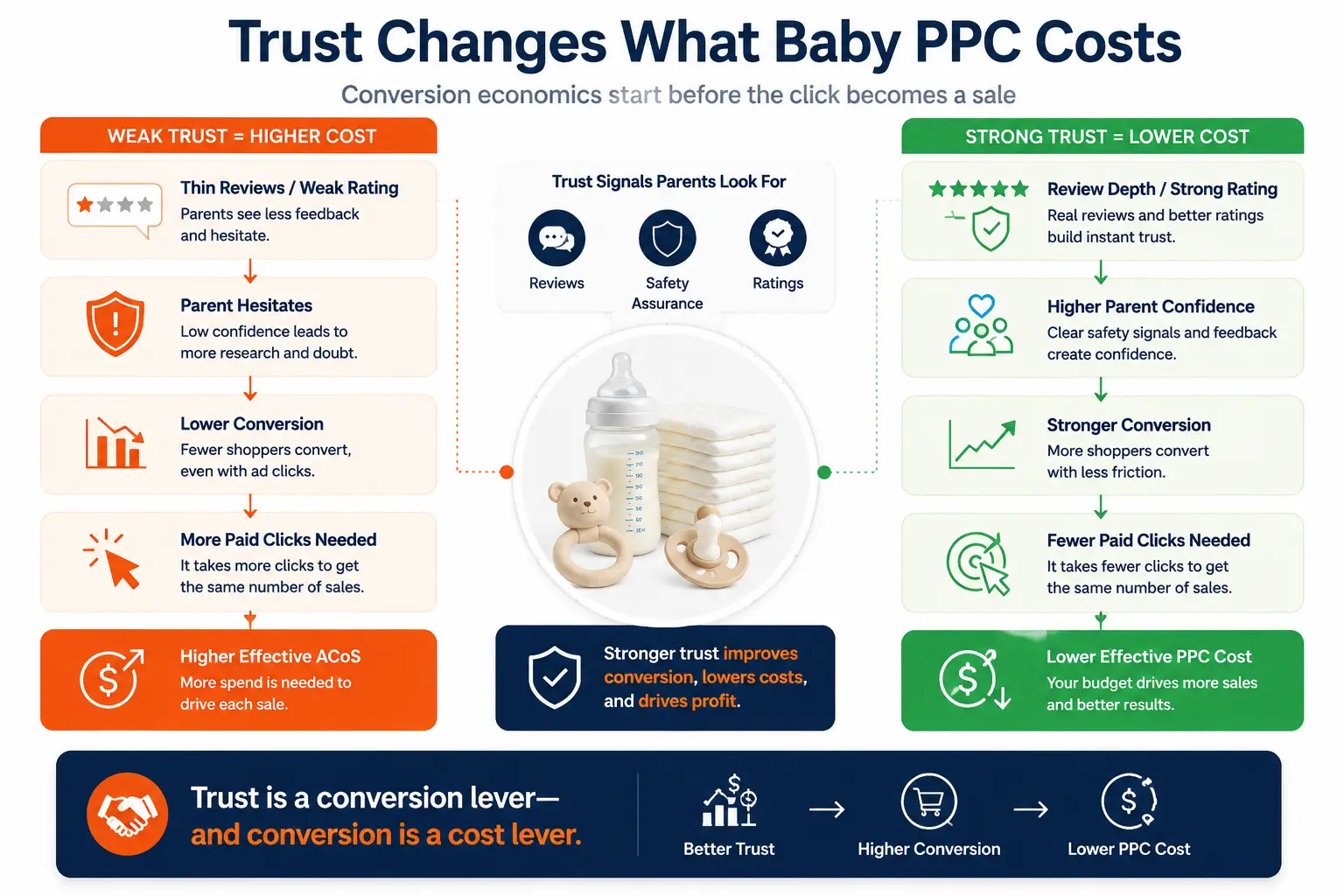
- Trust is the real cost driver. Reviews, ratings, and safety signals gate conversion, so a thin review count quietly raises the ACoS you need to move volume.
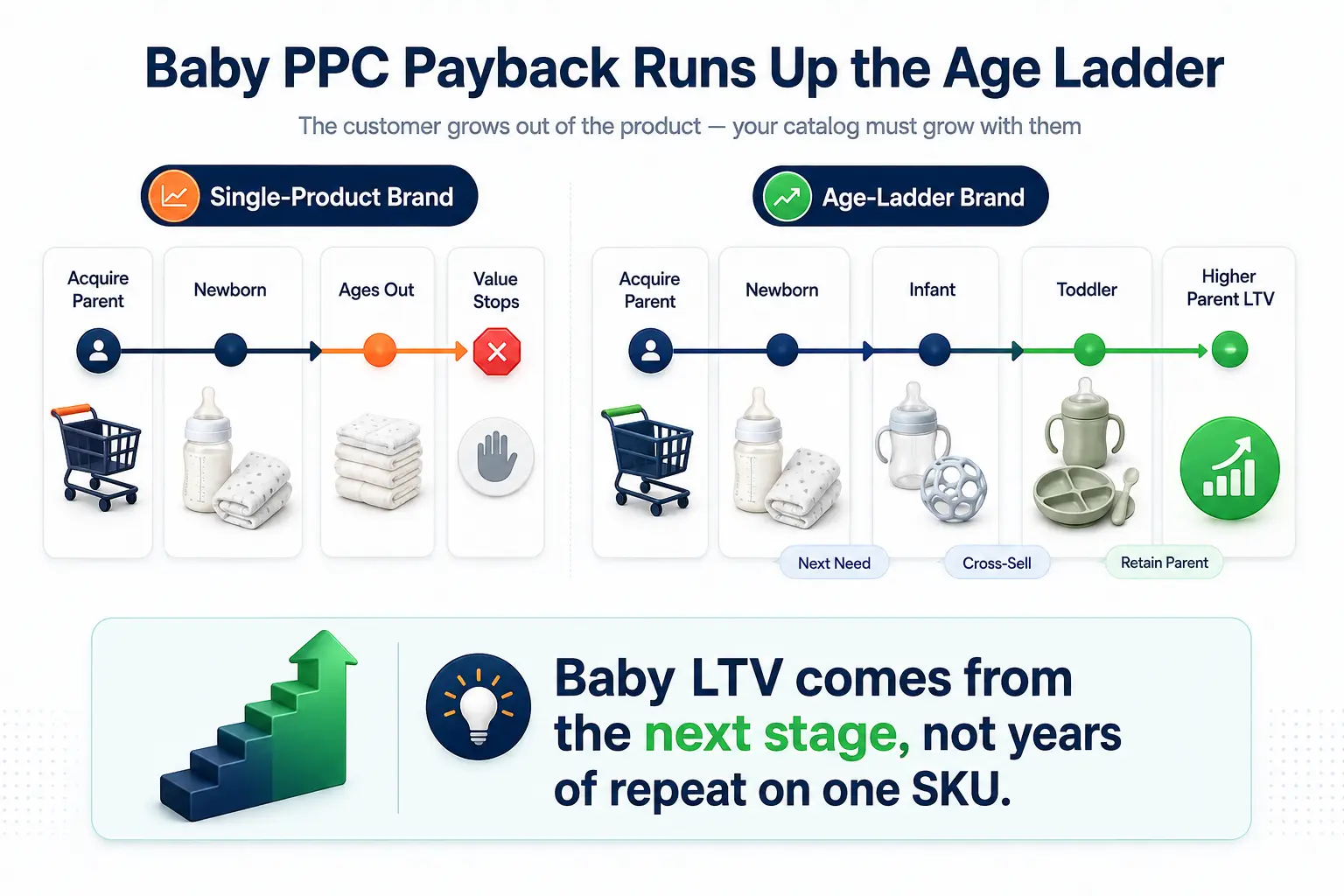
- The short lifecycle changes the break-even math. Babies age out fast, so a high acquisition cost pays back through an age-ladder catalog, not years of repeat on the same item.
- Benchmark against your break-even ACoS and your own trend, not a competitor's screenshot. Margin, review depth, and lifecycle decide what good actually costs for your brand.
Baby is one of the more expensive categories to advertise on Amazon, and most brands benchmark it against numbers that were never true for them. A generic average ACoS misses the two forces that actually shape baby cost: cautious, safety-first parents who convert slowly, and a customer whose needs change every few months.
This guide breaks down what Amazon PPC really costs a baby brand in 2026, why those costs sit above the marketplace average, and how to benchmark against the only figure that matters, which is your own. It is written for brands past the launch phase that need a realistic cost model, not a vanity target.
Why Does Baby PPC Cost More Than the Average Category?
Three forces push baby costs up: cautious parents convert slowly, safety and trust gate conversion, and a short product lifecycle shortens the payback window. Each one compounds the others.
The category rewards trust over speed, which changes the whole cost picture. How that plays out across spend levels is mapped in our guide to Amazon PPC for baby brands.
That trust premium is exactly why a borrowed benchmark misleads. A CPC or ACoS that is healthy in a fast, low-consideration category can be normal or even efficient in baby, because the buyer takes longer and demands more proof before committing.
Trust and safety gate conversion
Parents are among the most cautious buyers on Amazon, and they lean on reviews, ratings, and safety signals more than shoppers in almost any other category. A thin review count or a middling rating suppresses conversion no matter how sharp your bid is.
Safety is not just perception, either. Children's products must meet strict rules, and a Children's Product Certificate based on third-party testing is required, so trust and compliance are woven into how parents judge a listing.
That caution shapes search behavior too, which is why understanding how parents search on Amazon matters before you set a cost target. Slow, careful conversion is the norm, and it raises the ACoS needed to move the same volume.
New products feel this most. A launch with few reviews faces a cold start, where low trust drags conversion and a soft conversion rate inflates ACoS at the very moment a brand can least afford it. In baby, cost and credibility move together.
A short product lifecycle tightens the math
Baby products have an unusually short customer window. A newborn item is irrelevant in six months, so unlike categories where the same customer rebuys for years, a baby brand has a narrow period to recoup what it spent to acquire that parent.
That compresses the payback math. When the window to earn back an acquisition cost is measured in months, a high ACoS that a pet or supplement brand could carry on years of repeat looks very different for a baby brand.
Timing adds another twist. Much baby demand clusters around due dates, registries, and gifting, so the window to reach a parent is not only short but scheduled, which rewards brands that show up at the right moment and punishes those that arrive late.
A competitive, high-consideration category
Baby is crowded and heavily researched, and both traits raise cost. Many similar products bid on the same protective, safety-driven keywords, so click prices climb, and the long consideration cycle means shoppers compare extensively before buying.
The result is a category where a normal-looking CPC hides a slow conversion, so the true cost to acquire a customer runs higher than the click price alone suggests.
New entrants keep the pressure on. Baby attracts a steady stream of new sellers chasing the same protective keywords, so a term that was affordable last quarter can climb without any change on your side, and your benchmark has to move with the auction.
What Should Baby Brands Actually Benchmark?
Benchmark your break-even ACoS, TACoS, CPC, conversion rate, and new-to-brand share, measured from your own data rather than a category average. Those five tell you almost everything about your cost position.
The metrics that matter are the ones tied to your economics. Break-even ACoS, set by your contribution margin, marks the ceiling before a sale loses money, and TACoS shows whether ad spend is buying real growth or shifting organic sales into paid.
Your conversion rate and cost per click explain most of your ACoS, and new-to-brand metrics tell you whether spend is acquiring new parents or repeating existing ones. Brand Analytics and Search Query Performance is where you pull the data to ground each of these in reality.
New-to-brand share deserves particular attention here. Because a parent's window is short, knowing what portion of spend brings genuinely new customers, rather than repeating existing ones, tells you whether you are refilling the top of a funnel that naturally empties every few months.
None of this comes from a public benchmark, and that is the point. The method for building your own cost model from the ground up is covered in our Amazon PPC cost breakdown by spend tier.
What Do 2026 Baby PPC Costs Look Like?
Expect baby CPCs and ACoS to run above the marketplace average, but treat any specific figure as a directional range, not a target. The honest answer is that no trustworthy public number exists.
The average baby CPC and average baby ACoS figures floating around are mostly pulled from individual tool datasets, not representative samples, so they are directional at best. Anchoring your budget to them is how brands set the wrong target and then miss it.
Cost also varies inside a single account. Product age, review depth, and how contested each keyword is all pull the number in different directions, so an account-wide average can hide a handful of expensive terms quietly dragging the whole figure up.
Read the table as a diagnosis, not a scorecard. Each row tells you which lever moved your cost, so you can act on the cause instead of chasing a number published for a different brand.
How Does the Short Lifecycle Change Break-Even Math?
It shortens the payback window, so a high acquisition cost has to be recouped fast or laddered into the next stage, not repeated on the same item. This is the piece most benchmarks miss for baby.
In a repeat-purchase category, a high first-order ACoS is rescued by years of reorders. Baby does not work that way, because the child grows out of the product before those reorders can happen, so the same acquisition cost carries more risk.
The rescue is the age-ladder, not repeat. A brand that carries newborn, infant, and toddler products can move a parent up the stages and earn a real lifetime value, a growth pattern covered in our guide on building an Amazon PPC strategy for baby brands at $200K a month.
That is why baby brands should benchmark acquisition against ladder value, not a single order. A single-item view makes a healthy acquisition cost look wasteful, when the parent may buy across your range for two or three years.
A quick example shows the effect. If acquiring a newborn-stage customer costs more than that first order returns, the math only works when the parent buys again at the infant and toddler stages. A brand with no next rung on the ladder simply absorbs the loss.
How Do Baby Subcategories Differ on Cost?
Cost varies widely between durable gear, consumables, feeding, and toys, so benchmarking the whole category as one number blurs differences that decide whether your spend is efficient. Baby is not one market.
Durable gear like strollers and car seats carries high prices and heavy safety scrutiny, so click costs are high but a single sale is large. Consumables like diapers and wipes repeat, which changes the payback entirely and pulls their economics closer to a subscription category.
Feeding and nursing products sit in between, with strong trust sensitivity and moderate repeat. Toys and developmental products lean on reviews and gifting demand, so their cost swings with season more than the rest of the category does.
Benchmark your subcategory, not the baby average, or the comparison will mislead you. A stroller brand and a wipes brand share a category label and almost nothing about their cost structure.
Safety scrutiny also scales with the product. A car seat or crib faces far heavier compliance and review expectations than a soft toy, and that scrutiny shows up as slower conversion and a higher cost to earn a parent's trust.
How Do You Bring Baby PPC Cost Down Without Cutting Growth?
Lower baby cost by tightening structure, building trust signals, and pruning non-converting spend, not by slashing bids across the board. Cutting bids blindly usually cuts the profitable spend along with the waste.
The cheapest click is the one you never waste. Clean structure, tight match types, and disciplined negatives cut the spend a crowded category quietly drains, and on Sponsored Products that discipline usually moves ACoS more than any single bid change.
Because trust drives conversion, building it is a cost lever in itself. Sponsored Brands and strong creative reinforce the safety and quality signals that help cautious parents commit, which lifts conversion and lowers effective cost.
Reviews are a cost lever in disguise. Because rating and review depth gate conversion so heavily in baby, the work of earning genuine reviews often lowers ACoS more than any bid change, since every point of conversion improvement spreads across all of your spend.
Beyond structure, match your bids to what actually converts. Amazon's own Sponsored Products best practices point to raising on proven terms and cutting the weak ones, which protects margin in a fee-aware category.
Retargeting earns its keep during the long baby consideration cycle. Sponsored Display keeps your product in front of parents who researched but did not buy, recovering conversions a single search ad never closes.
Because the category is contested, market context matters as much as your own numbers. A structured Amazon PPC competitor analysis shows why your share and cost are moving, so cuts target real waste rather than guesswork.
What Benchmarking Mistakes Do Baby Brands Make?
The common mistakes are trusting public averages, ignoring the age-ladder, and judging cost without accounting for slow, trust-gated conversion. Each one leads a brand to the wrong decision about spend.
The first is treating a published average as a target. Those numbers rarely match your margin, your review depth, or your subcategory, so they set you chasing an ACoS that was never right for you.
The second is benchmarking on single-order revenue in a category built on laddering. That understates what a parent is worth across stages and makes healthy acquisition look wasteful, which pushes brands to underspend.
The third is forgetting that baby conversion is slow by nature. Comparing yourself to a fast-converting category makes your cost look broken when it is simply the price of a cautious, safety-first buyer.
A fourth mistake is comparing a new product to an established one. Cost during a launch, when reviews are thin and trust is unearned, looks nothing like cost for a proven product, so benchmark like against like or the comparison points you the wrong way.
How Amplivus Benchmarks and Manages Baby PPC
As a specialist Amazon PPC agency, Amplivus builds baby cost models from your real margin, review depth, and age-ladder, not a borrowed average. That is the only benchmark that tells you whether your spend is genuinely working.
Day to day, that means disciplined Amazon PPC management that prunes waste and builds the trust signals cautious parents need before they buy.
If you want a clear read on where your baby spend is leaking, a free Amazon PPC audit shows the gaps first, and a short Amazon strategy session turns it into a cost model and a plan for the year ahead.
Authoritative Resources
- CPSC, Children's Product Certificate, the safety certification required for children's products.
- Amazon, Brand Analytics and Search Query Performance, where your real cost and share data lives.
- Amazon Ads, Sponsored Products, the core ad type most baby spend runs through.
- Amazon Ads, Sponsored Brands, brand and creative formats that build parent trust.
- Amazon Ads, Sponsored Products best practices, data-first bidding to control cost.
- Amazon Ads, Sponsored Display, retargeting through a long consideration cycle.
Frequently Asked Questions?
Why is Amazon PPC more expensive for baby brands?

What is a good ACoS for a baby brand?
Are there reliable baby PPC cost benchmarks for 2026?
How does the short product lifecycle affect baby PPC cost?
How do I lower Amazon PPC costs for a baby brand?
Should I benchmark baby PPC on ACoS or lifetime value?
YOY
Spend
Build Your Baby PPC Benchmark
Stop relying on generic averages. Build baby PPC targets around your real margins, review depth, lifecycle, and age-ladder value today.